

Blog
Watch Winders & Accessories: What You Really Need

Mar

Last updated: March 5, 2026
Not every watch collector needs a watch winder. But if you own automatic watches and rotate them regularly, the right winder and a small set of quality accessories can save you time, protect your investment, and keep every piece ready to wear. This guide covers Watch Winders & Accessories: What You Really Need — from how winders actually work to which extras are worth buying and which ones you can skip entirely.
Key Takeaways
- Watch winders are only for automatic watches — quartz and manual-wind watches don’t benefit from them.
- The most important winder spec is turns per day (TPD) and rotation direction, which must match your specific movement.
- A single-watch winder is enough for most collectors; multi-watch units make sense when you own three or more automatics you wear on rotation.
- Cheap winders with poor motors can damage a watch over time through over-winding stress on the mainspring (though most modern automatics have a slip clutch for protection).
- Essential accessories include a watch roll or case, a spring bar tool, a microfiber cloth, and proper storage. Everything else is optional.
- Storage conditions matter: humidity above 60% and direct sunlight are the two biggest threats to watch condition.
- Budget winders start around $30–$50; reliable mid-range units run $100–$400; premium options from Wolf, Orbita, and Buben & Zörweg can exceed $1,000.
- A watch winder is not a substitute for regular servicing — movements still need professional care every 5–7 years.
Quick Answer
A watch winder is a motorized device that rotates an automatic watch to keep its mainspring wound when not being worn. For collectors who own multiple automatic watches, a quality winder prevents the inconvenience of resetting complications like perpetual calendars or annual calendars every time you pick up a watch. The essential accessories every watch owner needs are a protective storage solution, a spring bar tool, and a cleaning cloth — everything beyond that depends on collection size and lifestyle.
What Is a Watch Winder and How Does It Work?
A watch winder mimics the motion of a wrist to keep an automatic watch’s rotor spinning, which winds the mainspring. Without regular movement, an automatic watch will stop within 36–72 hours, depending on its power reserve.
How the mechanism works:
- Automatic watches use a rotor (a weighted half-disc) that spins as your wrist moves, winding the mainspring through a series of gears.
- A winder replicates this by rotating the watch on a motorized turret in programmed cycles.
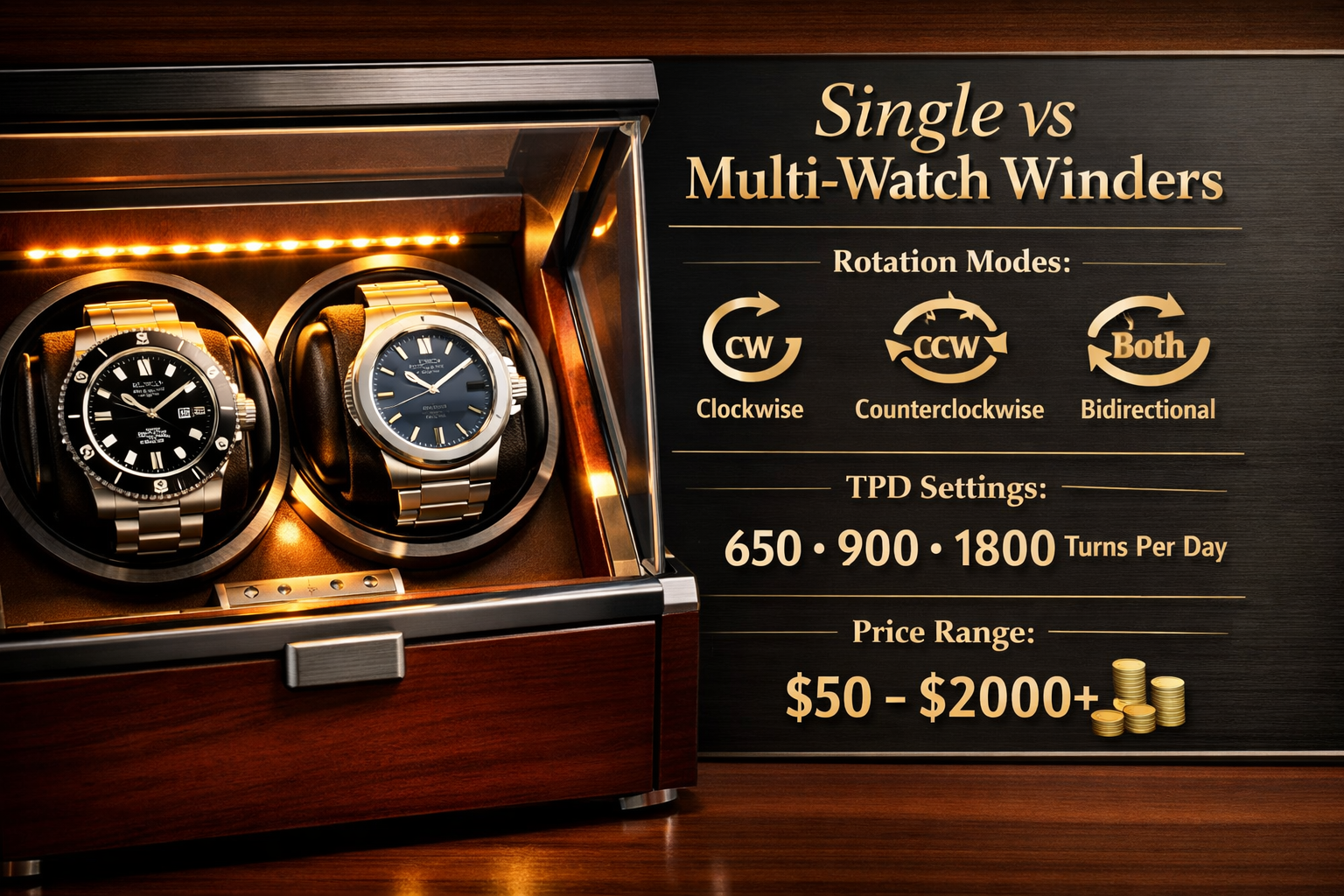
- Most modern winders rotate clockwise (CW), counterclockwise (CCW), or bidirectionally, and allow you to set the number of turns per day (TPD).
Who needs one:
- Collectors with three or more automatic watches who don’t wear each piece daily.
- Owners of watches with complex complications — perpetual calendars, annual calendars, moon phases — where resetting is time-consuming or risks incorrect adjustment.
- Anyone who travels frequently and leaves watches unworn for days at a time.
Who doesn’t need one:
- Owners of quartz watches (battery-powered, no rotor).
- Collectors who wear the same automatic watch every day.
- Anyone with a simple date-only automatic — resetting the date takes under a minute.
“The real value of a winder isn’t keeping the watch running. It’s avoiding the 20-minute process of resetting a perpetual calendar from scratch.”
For a deeper look at how the rotor and mainspring interact, see this guide on how automatic watches work.
Understanding Watch Winders & Accessories: What You Really Need Before You Buy
Before spending money on a winder, match the unit’s specs to your specific watch’s movement requirements. Using the wrong settings won’t necessarily break a watch immediately, but it can cause unnecessary wear over months and years.
The three specs that matter most:
| Spec | What It Means | Why It Matters |
|---|---|---|
| TPD (Turns Per Day) | How many full rotations per 24 hours | Must meet the movement’s minimum winding requirement |
| Rotation Direction | CW, CCW, or bidirectional | Some movements only wind in one direction |
| Rest Periods | Programmed pauses between rotation cycles | Prevents over-winding stress; important for older movements |
Common TPD requirements by brand (approximate):
- Rolex: ~650–800 TPD, bidirectional
- Patek Philippe: ~650–800 TPD, bidirectional
- IWC: ~900 TPD, bidirectional
- Omega: ~650–800 TPD, bidirectional
Note: Always verify TPD requirements in your watch’s manual or with the manufacturer, as they vary by caliber.
Common mistake: Buying a winder based on looks alone. A beautiful wooden box with a weak motor that runs at a fixed 1,800 TPD in one direction may be wrong for your Rolex and completely wrong for a vintage Omega with a unidirectional rotor.
Decision rule:
- Choose a programmable winder if you own watches from multiple brands.
- Choose a fixed-setting winder only if all your watches share the same movement requirements.
Single vs. Multi-Watch Winders: Which Size Do You Actually Need?
For most collectors, a single or double winder is the right starting point. Multi-watch units make sense once a collection grows past three or four automatic pieces worn on rotation.
Single-watch winders ($30–$300):
- Best for: one primary automatic watch, entry-level collectors, travel use.
- Pros: compact, affordable, easy to program.
- Cons: doesn’t scale with collection growth.
Double winders ($80–$500):
- Best for: two automatics worn on alternating days.
- Good balance of cost and utility for most collectors.
Multi-watch winders (4–12 slots, $200–$3,000+):
- Best for: serious collectors with five or more automatics.
- Premium brands like Wolf, Orbita, Buben & Zörweg, and Rapport offer units with individual motor control per slot, allowing different TPD and direction settings for each watch.
- Some high-end cabinets double as display furniture.
Edge case: If you own a watch with an exceptionally long power reserve — some modern movements offer 7–10 days — a winder may be unnecessary even for a collector who wears that piece only once a week.
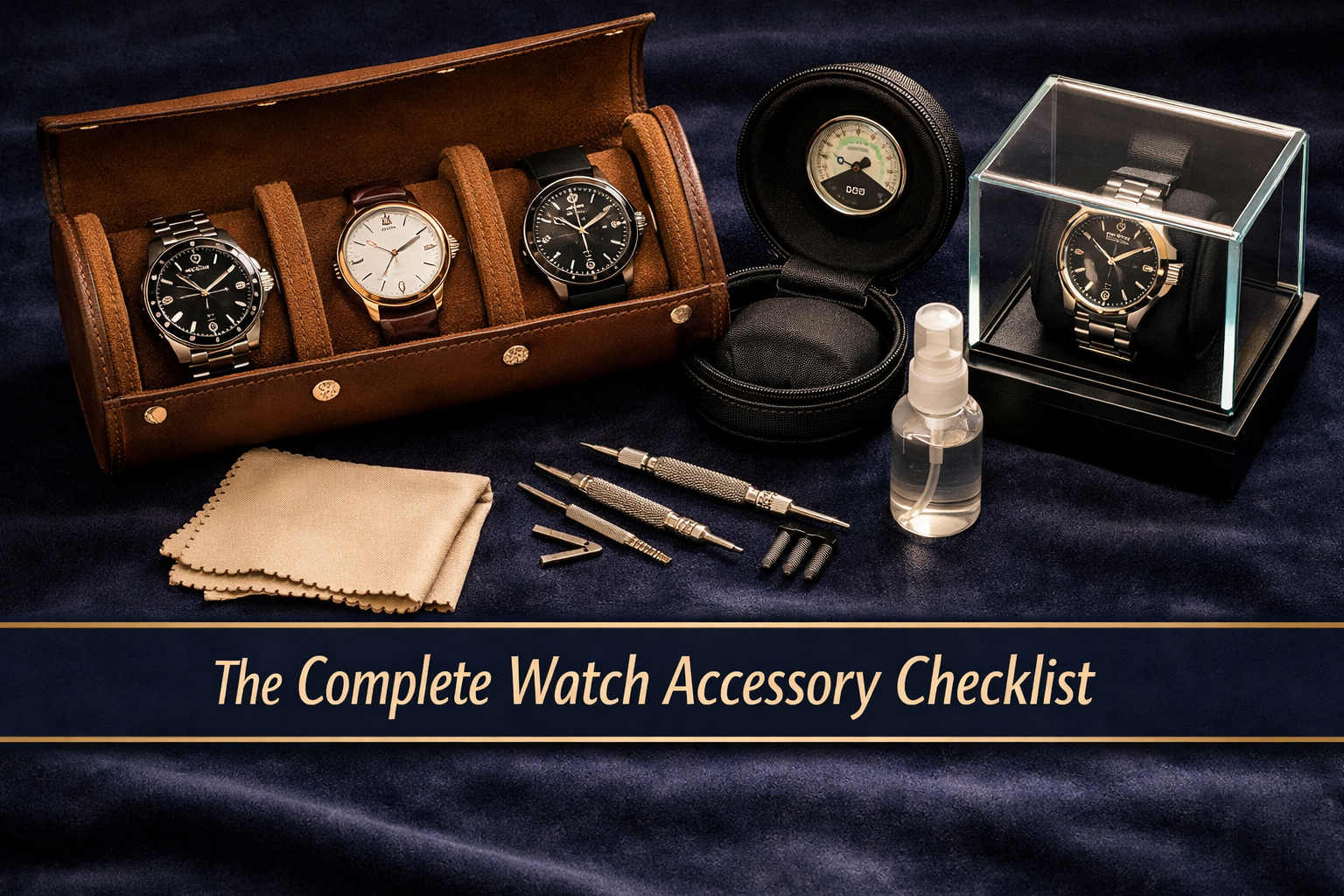
The Essential Watch Accessories Every Collector Needs
Watch Winders & Accessories: What You Really Need goes beyond the winder itself. A short list of practical accessories will protect your watches, make maintenance easier, and keep your collection organized.
The non-negotiables:
1. Watch Roll or Travel Case A quality leather or canvas watch roll protects watches during travel. Look for individual cushioned slots, a secure closure, and a lining that won’t scratch crystals or cases. A good roll holds 3–5 watches and costs $40–$150.
2. Spring Bar Tool A spring bar tool lets you swap straps without visiting a watchmaker. A basic stainless steel tool costs $10–$30 and is one of the most useful things a collector can own. Without one, every strap change requires a trip to a jeweler.
3. Microfiber Polishing Cloth Fingerprints and light smudges are inevitable. A dedicated watch microfiber cloth (not a glasses cloth, which can be too rough for polished case surfaces) is a $5–$15 investment that keeps watches looking sharp between professional cleanings.
4. Watch Storage Box or Case For watches not on a winder, a lined storage box with individual compartments prevents scratches from watches contacting each other. Avoid storing watches loose in a drawer. For a full breakdown of storage best practices, see this guide on how to properly store and protect your luxury watches.
5. Silica Gel Packets Humidity is a genuine threat to watch movements, especially for vintage pieces with older lubricants. Placing food-grade silica gel packets in a closed storage box keeps moisture levels controlled. Replace or recharge them every 3–6 months.
Optional but useful:
- Loupe or magnifier for inspecting dials and case details.
- Watch demagnetizer if a watch starts running fast unexpectedly (magnetization is a common culprit).
- Strap collection — a good watch on the wrong strap looks wrong. Building a small set of leather, rubber, and metal bracelets adds versatility.
For practical guidance on keeping watches clean between services, see this step-by-step luxury watch cleaning guide.
How to Choose a Quality Watch Winder: What Separates Good from Bad
The winder market ranges from $30 Amazon units to $10,000 custom cabinets. Price doesn’t always equal quality, but the cheapest options carry real risks.
What to look for:
- Quiet motor: A winder that runs all night should be nearly silent. Cheap motors create audible vibration that’s disruptive and a sign of poor engineering.
- Adjustable TPD and direction: Non-negotiable for a mixed collection.
- Intermittent cycle programming: The winder should run for a period, then rest, rather than spinning continuously. Continuous rotation is unnecessary and creates more wear on the winder’s mechanism.
- Secure watch holder: The cushion or holder should grip the watch firmly without putting pressure on the crown or crystal.
- Power source: Mains power is more reliable for home use. Battery-powered units are better for travel but need regular battery changes.
Brands worth considering (2026):
| Brand | Price Range | Best For |
|---|---|---|
| Wolf | $100–$1,500 | Reliable mid-to-premium, wide range |
| Orbita | $200–$2,000 | Programmable, Swiss-made movements |
| Rapport London | $80–$600 | Elegant design, solid motors |
| Buben & Zörweg | $1,000–$10,000+ | Ultra-premium, collector furniture |
| Belocia / Chiyoda | $30–$150 | Budget entry-level |
Price ranges are estimates based on retail availability as of 2026. Verify current pricing with retailers.
Common mistake: Buying a winder with a motor that only rotates in one direction for a watch that winds bidirectionally. The watch will still wind, but only half as efficiently, meaning it may stop if worn infrequently.
Watch Winder Myths Worth Ignoring
Several persistent myths cause collectors to either over-invest in winders or avoid them entirely. Here’s what the evidence actually supports.
Myth 1: “Watch winders wear out your movement faster.” Modern automatic movements include a slip clutch mechanism that disengages when the mainspring is fully wound. A properly programmed winder with appropriate rest periods does not over-wind a modern watch. Vintage movements without a slip clutch are the exception — check before winding.
Myth 2: “Any winder will work for any watch.” False. TPD and direction requirements vary significantly by caliber. Using a winder set to 1,800 TPD bidirectional for a movement that only needs 650 TPD won’t damage the watch (the slip clutch handles it), but it wastes energy and puts unnecessary rotational hours on the winder’s motor.
Myth 3: “A winder replaces servicing.” A winder keeps a watch running. It does not clean old lubricants, replace worn gaskets, or inspect for internal wear. Automatic watches still need professional servicing every 5–7 years regardless of winder use. For context on why Swiss movements require this level of care, see why Swiss watches are so expensive.
Myth 4: “Expensive watches need expensive winders.” A $150 Wolf winder is entirely appropriate for a $50,000 Patek Philippe, provided the settings match the movement. The watch doesn’t benefit from a $5,000 cabinet — the collector might enjoy it aesthetically, but it’s a lifestyle purchase, not a technical requirement.
Watch Winders & Accessories: What You Really Need for Specific Watch Types
Different watch types have different winder and storage requirements. Matching accessories to the watch type prevents mistakes.
Perpetual and annual calendar watches: These are the strongest use case for a winder. Resetting a perpetual calendar incorrectly can damage the mechanism. Watches like the Patek Philippe 5330G World Time or annual calendar references should ideally never be allowed to stop. A reliable winder with the correct TPD setting is a sound investment for these pieces.
Dive watches: Dive watches like the Rolex Submariner and Daytona are robust daily wearers that rarely need a winder. If stored, focus on a padded case that protects the bezel and crown from impact. The main accessory priority for dive watches is a rubber or NATO strap for casual wear and proper rinsing after saltwater exposure.
Dress and complications watches: Pieces like the IWC Portugieser or Portofino series benefit from winders and careful storage in a humidity-controlled environment. Avoid storing these watches near magnetic sources (speakers, phone chargers, laptop bags), as thin dress watch movements are more susceptible to magnetization.
Vintage watches: Approach winders cautiously with vintage pieces. Older movements may lack a slip clutch, and aged lubricants can be disturbed by constant rotation. Manual-wind vintage watches don’t use winders at all — see this guide on how to wind a wrist watch for proper technique.
What Does a Complete Watch Winder and Accessory Setup Cost?
A practical setup for a serious collector doesn’t require spending thousands. Here’s a realistic budget breakdown for three scenarios.
Entry-level collector (1–2 automatic watches):
| Item | Estimated Cost |
|---|---|
| Single-watch winder (Chiyoda or similar) | $40–$80 |
| Watch roll (3-slot leather) | $40–$70 |
| Spring bar tool | $15–$25 |
| Microfiber cloths (pack of 5) | $10–$15 |
| Storage box (2-slot lined) | $30–$60 |
| Total | ~$135–$250 |
Mid-level collector (3–6 automatic watches):
| Item | Estimated Cost |
|---|---|
| Double or quad winder (Wolf or Rapport) | $150–$400 |
| Leather watch roll (5-slot) | $80–$150 |
| Spring bar tool set | $25–$50 |
| Watch case (6–8 slot) | $80–$200 |
| Silica gel packets + demagnetizer | $20–$40 |
| Total | ~$355–$840 |
Advanced collector (7+ watches, complications):
- Multi-slot programmable winder cabinet (Wolf, Orbita): $500–$2,500+
- Full accessory kit: $200–$500
- Total: $700–$3,000+ depending on aesthetic preferences
All cost estimates are approximate retail ranges for 2026 and will vary by retailer and region.
FAQ: Watch Winders & Accessories
Q: Do I need a watch winder for a Rolex? Only if you own multiple Rolex automatics and rotate them infrequently. A single daily-wear Rolex doesn’t need a winder — wearing it provides all the winding it needs.
Q: Can a watch winder damage my watch? A properly programmed winder with correct TPD settings and rest periods will not damage a modern automatic watch. Cheap winders with incorrect settings or no rest periods carry a small risk of unnecessary wear over years of use.
Q: What TPD setting should I use? Check your watch’s manual or the manufacturer’s website for the specific caliber’s recommended TPD. When in doubt, 650–900 TPD bidirectional covers most modern Swiss automatics.
Q: Are battery-powered winders as good as plug-in winders? For travel, yes. For home use, plug-in winders are more consistent and don’t risk stopping due to dead batteries.
Q: How long should a winder run each day? Most programmable winders run for 30–60 minutes, then rest for several hours, repeating throughout the day. Continuous 24-hour rotation is unnecessary for any modern watch.
Q: Do quartz watches need winders? No. Quartz watches are battery-powered and have no rotor. A winder does nothing for them.
Q: What’s the best way to store a watch I’m not wearing for several months? Wind the mainspring to roughly half capacity, store in a dry environment (below 60% humidity) away from magnets and direct light, and in a padded case. For longer storage, consider having the watch serviced before putting it away.
Q: Is a spring bar tool really necessary? Yes, if you plan to change straps yourself. It’s a $15–$30 tool that saves repeated jeweler visits and lets you customize your watch to fit any occasion.
Q: Can I put a manual-wind watch in a winder? No. Manual-wind watches must be wound by hand via the crown. A winder cannot interact with a manual-wind movement and will do nothing useful.
Q: How often should I service a watch even if it’s on a winder? Every 5–7 years for most modern Swiss movements, regardless of winder use. The winder keeps it running but doesn’t replace internal cleaning and lubrication.
Q: What’s the most important accessory for a luxury watch? A proper storage case or watch roll. Scratches from improper storage are permanent and reduce resale value. Everything else is secondary.
Q: Does watch storage affect resale value? Yes, significantly. Watches stored correctly — away from moisture, magnets, and physical impact — retain better condition. Condition is one of the primary factors in resale pricing for luxury pieces.
Conclusion: Build Your Setup Around What You Actually Own
The right watch winder and accessory setup depends on your collection, not on what looks most impressive on a shelf. Start with the basics: a quality winder matched to your movement’s TPD and direction requirements, a protective storage solution, a spring bar tool, and a cleaning cloth. Add complexity only when your collection grows to justify it.
Actionable next steps:
- Identify your watch types — automatic, quartz, or manual-wind — before buying any winder.
- Look up the TPD and rotation direction for each automatic movement you own.
- Start with a single or double winder from a reputable brand (Wolf, Rapport, or Orbita) rather than the cheapest option available.
- Invest in a proper storage case before spending on premium winder aesthetics.
- Schedule servicing for any automatic watch that hasn’t been serviced in the last 5–7 years, regardless of winder use.
For collectors building or expanding a serious collection, the ultimate guide to choosing a luxury watch is a strong companion resource to this one.