

Complications & Tech
Power Reserve in Luxury Watches: Why It Matters More Than People Think

Jul
Last updated: July 6, 2026
Quick Answer: Power reserve in luxury watches refers to how long a mechanical movement will keep running on a full wind without being worn or manually wound. Most watches still offer around 46 hours, but the practical minimum for modern collectors has shifted to 60 hours or more, so a watch taken off Friday evening is still running Monday morning. For collectors who rotate multiple pieces, power reserve directly affects accuracy, convenience, and long-term movement health.
Key Takeaways
- Power reserve is the total running time a fully wound mechanical watch can sustain without additional winding or wrist motion.
- The traditional industry standard of roughly 46 hours is no longer adequate for collectors who rotate watches or take weekends off.
- A 60-hour minimum has become the new practical benchmark for modern luxury calibres, specifically to survive a full weekend off the wrist.
- Some brands now offer 5-day (120-hour) and even one-month reserves, positioning extended autonomy as a marker of movement efficiency and lower service costs.
- Longer power reserve is not just a convenience feature, it correlates with mainspring size, gear-train efficiency, and overall movement quality.
- A power reserve indicator complication lets the wearer monitor energy levels at a glance, preventing the accuracy degradation that occurs as the mainspring runs low.
- Running a watch to zero repeatedly can stress lubricants and increase wear on pivot points over time.
- When choosing a luxury watch for occasional wear, power reserve should rank alongside movement finishing, case material, and complication set.
What Does Power Reserve Mean in Watches?
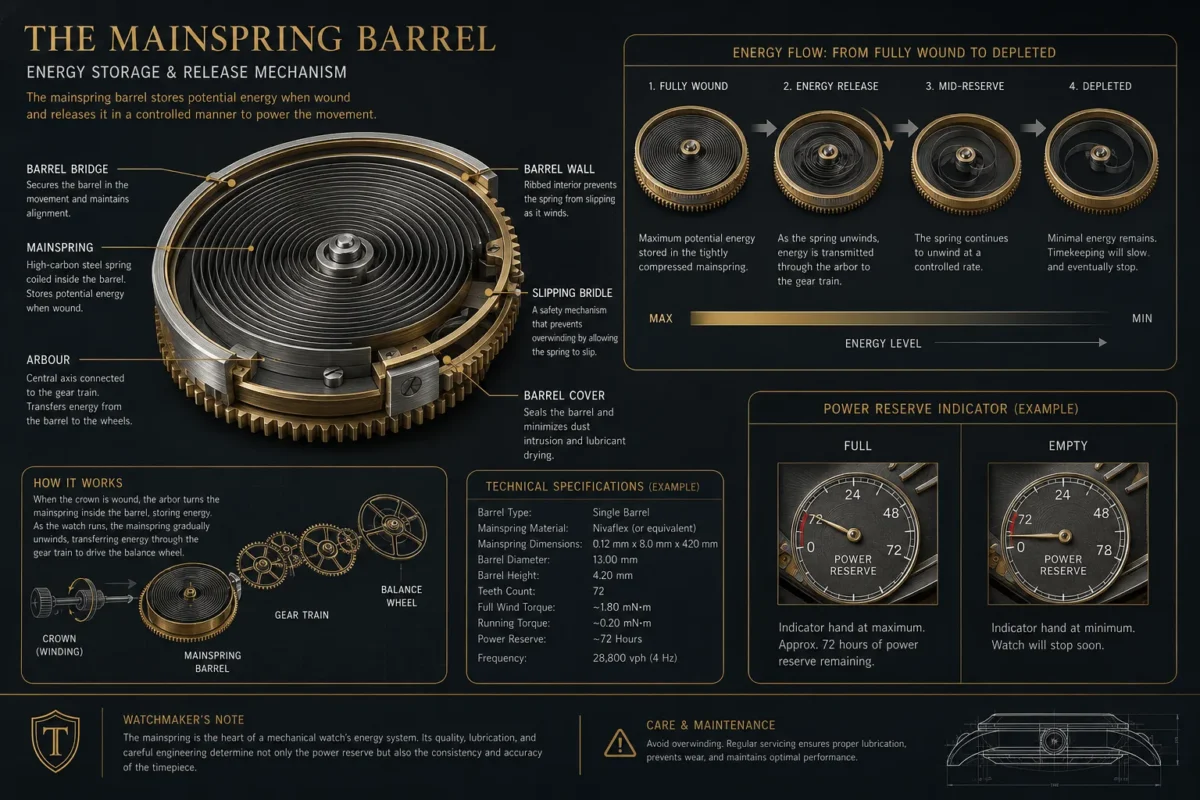
Power reserve is the amount of time a mechanical watch movement will continue running from a full wind to completely stopped. It is determined by the capacity of the mainspring, the coiled metal strip inside the barrel that stores energy, and how efficiently the gear train and escapement consume that stored energy.
When a watch is worn, the rotor (in an automatic) or the crown (in a manual-wind) tensions the mainspring. As the spring gradually uncoils, it releases energy through the gear train to the escapement, which regulates the release into precise time increments. Once the mainspring is fully relaxed, the watch stops.
Key terms worth knowing:
- Mainspring barrel: The housing that contains the coiled mainspring.
- Rotor: The weighted semicircle in an automatic watch that winds the mainspring through wrist motion.
- Power reserve indicator: A subdial or sector display showing remaining energy, usually expressed as hours or as a graduated arc from “full” to “empty.”
- Autonomy: Another word for power reserve, used frequently by Swiss and French-speaking watchmakers.
The history of mechanical timekeeping shows that watchmakers have always wrestled with this trade-off between spring capacity and movement size. For a deeper look at how these mechanisms evolved, see when wrist watches were invented.
Why Is Power Reserve Important in Luxury Watches?
Power reserve in luxury watches matters because it directly affects accuracy, movement longevity, and day-to-day usability, especially for collectors who own more than one piece.
A mechanical movement does not perform at peak accuracy when the mainspring is nearly depleted. As tension drops in the final hours of a reserve, the escapement receives less consistent impulse, and the watch can gain or lose seconds more noticeably than it would at mid-wind. For a high-end timepiece regulated to COSC chronometer standards or better, allowing the spring to run flat regularly undermines the precision the movement was built to deliver.
There is also a mechanical wear argument. Lubricants inside a movement are distributed partly by the motion of the gear train. A watch that sits completely stopped for extended periods can allow oils to settle or dry unevenly on pivot points. Running a watch to zero repeatedly, and then restarting it from a cold stop, adds minor but cumulative stress.
For collectors rotating between multiple watches, a short power reserve means more frequent resetting and time-setting, which adds friction to the ownership experience. This is why power reserve has become one of the first specifications serious buyers check, right alongside movement finishing and case material. If you are still building your collection framework, the ultimate guide to choosing your perfect luxury watch covers the full decision matrix.
How Long Should a Luxury Watch Power Reserve Last?
The practical minimum for a modern luxury watch is 60 hours. Anything below that risks stopping over a standard two-day weekend.
The traditional figure has long been around 46 hours, which covers roughly two days of non-wear. But that number assumes the watch was fully wound when removed, which is rarely the case. A watch worn for eight hours on a Friday, then taken off, may have only 30 to 38 hours of reserve remaining, meaning it stops sometime Saturday night.
A 60-hour reserve provides genuine weekend autonomy: take the watch off Friday evening after a full day of wear, and it is still ticking Monday morning. This has become the new de facto standard for many newly developed calibres, according to technical analysis published by WorldTempus.
Beyond 60 hours, the tiers break down roughly as follows:
| Power Reserve Duration | Practical Use Case | Typical Buyer Profile |
|---|---|---|
| 38-46 hours | Daily wearer, single watch | Entry-level collector |
| 60-72 hours | Weekend autonomy, occasional rotation | Mid-level collector, 2-4 watches |
| 100-120 hours (5 days) | Active rotator, travel use | Serious collector, 5+ watches |
| 240+ hours (10+ days) | Display pieces, vault storage | Investor, exhibition collector |
| ~720 hours (one month) | Extreme autonomy, technical showcase | High-end enthusiast, brand devotee |
Power Reserve vs. Battery Life: What Is the Difference?
Power reserve applies exclusively to mechanical watches (automatic and manual-wind). Battery life is the equivalent concept for quartz watches. They measure the same idea, how long the watch runs without intervention, but the underlying technology is completely different.
A mechanical watch stores energy mechanically in a coiled spring and releases it through a physical gear train. A quartz watch uses a battery to send electrical pulses to a quartz crystal, which vibrates at a precise frequency to regulate time. Quartz batteries typically last one to three years with no action required from the wearer, while a mechanical power reserve requires daily wear or periodic winding.
The key distinction for luxury buyers: power reserve is a sign of mechanical craftsmanship. It represents the watchmaker’s ability to balance spring capacity, gear-train efficiency, and escapement regulation. Battery life in a quartz watch is simply a function of battery size and circuit efficiency, it carries no horological prestige. This is one reason why Swiss watches are so expensive: the engineering behind a long-running, accurate mechanical movement is genuinely difficult.
Which Luxury Watch Brands Have the Longest Power Reserve?
Several brands have made extended power reserve a defining technical achievement, with reserves ranging from 5 days to one full month.
Notable examples in 2026:
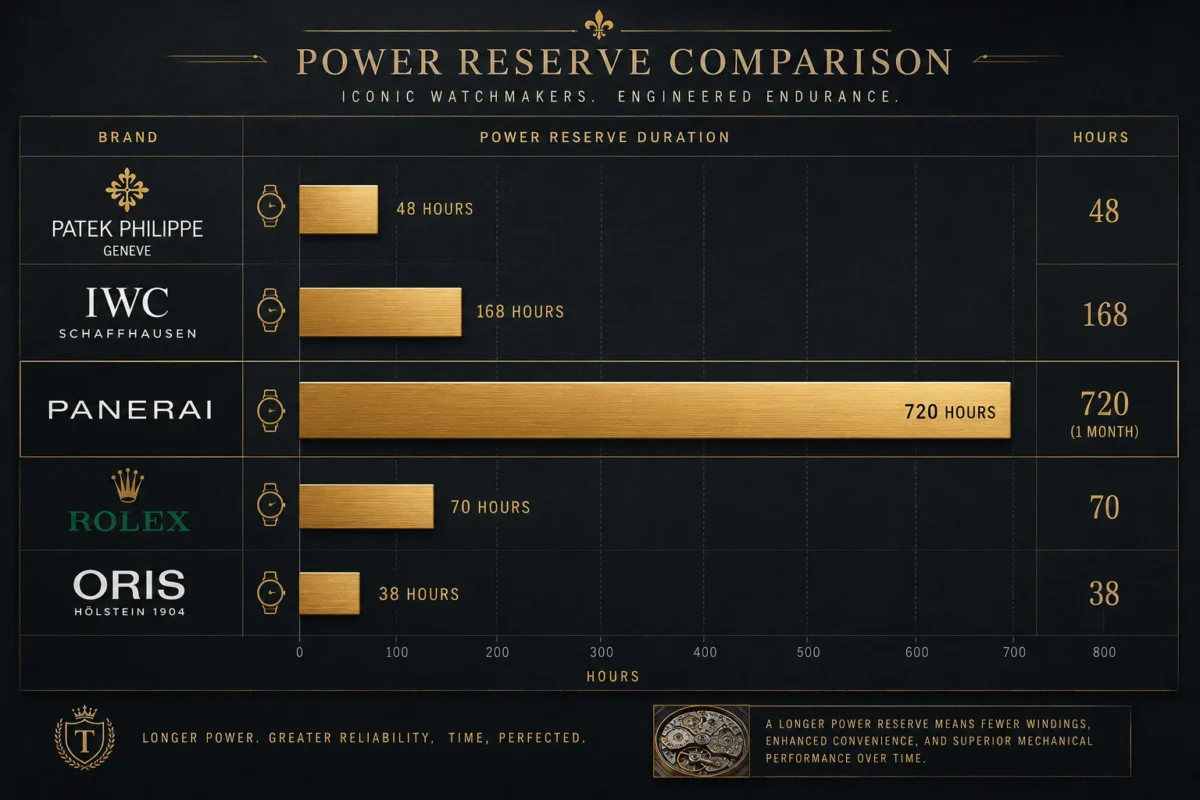
- Panerai: At Watches & Wonders 2026, Panerai launched five new Luminor models, including one with approximately one month of power reserve from a full wind, a figure that stands apart from virtually every other production watch on the market [4].
- Oris (Calibre 400): Delivers 120 hours (five days) of power reserve. Oris ties this directly to movement efficiency and claims Calibre 400 watches can operate for a decade before requiring maintenance, supported by a 10-year warranty and extended service intervals compared to the typical 4-5 year cycle.
- IWC: Several Portugieser and Pilot models offer 7-day (168-hour) reserves through their in-house calibres, made possible by multiple mainspring barrels arranged in series.
- Patek Philippe: The Calibre 240 and related movements offer 48 hours, but the brand’s focus is on precision finishing rather than maximum autonomy. The Patek Philippe 5712 Nautilus offers a power reserve indicator as a complication, balancing display and function.
- A. Lange & Söhne: The Lange 31 holds 31 days of power reserve, achieved through a massive mainspring and a constant-force mechanism.
- Rolex: Most current Rolex calibres offer 70 hours, a significant upgrade from earlier 48-hour movements, achieved through the Perpetual rotor and efficient gear train [2].
For collectors interested in exploring specific models across brands, browsing luxury watches by brand provides a useful starting point.
How Do I Check My Watch Power Reserve?
Checking a watch’s power reserve depends on whether the watch has a power reserve indicator complication or not.
If the watch has a power reserve indicator: The subdial or sector display will show remaining energy, typically as a needle moving along an arc labeled with hours or simply “full” and “empty.” The Omega De Ville Prestige Power Reserve Co-Axial, for example, features a dedicated power reserve display that makes energy status immediately readable.
If the watch does not have an indicator: The only reliable method is to fully wind the watch (manually or by wearing it continuously for several hours), then time how long it runs until it stops. Alternatively, consult the manufacturer’s specification for the calibre and track the last time the watch was worn or wound.
Practical tips:
- For automatic watches, 8 hours of active wrist wear generally provides a full wind on most calibres.
- A watch that is running noticeably slow may be approaching the end of its reserve, even without an indicator.
- Manual-wind watches should be wound at the same time each day to maintain consistent mainspring tension.
How Does a Power Reserve Indicator Work?
A power reserve indicator is a mechanical complication that translates mainspring tension into a visual display. It works by connecting a small gear or lever system to the mainspring barrel, measuring how tightly the spring is wound and converting that mechanical information into the position of a needle or hand on a subdial.
As the mainspring uncoils and tension decreases, the indicator needle moves from the “full” end of the arc toward “empty.” The mechanism must be carefully calibrated so the movement of the indicator is proportional and accurate across the full range of the spring’s tension.
From a watchmaking perspective, adding a power reserve indicator is non-trivial. The complication must be integrated without significantly increasing the movement’s thickness or consuming energy that would otherwise extend the reserve. This is why power reserve indicators are more common in dress watches with generous case heights than in ultra-thin models.
Does Longer Power Reserve Cost More?
Generally, yes, but the relationship is not perfectly linear. Longer power reserve usually requires a larger or more efficient mainspring, additional barrel capacity, or both, all of which add cost and complexity.
However, the price premium depends heavily on how the extended reserve is achieved:
- Multiple barrels in series (as used by IWC in its 7-day movements) add significant movement volume and finishing cost.
- More efficient escapements (such as Omega’s Co-Axial) can extend reserve without adding barrels, spreading the cost across broader movement improvements.
- Larger mainsprings in a single barrel (as in Oris Calibre 400) add moderate cost but represent genuine engineering investment.
A watch with a 70-hour reserve from an efficient modern calibre may cost only modestly more than a comparable 46-hour watch. A 7-day or 31-day reserve, by contrast, typically commands a meaningful premium because the engineering complexity is substantially higher.
The investment angle is also worth noting: watches with technically distinguished movements, including those with impressive power reserves, tend to hold value better in the secondary market. See the high-value luxury watch investment guide for a broader analysis of which specifications correlate with resale strength.
What Happens When a Watch Runs Out of Power Reserve?
When a mechanical watch exhausts its power reserve, it simply stops. The mainspring is fully relaxed, and no energy remains to drive the gear train or escapement.
This is not harmful in a single instance, but repeated full-depletion cycles carry some risk:
- Lubricant redistribution: When the gear train stops completely, oils can settle or pool unevenly. On restart, pivot points may briefly run with less lubrication than optimal.
- Accuracy on restart: A watch restarted from zero may take a short period to stabilize its rate, particularly if the balance wheel needs to settle back into its regulated amplitude.
- Date and complication reset: Any watch with a date, day, or additional complication will need to be manually reset after stopping, which adds time and increases the risk of incorrect crown manipulation.
For watches stored long-term, the best practice is to store them properly wound or on a watch winder if they are automatics. The guide on how to properly store and protect your luxury watches covers storage best practices in detail.
Can You Extend a Watch’s Power Reserve?
The power reserve of a specific calibre is fixed by its design and cannot be meaningfully extended by the owner. However, there are practical steps that maximize the available reserve:
- Keep the watch fully wound. For manual-wind watches, wind at the same time daily. For automatics, wear the watch for at least 6-8 hours before storing it.
- Use a quality watch winder. A winder set to the correct rotation direction and turns-per-day for the specific calibre keeps an automatic fully wound during storage.
- Service the movement on schedule. Worn lubricants and dirty pivot points increase friction in the gear train, which consumes energy faster and effectively shortens the usable reserve. A properly serviced movement runs closer to its rated specification.
- Avoid extreme temperatures. Cold temperatures can thicken lubricants and increase gear-train resistance, reducing effective running time.
What cannot be changed without a full movement modification: the mainspring size, barrel count, or escapement efficiency. These are engineering decisions made at the design stage.
Is 40 Hours Power Reserve Good for a Luxury Watch?
A 40-hour power reserve is functional for a daily wearer who puts the watch on every morning and takes it off every night, but it is below the current standard for a modern luxury calibre.
For a watch worn consistently every day, 40 hours provides a small buffer, roughly 16 hours of margin beyond a standard waking day. But for anyone who occasionally skips a day, travels, or rotates between watches, 40 hours is genuinely insufficient. The watch will stop regularly, requiring resetting that is inconvenient and, for complicated watches, potentially risky if the crown is handled incorrectly.
The honest assessment: a 40-hour reserve in 2026 is a legacy specification. It was acceptable when most calibres were designed decades ago and most buyers owned one watch. For a new calibre being developed today, 60 hours should be the floor, and 70-72 hours is a more credible minimum for a brand positioning itself at the top of the market.
Choose a 40-hour watch if: It is a vintage or heritage piece where the movement’s historical significance outweighs modern convenience, or if you are a committed daily wearer who will never skip a day.
Choose 60+ hours if: You rotate watches, travel frequently, or simply want the peace of mind that the watch is still running after a weekend away.
Automatic vs. Manual Wind Power Reserve: Which Lasts Longer?
Neither winding type inherently produces a longer power reserve. The duration depends on the specific calibre’s mainspring design, not on whether it winds automatically or manually.
That said, automatic movements tend to stay closer to full wind in daily use because the rotor continuously tops up the mainspring with wrist motion. A manual-wind watch relies entirely on the wearer remembering to wind it, so it may spend more time at partial wind, which means its effective reserve in practice can be shorter even if the rated maximum is identical.
Manual-wind movements can sometimes achieve higher maximum reserves because the absence of a rotor frees up space and reduces the movement’s energy consumption slightly. Some of the most extreme power reserves (31-day movements, for example) are manual-wind for exactly this reason.
Practical summary:
- Automatic: Stays near full wind with regular wear; rotor adds convenience.
- Manual-wind: Requires daily discipline; can achieve very long reserves in specialized calibres.
- For collectors who rotate watches: automatic with 60+ hours or manual-wind with disciplined winding schedule both work, but a watch winder is the most reliable solution for automatics.
Do I Need to Wind My Watch If I Don’t Wear It Daily?
Yes. If a mechanical watch is not worn daily, it will eventually stop, and for an automatic, the rotor cannot wind the mainspring without wrist motion.
The options for watches not worn every day:
- Manual winding: Wind the watch fully before wearing it. For a watch that has been sitting stopped, wind it fully, set the time and date, and allow it to run for 15-20 minutes before relying on it for accuracy.
- Watch winder: An automatic watch placed on a quality winder set to the correct parameters will remain fully wound and ready to wear. This is the preferred solution for collectors with multiple automatics.
- Accept the reset: Some collectors simply accept that a watch will stop between wears and reset it each time. This is fine for simple time-only watches but becomes tedious for perpetual calendars or other complex complications.
For watches with very long power reserves (5 days or more), daily winding is unnecessary. A watch with a 120-hour reserve worn on Monday and Wednesday will still be running Thursday morning, making it practical for a 2-3 day rotation without a winder.
Best Luxury Watches for People Who Don’t Wear Them Daily
For collectors who rotate frequently or wear a watch only a few days per week, power reserve should be a primary selection criterion. The best choices combine a reserve of at least 72 hours with a reliable, low-maintenance movement.
Strong options by category:
- Best overall for rotation: IWC Portugieser Automatic, 7-day power reserve, in-house calibre, power reserve indicator. The IWC Portugieser IW358304 is a well-regarded example.
- Best for the collector who wants a display: Omega De Ville Prestige Power Reserve Co-Axial, the power reserve indicator complication makes energy status immediately visible, and the Co-Axial escapement reduces service frequency.
- Best for extreme autonomy: Panerai Luminor with extended reserve, Panerai’s 2026 Luminor lineup includes a model with approximately one month of power reserve [4], making it the most practical choice for infrequent wearers.
- Best investment-grade option: Patek Philippe complications with power reserve indicator, combines horological prestige with functional display and strong secondary market value.
For collectors considering the investment dimension of their purchases, the high-value luxury watch investment guide provides context on which brands and references retain value most reliably.
Conclusion: What to Do With This Information
Power reserve in luxury watches is one of the most underappreciated specifications in the buying process. Most buyers focus on dial aesthetics, case material, and brand prestige, all legitimate considerations, but overlook the practical reality that a watch with a 46-hour reserve will stop every weekend for anyone who rotates their collection.
Actionable next steps:
- Audit your current collection. Check the rated power reserve for each calibre you own. If any fall below 60 hours and you rotate watches, consider adding a watch winder or adjusting your wearing schedule.
- Set a minimum for new purchases. If you own more than two watches, treat 60 hours as your floor for any new acquisition. For serious rotation (5+ watches), target 72 hours or more.
- Prioritize the power reserve indicator complication on watches you plan to wear infrequently, it removes the guesswork of whether the watch is still running.
- Factor service intervals into cost of ownership. Movements with longer power reserves, like the Oris Calibre 400, are often engineered for lower friction and longer service intervals, which reduces lifetime maintenance costs.
- Research before buying. Before committing to any luxury timepiece, verify the calibre’s power reserve specification and cross-reference it against your wearing habits. The luxury watch FAQ is a useful resource for quick reference on common movement and specification questions.
Power reserve will not make or break the beauty of a watch on the wrist. But for a collector who expects their timepieces to be ready when needed, it is the specification that separates a watch that works with your life from one that constantly needs attention.
Frequently Asked Questions
What is a good power reserve for a luxury watch in 2026? A minimum of 60 hours is the current practical standard for luxury calibres, ensuring the watch survives a full weekend off the wrist. Seventy to 72 hours is preferable for collectors who rotate between multiple pieces.
Does power reserve affect watch accuracy? Yes. A mechanical watch is less accurate in the final hours of its reserve as mainspring tension drops. Running a watch near empty regularly can increase daily rate variation compared to a consistently wound movement.
What is the longest power reserve available in a production watch? As of 2026, Panerai has introduced a Luminor model with approximately one month of power reserve, making it among the longest available in a production timepiece [4]. A. Lange & Söhne’s Lange 31 also offers 31 days.
Is a power reserve indicator worth the extra cost? For collectors who rotate watches or wear them infrequently, yes. The complication removes uncertainty about whether the watch is still running and helps avoid the inconvenience of resetting stopped complications.
Can a watch winder damage my automatic watch? A quality winder set to the correct turns-per-day and rotation direction for the specific calibre will not damage the movement. An incorrectly configured winder that over-winds can stress the mainspring, so always check the manufacturer’s specifications.
How often should I wind a manual-wind watch? Daily winding at the same time each day is the standard recommendation. This keeps the mainspring at consistent tension and helps stabilize the watch’s rate.
Does a longer power reserve mean a better quality movement? Not automatically, but extended reserve often correlates with engineering investment in mainspring efficiency, gear-train finishing, and escapement design. It is a useful proxy for movement quality when comparing watches at similar price points.
What happens to the date complication when a watch stops? The date display freezes at the position it was in when the watch stopped. After restarting, the date must be manually set, which requires advancing the crown carefully, particularly important for watches with quick-set date mechanisms that should not be adjusted between 9 PM and 2 AM.
Is 72 hours power reserve enough for a weekend trip? Yes, comfortably. A watch fully wound Thursday morning and packed Friday will still be running Sunday evening with a 72-hour reserve, assuming it was worn for most of Thursday and Friday.
Do quartz luxury watches have a power reserve? Quartz watches have battery life rather than power reserve. The term “power reserve” is specific to mechanical movements. Some high-end quartz watches include a battery life indicator, which serves a similar practical function.
Why do some luxury watches still have only 46 hours of reserve? Many established calibres were designed decades ago when 46 hours was the accepted standard. Brands often continue producing proven movements rather than redesigning them, particularly for heritage or entry-level lines where movement replacement would increase cost significantly.
Does storing a watch affect its power reserve? Proper storage in a stable temperature environment with appropriate humidity has no meaningful effect on rated power reserve. However, old or degraded lubricants from infrequent servicing can increase gear-train friction and reduce effective running time below the manufacturer’s specification.
References
[4] Panerai Launches Five New Luminor Models At Watches And Wonders One With An Unbelievable Spec Sheet – https://www.t3.com/luxury/watches/panerai-launches-five-new-luminor-models-at-watches-and-wonders-one-with-an-unbelievable-spec-sheet
[2] Heres Everything Rolex Just Revealed At Watches And Wonders 2026 – https://www.t3.com/luxury/watches/heres-everything-rolex-just-revealed-at-watches-and-wonders-2026