

Care & Authenticity
Water Resistance in Luxury Watches Ratings Explained: What They Really Mean
Jul
Last updated: July 8, 2026
Quick Answer: Water resistance in luxury watches is measured in meters or ATM (atmospheres of pressure), but these numbers reflect static laboratory pressure tests, not real-world diving depth. A watch marked “30m water resistant” is not safe to swim with. Understanding what each rating actually permits, and how that protection degrades over time, is essential before you expose any fine timepiece to water.
Key Takeaways
- Water resistance ratings on luxury watches are based on static pressure tests in a lab, not real-world submersion depths.
- A 30m (3 ATM) rating means splash protection only. It does not mean the watch is safe for swimming.
- No watch is truly “waterproof.” The correct term is “water resistant,” and every rating has strict activity limits.
- Gaskets and seals degrade over time, so a watch that passed its original pressure test may no longer hold that rating after years of wear.
- Battery replacement, crown manipulation, and impact can all compromise water resistance, even on high-end pieces.
- Luxury dive watches rated 100m or higher (such as the Rolex Submariner or Omega Seamaster) are engineered for serious water exposure, but they still require periodic resealing.
- Most dress watches and jewelry-style luxury watches carry only 30m ratings and should be treated as splash-resistant at best.
- Annual or biennial pressure testing by a certified watchmaker is the best way to maintain a watch’s rated protection.
What Does “Water Resistant” Mean on a Luxury Watch
Water resistant on a luxury watch means the case, crown, and crystal have been sealed to withstand a specific amount of static water pressure in controlled test conditions. It does not mean the watch can be submerged freely or used in any water activity without restriction.
The term “waterproof” was banned from watch marketing by the U.S. Federal Trade Commission decades ago because no watch can guarantee absolute water exclusion under all conditions. Every luxury watch described as water resistant carries an implied asterisk: the protection is conditional on the seals being intact, the crown being fully pushed in or screwed down, and the watch not being subjected to sudden pressure changes from movement or impact.
For collectors and buyers browsing luxury watches by brand, this distinction matters enormously. A Cartier Tank or Patek Philippe Calatrava might carry a 30m rating, which sounds reassuring, but that rating is designed for accidental splashes, not pool laps.
Water Resistance Ratings Explained: 30m, 50m, 100m, and Beyond
Each water resistance rating corresponds to a specific pressure threshold and a narrow set of permitted activities. The numbers are frequently misread as literal safe diving depths, but they are not.
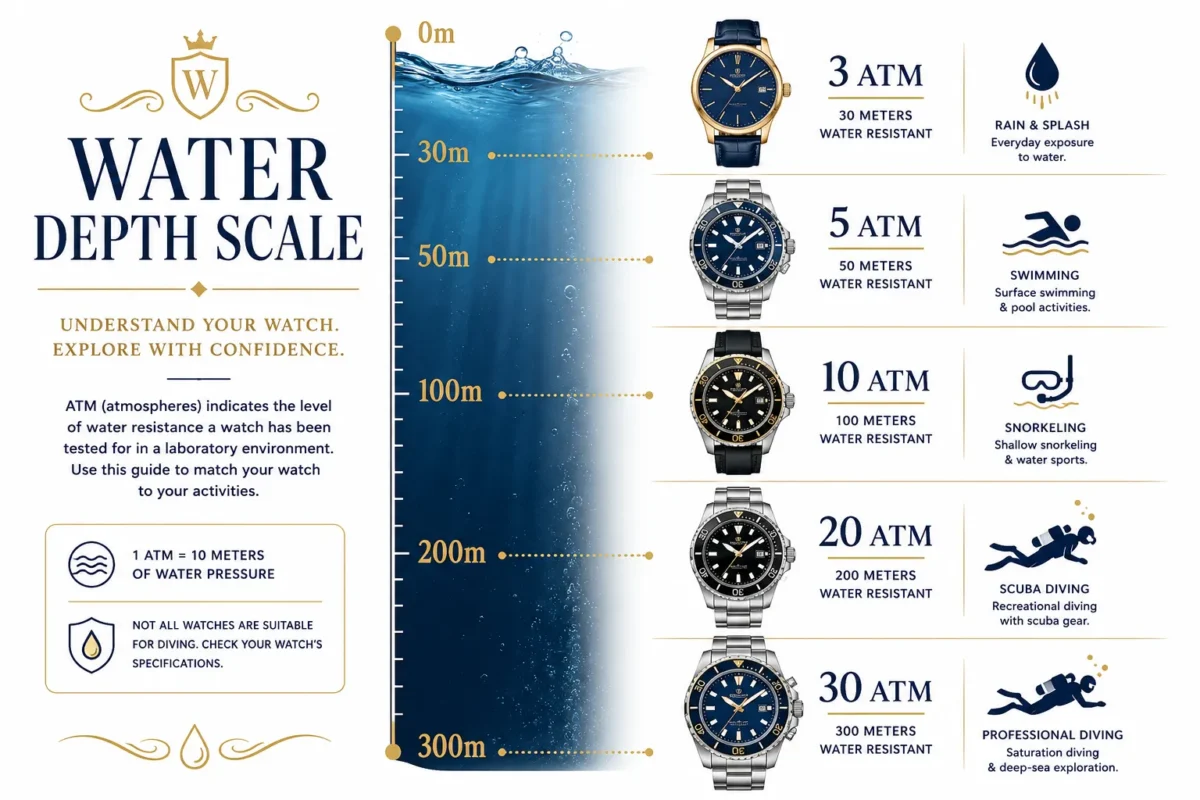
Here is what each common rating actually permits:
| Rating | ATM | What It Actually Allows | What It Does NOT Allow |
|---|---|---|---|
| 30m | 3 ATM | Rain, hand washing, accidental splashes | Swimming, showering, snorkeling |
| 50m | 5 ATM | Light surface swimming, brief immersion | Diving, snorkeling, high-impact water sports |
| 100m | 10 ATM | Swimming, snorkeling, surface water sports | Scuba diving (unless marked “diver’s watch”) |
| 200m | 20 ATM | Recreational scuba diving | Saturation or deep technical diving |
| 300m+ | 30 ATM+ | Professional and saturation diving | Virtually nothing at this level |
Why the gap between the number and reality? The test is conducted with the watch stationary in pressurized water. In real use, sudden wrist movements, jumping into water, or swimming strokes create dynamic pressure spikes that can exceed the static test rating by a significant margin. A 30m-rated watch on a wrist hitting the water during a dive entry can experience momentary pressure equivalent to far more than 3 ATM.
The practical rule: treat every rating as roughly half what you might assume is safe for active water use.
The Difference Between Water Resistant and Waterproof Watches
No luxury watch is waterproof. “Water resistant” is the only accurate and legally permitted term in the watch industry, and it always comes with activity and depth limits.
The word “waterproof” implies absolute, unconditional protection. Because no mechanical or quartz watch can guarantee that, the industry and regulators moved away from the term entirely. Even the most formidable professional dive watches, rated to 300m or 600m, are described as water resistant because their protection depends on seal integrity, proper crown engagement, and the absence of physical damage.
The practical difference for buyers: a “waterproof” claim on any watch is either a marketing error or a red flag. When evaluating a luxury timepiece, look for the specific ATM or meter rating and cross-reference it against the activity table above.
Can You Wear a Water Resistant Watch in the Shower
For most luxury watches, the answer is no, and the reasoning goes beyond just the depth rating. Showering exposes a watch to hot water, steam, soap, and shampoo, all of which accelerate gasket degradation.
Even a watch rated at 100m should not be worn regularly in the shower. Here is why:
- Hot water and steam cause rubber and silicone gaskets to expand and then contract, weakening their seal over repeated cycles.
- Soap and shampoo can work into microscopic gaps and degrade gasket material over time.
- Sudden temperature changes (cold air to hot shower) create thermal stress on the case and crystal adhesives.
- Crown position matters. If the crown is not fully screwed down or pushed in, even a 200m-rated watch can admit water at shower pressure.
For dress watches rated at 30m, the shower is a clear risk. For sport watches rated at 100m or above, occasional exposure is unlikely to cause immediate damage, but regular shower use will shorten the effective life of the seals. The better habit is to remove the watch before showering entirely.
How Is Water Resistance Tested on Watches
Water resistance in luxury watches is verified through two primary tests: a static pressure test and a condensation (or moisture) test. These are conducted in controlled lab conditions and simulate the pressure the watch would face at its rated depth.
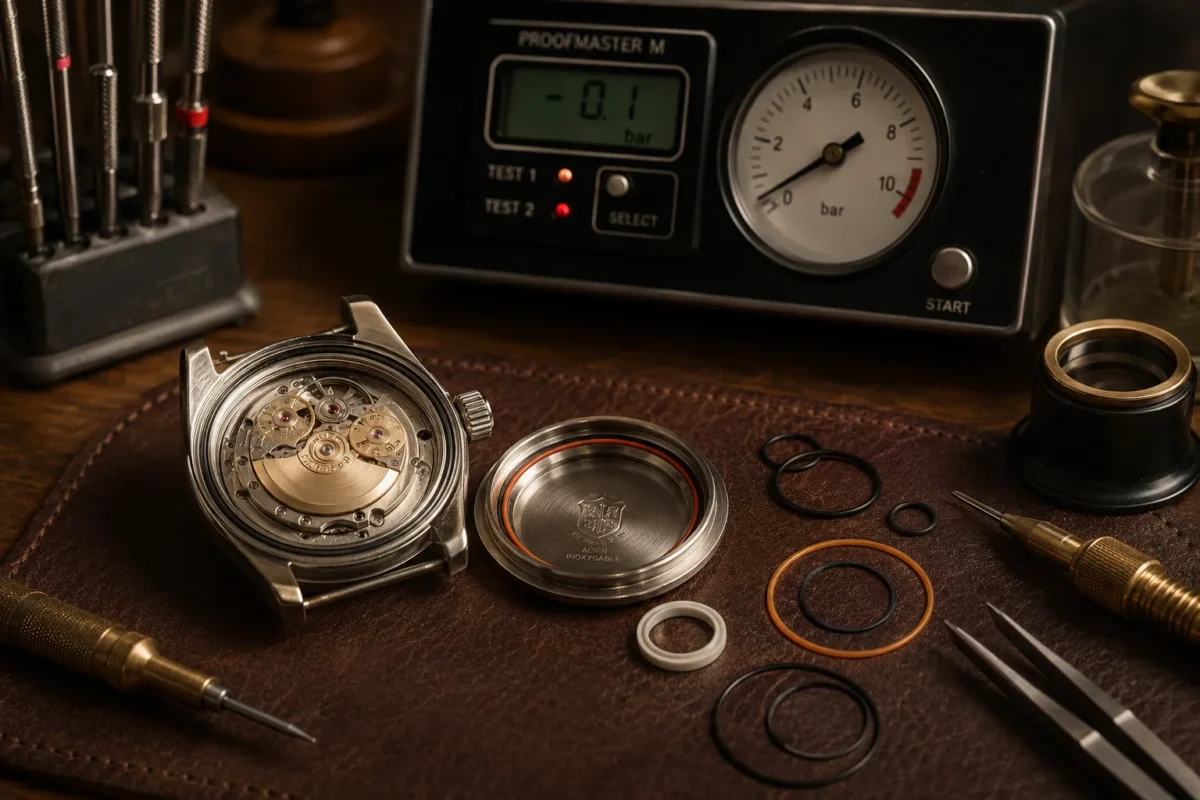
The static pressure test submerges the watch in water and applies pressure equivalent to the rated depth. The watch is held at that pressure for a set period, then inspected for any moisture ingress.
The condensation test places a dry watch on a heated metal plate, then places a cold, wet disc on the crystal. If moisture has entered the case, the crystal fogs from the inside. This test is particularly effective at detecting subtle seal failures.
ISO 22810:2010 is the international standard governing water resistance testing for watches intended for recreational use up to 100m. Watches claiming “diver’s watch” status must meet ISO 6425, which is a more demanding standard requiring tested resistance to 125% of the rated depth, along with additional requirements for legibility, magnetic resistance, and strap integrity.
The critical caveat: these tests are conducted on new watches with factory-fresh seals. A watch that passed its original certification may no longer meet that standard after years of wear, temperature cycling, and crown use.
Do Expensive Watches Hold Up Better in Water
Higher price does not automatically mean better water resistance, but it often correlates with more precise engineering, tighter tolerances, and higher-quality sealing materials. The relationship is real but not absolute.
A Rolex Submariner or Omega Seamaster Planet Ocean is built from the ground up with water exposure as a core design requirement. The case construction, crown system (screw-down crowns on Rolex are a key feature), and gasket materials are all optimized for sustained water contact. For a deeper look at how these models compare, see this Rolex Daytona vs Submariner comparison.
By contrast, a high-priced dress watch, even one costing five or six figures, may carry only a 30m rating because water resistance was never a design priority. The Patek Philippe Calatrava and many Cartier Tank variants fall into this category. Their value lies in movement finishing, aesthetic design, and horological heritage, not aquatic performance.
The honest answer for buyers: if water resistance matters to you, check the specific rating of the specific reference, not just the brand’s reputation. A $50,000 dress watch can be more vulnerable to water damage than a $500 sport watch with a proper 200m rating.
Best Water Resistant Luxury Watch Brands and Models
Several luxury brands have built genuine technical reputations for water resistance, backed by decades of engineering and real-world validation.
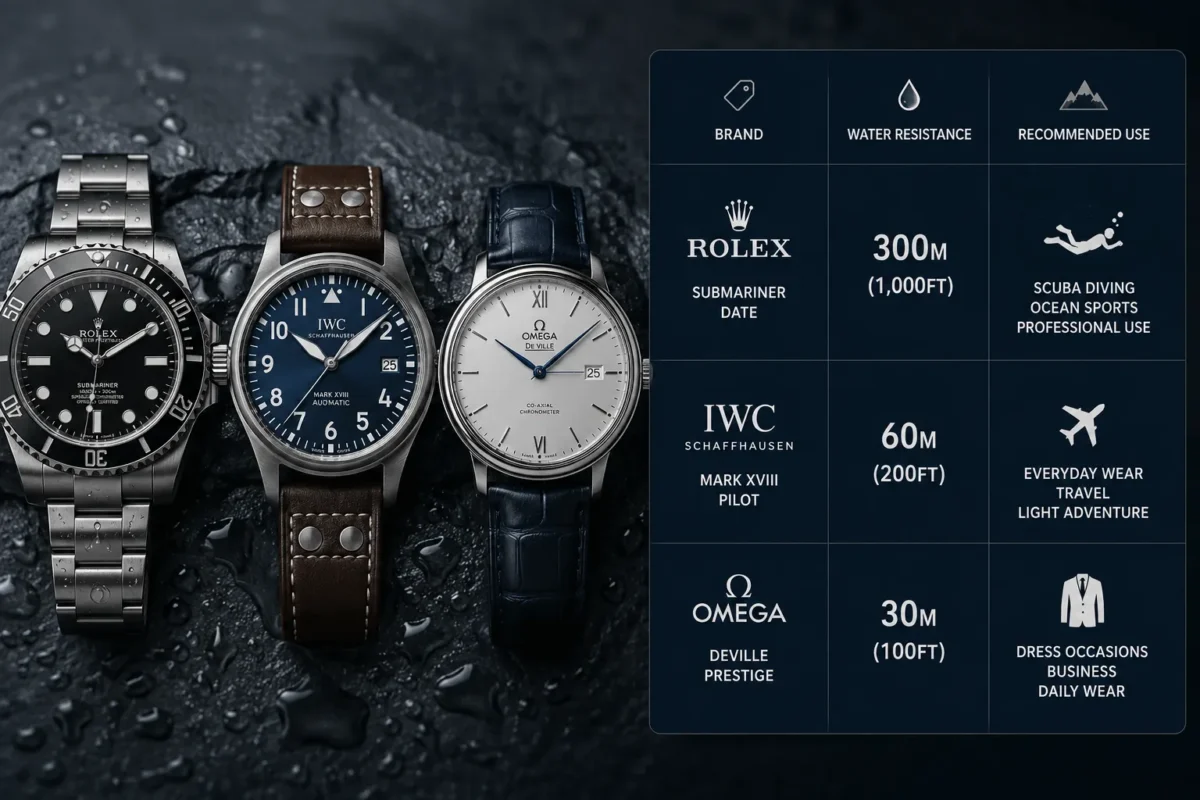
Rolex is the benchmark for luxury dive watches. The Submariner (300m) and Sea-Dweller (1220m) use screw-down Oyster crowns and Triplock or Twinlock crown tube systems that are genuinely engineered for diving. The best Rolex dive watches remain the reference point for the category.
Omega produces the Seamaster Planet Ocean (600m) and the Seamaster Diver 300M, both of which meet or exceed ISO 6425 diver’s watch standards. Omega’s helium escape valve on professional models addresses the specific pressure challenges of saturation diving.
Audemars Piguet Royal Oak Offshore models are rated to 100m and carry a genuine sport watch pedigree. The standard Royal Oak is rated at 50m, which is adequate for light swimming.
Patek Philippe Nautilus and Aquanaut are rated at 120m, which is notable for a brand primarily associated with dress watches. The Nautilus vs. Aquanaut comparison covers their differences in detail.
IWC Aquatimer series reaches 300m and is built for serious diving, while most IWC Portugieser and Portofino models carry 30m ratings and are strictly splash-resistant.
Breitling Superocean models reach 2000m, making them among the most water-resistant luxury watches available.
For buyers looking at investment-grade pieces, the high-value luxury watch investment guide provides broader context on which models hold value over time.
Which Water Resistance Rating Do You Actually Need
The right rating depends entirely on how you plan to use the watch. Most luxury watch buyers need far less water resistance than they assume.
- 30m (3 ATM): Sufficient for everyday life if you avoid swimming and showering with the watch. Appropriate for dress watches and jewelry-style pieces.
- 50m (5 ATM): Adds a margin of safety for light swimming, but still conservative. Suitable for casual pool use at low intensity.
- 100m (10 ATM): The minimum for regular swimming and snorkeling. A solid choice for buyers who want one watch for all occasions.
- 200m (20 ATM) or higher: Required for recreational scuba diving. Also the right choice for anyone who wants genuine peace of mind in water environments.
Decision rule: If you swim regularly or vacation near water, choose a minimum of 100m. If you dive, choose 200m or above with ISO 6425 certification. If the watch is primarily for business and social wear, 30m to 50m is adequate, provided you remove it before water activities.
For broader guidance on selecting the right timepiece for your lifestyle, the ultimate guide to choosing a luxury watch covers the full decision framework.
Does Water Resistance Decrease Over Time on Luxury Watches
Yes, and this is one of the most overlooked maintenance issues among luxury watch owners. Water resistance is not a permanent property. It degrades as gaskets age, compress, and dry out, regardless of how carefully the watch is handled.
Gaskets are typically made from rubber, silicone, or nylon. Over time, these materials:
- Lose elasticity and compress permanently under repeated pressure
- Dry out and crack, especially in low-humidity environments or when exposed to chemicals
- Degrade from UV exposure if the watch is worn outdoors regularly
- Shrink or harden after repeated temperature cycling
A watch that left the factory with a certified 100m rating may offer significantly less protection after five years without a service. There is no dashboard warning light for this. The only way to know is to have the watch pressure tested.
Practical guidance: Have the gaskets inspected and replaced during every full service, and have the watch pressure tested independently if it has been more than two to three years since the last service. For detailed guidance on protecting your investment, see how to properly store and protect your luxury watches.
How Often Do Water Resistant Watches Need Resealing
For watches worn regularly near water, gasket replacement every two to three years is a reasonable target. For watches worn primarily in dry conditions, every three to five years is generally sufficient, aligned with the standard full service interval.
The resealing process involves:
- Disassembling the case back, crown, and pushers
- Removing old gaskets and cleaning the seating surfaces
- Installing new gaskets of the correct specification
- Reassembling and pressure testing to confirm the original rating is restored
This is not a DIY procedure. It requires proper tools, the correct replacement gaskets for the specific reference, and access to a pressure testing machine. Authorized service centers and reputable independent watchmakers can perform this service.
Cost estimate: Gasket replacement and pressure testing at an independent watchmaker typically ranges from $50 to $150 for straightforward cases. At brand-authorized service centers, costs are higher and often bundled into a full service. For watches with complex case designs or proprietary gasket systems, costs can be higher.
Water Resistance Rating Lost After Battery Replacement
Battery replacement is one of the most common ways water resistance is compromised on quartz luxury watches. Opening the case back to replace a battery exposes the gasket, and if it is not replaced or properly reseated, the original rating is no longer valid.
Many quick-service battery replacement shops do not replace gaskets as a standard step, and they may not have access to pressure testing equipment. The result is a watch that looks unchanged but has lost its certified water resistance.
What to do: Always have battery replacements performed by a watchmaker who replaces the case back gasket as part of the service and can pressure test the watch afterward. This applies even to watches with modest 30m ratings, where a compromised seal can allow moisture to damage the movement.
For quartz luxury watches, this is a recurring consideration because batteries need replacement every one to three years depending on the movement. Each replacement is an opportunity for the seal to be compromised or properly maintained.
Is Snorkeling With a Water Resistant Watch Safe
Snorkeling is generally safe with a watch rated at 100m (10 ATM) or higher, provided the crown is fully secured and the seals are in good condition. A 50m-rated watch is technically borderline for snorkeling and carries real risk.
The reasons snorkeling demands more than the rating might suggest:
- Entry into the water (jumping or falling in) creates a sharp dynamic pressure spike
- Arm movements while swimming generate localized pressure increases
- Depth during snorkeling can reach 3 to 5 meters, but the surface entry impact is the bigger concern
For a 30m-rated dress watch, snorkeling is not safe. For a 100m-rated sport watch with intact seals, snorkeling is within the intended use range. For any serious water activity, a watch rated at 200m with a screw-down crown provides the most reliable protection.
Why Do Luxury Watches Cost More If They Are Water Resistant
Water resistance is not a feature that comes free with price. It requires specific engineering choices that add cost, and in some cases, those choices conflict with other desirable qualities in a luxury watch.
Achieving meaningful water resistance in a luxury watch requires:
- Screw-down or sealed crowns: More complex and expensive than push-pull crowns, and they add thickness to the case.
- Case back gaskets and case back design: A solid screw-down case back is more expensive to machine and finish than a snap-on back.
- Sapphire crystal gaskets: The crystal must be sealed to the case, adding a layer of engineering complexity.
- Helium escape valves on professional dive watches: A precision component that adds cost and requires its own sealing solution.
- Tighter manufacturing tolerances: Water-resistant cases require more precise machining, which increases production cost.
For brands like Rolex, these engineering investments are part of the core value proposition. For dress watch brands, the investment goes elsewhere, into movement finishing, case shaping, and dial artistry. Understanding why Swiss watches are so expensive provides useful context on where luxury pricing comes from across different categories.
My Water Resistant Watch Stopped Working After Getting Wet
If a water-resistant watch stops working after water exposure, moisture has entered the case. This is a service emergency, not a wait-and-see situation.
Immediate steps:
- Do not attempt to open the case yourself. This will introduce more moisture and may void any service warranty.
- Do not try to dry it with a hair dryer or place it in direct sunlight. Rapid heat can cause condensation to migrate further into the movement.
- Place the watch in a sealed bag with silica gel packets if available, to slow further moisture absorption.
- Take it to a watchmaker as soon as possible, ideally within 24 to 48 hours.
Moisture inside a watch movement causes corrosion rapidly. Even a brief exposure can oxidize steel components, damage lubricants, and corrode electrical contacts on quartz movements. The faster the watch reaches a professional, the better the outcome.
Prevention: Regular pressure testing and gasket maintenance are far less expensive than a movement service caused by water ingress. For guidance on keeping a luxury watch in optimal condition, see how to properly clean your luxury watch.
FAQ
What does 30m water resistant actually mean in practice? A 30m (3 ATM) rating means the watch can handle accidental splashes, rain, and brief hand washing. It is not safe for swimming, showering, or any intentional immersion. Despite the number, treat it as splash-only protection.
Is ATM the same as meters of water resistance? Conceptually yes, 1 ATM corresponds to approximately 10 meters of water pressure. So 3 ATM equals 30m, 10 ATM equals 100m, and so on. However, both figures refer to static lab pressure, not safe diving depth.
Can I swim with a 50m water resistant watch? Technically yes for light, calm swimming, but it is not recommended for luxury watches because 50m provides a narrow safety margin. Dynamic pressure from swimming strokes can exceed the rated threshold. A 100m-rated watch is a safer minimum for swimming.
How do I know if my watch’s water resistance is still valid? You cannot tell by looking at it. The only way to confirm is a pressure test performed by a watchmaker with the appropriate equipment. If the watch has not been serviced in three or more years, assume the rating may have degraded.
Does a screw-down crown make a watch more water resistant? Yes, significantly. A screw-down crown locks into the case tube and compresses the crown gasket, creating a much more reliable seal than a push-pull crown. It is one of the most important design features in any watch intended for water use.
Can luxury watches with leather straps be worn in water? No. Even if the watch case is rated for water exposure, leather straps absorb water, stretch, degrade, and develop odor rapidly. For water activities, use a rubber, silicone, or metal bracelet.
What is ISO 6425 and why does it matter? ISO 6425 is the international standard for diver’s watches. It requires the watch to be tested to 125% of its rated depth, plus additional tests for legibility, magnetic resistance, and strap strength. A watch meeting ISO 6425 is genuinely designed for diving. A watch simply rated at 100m without this certification is not a certified diver’s watch.
Does wearing a watch in the ocean damage it more than freshwater? Yes. Saltwater is more corrosive than freshwater and can accelerate gasket degradation and case corrosion if moisture enters. After any ocean exposure, rinse the watch with fresh water and dry it thoroughly.
Can I wear my luxury watch in a hot tub or sauna? No. Hot tubs and saunas combine high heat, steam, and chemicals (in the case of hot tubs) that rapidly degrade gasket materials. Even watches rated at 200m should not be worn in these environments.
How much does a water resistance pressure test cost? At an independent watchmaker, a standalone pressure test typically costs between $20 and $75, depending on location and the complexity of the case. It is one of the most cost-effective maintenance steps available for any water-resistant watch.
Are quartz luxury watches more or less water resistant than mechanical ones? The movement type does not directly determine water resistance. Case construction and seal quality are what matter. However, quartz watches require more frequent case opening for battery replacement, which creates more opportunities for seal compromise if not handled carefully.
What is a helium escape valve and which watches have one? A helium escape valve is a one-way valve built into the case of professional saturation dive watches. During deep saturation diving, helium molecules penetrate the watch case over days of exposure. When the diver decompresses, the valve releases the built-up helium pressure to prevent the crystal from being blown off. It is found on watches like the Omega Seamaster Planet Ocean and Rolex Sea-Dweller, and is only relevant for professional saturation divers.
Conclusion
Water resistance in luxury watches is one of the most misunderstood specifications in the entire category. The numbers on the dial, whether 30m, 100m, or 300m, reflect controlled lab conditions, not real-world swimming depths. Every rating has strict activity limits, every seal degrades over time, and every case opening is an opportunity for protection to be compromised.
Actionable next steps for watch buyers and owners:
- Match the water resistance rating to your actual lifestyle. If you swim, start at 100m. If you dive, require 200m and ISO 6425 certification.
- Have any watch pressure tested before exposing it to water for the first time, especially if it is pre-owned.
- Schedule gasket replacement and pressure testing every two to three years for watches worn near water, and at every full service for all others.
- Never have a battery replaced without confirming the watchmaker will replace the gasket and pressure test afterward.
- Remove any watch rated below 100m before showering, swimming, or any water activity.
- If moisture enters a watch, treat it as an emergency and get it to a watchmaker within 24 to 48 hours.
Understanding these realities does not diminish the appeal of luxury timepieces. It simply ensures that a significant investment is protected, maintained correctly, and used within its genuine capabilities. For anyone building or refining a collection, explore the full range of options at Mio Jewelry’s luxury watch store and consult the wrist watch education resources for deeper technical guidance.