

Care & Authenticity
How to Tell If a Patek Philippe Is Real: 7 Things to Check
Jul
Last updated: July 13, 2026
Quick Answer: To tell if a Patek Philippe is real, examine the dial printing quality, serial number, movement finishing, caseback engravings, weight, certificate of origin, and overall build quality under magnification. Counterfeits almost always fail at least two or three of these checks. Buying from an authorized dealer or having the watch authenticated by a certified expert eliminates virtually all risk.
Table of Contents
Key Takeaways
- Authentic Patek Philippe watches have flawlessly printed dials with razor-sharp fonts and a perfectly centered Calatrava cross logo, any blurring or misalignment is a red flag.
- Every genuine Patek Philippe carries a unique serial number that can be cross-referenced with Patek’s archival records and the watch’s original Certificate of Origin.
- Real Patek Philippe movements are hand-finished to an extraordinary standard; even entry-level models show polished bevels, Geneva stripes, and perlage under magnification.
- Weight and feel matter: genuine Patek Philippe cases in gold or platinum have a distinct heft that cheap alloy fakes cannot replicate.
- The caseback engravings on authentic pieces are laser-sharp and deeply struck; fakes typically show shallow, uneven, or slightly blurry engraving.
- A genuine Certificate of Origin (COA) includes a unique reference number, holographic elements, and matches the watch’s serial number exactly.
- When in doubt, use a certified watchmaker, an authorized Patek Philippe retailer, or a reputable luxury watch dealer for professional authentication.
What Are the Signs of a Fake Patek Philippe Watch?
Fake Patek Philippe watches almost always show visible quality deficiencies once you know what to look for. The most common signs include blurry dial text, incorrect font weights, poorly finished case edges, lightweight construction, and movements that tick audibly like a quartz watch rather than sweeping smoothly.
Here are the most telling signs of a counterfeit Patek Philippe:
- Dial printing errors: Text that appears slightly fuzzy, unevenly spaced, or uses the wrong font weight.
- Incorrect logo placement: The Calatrava cross (the brand’s signature emblem) is off-center, too large, too small, or poorly rendered.
- Audible ticking: Genuine Patek Philippe mechanical movements sweep; a loud “tick-tick-tick” almost always means a cheap quartz movement inside.
- Lightweight case: Fakes are typically made from zinc alloys or low-grade stainless steel, making them noticeably lighter than gold or platinum originals.
- Sloppy case finishing: Authentic Patek Philippe cases have alternating polished and brushed surfaces with crisp, clean transitions. Fakes blur these lines.
- Cheap crown and pushers: On a real Patek Philippe, the crown screws or seats perfectly. On fakes, it often wobbles or feels loose.
- Missing or incorrect hallmarks: Gold and platinum Patek Philippe watches carry metal purity hallmarks. Fakes either omit them or stamp them incorrectly.
Common mistake: Many buyers focus only on the dial and miss the caseback and crown, which are often the easiest places to spot a fake.
How to Authenticate a Patek Philippe Serial Number
Every genuine Patek Philippe carries a unique serial number that serves as its fingerprint. The serial number appears on the caseback, the movement, and the original paperwork, and all three must match.
How to check the serial number:
- Locate the serial number engraved on the caseback or visible through a display caseback on the movement.
- Compare it against the number printed on the Certificate of Origin and any accompanying service records.
- Contact Patek Philippe directly or visit an authorized service center to cross-reference the number against their archival records. Patek Philippe maintains detailed production records going back well over a century.
- Use the serial number to confirm the approximate production year and verify that the reference number matches the model you’re looking at.
Can you tell if a Patek Philippe is real by serial number alone? Not entirely. Counterfeiters sometimes copy serial numbers from known genuine watches. A matching serial number is necessary but not sufficient, it must be combined with physical inspection of the watch and its paperwork.
Edge case: Some very early vintage Patek Philippe watches have serial numbers that are harder to trace through public databases. For pieces made before the mid-20th century, a certified horological expert or direct contact with Patek Philippe’s archives in Geneva is the most reliable route.
Patek Philippe Real vs Fake: Weight and Feel
A genuine Patek Philippe has a weight and tactile quality that fakes rarely match. Gold and platinum are dense metals; a real Nautilus in stainless steel or a Calatrava in rose gold will feel substantial in the hand in a way that zinc-alloy counterfeits simply cannot replicate.
What to expect by material:
- Stainless steel models (such as the Nautilus 5711 or Aquanaut): firm, cool to the touch, with a solid heft.
- Gold models (yellow, white, or rose gold): noticeably heavier than steel; 18k gold is denser than most alloys used in fakes.
- Platinum models: the heaviest of all, platinum is approximately 60% denser than gold, so a fake platinum Patek Philippe will feel dramatically lighter than the real thing.
Beyond weight, run a finger along the case edges. Genuine Patek Philippe cases have transitions between polished and brushed surfaces that are almost impossibly sharp. The lugs, flanks, and bezel meet at precise angles. On a fake, these transitions feel rounded, smeared, or inconsistent.
The crown is another tactile test: on a real Patek Philippe, it turns with smooth, precise resistance. On a fake, it often feels gritty, loose, or overly stiff.
How to Check Patek Philippe Movement Quality
The movement inside a genuine Patek Philippe is one of the clearest ways to confirm authenticity. Patek Philippe manufactures its own calibers in-house, and the finishing standards are among the highest in Swiss watchmaking.
If the watch has a display caseback (or if a watchmaker opens a solid caseback), look for:
- Geneva Stripes (Cotes de Geneve): Fine parallel lines decorating the bridges and plates, applied by hand.
- Perlage: A pattern of tiny overlapping circles on the movement’s base plate, visible under magnification.
- Beveled and polished edges: Every anglage (beveled edge) on the movement parts should be hand-finished to a mirror polish.
- Patek Philippe signature: The movement itself is engraved or printed with the Patek Philippe name and caliber number.
- No visible glue or rough machining: Fakes often use movements sourced from cheap Chinese suppliers with none of the above finishing.
Practical tip: A loupe or jeweler’s magnifying glass (10x) is enough to spot the difference. Genuine Patek Philippe finishing looks almost impossibly perfect under magnification; fake movements look rough, dull, or machine-stamped.
For a deeper look at how mechanical movements work and what separates them from lesser alternatives, see this guide to watch movements: mechanical vs automatic vs quartz.
Patek Philippe Caseback Engravings: What to Look For
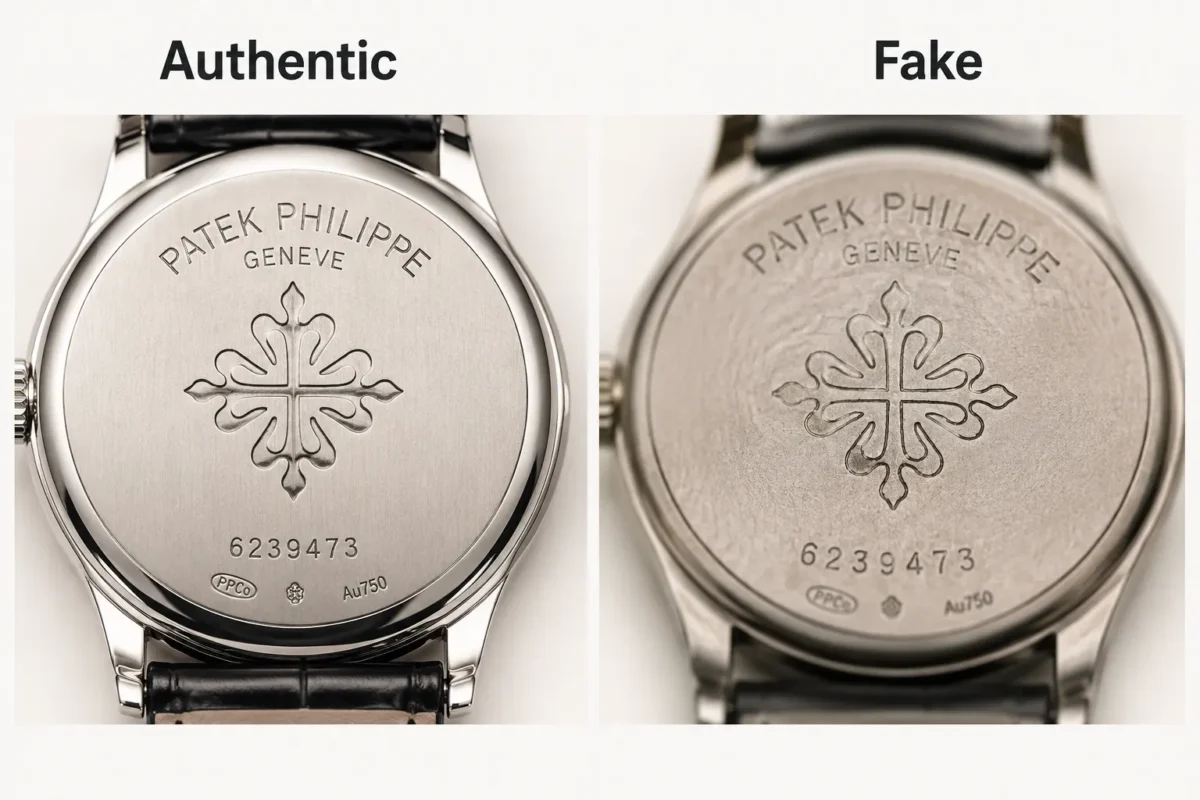
The caseback is one of the most reliable places to spot a counterfeit. On a genuine Patek Philippe, caseback engravings are deeply struck, perfectly spaced, and laser-sharp even under a loupe.
What appears on an authentic Patek Philippe caseback:
- The Calatrava cross (the brand’s emblem), rendered with clean, symmetrical lines.
- “PATEK PHILIPPE & CO. GENEVE” in a specific, consistent font.
- The reference number and serial number, engraved with uniform depth and spacing.
- Metal purity hallmarks (e.g., “750” for 18k gold, “950” for platinum), often accompanied by Swiss hallmarking stamps.
- For certain models, a case number distinct from the serial number.
On a fake:
- Engravings are shallow, slightly blurry, or inconsistently spaced.
- The Calatrava cross may have uneven arms or a slightly different proportion.
- Font weight varies within the same word, a sure sign of poor tooling.
- Hallmarks may be absent, incorrectly formatted, or stamped rather than engraved.
Edge case: Some vintage Patek Philippe watches have casebacks made by third-party case manufacturers (a common practice before the mid-20th century). These may carry slightly different markings. When authenticating vintage pieces, consult a specialist who knows the production history of that specific reference.
Models like the Patek Philippe 5738/51G-001 Golden Ellipse showcase the level of craftsmanship visible even on the exterior, a useful reference point for understanding what genuine Patek Philippe finishing looks like.
Patek Philippe Dial Printing: Fake vs Real
The dial is the face of the watch, and Patek Philippe treats it as a work of art. Authentic dials are produced to tolerances that consumer-grade counterfeiting equipment cannot match.
Key dial checks:
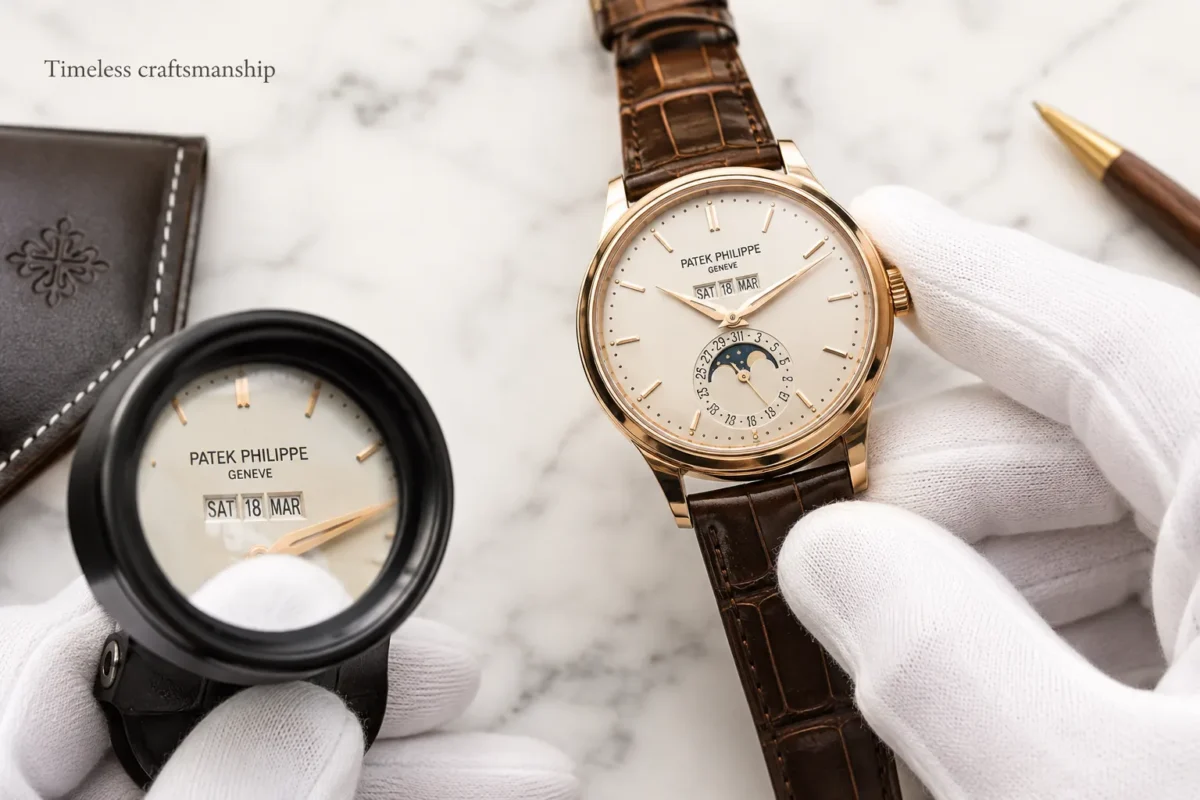
- Text sharpness: Every letter and numeral on a genuine dial is crisp under 10x magnification. No bleeding, no fuzzy edges, no ink pooling.
- Logo rendering: The Calatrava cross above “PATEK PHILIPPE” is perfectly proportioned. The cross arms are equal in width and length.
- Font consistency: Patek Philippe uses proprietary fonts across its dial families. The weight, spacing, and kerning are consistent across every character.
- Lume application: On models with luminous hands or indices, the lume is applied evenly, with no overflow onto the dial surface.
- Date window (where present): The date disc font and alignment are precise. On fakes, the date often sits slightly off-center in the aperture.
- Subdial alignment: On chronograph or complication models, the subdials are perfectly concentric and evenly spaced. Misalignment is a strong counterfeit indicator.
Quick test: Hold the watch at a low angle under a bright light. A genuine Patek Philippe dial has a consistent surface finish (matte, sunburst, or guilloché) with no visible tool marks or uneven texture. Fakes often show streaking or inconsistent finish under raking light.
Patek Philippe Certificate of Authenticity: How to Verify
Every new Patek Philippe watch ships with a Certificate of Origin (often called the Certificate of Authenticity or COA). This document is a critical part of authentication, and verifying it is a non-negotiable step for any serious buyer.
What a genuine Patek Philippe COA includes:
- The watch’s reference number and serial number, printed (not handwritten) in a specific format.
- The retailer’s name and stamp, confirming the point of original sale.
- A holographic seal that changes appearance when tilted.
- The date of sale.
- Patek Philippe’s signature emblem and branding, printed to a high standard.
How to verify the COA:
- Confirm the serial number on the certificate matches the number engraved on the watch and movement exactly.
- Check the holographic seal, genuine holograms shift color and pattern when tilted; photocopied or printed fakes do not.
- Look up the authorized retailer listed on the certificate. Patek Philippe publishes a list of authorized dealers on its official website.
- Contact Patek Philippe’s customer service or an authorized service center with the serial number to confirm the certificate’s validity.
Important: A COA alone does not guarantee authenticity. Counterfeiters produce fake certificates. The COA must be verified alongside physical inspection of the watch.
How Much Does a Real Patek Philippe Cost?
Authentic Patek Philippe watches start at roughly $20,000 USD for entry-level models and can reach several million dollars for grand complications or rare limited editions. If a deal seems significantly below market value, that is itself a warning sign.
General price ranges (retail, as of 2026):
- Calatrava (entry-level): Approximately $20,000,$40,000 USD
- Complications (annual calendar, world time): Approximately $40,000,$100,000 USD
- Nautilus and Aquanaut: Retail from approximately $30,000,$60,000 USD, though secondary market prices are often significantly higher due to demand
- Grand Complications (perpetual calendar, minute repeater, tourbillon): $100,000,$1,000,000+ USD
The price test: If someone is offering a “Patek Philippe” for $500, $1,000, or even $5,000, it is not a genuine Patek Philippe. No legitimate scenario produces a new or near-new Patek Philippe at those prices. Even heavily worn or damaged genuine pieces retain substantial value.
For a closer look at some of the most desirable references, the guide to most sought-after Patek Philippe watches provides useful context on what the market values and why.
What Makes Patek Philippe Watches So Expensive?
Patek Philippe’s prices reflect a combination of in-house manufacturing, hand-finishing, limited production, and a 185-year heritage of horological innovation. Understanding why genuine pieces cost what they do helps buyers recognize why fakes are so obviously inferior once examined closely.
The key cost drivers:
- In-house calibers: Patek Philippe designs, manufactures, and finishes its own movements. No outsourcing of critical components.
- Hand finishing: Even the simplest Calatrava movement receives hours of hand-finishing, beveling, polishing, and decorating by skilled artisans.
- Limited production: Patek Philippe produces a relatively small number of watches per year compared to mass-market brands, keeping quality control extremely high.
- Precious materials: Cases in 18k gold, platinum, or high-grade stainless steel; dials in enamel, meteorite, or guilloché-engraved gold; sapphire crystals.
- Complications: Many Patek Philippe watches contain multiple complications (annual calendar, moon phase, chronograph) that require years of engineering and assembly.
- Resale value: Genuine Patek Philippe watches are among the few consumer goods that consistently hold or increase in value over time, which is itself a function of authentic scarcity and quality.
The Patek Philippe Nautilus vs. Aquanaut comparison illustrates how different references within the same brand can vary in design philosophy while maintaining the same uncompromising quality standards.
Where Can I Get a Patek Philippe Authenticated?
Professional authentication is available through several reliable channels. For any purchase above a few thousand dollars, independent verification is worth the cost.
Best options for Patek Philippe authentication:
- Authorized Patek Philippe retailers: The most direct route. Authorized dealers can inspect the watch and cross-reference the serial number with Patek Philippe’s records. Find the official list of authorized dealers on Patek Philippe’s website.
- Patek Philippe service centers: Patek Philippe operates service centers in major cities globally. They can authenticate any piece and provide a service history.
- Certified independent watchmakers: Look for watchmakers certified by the WOSTEP (Watchmakers of Switzerland Training and Educational Program) or similar bodies. They have the tools and training to open and inspect movements.
- Reputable luxury watch dealers: Established dealers who specialize in pre-owned luxury watches (and who stake their reputation on authenticity) are a reliable option for secondary market purchases.
- Third-party authentication services: Services such as WatchCSA and similar specialist firms offer formal authentication reports, useful for insurance or resale purposes.
Choose a certified expert if: you are buying a pre-owned piece from a private seller, the price seems below market, or the paperwork is incomplete.
If you are considering selling a genuine Patek Philippe, working with a trusted specialist who handles luxury watch sales ensures proper valuation and documentation.
Best Places to Buy Authentic Patek Philippe Watches
Buying from the right source is the single most effective way to avoid counterfeits entirely. Authentic Patek Philippe watches are available through a short list of trustworthy channels.
Recommended sources:
- Authorized Patek Philippe boutiques and retailers: The only source for new watches. Every piece comes with full paperwork, warranty, and factory-fresh condition.
- Established pre-owned luxury watch dealers: Look for dealers with verifiable track records, transparent return policies, and authentication guarantees. A reputable dealer will provide documentation and stand behind every sale.
- Major auction houses: Christie’s, Sotheby’s, and Phillips all have dedicated watch departments with expert authentication teams. Buying at auction from these houses carries a high degree of confidence.
- Certified pre-owned programs: Some authorized dealers now offer certified pre-owned Patek Philippe watches with full authentication documentation.
Avoid: Private sellers on general marketplace platforms without verifiable authentication, social media sellers offering “deals,” and gray market sources that cannot produce original paperwork.
For those exploring specific references, pieces like the Patek Philippe 5712/1R-001 Nautilus in rose gold are available through specialist retailers who provide full provenance documentation.
Common Mistakes People Make Buying Patek Philippe
Even experienced collectors make errors when buying Patek Philippe watches. Knowing the most frequent pitfalls prevents costly mistakes.
The most common buying mistakes:
- Trusting photos alone: Counterfeiters have become skilled at producing convincing photographs. Never buy a Patek Philippe without a physical inspection or a trusted intermediary who has inspected it in person.
- Ignoring the paperwork: Missing or incomplete documentation is a serious red flag. A genuine Patek Philippe should have its Certificate of Origin, warranty card, and ideally the original box.
- Focusing only on the dial: Many buyers check the dial carefully but overlook the caseback, crown, movement, and bracelet, all of which reveal fakes.
- Assuming price equals authenticity: Some sophisticated fakes are priced near or at market value to appear legitimate. Price is not a substitute for authentication.
- Skipping professional verification for “obvious” deals: If the deal looks too good to be true, it almost certainly is.
- Not checking the bracelet: On bracelet models like the Nautilus or Aquanaut, the bracelet finishing, clasp mechanism, and Patek Philippe engravings on the clasp are all authentication points that fakes frequently get wrong.
What to Do If You Think You Have a Counterfeit Patek Philippe
If you suspect a watch is fake, stop wearing it and take specific steps immediately. Acting quickly protects both your financial interests and any potential legal recourse.
Step-by-step response:
- Stop wearing the watch. Continued use of a suspected fake is not a legal issue for the wearer in most jurisdictions, but it is prudent to set it aside.
- Document everything. Photograph the watch, all paperwork, and any communications with the seller.
- Get a professional opinion. Take the watch to an authorized Patek Philippe service center or a certified watchmaker for a formal assessment.
- Contact the seller. If the watch was recently purchased and is confirmed fake, contact the seller in writing requesting a refund. Keep all records.
- Report to consumer protection authorities. In the US, counterfeit goods can be reported to the Federal Trade Commission (FTC) or Customs and Border Protection (CBP). In the EU, contact the relevant national IP enforcement body.
- Consult a legal professional. If significant money is involved, an attorney specializing in consumer fraud or intellectual property can advise on recovery options.
Important: Knowingly selling a counterfeit watch is a criminal offense in most countries. Buyers who unknowingly purchased a fake and can demonstrate good faith are generally protected as victims, not perpetrators.
How to Tell If a Patek Philippe Is Real: A 7-Point Checklist
Bringing together all the checks above, here is a practical 7-point authentication checklist for any Patek Philippe watch:
Patek Philippe Authentication Checklist
- Dial quality: Crisp text, correct fonts, perfectly centered Calatrava cross, no blurring under 10x magnification.
- Serial number: Matches the Certificate of Origin and movement; verifiable through Patek Philippe’s records.
- Movement finishing: Geneva stripes, perlage, polished bevels visible through display caseback or confirmed by a watchmaker.
- Caseback engravings: Deep, sharp, consistent, Calatrava cross, brand name, reference and serial numbers all correctly rendered.
- Weight and feel: Appropriate heft for the stated metal; smooth crown action; crisp case finishing transitions.
- Certificate of Origin: Serial number matches, holographic seal intact, authorized retailer listed and verifiable.
- Source verification: Purchased from an authorized dealer, reputable pre-owned specialist, or major auction house with authentication guarantee.
Passing all seven checks does not guarantee authenticity with 100% certainty, but failing any one of them is a strong reason to seek professional authentication before completing a purchase.
Frequently Asked Questions
How can I tell if a Patek Philippe is real without opening it? Check the dial printing quality, caseback engravings, serial number against the COA, weight relative to the stated metal, and the smoothness of the crown and movement sweep. These external checks identify the vast majority of fakes without needing to open the case.
Can a fake Patek Philippe have a real serial number? Yes. Counterfeiters sometimes engrave serial numbers copied from known genuine watches. A matching serial number must be combined with physical inspection and COA verification to be meaningful.
Is a display caseback on a Patek Philippe a sign of a fake? No. Several genuine Patek Philippe references feature display casebacks, including many complications and grand complications. However, if a model is not known to come with a display caseback, the presence of one is suspicious.
Does Patek Philippe have a free authentication service? Patek Philippe authorized service centers can inspect watches and cross-reference serial numbers. There may be a service fee depending on the scope of the inspection. Contact your nearest authorized service center for specifics.
What is the Calatrava cross and why does it matter for authentication? The Calatrava cross is Patek Philippe’s official emblem, derived from the cross of the Knights of Calatrava. It appears on the crown, caseback, and dial of genuine watches. Its proportions and rendering are highly specific, any deviation is a counterfeit indicator.
How do I know if a pre-owned Patek Philippe is authentic? Request the original Certificate of Origin, check the serial number against Patek Philippe’s records, have the movement inspected by a certified watchmaker, and buy from a reputable dealer who provides an authentication guarantee.
Are there any Patek Philippe watches that are harder to fake convincingly? Grand complication models (minute repeaters, perpetual calendars, tourbillons) are the hardest to fake convincingly because the movement complexity is nearly impossible to replicate at a counterfeit price point. However, simpler models like the Calatrava are more commonly faked because demand is higher and the exterior is easier to copy.
What should I do if an online seller refuses to provide the serial number before purchase? Walk away. Any legitimate seller of a genuine Patek Philippe will provide the serial number for verification. Refusal is a strong indicator of a counterfeit or a stolen watch.
Does the weight of a fake Patek Philippe always feel wrong? Almost always, yes, especially for gold and platinum models. Stainless steel fakes can sometimes approximate the weight of a genuine steel Patek Philippe more closely, so weight alone is not sufficient for steel models. Always combine weight checks with other authentication steps.
Can I authenticate a Patek Philippe using only photos? No. Photographs are insufficient for authentication. High-quality fakes can look convincing in photos. Physical inspection or inspection by a trusted expert who has handled the watch in person is required.
Conclusion
Knowing how to tell if a Patek Philippe is real is not just a skill for watchmakers, it is essential knowledge for any buyer, collector, or investor considering a purchase. The seven checks covered in this guide (dial quality, serial number, movement finishing, caseback engravings, weight and feel, certificate verification, and source credibility) work together as a system. No single check is infallible, but together they create a robust authentication framework.
Actionable next steps:
- Before any purchase, obtain the serial number and verify it against the Certificate of Origin and Patek Philippe’s records.
- Use a jeweler’s loupe (10x) to inspect the dial and caseback engravings before committing to a sale.
- For pre-owned purchases, always budget for a professional authentication inspection, the cost is trivial relative to the price of a genuine Patek Philippe.
- Buy from authorized dealers, established pre-owned specialists, or major auction houses whenever possible.
- If you are exploring specific references, reviewing detailed guides on models like the Patek Philippe 5230G-010 World Time gives you a precise understanding of what authentic examples look like, knowledge that directly improves your ability to spot fakes.
A genuine Patek Philippe is one of the most rewarding purchases in the luxury watch market. Taking the time to authenticate properly protects that investment and ensures the piece you acquire is everything it should be.