

Brand History & Storytelling
How Cartier Went from Jewelry House to the Hottest Watch Brand of 2026

Aug
Last updated: August 31, 2026
Quick Answer
Cartier is now the world’s second-largest Swiss watch brand by sales, trailing only Rolex, with wholesale watch revenue estimated at approximately CHF 3.5 billion in 2025. The brand achieved this position by converting its century-long jewelry heritage into a distinct watchmaking identity built on iconic design, precious materials, and a dual appeal to both jewelry clients and dedicated watch collectors. By 2026, demand metrics across primary sales, auction results, and pre-owned platforms confirm that Cartier is not merely rising, it is accelerating faster than any other major watch brand.
Key Takeaways
- Cartier holds an estimated 8.7% share of the global Swiss watch market by value, making it the clear No. 2 brand behind Rolex.
- Auction sales of Cartier watches reached approximately USD 523 million in 2025, a 43% increase versus the prior year.
- Average order values for Cartier on pre-owned platforms rose roughly 36.5% over three years, from about USD 4,800 in 2023 to approximately USD 6,553 in 2026.
- The Chrono24 ChronoPulse Index shows Cartier’s market “heat” rising at about 3.5 times the rate of any competing watch brand.
- Cartier’s 2026 Watches & Wonders releases, including the Crash Squelette, Privé Tortue Monopoussoir, Tank Normale, and expanded Santos-Dumont line, have been widely recognized as among the most significant launches of the year.
- The brand’s jewelry DNA is a strategic advantage, not a liability: it attracts jewelry clients upgrading into watches while simultaneously drawing serious horological collectors.
- Cartier watches are investment-grade timepieces, with select references commanding immediate secondary-market premiums after launch.
- Understanding how Cartier went from jewelry house to the hottest watch brand of 2026 requires examining its design philosophy, pricing strategy, and cultural positioning together.
How Did Cartier Become a Watch Brand
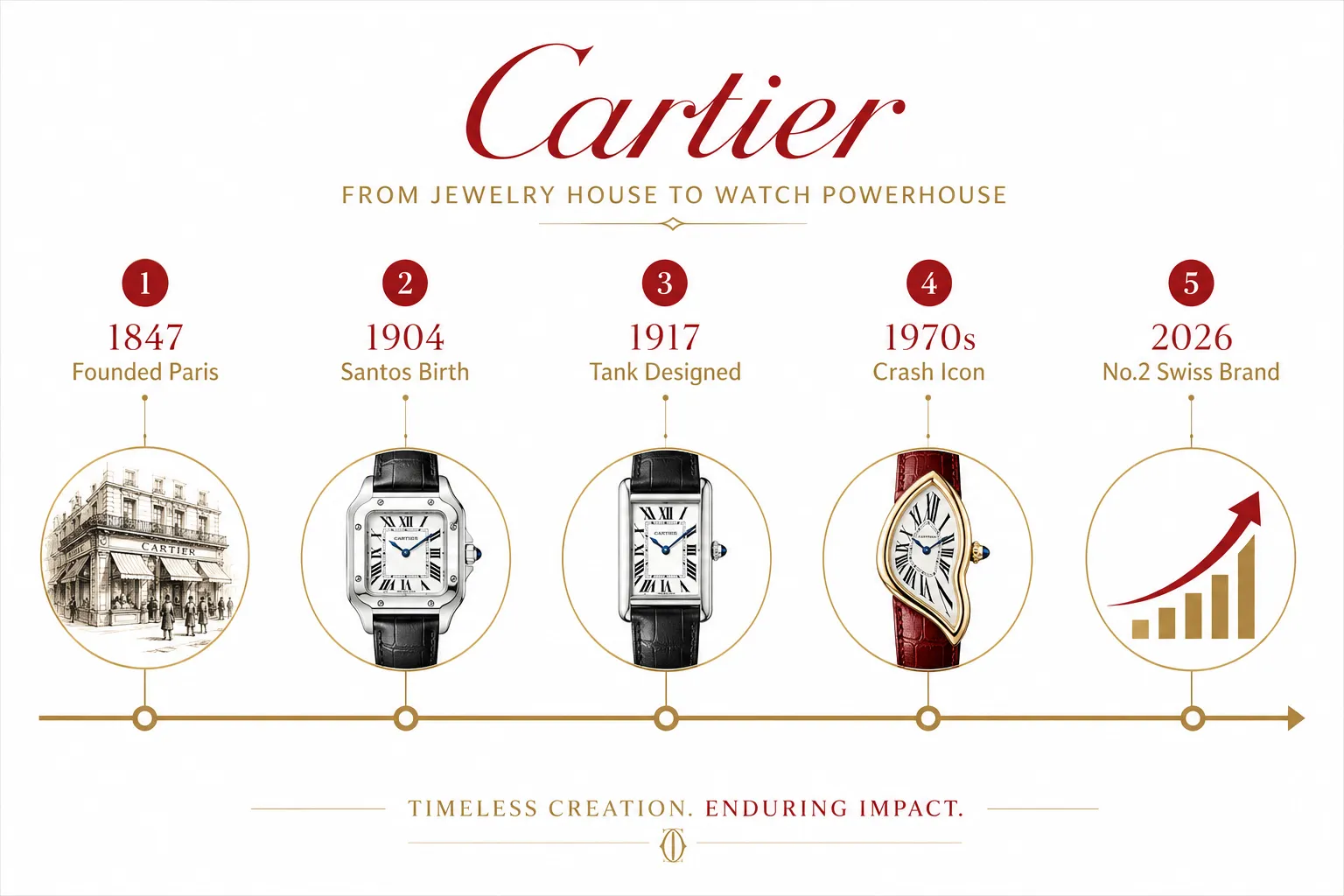
Cartier’s entry into watchmaking was not a diversification strategy, it was a natural extension of its jewelry mastery. Founded in Paris in 1847 by Louis-François Cartier, the maison built its reputation on exceptional gem-setting, precious metalwork, and aristocratic clientele. Watchmaking followed organically, because a jeweler who could craft the most refined gold and platinum settings was already equipped to produce watch cases of the highest order.
The pivotal moment came in 1904, when Louis Cartier designed a wristwatch for his friend Alberto Santos-Dumont, the Brazilian aviator who needed a timepiece he could read without releasing an aircraft’s controls. That commission produced the Santos, widely regarded as one of the first purpose-built wristwatches for men. Thirteen years later, in 1917, Louis Cartier designed the Tank, inspired by the aerial silhouette of Allied Renault tanks on the Western Front. Both designs remain in active production today, which is a testament to their enduring authority.
The Crash followed in 1967, reportedly born from a damaged watch case that a Cartier London craftsman transformed into an intentional design. The Panthère arrived in 1983, and the Santos-Dumont, a slimmer, more dressy interpretation of the original Santos, became a defining piece of Cartier’s modern identity.
What distinguishes Cartier’s horological history from that of most watch brands is that its greatest designs emerged from an artistic sensibility rather than a technical brief. That distinction matters enormously in 2026, when collectors are actively seeking watches with genuine design identity.
What Makes Cartier Watches So Popular Right Now
Cartier watches are popular right now because they sit at the intersection of two powerful collector trends: the demand for design-led timepieces and the appetite for pieces with genuine cultural heritage. In 2026, the brand’s heat index on Chrono24 is rising at approximately 3.5 times the rate of any other watch brand, a figure that reflects search activity, listing views, and completed transactions simultaneously.
Several factors converge to explain this momentum:
Design Differentiation. In a market where many sports watches have converged on similar proportions and materials, Cartier’s rectangular and asymmetric cases, the Tank, the Crash, the Tortue, are immediately recognizable. Collectors who want a watch that does not look like everything else on the market have a clear reason to choose Cartier.
Jewelry-Grade Finishing. Cartier’s case finishing, dial craftsmanship, and bracelet quality reflect the standards of a fine jewelry house. The attention to surface quality, the precision of the Roman numerals, and the characteristic blued-steel hands are details that reward close examination.
Dual Audience Appeal. Cartier converts its existing jewelry clients into watch buyers while simultaneously attracting dedicated watch enthusiasts. Few brands operate effectively across both audiences. This dual appeal expands the total pool of potential buyers, which supports both primary-market pricing and secondary-market liquidity.
Cultural Resonance. Cartier has maintained cultural visibility across fashion, art, and celebrity circles for over a century. That visibility drives aspirational demand among younger buyers entering the luxury watch market for the first time.
2026 Releases. The brand’s Watches & Wonders 2026 presentations, particularly the Crash Squelette, the Privé Tortue Monopoussoir chronograph, and new Tank Normale configurations, have been received as defining statements. One prominent publication described the Crash Squelette as the piece most likely to become the face of Cartier’s current watch renaissance.
Cartier Watch Prices Compared to Rolex and Omega
Cartier’s pricing occupies a broad range, from accessible steel sport watches to precious-metal high-jewelry pieces in the six figures. Understanding where Cartier sits relative to Rolex and Omega helps collectors calibrate expectations.
| Brand | Entry-Level Steel | Mid-Range | Precious Metal / High Complication | Market Position |
|---|---|---|---|---|
| Cartier | ~USD 4,000-7,000 | ~USD 8,000-20,000 | USD 30,000-100,000+ | No. 2 Swiss brand by value |
| Rolex | ~USD 6,000-9,000 | ~USD 10,000-25,000 | USD 30,000-200,000+ | No. 1 Swiss brand, ~33% market share |
| Omega | ~USD 3,000-5,500 | ~USD 6,000-15,000 | USD 20,000-60,000+ | No. 3 Swiss brand by volume |
Note: Retail prices are approximate and vary by configuration, metal, and market. Pre-owned values may differ significantly.
Cartier’s pricing has moved upward consistently. The average order value on major pre-owned platforms rose from roughly USD 4,800 in 2023 to approximately USD 6,553 in 2026, an increase of about 36.5% in three years. That trajectory mirrors what Rolex experienced in the early 2010s, when secondary-market values began pulling away from retail prices.
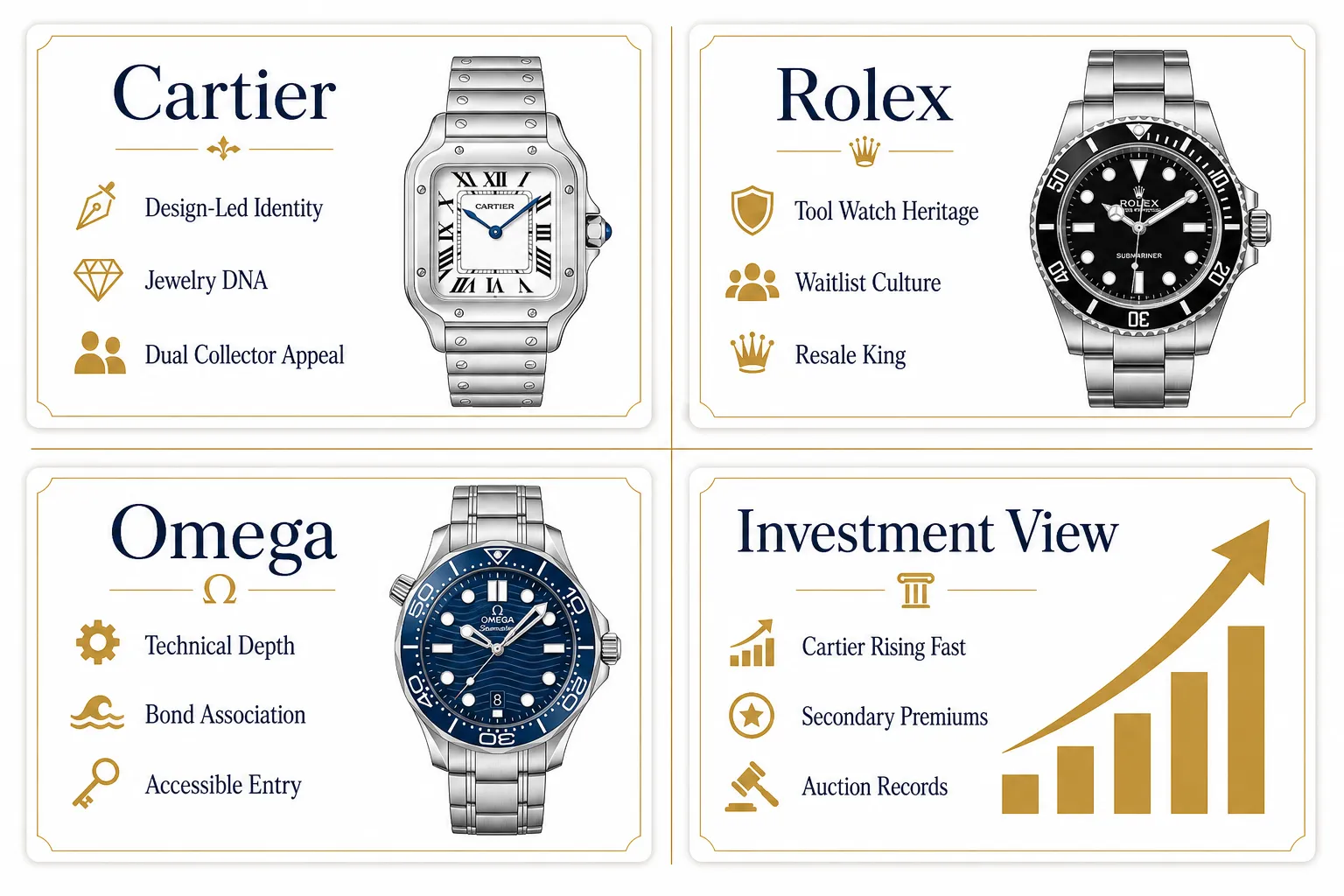
For collectors comparing Cartier to Rolex at similar price points, the key difference is design language. A Rolex Datejust or Submariner offers tool-watch functionality and unmatched resale liquidity. A Cartier Santos or Tank offers a distinctive aesthetic identity and jewelry-house craftsmanship. Both are legitimate choices; the decision depends on what the collector values most.
Explore the full luxury watch collection at MioJewelry to compare current availability across brands and price tiers.
Cartier Watch vs. Rolex: Which Is Better
Neither brand is objectively superior, the better choice depends entirely on what the buyer prioritizes. Rolex dominates the secondary market with the highest resale liquidity of any watch brand. Cartier offers stronger design differentiation and a jewelry-house aesthetic that Rolex does not attempt to replicate.
Choose Cartier if:
- Design identity and aesthetic distinctiveness are the primary criteria
- The buyer also collects fine jewelry and values a coherent aesthetic across both categories
- The goal is a watch that reads as artistic and culturally sophisticated rather than technical
- The collector is drawn to rectangular, asymmetric, or unconventional case shapes
Choose Rolex if:
- Maximum secondary-market liquidity is the priority
- The buyer wants a tool-watch heritage with proven water resistance and durability
- The preference is for round case sports watches or classic dress pieces in the Rolex tradition
- The goal is the single most recognizable luxury watch brand globally
Both brands are investment-grade timepieces with long track records of value retention. Cartier’s secondary-market momentum in 2026 is accelerating, but Rolex retains the deepest liquidity pool. For a collector building a diverse watch portfolio, owning one of each is a sound strategy.
For reference, the Rolex Day-Date 228238 in yellow gold represents Rolex at its most prestigious, while the Santos or Tank occupies a comparable position within Cartier’s hierarchy.
Best Cartier Watch Models for Men in 2026
The strongest Cartier references for men in 2026 combine iconic design lineage with current collector momentum. Each of the following models offers a distinct proposition.
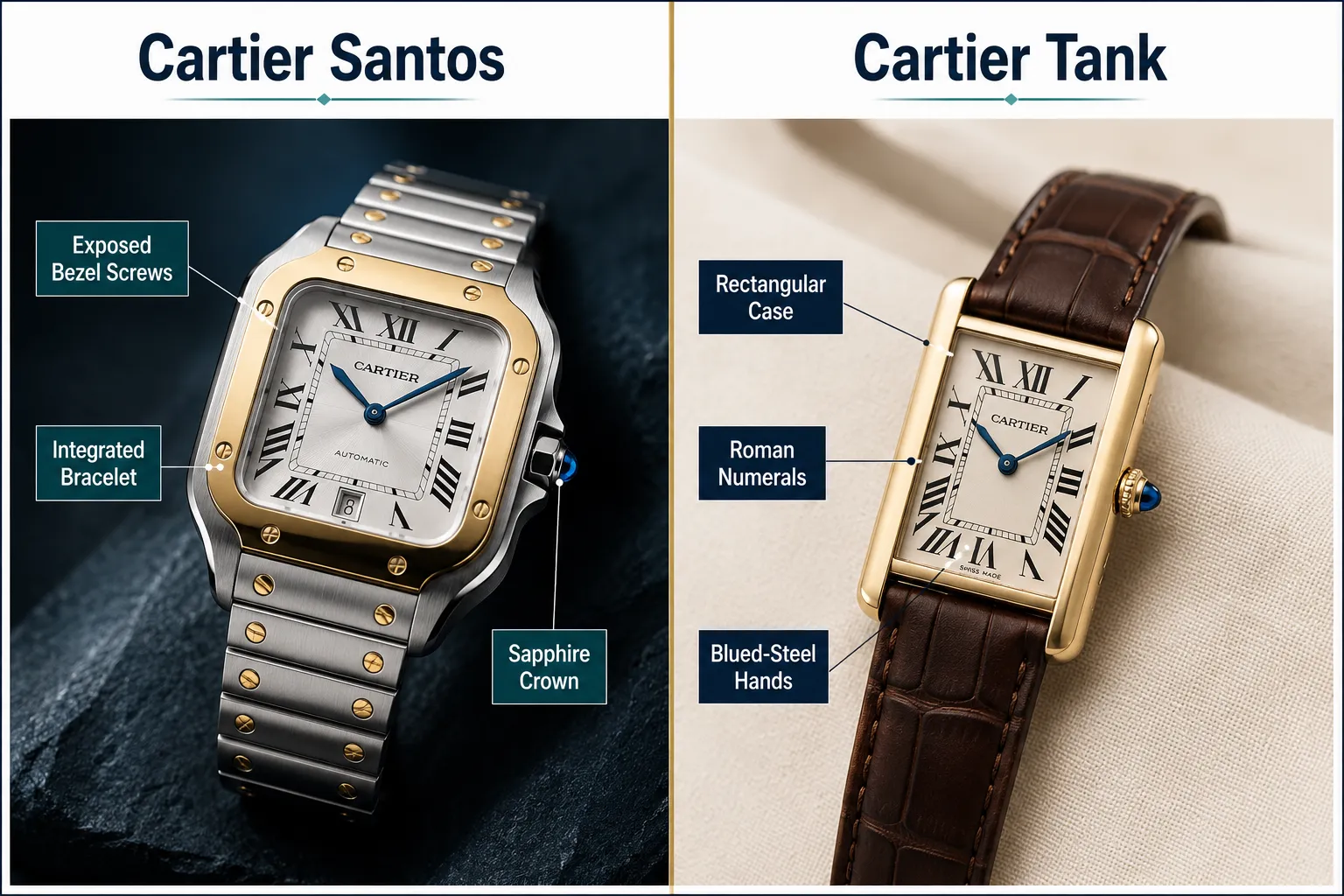
Santos de Cartier The Santos remains Cartier’s most versatile men’s watch. The exposed square screws on the bezel and the integrated bracelet are immediately recognizable. Available in steel, two-tone steel and yellow gold (WSSA0061), and full gold configurations, the Santos covers a wide price range. The two-tone version is particularly strong on the secondary market in 2026.
Tank Normale The Tank Normale is one of Cartier’s most significant 2026 releases. Its proportions are closer to the original 1917 design than modern iterations, which has resonated strongly with collectors who prize historical fidelity. Available in yellow gold, it is positioned as a serious collector’s piece.
Santos-Dumont The Santos-Dumont offers the Santos aesthetic in a slimmer, more dress-oriented profile. It wears beautifully under a shirt cuff and appeals to collectors who prefer understated elegance over sportiness.
Crash Squelette The 2026 Crash Squelette is the year’s most talked-about Cartier release. Its asymmetric case and skeletonized movement represent the brand’s jewelry and watchmaking identities working in concert. Certain configurations are priced in the mid-USD 40,000s, and secondary-market premiums are already anticipated.
Privé Tortue Monopoussoir Chronograph A single-pusher chronograph in the Tortue case, this piece appeals to serious watch collectors who want a genuine complication delivered with Cartier’s characteristic design restraint.
Roadster The Roadster has emerged as a sleeper hit among vintage-leaning collectors. Its barrel-shaped case and bold dial proportions feel fresh against the current landscape of round sports watches.
Cartier Santos vs. Tank: Which Should I Buy
The Santos and Tank are Cartier’s two most iconic men’s references, and the choice between them is one of the most common questions serious buyers face. The Santos is sportier and more versatile; the Tank is dressier and more historically significant.
Santos de Cartier, best for buyers who want:
- A watch that transitions from business to weekend wear
- An integrated bracelet with strong wrist presence
- The most recognizable Cartier men’s watch globally
- Strong secondary-market demand and liquidity in 2026
Tank (Normale, Solo, or Louis), best for buyers who want:
- A pure dress watch with historical gravitas
- A slimmer profile that wears elegantly under formal attire
- A piece that references over a century of design history
- A watch that signals refined taste rather than brand recognition
The decision often comes down to lifestyle. An executive who wears a watch seven days a week in varied settings will likely find the Santos more practical. A collector who rotates multiple pieces and wants a dedicated dress watch will find the Tank more satisfying in that role.
Both references have demonstrated strong appreciation on the secondary market. The Santos two-tone and the Tank in yellow gold have been particularly active in 2026 auction and pre-owned trading data.
Cartier Watches for Women vs. Men
Cartier has always designed watches that transcend traditional gender categories, and that approach has become a genuine competitive advantage in 2026. The Panthère, Tank, and Baignoire are worn by both men and women, often in different sizes but identical designs.
For women, the strongest Cartier references in 2026 include:
- Panthère de Cartier, the quintessential Cartier women’s watch, with its supple mesh bracelet and square case. Available in yellow gold, white gold, and steel. The Panthère de Cartier WGPN0018 and Panthère de Cartier WJPN0016 represent the range in precious metal and steel respectively.
- Tank Française, a slightly more contemporary Tank variant with an integrated bracelet, popular among professional women who want a refined but wearable daily watch.
- Ballon Bleu, the round case with the distinctive crown guard is one of Cartier’s most commercially successful designs, available in sizes from 28mm to 42mm.
For men, the Santos, Tank Normale, and Crash Squelette lead the 2026 conversation as discussed above.
The Panthère deserves particular attention as an investment-grade timepiece. Yellow gold Panthère references have appreciated meaningfully over the past three years, and the Panthère de Cartier HPI01129 exemplifies the quality and finishing that drives collector demand.
Are Cartier Watches a Good Investment
Cartier watches are increasingly treated as investment-grade timepieces by serious collectors and luxury investors. The data supporting this view has strengthened considerably in 2026.
Auction sales of Cartier watches reached approximately USD 523 million in 2025, a 43% increase versus 2024. That figure reflects both rising prices and rising volume, a combination that signals genuine demand expansion rather than speculative inflation in a thin market.
Pre-owned platform data reinforces the trend. Average transaction values for Cartier watches rose approximately 36.5% over three years, and sales volume on at least one major platform grew roughly 75% in 2025 versus 2024. These are not the metrics of a brand in gradual decline; they are the metrics of a brand in active ascent.
Key investment considerations:
- Reference selection matters. The Santos two-tone, Tank in yellow gold, Crash in any configuration, and Panthère in precious metal have demonstrated the strongest appreciation. Steel-only references with no precious metal content tend to hold value but appreciate more modestly.
- Condition and completeness are critical. Full Set Complete pieces, original box, papers, and accessories, command meaningful premiums over incomplete sets. Authenticity Guaranteed documentation from a trusted dealer is non-negotiable.
- Vintage Cartier is a separate market. Vintage Tank, Santos, and Crash references from the 1960s through 1980s have their own collector dynamics and can command significant premiums at auction.
- Liquidity is improving but not yet at Rolex levels. Cartier’s secondary market is deepening rapidly, but a collector who needs to liquidate quickly may find Rolex offers faster execution at tighter bid-ask spreads.
For collectors considering Cartier as part of a diversified luxury watch portfolio, the current moment represents a compelling entry point. The brand’s trajectory suggests that 2026 prices on key references may look conservative in retrospect.
Those exploring the broader investment landscape for luxury watches can review the watch education guide at MioJewelry for foundational guidance on movements, materials, and buying criteria.
What Is the Resale Value of Cartier Watches
Cartier’s resale value varies significantly by reference, metal, and condition, but the overall trend in 2026 is strongly positive. The brand has moved from being undervalued on the secondary market, where it was often dismissed as “jewelry rather than watches”, to commanding premiums on sought-after references.
Strongest resale performers in 2026:
- Crash (any metal, especially yellow gold and white gold)
- Santos de Cartier two-tone (steel and yellow gold)
- Panthère de Cartier in yellow gold
- Tank Normale in yellow gold (2026 release)
- Privé collection pieces in precious metals
Factors that protect and enhance resale value:
- Full box and papers (complete set)
- Unpolished original surfaces
- Service history from an authorized Cartier service center
- Limited production or Privé designation
- Precious metal construction
Factors that reduce resale value:
- Missing box, papers, or accessories
- Heavy polishing that removes original surface character
- Aftermarket modifications (non-Cartier straps are acceptable; dial modifications are not)
- Damage to the case, crystal, or bracelet
Collectors who want to understand current market values for specific references before buying or selling can request a free quote through MioJewelry’s watch selling service.
Why Are Cartier Watches Hard to Get
Certain Cartier references are genuinely difficult to acquire at retail in 2026, though the situation differs from Rolex’s allocation model. Cartier does not operate the same waitlist culture that Rolex has built around its sport references. Instead, scarcity at Cartier is driven by a combination of limited production on high-demand pieces, strong global demand growth, and the deliberate positioning of Privé and high-jewelry pieces as exclusive releases.
The 2026 Crash Squelette is the clearest example. Produced in limited quantities in precious metal, it is expected to sell out quickly at authorized retailers and command an immediate secondary-market premium. The Privé Tortue Monopoussoir chronograph faces similar dynamics.
For the core commercial range, Santos, Ballon Bleu, Tank Solo, availability is generally better than for Rolex’s most sought-after references. A buyer who wants a steel Santos de Cartier can typically acquire one from an authorized dealer or a trusted pre-owned specialist without a multi-year wait.
The practical implication: buyers who want specific precious-metal or limited-edition Cartier references should act decisively when they become available. Waiting for prices to soften on a piece like the Crash Squelette or a full-diamond Panthère is unlikely to be a rewarding strategy in the current market.
MioJewelry maintains an exclusive collection of luxury watches by brand with immediate availability on select references, including Cartier pieces that are difficult to find through conventional retail channels.
How to Spot a Fake Cartier Watch
Counterfeit Cartier watches are prevalent at every price point, from crude fakes sold on street markets to sophisticated replicas that can deceive inexperienced buyers. Knowing the key authentication markers is essential before any purchase.
Primary authentication checks:
- Dial quality. Genuine Cartier dials have crisp, perfectly formed Roman numerals with consistent line weights. The “Cartier” signature is precise and never smudged or uneven. The minute track is clean and uniformly spaced.
- Crown and cabochon. Cartier’s signature blue sapphire cabochon on the crown is a polished, deep blue stone with consistent color. Fakes often use glass or synthetic stones that appear flat or slightly purple.
- Case finishing. Cartier cases combine brushed and polished surfaces with exceptional precision. The transitions between surfaces are sharp and clean. Fakes typically show uneven finishing, soft edges, or inconsistent surface textures.
- Movement. For watches with exhibition casebacks or open-worked dials, the movement finishing should be clean and consistent. Cartier uses ETA-based and in-house movements depending on the reference; both are finished to a standard that counterfeits cannot replicate affordably.
- Serial and reference numbers. Genuine Cartier watches have serial numbers engraved cleanly on the caseback or between the lugs. The reference number should match the model exactly. Cross-reference with Cartier’s official records or a trusted specialist.
- Weight and materials. Gold Cartier watches have a specific weight and warmth to the touch. Steel references have a precise heft. Fakes often feel noticeably lighter or have a different surface temperature.
The safest approach: purchase only from authorized Cartier retailers or trusted pre-owned specialists who provide Authenticity Guaranteed documentation, full provenance, and a traceable transaction record. MioJewelry’s white-glove service includes comprehensive authentication on every piece, with fully insured overnight shipping and complete documentation.
Cartier Watch Warranty and Service Costs
Cartier provides a standard international warranty on new watches, which covers manufacturing defects. As of 2026, new Cartier watches purchased from authorized retailers come with a warranty period that has been extended in recent years, consistent with broader industry moves toward longer coverage terms.
Key warranty and service facts:
- New Cartier watches purchased from authorized dealers are covered under the international warranty. Pieces sold as “Under Factory Warranty” through authorized pre-owned channels may carry remaining warranty coverage.
- Warranty does not cover damage from accidents, water ingress beyond the watch’s rated resistance, or unauthorized modifications.
- Cartier recommends service intervals of approximately every three to five years for mechanical movements, depending on usage and conditions.
- Official Cartier service costs vary by reference and complication. A basic service on a Santos or Tank mechanical movement typically runs in the range of USD 500-1,200. More complex movements, precious metal cases, or gem-set pieces will cost more.
- Cartier service centers return watches in original factory condition, which preserves collector value better than independent servicing in most cases.
For collectors purchasing pre-owned Cartier watches, confirming the service history and the date of the last official service is an important due diligence step. A recently serviced piece with documentation commands a premium and offers greater peace of mind.
How Cartier Went from Jewelry House to the Hottest Watch Brand of 2026: The Strategic Picture
The full story of how Cartier went from jewelry house to the hottest watch brand of 2026 is a study in the power of design identity sustained over generations. The brand did not reinvent itself. It doubled down on what it had always been.
Cartier’s watch division grew from under CHF 2 billion in wholesale revenue in 2019 to an estimated CHF 3.5 billion in 2025, representing roughly 8.7% of the entire Swiss watch market by value. That growth was achieved not by flooding the market with volume, production rose to approximately 695,000 pieces in 2025, a modest 2% year-on-year increase, but by increasing the average value of each watch sold. That is pricing power, and it is the hallmark of a brand with genuine desirability.
The 2026 collection strategy reflects this philosophy clearly. Rather than introducing entirely new designs, Cartier recalibrated its canonical shapes: the Tank returned to proportions closer to the original; the Crash gained a skeletonized movement that exposed its movement without abandoning its asymmetric identity; the Santos-Dumont received refinements that made it more compelling as a dress watch. These are not the moves of a brand chasing trends. They are the moves of a brand that understands its own heritage and uses it deliberately.
The result is a brand that now sits at the center of multiple collector conversations simultaneously: vintage Cartier at auction, modern Cartier at retail, Cartier as jewelry, and Cartier as serious horology. That breadth of appeal is rare. Rolex has it. Patek Philippe has it. In 2026, Cartier has joined that conversation in a way that was not fully evident five years ago.
For collectors and investors who want to understand how Cartier went from jewelry house to the hottest watch brand of 2026, the answer is both simple and profound: the brand never abandoned its identity, and the market eventually caught up to what that identity was worth.
Those building a luxury watch portfolio that includes Cartier alongside other investment-grade references can explore MioJewelry’s luxury watch consignment services for acquisition and liquidation options handled with the discretion and expertise that serious collectors require.
Frequently Asked Questions
Is Cartier considered a serious watch brand or just a jewelry brand? Cartier is both, and that dual identity is a strength. The brand has produced iconic watch designs since 1904, including the Santos, Tank, and Crash, all of which are studied seriously by horological historians. In 2026, Cartier is the world’s second-largest Swiss watch brand by sales value, which settles any debate about its standing in the watch industry.
What is the most iconic Cartier watch? The Tank, designed in 1917, is widely considered Cartier’s most historically significant watch. The Santos, from 1904, holds the distinction of being one of the first purpose-built men’s wristwatches. In 2026, the Crash Squelette is the most talked-about current release.
How does Cartier’s market share compare to Rolex? Rolex holds approximately 33% of the global Swiss watch market by value. Cartier holds approximately 8.7%, making it the clear second-largest brand. No other Swiss brand comes close to either figure.
Are pre-owned Cartier watches worth buying? Pre-owned Cartier watches offer excellent value, particularly Full Set Complete pieces with original box and papers. The pre-owned market for Cartier has deepened significantly in 2026, with average transaction values rising roughly 36.5% over three years.
What is the Cartier Crash, and why is it so sought after? The Crash is an asymmetric watch with a melted, distorted case shape, first produced in 1967. It is one of the most distinctive designs in watchmaking history. The 2026 Crash Squelette, with its skeletonized movement, is expected to be among the most sought-after Cartier releases of the decade.
How long does a Cartier watch last? A well-maintained Cartier watch will last generations. Cartier’s mechanical movements are robust and serviceable, and the brand’s precious metal cases are built to the standards of fine jewelry. Regular servicing every three to five years is recommended for mechanical references.
Does Cartier make its own movements? Cartier produces in-house movements for many of its references, including the calibers used in the Santos, Tank, and several complication pieces. Some references use movements from established Swiss suppliers. In-house calibers are generally preferred by serious collectors.
What is the best Cartier watch for a first-time buyer? The Santos de Cartier in steel or two-tone steel and yellow gold is the most practical entry point for a first-time Cartier buyer. It is versatile, well-supported on the secondary market, and immediately recognizable as a Cartier design.
Can Cartier watches be worn while swimming? Most Cartier watches are water-resistant to 30 meters, which means they can withstand splashes and brief immersion but are not designed for swimming or diving. The Santos 100 and certain sport-oriented references offer higher water resistance. Always confirm the specific reference’s rating before exposure to water.
Why is Cartier’s UK business growing faster than Richemont overall? Cartier’s UK sales rose 11% to GBP 251 million for the financial year ending March 2025, roughly twice the growth rate of its parent group Richemont in that market. This outperformance reflects Cartier’s stronger brand momentum relative to the broader Richemont portfolio, driven by watch demand and jewelry sales working in concert.
What makes a Cartier watch “investment grade”? An investment-grade Cartier watch combines a sought-after reference, precious metal construction, complete documentation (box and papers), excellent condition, and a verifiable service history. Pieces from the Privé collection, limited editions, and vintage references in original condition tend to meet this standard most consistently.
Where is the best place to buy a Cartier watch? Authorized Cartier retailers and trusted pre-owned specialists who provide Authenticity Guaranteed documentation, full provenance, and professional authentication are the safest sources. MioJewelry offers white-glove service, fully insured overnight shipping, and certified authentication on every piece in its collection.
Conclusion
The story of how Cartier went from jewelry house to the hottest watch brand of 2026 is ultimately a story about the enduring value of design integrity. Cartier did not chase the sports watch boom of the 2010s. It did not abandon its rectangular cases for round ones. It did not dilute its jewelry heritage to appear more technical. Instead, it deepened its commitment to iconic design, precious materials, and the dual identity that makes it unique among all luxury watch brands.
The results speak clearly. CHF 3.5 billion in estimated wholesale watch revenue. An 8.7% share of the global Swiss watch market. USD 523 million in auction sales in a single year. Secondary-market heat rising at 3.5 times the rate of any competing brand. These are not the metrics of a jewelry house dabbling in watches. They are the metrics of a watch brand that has arrived at the top of its industry.
Actionable next steps for serious buyers and collectors:
- Identify the Cartier reference that aligns with your aesthetic preferences and wearing context before engaging the market.
- Prioritize Full Set Complete pieces with original box and papers for maximum investment-grade positioning.
- Consult with trusted luxury watch experts before acquiring precious-metal or limited-edition references, particularly 2026 novelties where secondary-market premiums are already forming.
- Review current availability of certified authentic Cartier pieces through a trusted worldwide dealer before making any acquisition decision.
- Consider the role of Cartier within a broader luxury watch portfolio that may include complementary references from Rolex, Patek Philippe, or other investment-grade brands.
MioJewelry’s team of luxury watch experts is available to provide white-glove guidance on acquisition, authentication, and portfolio strategy. Every piece in the collection is certified authentic, with immediate availability and fully insured overnight shipping. For collectors ready to act, the current moment in Cartier’s ascent is one that rewards decisiveness.