

Market & Investment
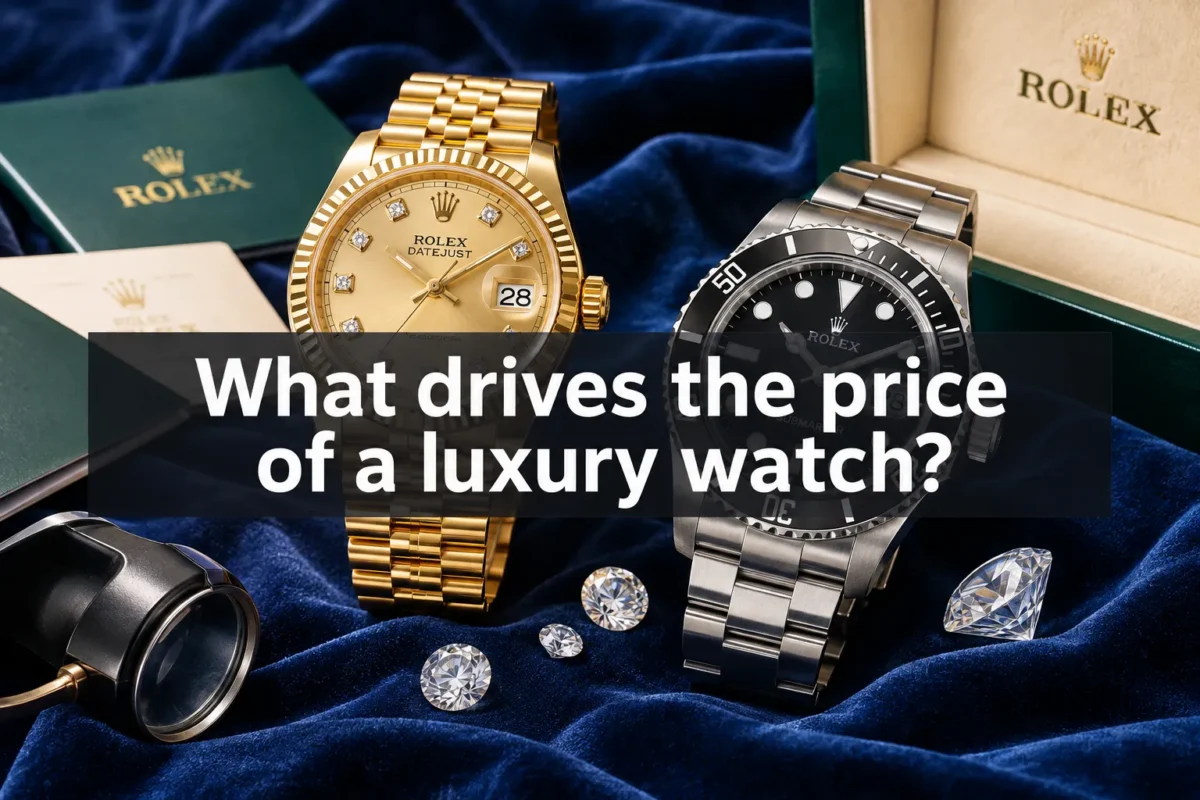
What Drives the Price of a Luxury Watch? 8 Factors Explained
Nov
Last updated: November 2, 2026
Quick Answer
The price of a luxury watch like a Rolex, Omega, or Patek Philippe is shaped by brand heritage, materials, movement complexity, rarity, condition, completeness (box and papers), market demand, and service history. Two watches sharing the same reference number can sell for very different amounts once you account for these factors. Buyers and sellers who understand what drives the price of a luxury watch? 8 factors explained below make far better decisions than those relying on a single online listing.
Key Takeaways
- A Rolex reference number tells you the model and generation, not the exact condition, originality, or value of that specific watch.
- Brand name alone does not set the price; materials, movement type, and rarity matter just as much.
- Diamond-set dials, gold cases, and limited production runs create separate value tiers within the same reference.
- Full set complete watches (original box, papers, and service history) consistently command higher resale prices than head-only pieces.
- Luxury watches, particularly steel sports models from Rolex and Patek Philippe, have historically held value better than most other luxury goods, though returns are never guaranteed.
- Quartz movements are cheaper to produce than mechanical ones, which is why mechanical watches remain pricier at every end of the market.
- Online asking prices often mislead buyers because sellers price aspirationally, not based on actual completed sales.
- Working with trusted luxury watch experts for authentication protects both buyers and sellers from costly mistakes.
What Makes a Luxury Watch Cost So Much
A luxury watch costs what it costs because of a combination of material cost, mechanical complexity, brand reputation, scarcity, and the labor required to hand-finish and assemble it. No single factor explains the price on its own; it is the layering of all eight factors that separates a $500 watch from a $50,000 one.
Here is a breakdown of the eight core price drivers:
- Brand heritage and reputation. Names like Rolex, Patek Philippe, Audemars Piguet, and Vacheron Constantin carry over a century of watchmaking trust, and that trust is priced into every piece.
- Materials. Solid gold, platinum, and diamond-set cases cost dramatically more than stainless steel.
- Movement type and complexity. In-house mechanical movements with complications (chronograph, perpetual calendar, GMT) require more hours of hand assembly than a basic quartz module.
- Rarity and production limits. Brands like Patek Philippe intentionally limit output, which keeps demand ahead of supply.
- Condition. Scratches, polish history, and dial fading all affect resale value.
- Completeness. A full set complete with box, papers, and warranty card sells for more than a watch head alone.
- Market demand. Certain references, like the Rolex Daytona or Submariner, see demand spikes that push secondary market prices above retail.
- Service and authenticity history. A watch under factory warranty or recently serviced by an authorized center is worth more because the buyer takes on less risk.
Choose a luxury watch based on all eight factors together, not brand name alone, if you want a purchase that holds its value over time.
Is Buying an Expensive Watch Actually Worth It
Buying an expensive watch is worth it if you value craftsmanship, durability, and the possibility of long-term value retention, and if you buy certified authentic pieces from trusted sources. It is not worth it if you are chasing short-term resale profit without understanding market cycles.
Luxury watches from Rolex, Omega, and Patek Philippe are engineered to last generations, often outliving several owners. Unlike most consumer electronics or fast fashion jewelry, a well-maintained mechanical watch can be serviced indefinitely. The investment-grade timepieces category exists precisely because certain references, kept in excellent condition with original parts, have proven more durable in value than typical luxury goods.
The mistake many first-time buyers make is assuming every luxury watch appreciates. It does not. Only a narrow set of references, usually steel sports models with strong waiting lists at retail, show consistent premiums on the secondary market. Everything else depreciates like a normal luxury good, at least initially.
How Much Should I Really Spend on a Quality Watch
A reasonable starting budget for a genuinely well-made Swiss mechanical watch begins around $3,000 to $5,000, while entry into true high end watch territory, meaning Rolex, Omega, or Tudor, typically starts near $6,000 to $9,000 for current production steel models. Spend less and you are usually buying brand recognition from quartz-powered fashion labels rather than mechanical craftsmanship.
This is the heart of the “3 watch rule,” a popular guideline among collectors suggesting that three watches, covering a dress piece, a sport piece, and a complication, cover nearly every life occasion without unnecessary duplication. Spending guidance under that rule usually scales to roughly one to two months of discretionary income per piece, though personal financial circumstances always come first.
A simple decision rule: choose a $3,000 to $6,000 Swiss automatic if you want your first mechanical watch and plan to wear it daily. Choose a $10,000-plus Rolex or Omega if you want a piece with demonstrated resale support in the secondary market.
What’s the Cheapest Luxury Watch Brand
Tudor, Rolex’s sister brand, and Omega generally offer the lowest entry prices among brands widely recognized as genuine luxury watch houses, with new models starting around $2,500 to $3,500. This is sometimes called the “poor man’s Rolex” strategy, though the phrase undersells how capable these watches actually are.
Tudor shares case-making and some technical DNA with Rolex but prices its mechanical sport watches thousands of dollars below comparable Rolex Submariner or GMT-Master models. Omega, maker of the Omega Seamaster worn in multiple James Bond films, similarly delivers Swiss chronometer-certified movements at a lower price point than Rolex while maintaining strong brand recognition.
Do Luxury Watches Hold Their Value Over Time
Certain luxury watch references hold value well, and some even appreciate, but this applies mainly to specific steel sports models from Rolex, Patek Philippe, and Audemars Piguet rather than the luxury watch category as a whole. A gold dress watch from a lesser-known brand will typically depreciate like any other luxury purchase.
Rolex Submariner, Daytona, and GMT-Master II references have shown strong value retention for decades because retail demand consistently outpaces supply. Patek Philippe Nautilus and Audemars Piguet Royal Oak models follow a similar pattern. Whether a specific watch holds value depends heavily on condition, completeness, and whether it carries matching box and papers at resale.
Does the Brand Name Really Affect the Price That Much
Yes, brand name affects price substantially, because it reflects decades of manufacturing reputation, in-house movement development, and controlled distribution that smaller brands cannot replicate. Rolex, Patek Philippe, and Audemars Piguet can command premiums that have little to do with the raw material cost of the watch itself.
That said, brand name is not the only lever. Two Rolex watches sharing the exact same reference number can still sell for very different prices once dial variant, material, and condition are factored in. This is why collectors study the full reference, not just the brand badge, before buying or selling.
What a Rolex Reference Number Does and Does Not Tell You
A Rolex reference number identifies the model, case size, bracelet type, and bezel style of a watch, but it does not tell you the dial color, condition, originality of parts, or completeness of the set. Two watches with an identical rolex reference can carry meaningfully different market prices.
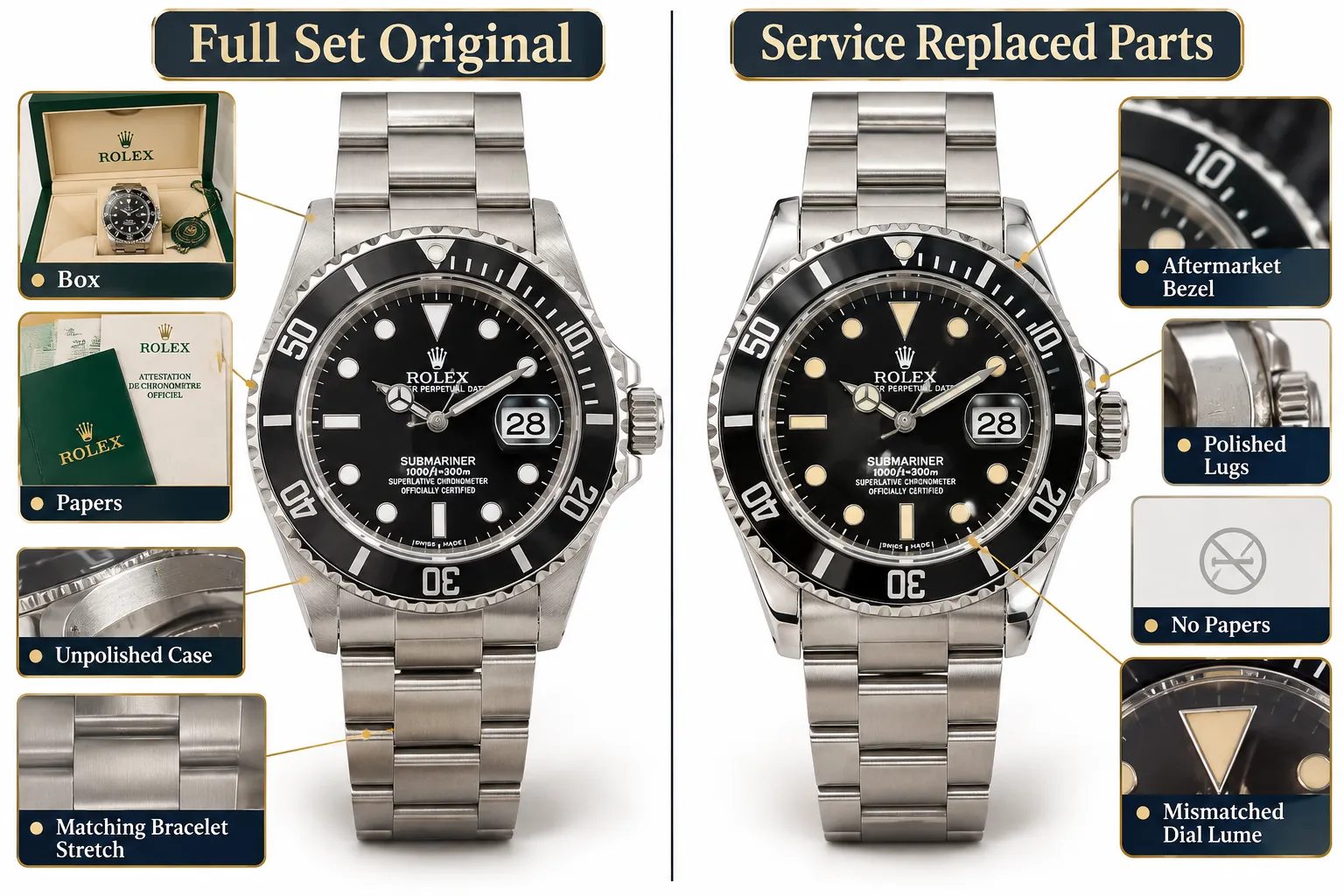
For example, the reference 116610 covers Submariner Date models made across several years, but within that single reference you will find variations in dial lume color, bezel insert material (ceramic versus aluminum on earlier runs), and bracelet generation. Collectors and dealers price each variant differently because rarity and desirability shift even within one reference family.
Two Submariner Date 16610 Examples, Side by Side
Consider two Rolex Submariner Date 16610 watches listed at the same time. One has its original box, papers, and an unpolished case with factory-sharp lugs. The other has a replaced bezel insert, a polished case, and no papers. Even though both share the same reference, the first example typically sells for 15 to 30 percent more because originality and completeness carry real weight in the secondary market.
What Bob’s Watches Sold Data Shows About Same-Reference Price Gaps
Dealer sold-price archives, including publicly posted sales from Bob’s Watches, consistently show spreads of several thousand dollars between examples of the same Rolex reference number depending on dial variant, box and papers status, and case condition. A forum post from a user who joined 2014 Oct 2019 era discussion threads might read, “nbsp nbsp nbsp save share reply, share reply quote, reply quote like this thread 039 data proves it,” reflecting how seasoned collectors cite sold archives, not asking prices, when debating value.
Correctable Condition Issues vs. Lasting Value Factors
Correctable condition issues, like a dirty bracelet or a watch needing a routine service, can be fixed and should not heavily discount a purchase price. Lasting value factors, like a replaced dial, polished case, or missing papers, permanently affect resale value and cannot be undone.
| Issue Type | Example | Fixable? | Long-Term Price Impact |
|---|---|---|---|
| Correctable | Dirty case, stretched bracelet link, needs battery or service | Yes | Minimal once serviced |
| Lasting | Polished case, aftermarket dial, missing box and papers | No | Permanent discount |
| Lasting | Non-original bezel insert or crystal | Partially | Moderate to significant discount |
Buyers should always ask whether an issue is correctable before walking away from an otherwise solid deal on a Rolex Datejust, GMT-Master, or Daytona.
How Bob’s Watches Evaluates a Rolex as Received
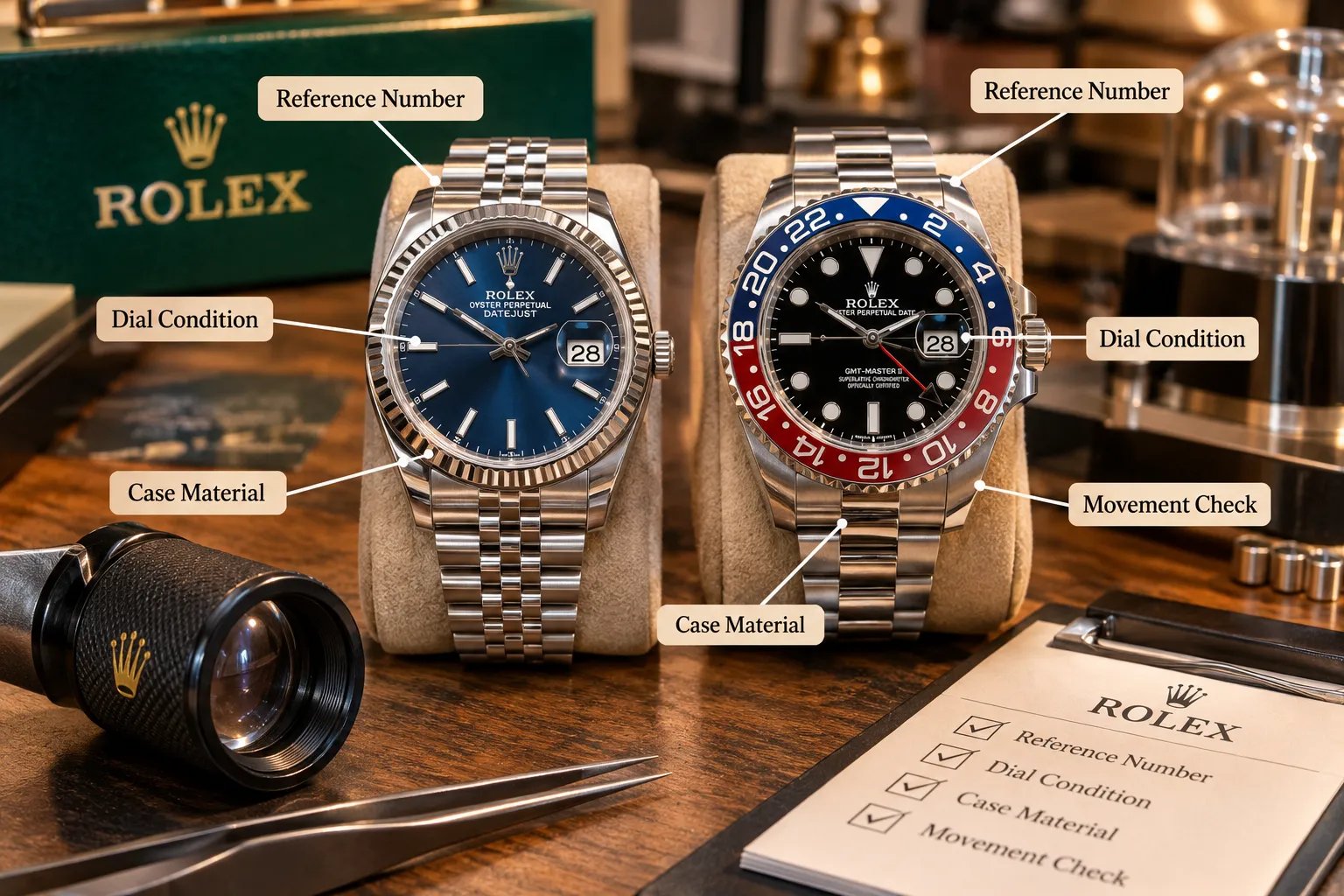
Dealers like Bob’s Watches assess a Rolex as received by checking the case, dial, movement, and bracelet against factory specifications, then grading originality before assigning a resale value. The goal is to separate cosmetic issues that service can correct from originality issues that permanently affect value.
The evaluation process generally follows these steps:
- Confirm authenticity through serial and case reference matching.
- Inspect the dial for fading, moisture damage, or refinishing.
- Check bracelet stretch and case polish history under strong light.
- Test movement accuracy and service condition.
- Verify box, papers, and any included service record.
- Compare the specific watch against recent sold data for the same reference before issuing a quote.
The Same Pattern Across Other Rolex References
This same-reference price gap pattern repeats across the catalog, not just on Submariner models.
Rolex Datejust 16234 examples with a factory diamond bezel or a rare blue dial variant sell at a clear premium over standard silver-dial versions of the identical reference.
Rolex GMT-Master II 16710 watches with the discontinued black-and-red “Coke” bezel insert, especially in strong original condition, routinely outsell standard black bezel examples of the same reference.
Rolex Daytona 116520 pieces with the “Patrick Dempsey” white dial variant or exceptional box and papers completeness can sell tens of thousands above a tired, polished example of the same reference number.
Small Production Details Can Create a Separate Value Tier
Small production details, such as a discontinued dial color, a factory diamond setting, or a short-run bezel material, can split a single reference into entirely separate value tiers. Collectors actively seek out these details because they signal rarity within an otherwise common reference.
Examples include tritium versus Super-LumiNova lume on older Submariner dials, factory set diamond markers on a Datejust, or a transitional bracelet clasp used for only a short production window. None of these details change the printed reference number, yet each can shift resale price substantially.
What’s the Difference Between a $500 Watch and a $5,000 Watch
The core differences are movement type, material quality, and brand backing. A $500 watch typically uses a quartz or basic automatic movement in a steel case with limited finishing, while a $5,000 watch usually features a Swiss-made mechanical movement, better water resistance, sapphire crystal, and documented brand heritage.
At $5,000 you enter territory where brands like Omega, Tudor, and some Tag Heuer chronographs apply in-house or co-developed movements with chronometer certification. At $500, you are almost always buying a quartz movement with mass-produced components and far less hand-finishing.
Are Luxury Watches a Good Investment
Luxury watches can function as a secondary store of value for a narrow set of in-demand references, but they should not be treated as a primary investment vehicle the way stocks or real estate are. Rolex, Patek Philippe, and Audemars Piguet sports models have historically shown the strongest resale support.
The watches that perform best in the secondary market typically share three traits: limited retail allocation, strong brand demand, and steel rather than precious metal cases. A diamond-encrusted gold dress watch from a niche brand almost never performs the same way. Treat any luxury watch purchase as a passion-driven acquisition first, and a possible store of value second.
Where Can I Buy Luxury Watches on Sale or Discounted
Authorized dealers rarely discount Rolex, Patek Philippe, or Audemars Piguet due to controlled supply, so the best discounted pricing on authentic pieces usually comes from reputable pre-owned specialists offering certified authentic, full set complete inventory. Mio Jewelry’s luxury watch store carries pre-owned and certified pieces across major brands at prices below current retail list.
Buyers should also compare inventory by brand directly, for example browsing luxury watches by brand, to find a specific reference at a competitive price point without sacrificing authenticity guarantees.
What’s the Biggest Mistake People Make When Buying Luxury Watches
The biggest mistake is trusting an online asking price as if it reflects true market value. Asking prices on marketplaces and forums are aspirational, not evidence of what buyers actually paid, and that gap misleads both first-time buyers and sellers trying to price their own watch.
Why Online Asking Prices Can Mislead
Online asking prices can mislead because sellers list watches at the top of their expectations, and listings can sit unsold for months without ever correcting lower. Bob’s Watches sold data and completed-sale archives, by contrast, reflect what buyers actually paid, which is a far more reliable benchmark.
A Buyer’s Checklist
- Verify the reference number and confirm it matches dial, bracelet, and bezel style for that production era.
- Request close-up photos of the case back, clasp, and movement.
- Ask whether the watch comes with box and papers, and confirm serial legibility.
- Confirm the watch is under factory warranty or has a documented recent service.
- Compare the asking price against recent sold data, not other active listings.
- Use a trusted dealer offering authenticity guaranteed inspection before final payment.
What Sellers Should Expect
Sellers should expect a trusted buyer to inspect condition thoroughly, request documentation, and offer a quote based on recent sold comparables rather than the seller’s original purchase price. A fair offer reflects current market value, completeness, and condition, not sentimental value or inflation-adjusted nostalgia.
Should I Buy a Vintage Luxury Watch or New
Buy new if you want factory warranty coverage, guaranteed service history, and the ability to choose your exact configuration. Buy vintage if you are drawn to discontinued dial variants, historical significance, or a lower price point for a comparable case size and movement caliber.
Vintage Rolex, Omega, and Patek Philippe pieces carry patina and character that new production cannot replicate, but they also carry higher authentication risk. New watches purchased through an authorized dealer or certified pre-owned retailer remove most of that risk at a correspondingly higher price.
What Luxury Watch Is Good for Beginners
A steel Rolex Datejust, Omega Seamaster, or Tudor Black Bay is a strong beginner choice because each offers a mechanical movement, everyday durability, and dependable resale support without requiring six-figure entry. The Rolex Datejust in particular pairs a timeless dress-casual design with one of the most recognized names in watchmaking.
Beginners should prioritize condition and documentation over chasing a specific rare dial variant on a first purchase. Starting with a well-documented, full set complete piece from a trusted jewelry and luxury watch retailer builds confidence before moving toward rarer references.
Why Are Mechanical Watches More Expensive Than Quartz
Mechanical watches cost more than quartz watches because they require hundreds of hand-assembled components, precision-finished by skilled watchmakers, while a quartz movement uses mass-produced electronic parts that require far less manual labor. This labor difference alone can account for a large share of the price gap between two otherwise similar-looking watches.
A mechanical movement inside a Rolex, Omega, or Patek Philippe can take a trained watchmaker hours to assemble, regulate, and test, and many high end calibers are finished by hand with details like perlage or Côtes de Genève that serve no functional purpose beyond craftsmanship. Quartz movements, by contrast, are designed for consistent mass production at a fraction of the cost.
Which Luxury Watch Brands Are Actually Worth the Price
Rolex, Patek Philippe, Audemars Piguet, Omega, and Vacheron Constantin are widely considered worth their price because each controls in-house movement production, maintains strict quality standards, and has sustained decades of documented demand on the secondary market. Because of that sustained demand, these brands are the ones most frequently cited as examples of genuine investment-grade timepieces within the luxury watch category.
Smaller or newer brands may offer comparable finishing at a lower price, but they lack the decades of resale data that make Rolex, Patek Philippe, and Audemars Piguet reliable benchmarks for value retention.
Same Rolex Reference, Different Value: What It Means for You
The practical takeaway is that a rolex reference number is a starting point for research, not a final price. Whether you are buying or selling, always evaluate dial variant, material, completeness, and documented service history before accepting any number as final.
For sellers specifically, working with a dealer experienced in authenticating and pricing against real sold comparables, rather than active asking prices, protects against underselling or overpricing a piece. Mio Jewelry’s sell your luxury watch service offers a free quote within 24 hours based on current market comparables, and the brand’s consignment services give sellers another route to maximize return while retaining more control over final sale price.
Where Is Rolex Made, and Does It Matter for Price
Rolex watches are manufactured entirely in Switzerland, with the company producing its own gold alloys, case components, and movements across several facilities rather than outsourcing to third parties. This vertical control over manufacturing is part of why Rolex can guarantee consistency across every reference and why Swiss-made status remains a meaningful price driver across the luxury watch market.
Brands that outsource components, by contrast, often face more variability in finishing and reliability, which secondary market buyers factor into resale pricing over time.
FAQ
What is the 3 watch rule?
The 3 watch rule is a collecting guideline suggesting three watches cover most needs: a dress watch for formal occasions, a sport watch for daily wear, and a complication piece, like a chronograph or GMT, for specific functions. It helps buyers avoid unnecessary duplication while building a practical collection.
What is the No. 1 luxury watch brand?
Rolex is widely regarded as the No. 1 luxury watch brand by global recognition, production scale, and secondary market demand. Patek Philippe and Audemars Piguet rank closely behind in prestige and collector demand, though Rolex leads in overall brand value and name recognition worldwide.
How much will a Rolex be worth in 10 years?
A Rolex’s value in 10 years depends heavily on reference, condition, and completeness; steel sports models like the Submariner or Daytona have historically held or gained value over similar periods, while gold dress models often depreciate before stabilizing. No luxury watch’s future value can be guaranteed, so buy based on enjoyment first.
Conclusion
What drives the price of a luxury watch comes down to eight interconnected factors: brand heritage, materials, movement complexity, rarity, condition, completeness, market demand, and service history. A rolex reference number or any other reference tells you the model family, not the full story behind an individual watch’s price. Whether you are comparing a Rolex Datejust against a Rolex GMT-Master II, weighing a Patek Philippe against an Audemars Piguet, or deciding between a Rolex Daytona and an Omega Seamaster, the same eight factors apply.
Serious buyers should always verify authenticity, inspect condition under strong light, and compare against actual sold data rather than online asking prices before committing. Sellers should seek a quote grounded in current market comparables rather than sentimental value. For guidance on movements, materials, and buying fundamentals, review the watch education guide, and when you are ready to sell, request a free quote on your watch from a trusted, white-glove luxury watch team offering fully insured overnight shipping and authenticity guaranteed service.