

Complications & Tech
What Is a Chronograph — And Do You Actually Need One?
May
Last updated: May 20, 2026
Quick Answer: A chronograph is a watch that combines standard timekeeping with a built-in stopwatch function, operated by pushers on the case. It is one of the most celebrated complications in horology — and one of the most frequently misunderstood. Whether you actually need one depends almost entirely on how you live, what you value, and what you expect from a fine timepiece.
Key Takeaways
- A chronograph measures elapsed time via a start/stop/reset mechanism — it is a complication, not a certification of accuracy (that would be a chronometer).
- The classic analog chronograph features a central seconds hand, sub-dials for minutes and hours, and pushers at 2 and 4 o’clock.
- Most owners rarely use the stopwatch function in daily life; the appeal is primarily aesthetic, historical, and emotional.
- Mechanical chronographs cost more to produce and service than three-hand watches; quartz versions are more affordable and more accurate for timing.
- Iconic references — the Rolex Daytona, Omega Speedmaster, TAG Heuer Carrera — command strong collector interest and long-term value.
- For professionals who need hands-free, battery-free timing (pilots, racing drivers, divers, physicians), a mechanical chronograph still offers genuine utility.
- If you rarely time anything, a clean three-hand dress watch or diver is often more practical — but “practical” is rarely the only reason serious collectors buy watches.
What Exactly Is a Chronograph Watch and How Does It Work?
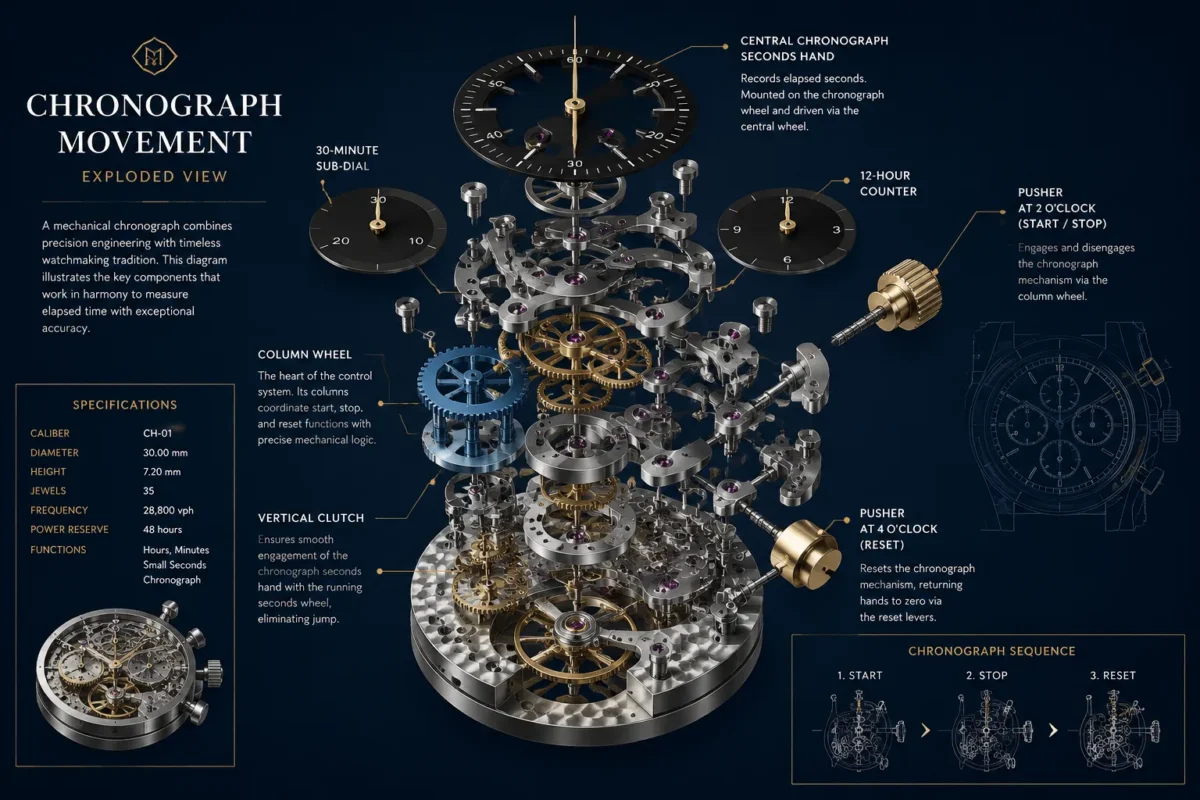
A chronograph is a timepiece that integrates a stopwatch complication into its standard movement, allowing the wearer to measure elapsed time independently of the running time display. [1] The word itself derives from the Greek chronos (time) and grapho (to write) — early chronographs literally marked time on paper dials with a small ink deposit.
In a traditional analog mechanical chronograph, three core elements work together:
- A central chronograph seconds hand that remains stationary until the stopwatch is activated. This hand is distinct from the running seconds hand found on many three-hand watches.
- Sub-dials — typically a 30-minute counter and a 12-hour counter — that accumulate elapsed minutes and hours while the chronograph is running. [1]
- Pushers positioned at 2 o’clock (start/stop) and 4 o’clock (reset), which engage and disengage the chronograph mechanism without disturbing the main timekeeping train. [2]
More advanced versions include a flyback function, which allows the wearer to reset and immediately restart the chronograph with a single press — invaluable for timing consecutive intervals such as flight legs or racing laps. [1]
Mechanically, the chronograph is driven by either a column wheel or a cam-lever system that controls the clutch connecting the chronograph seconds wheel to the main gear train. Column-wheel designs are generally considered more refined and precise, and are favored in prestige movements. [2]
Common mistake: Many buyers assume a chronograph is more accurate than a standard watch. Accuracy is a separate quality measured by chronometer certification (such as COSC), not by the presence of a stopwatch complication. A chronograph can be a chronometer — but the two terms describe entirely different attributes. [1]
Chronograph vs. Regular Watch: What’s the Difference?
The core difference is mechanical complexity. A regular three-hand watch displays hours, minutes, and a running seconds hand — nothing more. A chronograph adds a fully independent stopwatch mechanism that can be started, stopped, and reset on demand.
| Feature | Standard Three-Hand Watch | Chronograph Watch |
|---|---|---|
| Timekeeping | Hours, minutes, seconds | Hours, minutes, seconds |
| Stopwatch function | None | Yes — start/stop/reset |
| Sub-dials | Typically none | 2–3 (minutes, hours elapsed) |
| Pushers on case | None | Yes (at 2 and 4 o’clock) |
| Dial complexity | Clean, minimal | Busier, multi-register |
| Case thickness | Slimmer | Typically thicker |
| Servicing cost | Lower | Higher |
| Entry price (luxury tier) | Lower | Higher |
The visual difference is immediately apparent: a chronograph dial is more layered, with multiple registers and a tachymeter or other scale on the bezel or chapter ring. For some buyers, this complexity is the entire point. For others, it adds visual noise to a dial they’d prefer to keep legible. [6]
Choose a chronograph if you value the aesthetic of a multi-register dial, have an affinity for motorsport or aviation heritage, or want occasional timing capability on your wrist. Choose a standard watch if you prioritize dial clarity, slimmer case profiles, and lower long-term maintenance costs.
Why Are Some Chronographs So Expensive?
Chronograph movements are among the most mechanically demanding complications to produce, and that complexity is reflected directly in price. [6]
Several factors drive cost:
- Movement architecture: A chronograph adds dozens of additional components — column wheels, levers, springs, and clutch systems — to an already intricate movement. In-house calibers developed entirely by the manufacturer (as found in IWC, Patek Philippe, and Audemars Piguet references) represent years of engineering investment.
- Finishing standards: At the prestige tier, every component is hand-beveled, polished, and decorated to exacting standards. The Audemars Piguet Royal Oak Chronograph 41mm, for example, features an in-house integrated caliber with a level of finishing that takes skilled artisans considerable time to complete.
- Servicing complexity: Chronograph movements require more involved service intervals than three-hand calibers, which increases the lifetime cost of ownership.
- Heritage and rarity: References tied to significant historical moments — space exploration, Le Mans, aviation milestones — carry cultural premiums that transcend the mechanical. [3]
At the entry level, reliable automatic chronograph movements such as the Valjoux/ETA 7750 family offer excellent value and proven longevity. At the summit, bespoke in-house calibers from independent manufactures represent genuine horological achievement. [6]
How Much Do Good Chronograph Watches Cost?
Chronograph watches span an enormous price range, from a few hundred dollars to several hundred thousand. The tier you enter depends on your priorities: accuracy, heritage, movement quality, or investment potential.
Approximate price tiers in 2026:
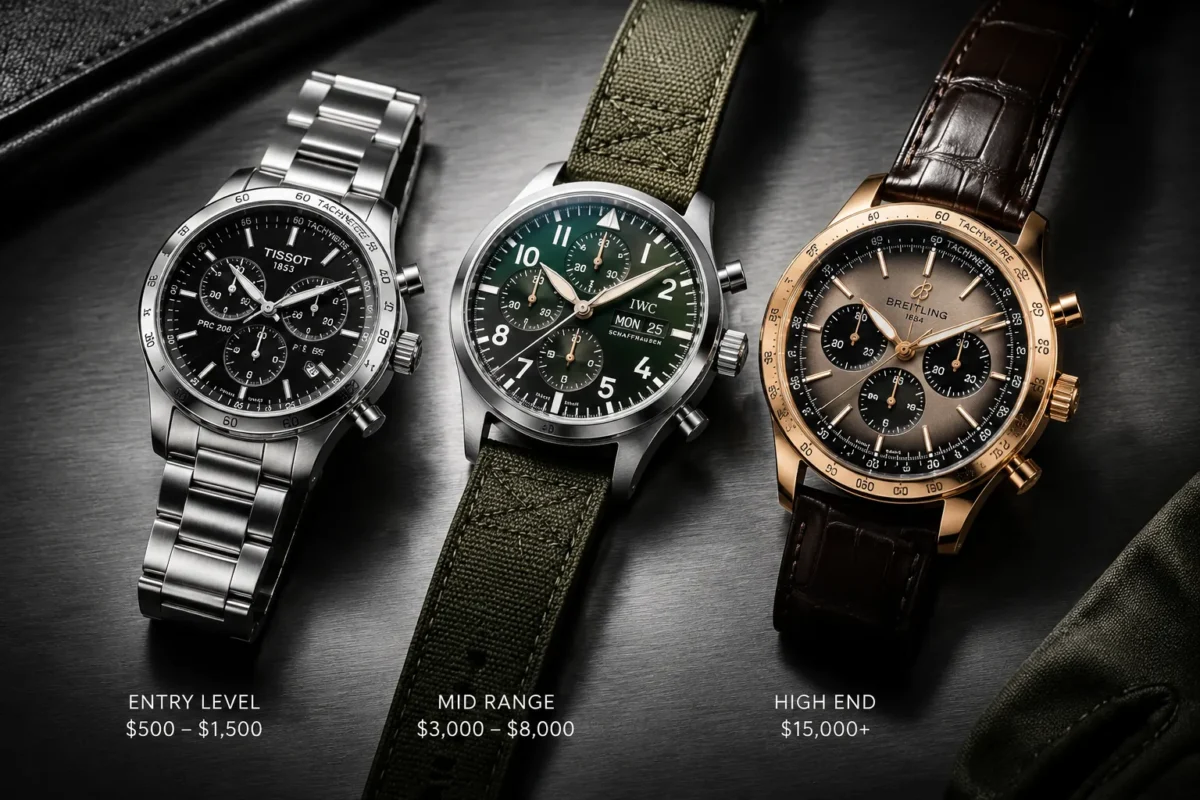
- Under $500: Quartz chronographs from Seiko, Citizen, and Tissot. Accurate, durable, and practical. Limited collector appeal but strong daily utility.
- $500–$2,000: Entry automatic chronographs from Tissot (T-Race), Hamilton (Intra-Matic), and Seiko Prospex. Valjoux-based movements. Solid build quality.
- $2,000–$8,000: Mid-tier prestige — TAG Heuer Carrera, Longines Master Collection, Mido Multifort. Strong heritage narratives and reliable movements.
- $8,000–$25,000: Serious collector territory — IWC Pilot’s Chronograph, Omega Speedmaster, Breitling Navitimer. Investment-grade timepieces with strong secondary market values.
- $25,000 and above: Patek Philippe, Audemars Piguet, A. Lange & Söhne, F.P. Journe. Rare, highly sought-after references with documented appreciation potential.
For buyers entering the luxury segment, the IWC Pilot Chronograph 41 represents a compelling intersection of heritage, in-house movement quality, and immediate availability — a certified authentic investment-grade timepiece with the full provenance serious collectors expect.
Are Chronographs Only for Professional Athletes or Pilots?
Chronographs were originally designed as precision tools for professionals — pilots, racing drivers, physicians, and military personnel who needed reliable elapsed-time measurement without electronic devices. [9] That professional heritage is very much alive today, but it no longer defines who buys them.
Professional use cases where a chronograph still earns its place:
- Aviation: Pilots use tachymeter and slide-rule bezels for fuel calculations and flight-leg timing. The IWC Pilot’s Spitfire Chronograph IW387901 is purpose-built for this context.
- Motorsport: Timing lap splits without a phone in hand remains a legitimate use case for track-day enthusiasts.
- Medicine: Pulsometer scales on vintage and heritage chronographs allow physicians to calculate heart rate from a timed pulse count.
- Diving: Some chronographs double as dive tools, though a dedicated diver’s watch is generally preferred for underwater use.
For the vast majority of buyers in 2026, however, the chronograph is chosen for reasons that have little to do with professional timing needs. [7] The motorsport narrative of the Rolex Daytona, the space-race legacy of the Omega Speedmaster, the aviation soul of the IWC Pilot line — these are the real drivers of purchase decisions at the luxury tier. [3]
Can I Use a Chronograph for Everyday Activities?
Yes — and many owners do, even if the stopwatch function rarely gets used. A well-chosen chronograph wears as comfortably as any sport or dress watch, and the added dial complexity can make it a more visually engaging daily companion. [7]
Practical everyday uses that require no professional expertise:
- Timing parking meters or street parking limits
- Tracking cooking or workout intervals
- Measuring commute times or meeting durations
- Timing a child’s sports event or school activity
The honest reality, noted consistently by industry writers, is that most chronograph owners use the stopwatch function infrequently. [3] The phone in their pocket is faster, more precise, and easier to read. What the chronograph offers instead is a physical, mechanical ritual — the satisfying click of a pusher, the sweep of a seconds hand — that no smartphone replicates. [6]
Edge case: If you wear a suit daily and value a clean, uncluttered dial, a chronograph’s busier layout may feel visually heavy. In that context, a refined dress watch or a simple three-hand automatic may serve better as an everyday companion. For guidance on pairing watch style with lifestyle, the MioJewelry Watch Education hub offers detailed resources.
Do I Really Need a Chronograph, or Is It Just a Fancy Feature?
Honestly? Most buyers do not need a chronograph in any strict functional sense. [7] Smartphones and smartwatches time everything with greater precision and zero effort. But “need” is rarely the right lens through which to evaluate a serious watch purchase.
The more useful question is: does a chronograph align with what you value in a watch?
Buy a chronograph if:
- The aesthetic of a multi-register dial appeals to you
- You connect with motorsport, aviation, or space heritage
- You want a single watch that can handle casual timing without reaching for your phone
- You are building a collection and want a complication that holds strong resale value
- You appreciate the mechanical complexity as a demonstration of horological craft [6]
Skip the chronograph if:
- You prioritize a clean, legible dial above all else
- You want a slimmer case profile
- You rarely time anything and have no emotional connection to the complication
- You are budget-conscious and want to minimize long-term servicing costs
The Rolex Daytona vs. Submariner comparison illustrates this tension perfectly: both are investment-grade timepieces with exceptional heritage, but they serve different aesthetic and functional preferences. Neither is the wrong choice — the right one depends entirely on the buyer.
Mechanical or Quartz Chronographs: Which Is Better?
Neither is objectively superior — they excel in different areas, and the right choice depends on what you prioritize. [6]
Mechanical chronographs (automatic or hand-wound):
- Offer the full horological experience — visible complexity, winding ritual, heritage
- Typically less accurate than quartz (±5–15 seconds per day for most calibers)
- Require regular wear or winding to stay running; power reserves on chronograph movements often run shorter than equivalent three-hand calibers
- Higher servicing costs, but stronger collector and resale value
- The Valjoux 7753, a widely used workhorse automatic chronograph caliber, runs at 28,800 vph and offers approximately 42 hours of power reserve [4]
Quartz chronographs:
- Significantly more accurate (±15 seconds per month or better)
- Lower purchase price and minimal servicing requirements
- Lack the mechanical soul and collector prestige of automatic movements
- Better suited to buyers who want reliable timing utility without maintenance concerns
For the serious collector or luxury investor, a mechanical chronograph from a prestige manufacturer is the clear choice — not because it times better, but because it represents a living mechanical tradition with documented investment value. For a buyer who wants a capable daily tool at an accessible price point, a quality quartz chronograph is entirely defensible. [7]
To understand how automatic movements work in greater depth, the guide to how automatic watches work provides a thorough foundation.
How to Properly Reset and Use All the Stopwatch Functions
Operating a chronograph correctly extends the life of the movement and ensures accurate timing. Misuse — particularly pressing pushers while the crown is pulled out — is one of the most common causes of chronograph damage.
Standard two-pusher chronograph operation:
- Start: Press the pusher at 2 o’clock. The central chronograph seconds hand begins sweeping. The sub-dials begin accumulating elapsed minutes and hours.
- Stop: Press the 2 o’clock pusher again. All hands freeze, displaying total elapsed time across the registers.
- Read: The central hand shows elapsed seconds; the sub-dial at 9 o’clock (or 3 o’clock, depending on layout) shows elapsed minutes; the 12-hour counter shows elapsed hours.
- Reset: Press the pusher at 4 o’clock. All chronograph hands snap back to zero. Only reset when the chronograph is stopped — resetting while running can damage the mechanism on most non-flyback calibers.
Flyback operation (advanced): On flyback-equipped chronographs, pressing the reset pusher while the chronograph is running simultaneously stops, resets, and restarts the mechanism in a single action. This is particularly useful for timing consecutive intervals. [1]
Common mistakes to avoid:
- Pressing pushers while the crown is in the setting position
- Resetting a non-flyback chronograph while it is still running
- Leaving the chronograph running indefinitely, which accelerates wear on the column wheel and clutch
- Attempting to set the time while the chronograph is engaged
For additional care guidance, the guide to properly storing and protecting luxury watches covers best practices for long-term ownership.
What Are Common Mistakes People Make When Using a Chronograph?
Beyond incorrect pusher operation, buyers and owners make several recurring errors that affect both the watch and their satisfaction with the purchase.
Before buying:
- Confusing “chronograph” with “chronometer” — purchasing a watch expecting certified accuracy when the chronograph designation only indicates a stopwatch complication [1]
- Buying for the complication without considering whether the dial layout suits their daily legibility needs
- Overlooking the power reserve trade-off — many chronograph movements have shorter reserves than equivalent three-hand calibers
After buying:
- Never using the stopwatch function and then feeling the added complexity was unnecessary — this is avoidable by honestly assessing timing habits before purchase [7]
- Neglecting service intervals — chronograph movements require more attentive servicing than standard calibers, typically every 5–7 years depending on manufacturer recommendations
- Storing the watch crown-out, which can stress the stem over time; always push the crown fully in when not adjusting the time
Best Affordable Chronograph Watches Under $500
Reliable chronograph performance is accessible well below the luxury threshold. Several brands offer quartz and entry-level automatic chronographs that deliver genuine utility without the investment-grade price point.
Notable options under $500 (approximate street prices in 2026):
- Seiko SSB Series (Quartz): Proven reliability, clean dials, and Seiko’s well-regarded movement quality. Widely available and easily serviced.
- Citizen Eco-Drive Chronograph: Solar-powered quartz with exceptional accuracy and no battery replacement required. Strong daily-wear proposition.
- Tissot T-Sport T-Race (Quartz): Swiss Made quality at an accessible price, with motorsport-inspired aesthetics.
- Orient Panda (Automatic): An entry-level mechanical chronograph with vintage-inspired panda dial. Collector-friendly aesthetics at an approachable price.
- Casio Edifice Series: Feature-rich quartz chronographs with solar and Bluetooth connectivity. Function-first design.
These references are well-suited to first-time chronograph buyers who want to explore the complication before committing to a prestige-tier investment. [7]
Which Brands Make the Most Reliable Chronograph Watches?
Reliability in a chronograph depends on movement architecture, finishing quality, and the manufacturer’s service infrastructure. Several houses have built decades-long reputations in this specific complication. [6]
Prestige tier (investment-grade):
- Rolex — The Daytona, with its in-house Calibre 4130, is among the most refined and reliable automatic chronographs produced at scale. Also one of the most rare and highly sought-after references in the secondary market.
- IWC Schaffhausen — The Pilot’s Chronograph line, including references such as the IWC Pilot IW388103 and the IWC Portugieser Chronograph IW371617, demonstrates IWC’s mastery of in-house chronograph calibers with aviation-grade reliability.
- Omega — The Speedmaster’s Calibre 3861 and the broader Co-Axial chronograph family represent decades of refinement and space-proven dependability.
- Patek Philippe — The CH 29-535 PS caliber, found in the Ref. 5172 and related references, is widely regarded as one of the finest manually-wound chronograph movements in production.
- Audemars Piguet — The Royal Oak Chronograph’s integrated caliber combines architectural elegance with exceptional mechanical performance.
Accessible prestige tier:
- TAG Heuer — The Carrera and Monaco lines offer Swiss Made quality with strong brand heritage at a more accessible price point. [9]
- Breitling — Purpose-built for aviation professionals, with COSC-certified movements and robust case construction.
- Zenith — The El Primero caliber, one of the first automatic chronograph movements ever produced, remains a benchmark for high-frequency mechanical timing.
FAQ: What Is a Chronograph — Everything Else You Need to Know
Q: What is a chronograph in simple terms? A chronograph is a watch with a built-in stopwatch. It tells the time like any other watch but also lets you measure elapsed time using pushers on the side of the case. [1]
Q: Is a chronograph the same as a chronometer? No. A chronograph is a complication (a stopwatch function). A chronometer is a certification of accuracy awarded by an independent body such as COSC. A watch can be both, either, or neither. [1]
Q: How accurate is a mechanical chronograph for timing? Most mechanical chronographs are accurate to within a few seconds per day for standard timekeeping, but the stopwatch function itself can measure elapsed time to 1/5th of a second or better depending on the caliber’s beat rate. For mission-critical timing, quartz remains more precise. [6]
Q: Will a chronograph watch hold its value? Iconic references from Rolex, Patek Philippe, Audemars Piguet, and IWC have demonstrated strong secondary market performance. Value retention depends heavily on reference, condition, completeness of set, and provenance. Full-set, certified authentic examples consistently command the strongest premiums. [3]
Q: How often does a chronograph need servicing? Most manufacturers recommend servicing a mechanical chronograph every 5–7 years. Chronograph movements are more complex than standard calibers, so service costs are correspondingly higher. Budgeting for this as part of the total cost of ownership is advisable.
Q: Can I wear a chronograph with formal attire? Yes, though the choice of reference matters. A slim, elegant chronograph such as the IWC Portofino Chronograph IW391027 pairs naturally with formal dress. A large-case sport chronograph may read as too casual in black-tie contexts.
Q: What is a flyback chronograph? A flyback chronograph allows the wearer to reset and immediately restart the stopwatch with a single pusher press, rather than requiring three separate actions (stop, reset, start). It is especially useful for timing consecutive intervals. [1]
Q: What does the tachymeter scale on a chronograph bezel do? A tachymeter calculates speed over a known distance. Start the chronograph when you begin a one-mile (or one-kilometer) interval; stop it at the end. The number on the tachymeter scale aligned with the central seconds hand gives your average speed in miles (or kilometers) per hour. [2]
Q: Are vintage chronographs a good investment? Vintage chronographs from prestigious houses can be exceptional investments, but condition, originality, and documentation are critical. Dials, hands, and pushers should be unrestored; movements should be in working order. White-glove service from a trusted dealer is essential when purchasing vintage references.
Q: What is the difference between a mono-pusher and a bi-compax chronograph? A mono-pusher chronograph uses a single pusher to cycle through start, stop, and reset functions sequentially. A bi-compax layout features two pushers and two sub-dials — the most common configuration on modern chronographs. [2]
Conclusion: The Chronograph Decision, Made Clear
A chronograph is one of watchmaking’s most enduring and celebrated complications — a mechanical achievement that transforms a timekeeping instrument into a precision tool with genuine historical weight. Understanding what is a chronograph means recognizing both its technical identity (a stopwatch complication) and its cultural one (a symbol of motorsport, aviation, and horological ambition).
For most buyers in 2026, the decision to purchase a chronograph is driven more by passion than practicality — and that is entirely legitimate. The right watch is the one that resonates with its owner, reflects their values, and rewards daily wear with a sense of connection to craft and heritage.
Actionable next steps:
- Clarify your priorities. If dial legibility and case slimness matter most, explore three-hand alternatives. If heritage and mechanical complexity appeal, the chronograph is a natural fit.
- Set a realistic budget that includes long-term servicing costs, not just the purchase price.
- Prioritize certified authentic, full-set examples — box, papers, and service history are the foundation of long-term value.
- Explore prestige references from IWC, Rolex, Omega, and Audemars Piguet through a trusted worldwide dealer that offers authenticity guarantees and white-glove service.
- Consult luxury watch experts before committing to a significant purchase — the right guidance protects both your investment and your satisfaction.
MioJewelry’s exclusive collection of investment-grade chronographs is available with immediate availability, fully insured overnight shipping, and authenticity guaranteed on every reference. Prestige and performance, delivered with the care serious collectors expect.
References
- [1] Chronograph — https://en.wikipedia.org/wiki/Chronograph
- [3] Best Chronograph Watches Ever — https://www.esquire.com/uk/watches/a65624376/best-chronograph-watches-ever/
- [4] Watch (ETA Valjoux 7753 review) — https://www.youtube.com/watch?v=A_4vXAG30kY
- [6] Chronographs — https://www.watchtime.com/brands/chronographs
- [7] Chronograph Watch Guide — https://www.theluxuryhut.com/blog/chronograph-watch-guide/
- [9] Chronographs — https://www.tagheuer.com/us/en/our-story/chronographs.html