

Care & Authenticity
Polishing vs. keeping patina: what collectors say

May
Last updated: May 12, 2026
Quick Answer: The debate over polishing vs. keeping patina is one of the most consequential decisions a watch collector faces. For vintage and investment-grade timepieces, the overwhelming consensus among serious collectors and auction specialists is clear: original, unpolished surfaces with authentic patina preserve — and often significantly increase — a watch’s long-term value. Polishing, once done, cannot be undone.
Table of Contents
Key Takeaways
- Original patina is a value signal. Unpolished cases with honest wear authenticate a watch’s age and history, which auction houses and serious collectors prize above cosmetic perfection.
- Polishing removes metal permanently. Even a single professional polish reshapes case edges, softens lug bevels, and eliminates the crisp geometry that defines a watch’s original form.
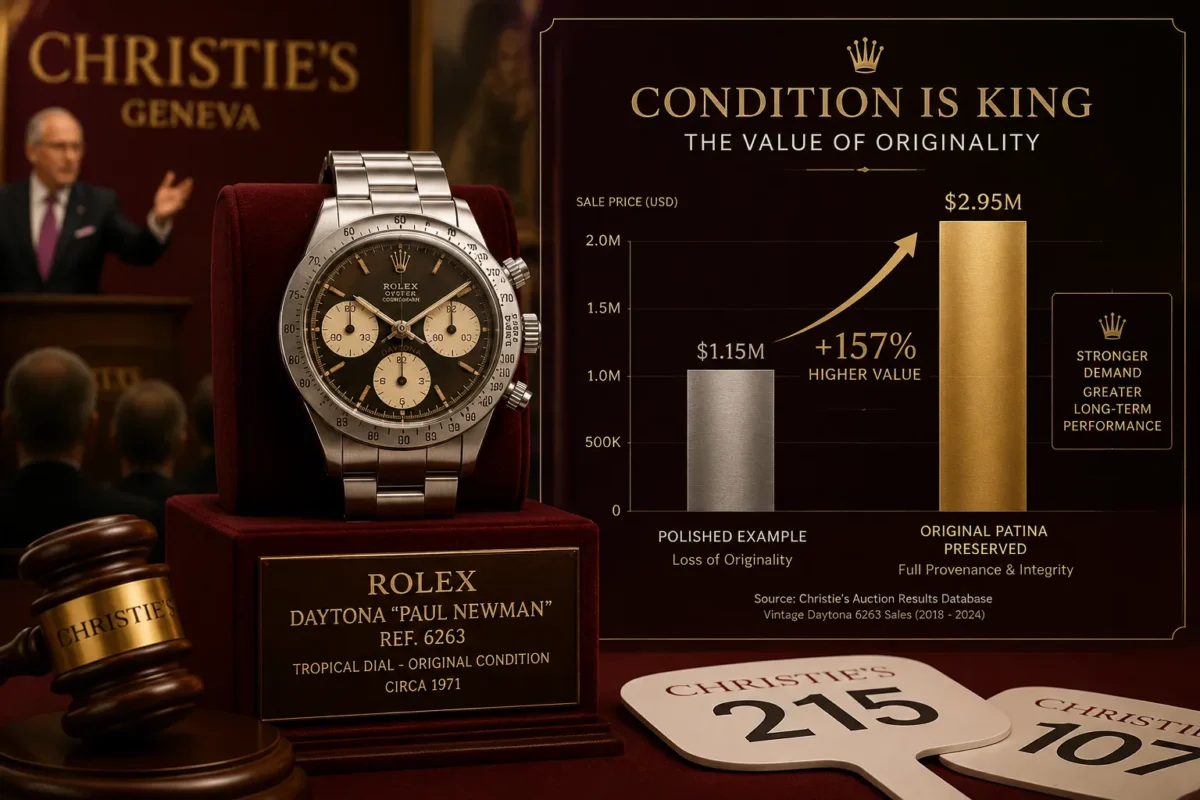
- The resale premium for unpolished examples is real. Vintage Rolex, Patek Philippe, and other investment-grade references regularly command higher prices at auction when case surfaces remain in original, unpolished condition.
- Modern watches follow different rules. For current-production timepieces worn daily, light servicing polish may be acceptable — but even here, many collectors prefer restraint.
- “Tropical” dials and aged bezels are now features, not flaws. Color-shifted dials and faded chapter rings on vintage references are among the most sought-after characteristics in the collector market.
- Service history matters. A watch with documented, conservative servicing from a reputable watchmaker is more trustworthy than one with an unknown polishing history.
- Full Set Complete watches command the highest premiums. Original boxes, papers, and hang tags compound the value of an unpolished case.
- The decision is irreversible. Once a case is polished, the watch’s collector status changes permanently.
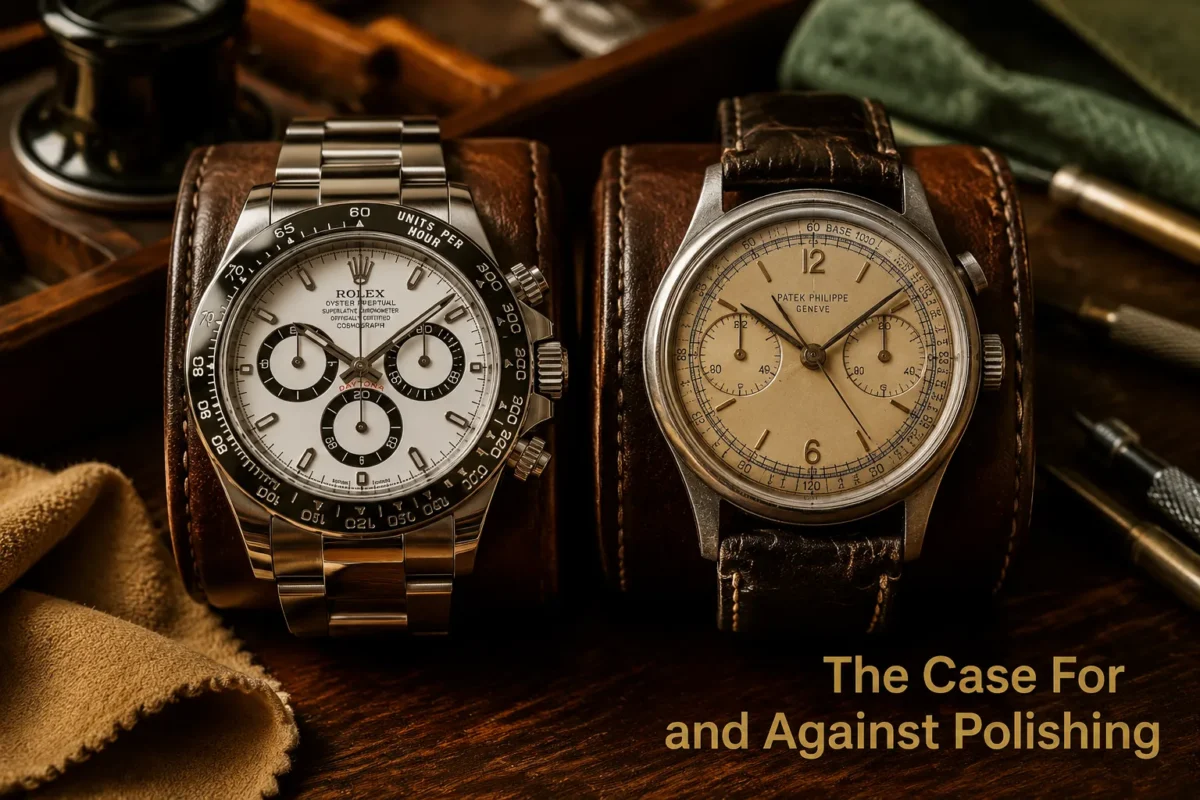
What Is Patina on a Watch, and Why Do Collectors Value It?
Patina refers to the natural aging of a watch’s surfaces over time — the warm yellowing of a cream dial, the softening of luma plots from white to gold, the micro-scratches on case flanks that accumulate through decades of wear. On a vintage timepiece, patina is not damage. It is evidence.
For collectors of investment-grade timepieces, patina serves as a kind of authentication. It confirms that a dial, case, and bracelet have aged together organically, without intervention. A watch that has been worn, not stored in a vault and never touched, tells a story that resonates deeply with serious buyers.
Why patina commands a premium:
- It confirms originality. Patina that developed consistently across all components (dial, hands, case) suggests the watch has not been tampered with or refinished.
- It is unreproducible. No restorer can convincingly recreate decades of honest aging on a dial or case surface.
- It signals rarity. The finest examples of aged vintage references — particularly those with “tropical” dials that have shifted to brown or chocolate tones — are among the rarest and most sought-after watches in the world.
- It satisfies connoisseurship. Experienced collectors understand that a watch in original condition, even with wear, is more authentic than a polished example that looks newer than it is.
“A watch with original patina is a primary source. A polished watch is a revised edition.”
Polishing vs. Keeping Patina: How Does Polishing Affect a Watch’s Value?
Polishing a watch case reduces its collector and resale value in most scenarios involving vintage or limited-production timepieces. The effect is not subtle — it can be the difference between a watch selling at a significant premium and one that struggles to attract serious bids.
Here is what polishing actually does to a case:
| Effect | What Happens | Impact on Value |
|---|---|---|
| Lug sharpness | Crisp bevels and edges are rounded | Significant negative |
| Case geometry | Original proportions are softened | Moderate to significant negative |
| Surface texture | Brushed vs. polished contrast is lost | Moderate negative |
| Metal removal | Microns of metal are permanently removed | Irreversible |
| Engraving clarity | Serial numbers and engravings may blur | Moderate negative |
| Perceived age | Watch appears newer than it is | Mixed (negative for collectors) |
For a reference like the Rolex Daytona ref. 126518LN or a vintage Patek Philippe complication, the difference between an unpolished and a polished example at auction can be substantial. Auction specialists at Christie’s, Phillips, and Sotheby’s consistently note case condition as one of the primary drivers of hammer price on vintage references.
Choose to preserve patina if:
- The watch is a vintage reference (generally pre-1990s production)
- The watch is a limited edition or rare variant
- The watch is intended for resale or investment
- The watch has original box and papers (Full Set Complete)
- The watch has a documented, unpolished ownership history
Polishing may be acceptable if:
- The watch is a modern daily wearer with no collector significance
- The watch has already been polished previously (the damage is done)
- The owner has no intention of reselling and prefers the aesthetic
What Do Serious Collectors Actually Say About This Debate?
The collector community has reached a strong consensus on polishing vs. keeping patina, particularly over the past two decades as the vintage watch market has matured into a serious asset class.
Collectors who frequent forums such as WatchUSeek, Hodinkee’s community, and the Rolex Forums consistently express a strong preference for unpolished examples. The phrase “original, unpolished” has become one of the most powerful descriptors in a watch listing — comparable in weight to “full set” or “double-signed.”
What experienced collectors say, summarized:
- “Never polish a vintage watch.” This is the near-universal rule among serious vintage collectors. The reasoning is simple: you can always polish later, but you can never un-polish.
- “Patina is the watch’s biography.” Collectors who study reference variations understand that aging patterns can help authenticate a watch and confirm its history.
- “A polished watch is a red flag.” When evaluating a potential purchase, a freshly polished case raises immediate questions about what else may have been altered — dial restoration, hand replacement, case work.
- “Original condition commands a premium at every level.” Whether the watch is a Rolex Submariner or a Patek Philippe Aquanaut ref. 5164R, original condition is the most defensible position for long-term value.
The investment-grade watch market has reinforced this consensus. As more buyers approach luxury timepieces as portfolio assets, the standards applied to condition have become more rigorous, not less.
How Does Patina Affect Auction Results and Resale Prices?
The relationship between original condition and auction performance is well-documented across major sale rooms. Watches described as “unpolished” or “original surfaces” consistently attract competitive bidding from the most sophisticated buyers in the market.
Several patterns emerge consistently in the vintage watch auction market:
“Tropical” dials: Vintage Rolex references with dials that have shifted from black to brown or chocolate tones — a result of specific lacquer formulations reacting to UV exposure over decades — now command extraordinary premiums. These dials were once considered defective. Today, they are among the most coveted features in vintage collecting.
Original bracelet condition: A Rolex Oyster or Jubilee bracelet with original, unstretched links and unpolished center links is far more valuable than one that has been polished or has stretched links. The bracelet’s condition often reflects whether the watch has been serviced aggressively.
Case sharpness: On references known for crisp lug geometry — such as early Rolex Daytona references or Patek Philippe Calatrava models like the ref. 4997/200G — original case sharpness is a primary grading criterion.
For investment-grade timepieces, original condition is not merely aesthetic preference. It is a quantifiable component of value.
Collectors considering the resale potential of their holdings should review guidance on how to properly store and protect luxury watches, as proper storage prevents the kind of unnecessary wear that might prompt a misguided polishing decision.
Polishing vs. Keeping Patina: Are There Cases Where Polishing Is Justified?
Yes — but the circumstances are narrower than many owners assume. The decision requires honest assessment of the watch’s significance, intended use, and market position.
Scenarios where polishing may be justified:
Deep damage that affects wearability. A case with sharp burrs, deep gouges from impact, or corrosion that is actively spreading may require professional attention. A skilled watchmaker can address specific damage with minimal material removal.
Modern production watches with no vintage collector market. A current-production steel sports watch worn daily occupies a different market than a vintage reference. Light case maintenance during a full service is generally acceptable.
Watches already polished previously. If a watch has been polished once, the collector premium for “original unpolished” is already lost. Subsequent light maintenance does not compound the damage significantly.
Watches purchased for personal enjoyment, not investment. Not every watch is a portfolio asset. An owner who derives genuine pleasure from a mirror-bright case and has no intention of selling has made a personal choice that is entirely valid.
What to avoid in every case:
- Aggressive machine polishing, which removes the most metal and most severely alters geometry
- Polishing a watch before consulting a specialist about its collector significance
- Assuming that a “clean” appearance adds value — in the collector market, it rarely does
For those uncertain about their watch’s significance, consulting with luxury watch experts before any service decision is strongly advisable.
How Should You Care for a Watch Without Polishing It?
Preserving patina does not mean neglecting a watch. Proper care maintains the integrity of original surfaces while keeping the timepiece in excellent functional condition.
Recommended care practices for unpolished watches:
- Clean gently, not aggressively. A soft, dry microfiber cloth removes fingerprints and surface dust without abrading case metal. For deeper cleaning, follow a conservative approach — see the detailed guidance in this step-by-step luxury watch cleaning guide.
- Service the movement, not the case. When a watch requires servicing, specify to the watchmaker that the case and bracelet should not be polished. Reputable watchmakers will honor this instruction.
- Store properly. Watches stored in watch rolls, cases, or boxes away from hard surfaces accumulate far fewer scratches over time. Proper storage is the most effective form of preservation. Review best practices for storing and protecting luxury watches.
- Wear with awareness. A watch worn on the wrist will develop wear. This is natural and expected. The goal is to avoid preventable damage — contact with hard surfaces, metal-on-metal abrasion — not to eliminate all evidence of use.
- Document condition. Photographs taken at purchase, and periodically thereafter, create a record of the watch’s condition history. This documentation adds credibility and value at resale.
Does the Brand or Reference Matter When Deciding?
Absolutely. The polishing vs. keeping patina calculus varies significantly by brand, reference, and production era. Not all watches carry the same collector sensitivity.
High collector sensitivity (preserve patina at all costs):
- Vintage Rolex sports references (Submariner, GMT-Master, Daytona, Explorer)
- Vintage Patek Philippe complications and Calatravas
- Vintage Omega Speedmaster and Seamaster references
- Any watch with a known “tropical” or unusual dial variant
- Limited editions and special references from any major manufacturer
Moderate collector sensitivity (exercise caution):
- Current-production Rolex sports models (Submariner, GMT-Master II, Daytona)
- Modern Patek Philippe references such as the Aquanaut 5164R or Grand Complication 5208R
- IWC Pilot and Portofino references
- Panerai Luminor references
Lower collector sensitivity (personal preference may guide decision):
- Entry-level luxury watches without significant secondary market demand
- Watches with no original box, papers, or provenance documentation
- Watches that have already been polished or restored
Understanding where a specific reference sits in the collector market requires expertise. The most sought-after Patek Philippe watches, for example, have an extremely active and knowledgeable collector base that scrutinizes condition with precision — as explored in this guide to the most sought-after Patek Philippe watches.
What Are the Most Common Mistakes Collectors Make on This Issue?
Even experienced buyers make avoidable errors when it comes to polishing decisions. Understanding these mistakes helps protect both the watch and its investment potential.
Mistake 1: Polishing before consulting a specialist. Many owners polish a watch before understanding its collector significance. A watch that appears to be an ordinary steel sports model may be a rare reference variant worth multiples of its apparent value — in original condition.
Mistake 2: Assuming a dealer or watchmaker’s default practice is acceptable. Some service centers polish cases as a matter of routine unless specifically instructed otherwise. Always provide explicit written instructions that the case and bracelet should not be polished during any service.
Mistake 3: Equating “clean” with “valuable.” The luxury watch collector market does not reward the appearance of newness in vintage pieces. It rewards authenticity. A watch that looks too new raises more questions than one that shows honest, consistent wear.
Mistake 4: Polishing to improve saleability. Sellers sometimes polish a watch before listing it, believing it will attract higher offers. In the serious collector market, this approach backfires. Buyers who know what they are looking for will discount a polished watch immediately.
Mistake 5: Ignoring the bracelet. The bracelet is often the first casualty of aggressive polishing. Original center links with brushed surfaces, correct taper, and unstretched construction are as important to condition assessment as the case itself.
FAQ: Polishing vs. Keeping Patina
Does polishing a watch void its warranty?
Polishing the case and bracelet does not typically void a manufacturer’s movement warranty, but it may affect the watch’s eligibility for certain certified pre-owned programs that require original, unaltered condition.
Can patina be faked on a vintage watch?
Attempts to artificially age dials or cases do exist, and they are a known form of fraud in the vintage market. Experienced collectors and specialists can usually identify artificial patina through inconsistency of aging patterns and material analysis. This is one reason why provenance documentation matters.
Is there a difference between a scratch and patina?
es. Patina refers to the overall aging character of a watch’s surfaces — the collective effect of micro-wear, oxidation, and material change over time. A single deep scratch from impact is damage, not patina. The distinction matters when assessing condition.
Should I polish a watch I plan to wear daily?
For a modern production watch worn as a daily driver, light maintenance during a full service is generally acceptable. For any watch with vintage or collector significance, the answer is no, regardless of how frequently it is worn.
What is a “ghost bezel” and is it valuable?
A ghost bezel refers to a vintage watch bezel insert (typically on a dive watch) that has faded significantly from its original color. Genuine ghost bezels on references like the Rolex Submariner are considered highly desirable by collectors and command premiums at auction.
Does keeping patina mean never servicing the movement?
No. Movement servicing — cleaning, lubricating, and regulating the caliber — is entirely separate from case polishing. A watch can and should receive regular movement service without any alteration to its external surfaces.
How do I tell if a watch has been polished?
Look for rounded lug edges (originally sharp), loss of contrast between brushed and polished surfaces, softened case geometry, and an overall “too new” appearance inconsistent with the watch’s age. A loupe or macro photograph can reveal these details clearly.
What is the best way to authenticate a watch’s condition before buying?
Purchase from a trusted source that provides Authenticity Guaranteed documentation, detailed condition photographs, and transparent service history. For guidance on spotting alterations, see this resource on how to spot a fake Rolex.
Conclusion: The Collector’s Verdict Is Clear
The debate over polishing vs. keeping patina has a definitive answer in the investment-grade watch market: original condition wins, consistently and by a meaningful margin.
Patina is not imperfection. It is the physical record of a timepiece’s life — evidence of authenticity that no restorer can replicate and no amount of polishing can restore once lost. For collectors, investors, and serious buyers, a watch in original, unpolished condition represents the highest standard of integrity.
Actionable next steps for collectors and buyers:
- Before any service, specify in writing that the case and bracelet should not be polished.
- Document your watch’s current condition with detailed photographs, stored securely.
- Consult a specialist before purchasing any vintage reference, to assess whether the case shows signs of polishing.
- Prioritize Full Set Complete examples — original box, papers, and unpolished case together represent the strongest investment position.
- Work with trusted, knowledgeable partners. Whether buying, selling, or servicing, White-Glove Service from experts who understand condition nuances protects both the watch and its value.
Explore the exclusive collection of investment-grade timepieces available through MioJewelry, where every piece is Certified Authentic, condition-documented, and presented with the transparency that serious collectors demand.
References
- Sotheby’s Important Watches auction catalogues and condition grading methodology. sothebys.com
- Phillips Watches auction results and specialist notes on case condition. phillipswatches.com
- Christie’s Watches department, condition reports and valuation guidance. christies.com
- WatchUSeek Vintage Forum, collector discussions on patina and originality. watchuseek.com
- Revolution Watch, “Why Original Condition Matters More Than Ever,” 2021. revolutionwatch.com