

Brand History & Storytelling
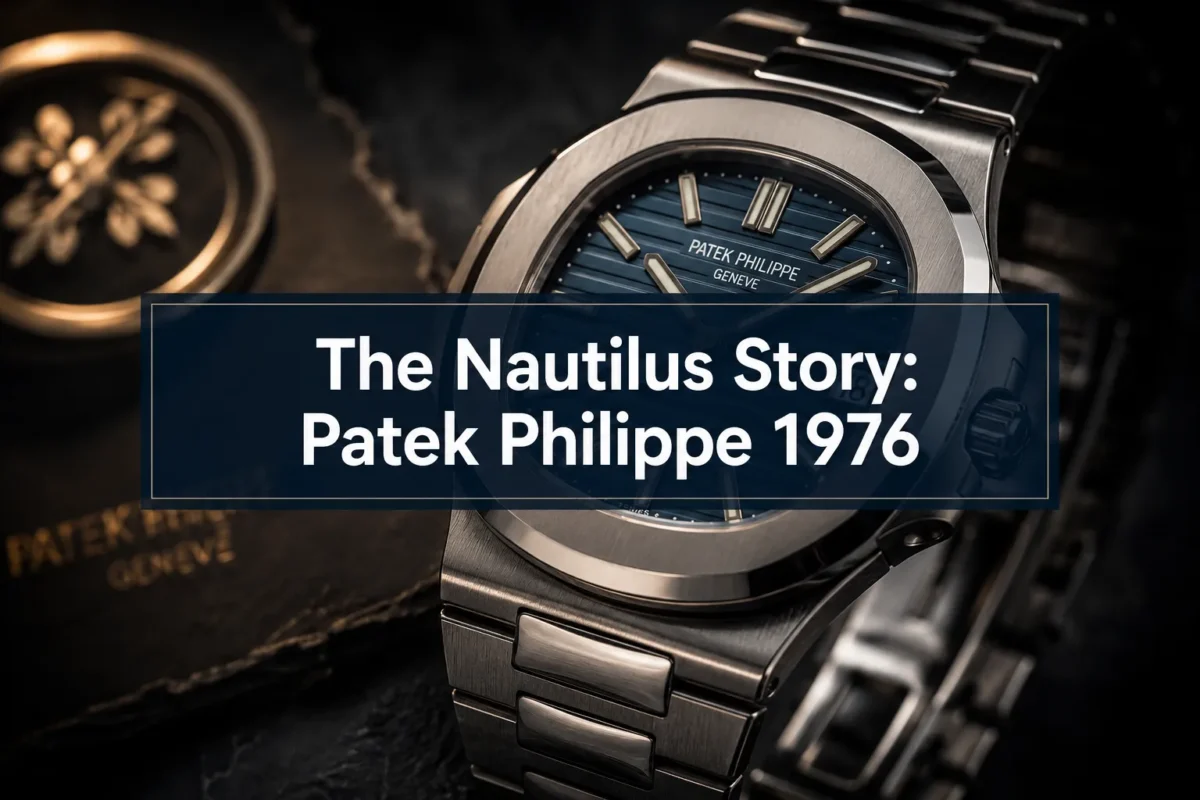
The Nautilus Story: How Patek Philippe Changed Watchmaking in 1976
Jul
Last updated: July 28, 2026
Quick Answer
The Nautilus story: how Patek Philippe changed watchmaking in 1976 is the account of how a single bold design decision transformed a conservative Swiss manufacture into the creator of the world’s most coveted luxury sports watch. Introduced at the Basel Watch Fair in April 1976, the Nautilus ref. 3700 was the first high-complication, precious-metal-grade timepiece built in stainless steel and sold at a price that shocked the industry. Designed by Gerald Genta in a single overnight session, it redefined what a luxury watch could be and created an entirely new category: the luxury sports watch.
Key Takeaways
- The Patek Philippe Nautilus debuted in 1976 as reference 3700, designed by Gerald Genta and priced higher than a Rolex Submariner in gold at the time.
- Gerald Genta sketched the design in one night, drawing inspiration from a porthole on an ocean liner.
- The Nautilus was Patek Philippe’s direct response to the quartz crisis, which threatened the entire Swiss mechanical watch industry.
- Its integrated bracelet, horizontal-stripe dial, and octagonal bezel with rounded corners remain the defining design elements across all modern references.
- Today, the Nautilus ref. 5711 in stainless steel regularly trades on the secondary market for multiples of its original retail price, making it one of the most recognized investment-grade timepieces in the world.
- Patek Philippe has never disclosed exact production figures, but industry analysts estimate fewer than 30,000 Nautilus watches are produced annually across all references.
- The Nautilus directly inspired the Audemars Piguet Royal Oak (which Genta also designed) and spawned an entire genre of luxury integrated-bracelet sports watches.
- Counterfeiting of the Nautilus is a serious and growing concern; authentication by a trusted expert is essential before any purchase.
- The Aquanaut, introduced in 1997, is Patek Philippe’s more accessible sports watch and shares the Nautilus’s spirit without replicating its design.
What Is the Nautilus Patek Philippe and Why Is It Famous
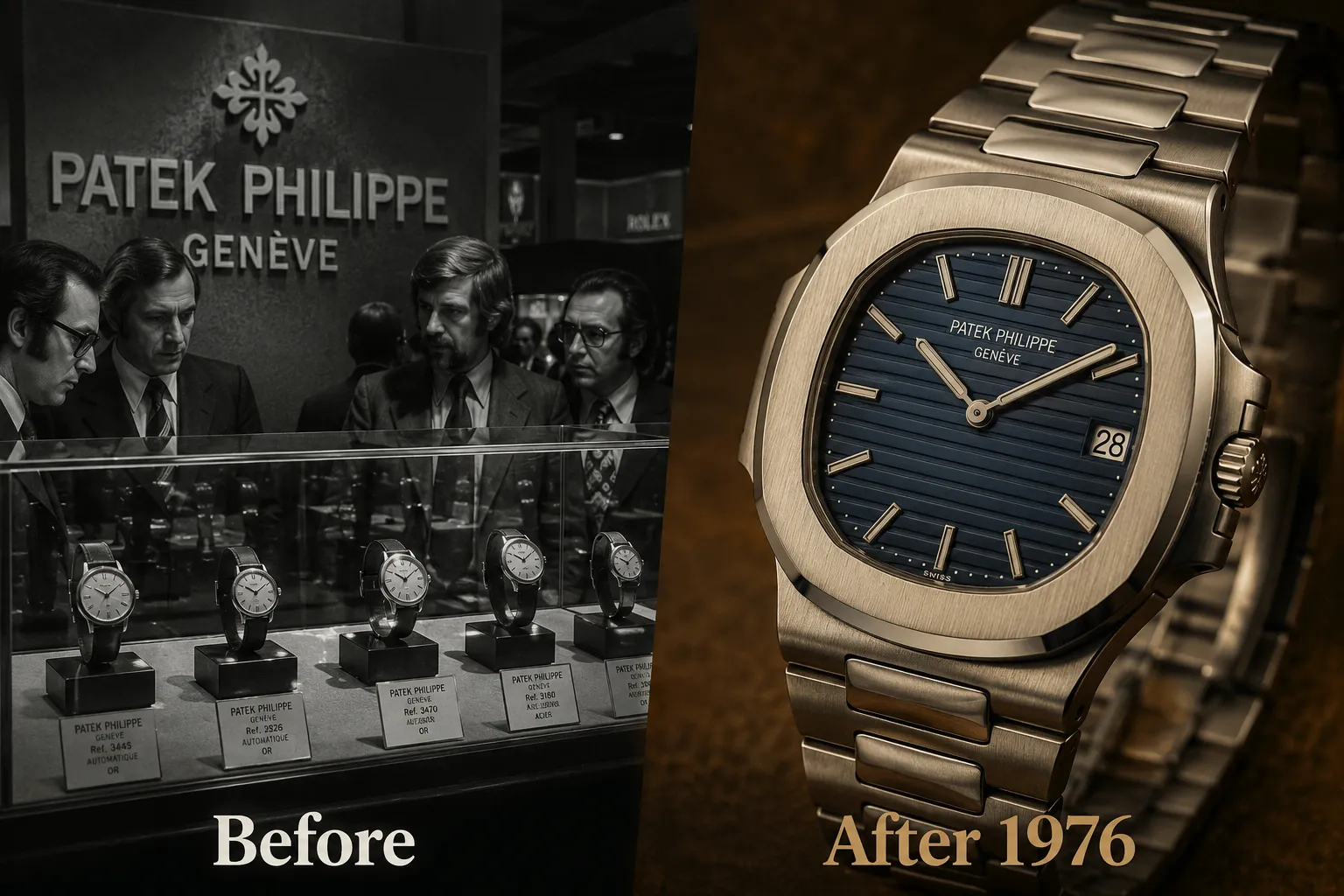
The Patek Philippe Nautilus is a luxury sports watch first introduced in 1976 as reference 3700. It is famous for combining the prestige of a Patek Philippe movement with a bold, industrial stainless steel case at a time when the Swiss watch industry considered steel beneath the dignity of a fine timepiece.
The Nautilus earns its name from Jules Verne’s submarine in Twenty Thousand Leagues Under the Sea, a nod to its water-resistant, porthole-inspired case design. The watch is rated to 120 meters of water resistance, which was exceptional for a dress-adjacent watch in 1976.
What makes it famous today is a combination of factors that compound over decades:
- Design longevity. The original silhouette has changed remarkably little since 1976. The octagonal bezel with rounded corners, the integrated bracelet that flows seamlessly from the case, and the horizontal-embossed dial are instantly recognizable.
- Movement quality. Every Nautilus houses a Patek Philippe in-house movement, calibrated and finished to the manufacture’s exacting standards.
- Scarcity. Patek Philippe produces the Nautilus in deliberately limited quantities, creating a persistent supply-demand imbalance.
- Cultural status. The Nautilus has appeared on the wrists of heads of state, tech founders, athletes, and serious collectors for five decades.
For collectors seeking a deeper understanding of Patek Philippe’s design philosophy across its collection, the Watch Education Guide at MioJewelry offers a comprehensive resource on movements, materials, and buying considerations.
Who Designed the Nautilus Watch in 1976
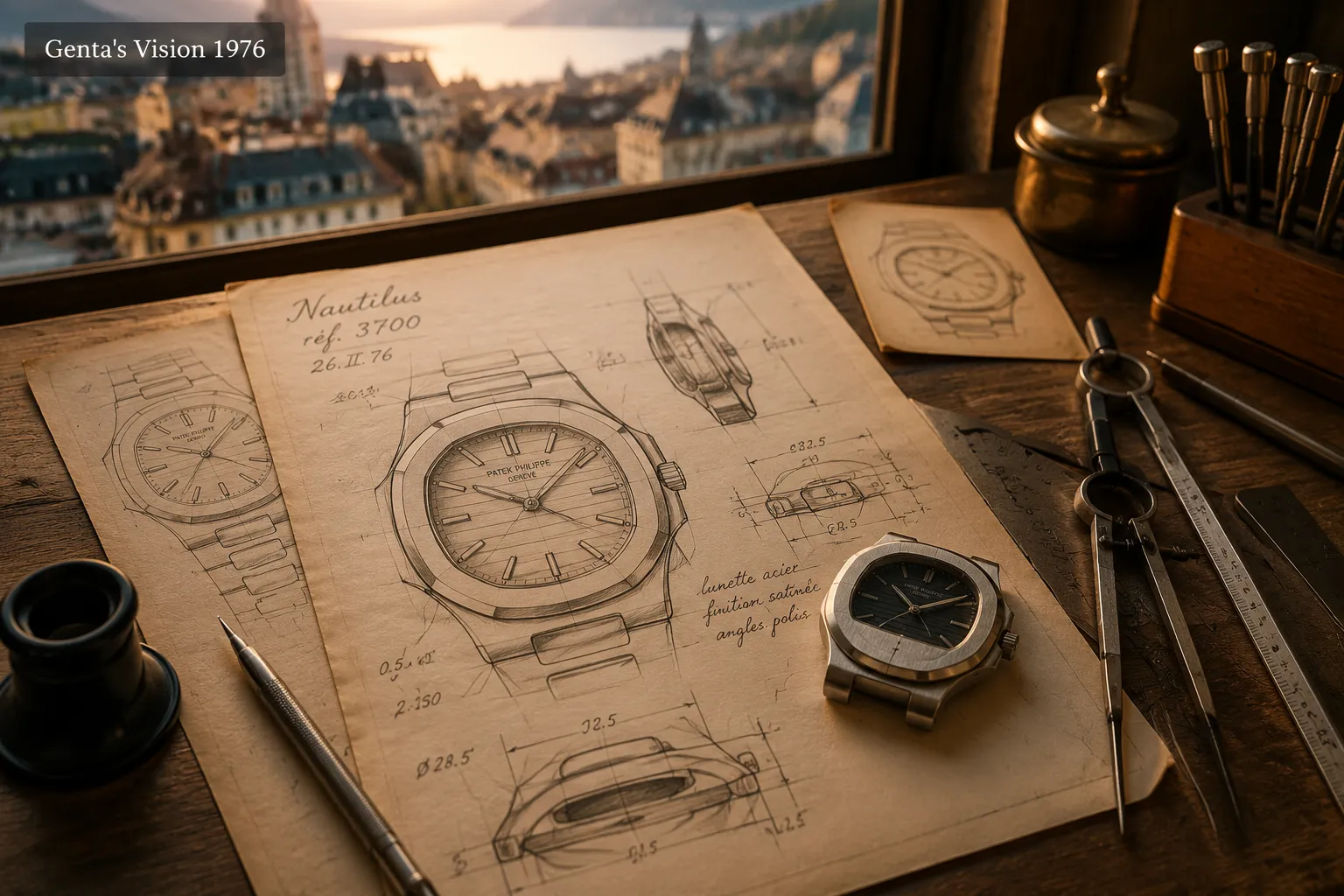
Gerald Genta designed the Nautilus in a single overnight session in 1975, delivering the sketch to Patek Philippe the following morning. Genta is widely regarded as the most important watch designer of the twentieth century, and the Nautilus stands as one of his two most celebrated works.
Genta drew inspiration from the porthole windows of the ocean liners he admired as a child growing up in Geneva. The porthole shape informed the octagonal bezel with its eight exposed screws, while the integrated bracelet was conceived to make the watch feel like a single sculpted object rather than a case with a strap attached.
What made Genta’s approach audacious was the material choice. Stainless steel was the domain of tool watches and entry-level timepieces. Genta and Patek Philippe’s then-president Henri Stern decided to build the Nautilus entirely in steel and price it accordingly, above gold watches from competing brands. That decision was controversial. Several retailers refused to stock it at launch.
Genta also designed the Audemars Piguet Royal Oak in 1972, four years before the Nautilus. Both watches share the integrated-bracelet philosophy and the use of steel as a prestige material, but the Royal Oak preceded the Nautilus to market. The two watches are now the twin pillars of the luxury sports watch category Genta effectively invented.
What Was Patek Philippe Doing Before the Nautilus Came Out
Before the Nautilus, Patek Philippe was primarily known as the maker of the world’s finest dress watches and grand complications. The manufacture’s reputation rested on pieces like the Calatrava, introduced in 1932, and extraordinarily complex pocket watches and wristwatches built for private clients and royalty.
The late 1960s and early 1970s brought an existential threat: the quartz crisis. Japanese manufacturers, led by Seiko, introduced battery-powered quartz movements that were more accurate and far cheaper to produce than mechanical calibers. Swiss mechanical watchmaking entered a severe contraction. Dozens of manufactures closed. Employment in the Swiss watch industry fell by more than half between 1970 and 1983, according to the Federation of the Swiss Watch Industry.
Patek Philippe faced a strategic choice: compete on price, pivot to quartz, or double down on the irreplaceable value of Swiss mechanical craftsmanship. Henri Stern chose the third path and went further, he commissioned a watch that would reframe steel as a luxury material and attract a younger, more active clientele who found traditional dress watches too formal.
The Nautilus was that answer. It was not a compromise. It was a statement.
How Did the Nautilus Change Luxury Watchmaking
The Nautilus story: how Patek Philippe changed watchmaking in 1976 is ultimately a story about redefining value. Before the Nautilus, the hierarchy was clear: gold meant luxury, steel meant utility. The Nautilus inverted that logic by pricing a steel watch above the market’s expectations for the material.
The effects on the broader industry were profound and lasting:
- Steel became aspirational. Other Swiss manufactures followed Patek Philippe’s lead, eventually producing their own integrated-bracelet sports watches in steel at premium price points.
- A new collector demographic emerged. The Nautilus attracted buyers who wore suits during the day and wanted a single watch that worked in a boardroom and on a yacht. This “active professional” archetype became the defining luxury watch consumer of the following decades.
- The integrated bracelet became a design benchmark. The seamless flow from case to bracelet that Genta pioneered on the Nautilus is now a standard of ambition for any sports watch aspiring to the top tier of the market.
- Investment value was formalized. The Nautilus was among the first watches to consistently appreciate in value on the secondary market, helping establish the concept of the watch as a financial asset rather than a depreciating accessory.
The Audemars Piguet Royal Oak, which had already established similar principles in 1972, reinforced the movement. Together, the Royal Oak and the Nautilus created the luxury integrated-bracelet sports watch category that now represents some of the most actively traded assets in the collector market. For a sense of how the Royal Oak compares today, the Audemars Piguet Royal Oak ref. 15550ST is a useful reference point.
What Makes the Nautilus Different from Other Patek Philippe Watches
The Nautilus occupies a unique position within Patek Philippe’s collection because it is the only line that combines sports functionality with the manufacture’s highest level of finishing. Most Patek Philippe watches are dress pieces: the Calatrava, the Gondolo, the Twenty~4. The Nautilus is built to be worn actively.
Key differentiators within the Patek Philippe collection:
| Feature | Nautilus | Calatrava | Grand Complications |
|---|---|---|---|
| Case material | Steel, gold, white gold | Gold, platinum | Gold, platinum |
| Water resistance | 120m | 30m | 30m |
| Bracelet type | Integrated steel/gold | Leather or bracelet | Leather |
| Primary use | Sports/dress crossover | Dress | Dress/collector |
| Secondary market premium | Very high | Moderate | Very high (select refs) |
The Nautilus also carries a distinct movement architecture. The ref. 5711 houses caliber 315 SC, a self-winding movement with a 45-hour power reserve and a peripheral rotor. The Nautilus ref. 5712G-001 adds a moon phase and power reserve indicator, demonstrating that the Nautilus family accommodates complications without sacrificing its sporting character.
For collectors interested in Patek Philippe’s more traditional complications, the Annual Calendar ref. 5146G-001 represents the manufacture’s dress-watch philosophy at its most refined.
How Much Does a Nautilus Watch Cost Today
In 2026, a new Patek Philippe Nautilus ref. 5711 in stainless steel carries an official retail price in the range of approximately $35,000 to $40,000 USD, though retail availability is effectively nonexistent for most buyers. On the secondary market, the same reference trades between $80,000 and $130,000 depending on condition, completeness of set, and dial variant, according to data tracked by major auction houses and pre-owned watch platforms.
Pricing varies significantly by reference and material:
- Ref. 5711/1A (steel, blue dial): Secondary market range approximately $80,000,$130,000+
- Ref. 5711/1R (rose gold): Secondary market range approximately $160,000,$210,000 (gold references trade closer to retail due to lower demand relative to steel)
- Ref. 5726A (Annual Calendar, steel): Secondary market range approximately $80,000,$110,000
- Ladies Nautilus ref. 7118 (steel): Secondary market range approximately $60,000,$90,000
The Nautilus ref. 5711/1A-014 with Olive Green dial is among the most sought-after modern references, with values reflecting its limited production run and the intensity of collector demand.
For rose gold enthusiasts, the Nautilus ref. 5980R-001 and the Nautilus Chronograph ref. 5980/1R-001 represent the pinnacle of the line’s complications in precious metal.
Why Is the Nautilus So Hard to Get and Expensive Now
The Nautilus is difficult to acquire at retail because Patek Philippe produces it in deliberately restricted quantities and allocates pieces through an authorized dealer network that prioritizes long-standing client relationships. New buyers with no purchase history at an authorized dealer have almost no realistic path to acquiring a new Nautilus ref. 5711 at retail price.
Several structural factors sustain the premium:
- Production constraint. Patek Philippe is a family-owned manufacture that has publicly stated it will not increase production to chase demand. The Stern family views scarcity as integral to the brand’s long-term value.
- Dealer allocation system. Authorized dealers receive very few Nautilus pieces per year. Many allocate them exclusively to clients who have purchased multiple other Patek Philippe references first.
- Speculative demand. The secondary market premium has attracted buyers who purchase Nautilus watches as financial assets, reducing the supply available to traditional collectors.
- Cultural moment. The rise of watch collecting as a mainstream hobby, accelerated by social media and high-profile celebrity ownership, dramatically expanded the global buyer pool after 2018.
The result is a persistent gap between retail price and secondary market value that shows no sign of closing in 2026.
How Many Nautilus Watches Has Patek Philippe Made
Patek Philippe does not publish production figures, and the Nautilus is no exception. Industry analysts and auction house specialists estimate that Patek Philippe produces somewhere between 50,000 and 65,000 watches total per year across all collections, based on historical data from the Federation of the Swiss Watch Industry and secondary market volume analysis.
The Nautilus is believed to represent a meaningful but minority share of that total. Estimates from reputable secondary market platforms suggest annual Nautilus production across all references is likely in the range of 10,000 to 15,000 pieces, though this figure is unverified by the manufacture. Given that the ref. 5711 in steel was the single most in-demand reference, its individual allocation to any given dealer in any given year was often measured in single digits.
What is known with certainty: the total number of Nautilus watches produced since 1976 is a fraction of the collector demand that exists today, and that imbalance is a deliberate feature of Patek Philippe’s business model.
What Is the Difference Between the Nautilus and the Aquanaut
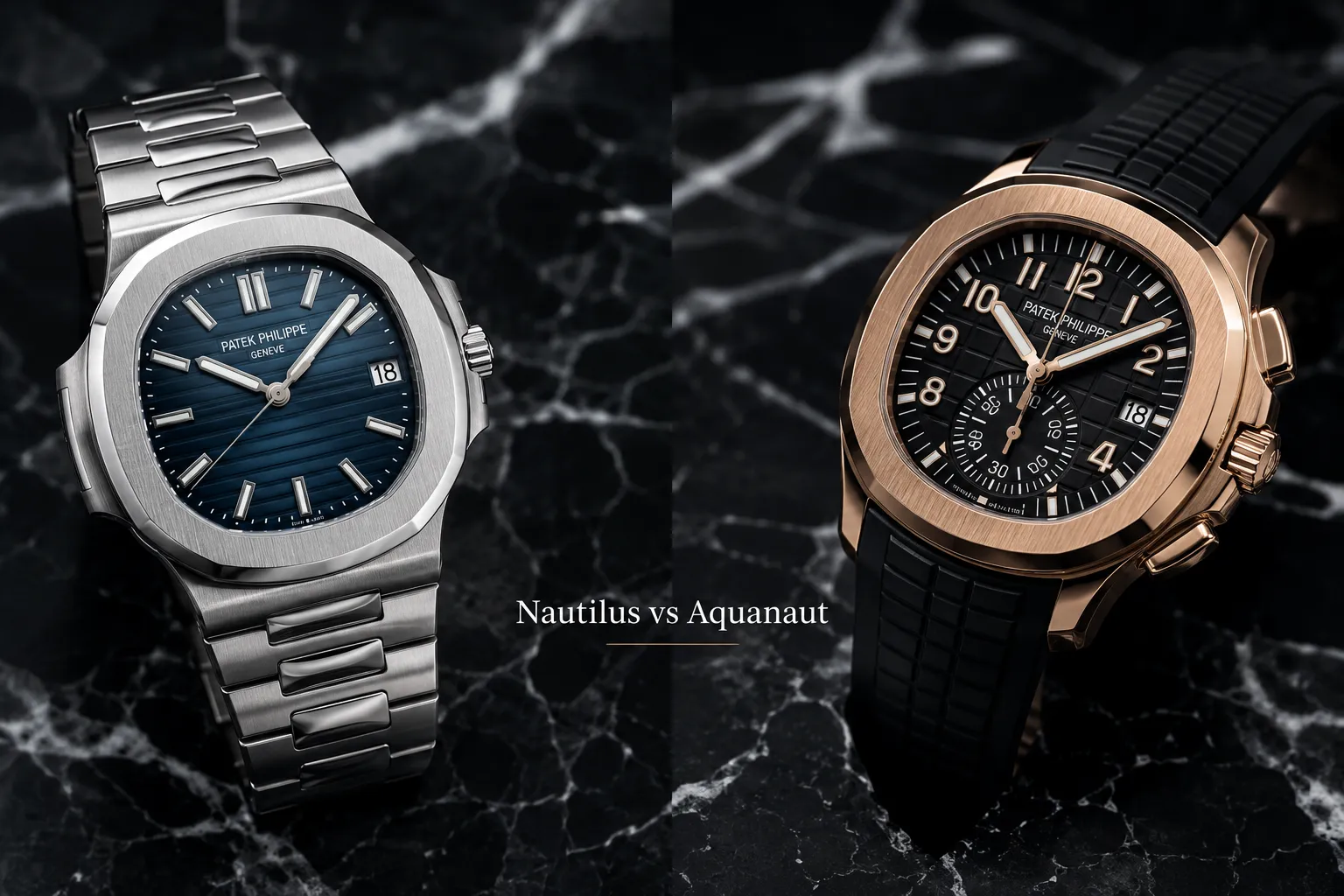
The Aquanaut, introduced in 1997 as reference 5060A, is Patek Philippe’s second sports watch line and is often described as the Nautilus’s younger, more casual sibling. The two watches share a design philosophy but are distinct in almost every meaningful detail.
Key differences:
- Case shape. The Nautilus has an octagonal bezel with rounded corners. The Aquanaut has a rounded octagonal case with a more contemporary, softer profile.
- Bracelet. The Nautilus uses a metal integrated bracelet. The Aquanaut uses a composite rubber strap with a tropical pattern, giving it a more athletic character.
- Dial texture. The Nautilus features horizontal embossed stripes. The Aquanaut uses a checkered embossed pattern.
- Price point. The Aquanaut has historically retailed at a lower price point than the Nautilus, though secondary market premiums on certain references have narrowed that gap considerably.
- Target wearer. The Nautilus bridges sports and formal occasions. The Aquanaut leans more casual and is better suited to active outdoor wear.
Both lines are investment-grade timepieces with strong secondary market performance. The Aquanaut ref. 5268/200R-010 and ref. 5268/461G-001 represent the current generation of the Aquanaut at its most sophisticated.
Can You Actually Buy a New Nautilus or Is It Only Vintage
Buying a new Nautilus from an authorized Patek Philippe dealer is theoretically possible but practically very difficult for most buyers in 2026. Patek Philippe continues to produce the Nautilus line actively, and new references do reach the market. However, the most desirable references, particularly the ref. 5711 in stainless steel, are allocated in such limited numbers that waitlists at authorized dealers can stretch years, and many dealers do not maintain public waitlists at all.
For most serious buyers, the realistic acquisition path runs through the pre-owned and secondary market. This is not a compromise. A well-maintained Nautilus purchased from a trusted, authenticated source with full set documentation (original box, papers, service records) is a legitimate and often superior acquisition to a new piece, particularly for discontinued references.
What to look for in a pre-owned Nautilus:
- Original box and papers (full set), this is non-negotiable for investment-grade acquisition
- Unpolished case and bracelet (original brushed and polished surfaces intact)
- Service history from an authorized Patek Philippe service center
- Authentication certificate from a reputable dealer
- Reference number verification against known production records
MioJewelry offers Certified Authentic, Full Set Complete Nautilus references with Authenticity Guaranteed and Fully Insured Overnight Shipping for qualified buyers seeking White-Glove Service and immediate access to Rare and Highly Sought After pieces.
What Happened to Patek Philippe’s Sales After the Nautilus Launched
The Nautilus was not an immediate commercial success. At launch in 1976, the watch was met with skepticism from retailers and collectors who questioned why a steel watch should cost more than a gold one. Several authorized dealers declined to carry it. Initial sales were slow.
The turnaround came gradually through the late 1970s and accelerated through the 1980s as the concept of the luxury sports watch gained cultural traction. By the time the Nautilus ref. 3800 replaced the original ref. 3700 in 1981, the market had begun to accept the premise. The ref. 3800 was slightly smaller and more refined, and it found a broader audience.
The real inflection point came with the introduction of the ref. 5711 in 2006, which brought modern proportions (40mm), an updated movement, and a dial that became the definitive version of the Nautilus aesthetic. From 2006 onward, secondary market values for the Nautilus began a sustained upward trajectory that accelerated sharply after 2018.
Patek Philippe’s overall brand standing was enhanced by the Nautilus’s eventual success. The watch demonstrated that the manufacture could create something contemporary and desirable without abandoning its commitment to quality, and it proved that scarcity and craftsmanship together could command premiums that defied conventional pricing logic.
Is the Nautilus Watch a Good Investment
The Nautilus has been one of the strongest-performing luxury watch investments over the past two decades, with secondary market values for key references significantly outpacing their original retail prices. That said, treating any watch purely as a financial instrument carries risks that serious collectors should understand.
Arguments in favor of investment value:
- Patek Philippe’s “You never actually own a Patek Philippe” brand positioning reinforces the idea of generational value transfer.
- The manufacture’s deliberate production restraint sustains supply-demand imbalance.
- The Nautilus has maintained collector desirability across multiple market cycles.
- Full set, unpolished examples in excellent condition consistently command the strongest premiums.
Risk factors to consider:
- Secondary market prices for the ref. 5711 peaked sharply in 2021-2022 and have moderated since, demonstrating that even the most desirable references are not immune to market correction.
- Condition and completeness are critical. A polished case, missing papers, or an unverified service history can reduce value by 20-40% relative to a comparable full-set example.
- Counterfeit risk is real and growing (see below).
For buyers approaching the Nautilus as an investment-grade acquisition, the guidance of Luxury Watch Experts with verifiable authentication credentials and a track record of Trusted Worldwide service is not optional, it is essential.
What Are People Saying About Nautilus Counterfeits
Nautilus counterfeiting is a serious and growing problem, driven directly by the watch’s extreme secondary market value. As prices for genuine references climbed into six figures, the incentive to produce high-quality fakes increased proportionally. Today’s most sophisticated Nautilus counterfeits are far more convincing than those of a decade ago.
Common counterfeiting concerns raised by the collector community:
- Dial swaps. Genuine Nautilus cases fitted with aftermarket or counterfeit dials, particularly for rare variants like the Tiffany Blue or Olive Green.
- Full replicas. Complete fake watches using non-Patek movements in cases designed to mimic the ref. 5711 silhouette.
- Paper fraud. Counterfeit or altered documentation presented with otherwise genuine watches to inflate provenance or suggest full-set status.
Authentication best practices:
- Purchase only from dealers who provide written Authenticity Guaranteed documentation and who can demonstrate a verifiable authentication process.
- Request movement inspection by a qualified watchmaker or Patek Philippe service center before finalizing any significant purchase.
- Verify reference numbers against Patek Philippe’s own records where possible.
- Be skeptical of pricing that appears below secondary market norms, genuine Nautilus pieces do not trade at significant discounts without a reason.
MioJewelry’s authentication process for every Nautilus in its Exclusive Collection addresses each of these concerns, providing buyers with the confidence appropriate to an investment of this magnitude.
Did Other Watch Brands Copy the Nautilus Design
No other brand has directly copied the Nautilus, but the design philosophy it pioneered, an integrated-bracelet, steel luxury sports watch with a bold geometric case, has been widely emulated across the industry. The Nautilus and the Audemars Piguet Royal Oak together established a template that virtually every Swiss manufacture has since referenced.
Notable watches in the luxury integrated-bracelet sports category that owe a conceptual debt to the Nautilus:
- Audemars Piguet Royal Oak (1972, also by Genta), the predecessor that shared the same design logic
- IWC Ingenieur (various generations), integrated bracelet, sports orientation
- Vacheron Constantin Overseas, directly competes in the same category
- Girard-Perregaux Laureato, octagonal bezel, integrated bracelet
The Vacheron Constantin Overseas, in particular, is often positioned as a direct alternative to the Nautilus for collectors who cannot access the Patek Philippe. The Vacheron Constantin Historiques ref. 5000H demonstrates the manufacture’s own heritage in the sports watch space.
What no brand has replicated is the specific combination of Patek Philippe’s movement quality, the Nautilus’s precise proportions, and the manufacture’s production discipline. Those elements together are what sustain the Nautilus’s position at the apex of the category it created.
FAQ
What year did the Patek Philippe Nautilus first come out? The Nautilus was introduced at the Basel Watch Fair in April 1976 as reference 3700. It was designed by Gerald Genta and priced in stainless steel at a level that exceeded the cost of gold watches from competing brands.
What is the reference number of the most iconic Nautilus? The ref. 5711/1A-010 (stainless steel, blue dial) is widely considered the definitive modern Nautilus. It was produced from 2006 until Patek Philippe announced its discontinuation in 2021, and it remains the most actively traded Nautilus reference on the secondary market.
Why did Patek Philippe discontinue the ref. 5711? Patek Philippe announced the discontinuation of the ref. 5711 in January 2021. The official reason was to make room for new references and to address the extreme secondary market speculation that had developed around the model. The announcement itself caused secondary market prices to spike further before eventually moderating.
Is the Nautilus waterproof? The Nautilus is water-resistant to 120 meters (approximately 394 feet). This is sufficient for swimming and recreational water activities but is not rated for scuba diving. The gaskets and seals should be inspected by a service center every few years to maintain the rated water resistance.
What is the difference between the Nautilus ref. 5711 and ref. 5726? The ref. 5711 is the time-only model, displaying hours, minutes, and seconds. The ref. 5726 adds an Annual Calendar complication, displaying day, date, month, and moon phase. Both share the same case dimensions and overall aesthetic, but the 5726 commands a higher price due to its added complexity.
How do I know if a Nautilus is authentic? Authentication requires physical inspection of the movement, dial, case finishing, and documentation. Key indicators include the quality of the horizontal-stripe dial texture, the precision of the bezel screws, the weight and feel of the integrated bracelet, and the presence of original box and papers. Always purchase from a dealer offering written Authenticity Guaranteed documentation.
Does Patek Philippe service Nautilus watches bought on the secondary market? Yes. Patek Philippe’s authorized service centers will service any genuine Nautilus regardless of where it was purchased. Service intervals are typically recommended every 3 to 5 years, and a full service from an authorized center includes pressure testing, movement overhaul, and case cleaning.
What is the ladies Nautilus? Patek Philippe produces several Nautilus references sized and designed for women, including the ref. 7118 and ref. 7010. These feature smaller case dimensions and are available in steel, rose gold, and white gold, often with diamond-set bezels. The Ladies Nautilus ref. 7014/1R-001 and the ref. 7018/1A-010 with mother-of-pearl dial represent the current ladies collection at its most refined.
Is the Nautilus better than the Royal Oak? Neither is objectively superior. Both are masterworks of twentieth-century watch design by the same designer. The choice between them is a matter of personal preference, proportions, and brand allegiance. The Royal Oak (ref. 15202) is slightly thinner; the Nautilus is slightly larger in modern form. Both command comparable secondary market premiums.
Can I sell a Nautilus I already own? Yes. The secondary market for genuine Nautilus watches is highly liquid. Full-set examples in excellent, unpolished condition command the strongest prices. For a free valuation, MioJewelry’s sell your watch service provides a professional assessment within 24 hours.
Conclusion
The Nautilus story: how Patek Philippe changed watchmaking in 1976 is not simply a product history. It is the account of a calculated act of creative courage that reshaped an industry’s understanding of value, material, and design. Gerald Genta’s overnight sketch became the blueprint for an entirely new category of luxury object, and Patek Philippe’s willingness to price steel above gold was a provocation that the market eventually vindicated, emphatically.
Nearly five decades later, the Nautilus remains the most recognizable luxury sports watch in the world and one of the most actively sought investment-grade timepieces available to collectors. Its scarcity is real, its authenticity demands verification, and its acquisition requires the guidance of professionals who understand both the watch and the market.
Actionable next steps for serious buyers and collectors:
- Define your reference. Determine whether you are seeking a time-only model, a complication, a ladies reference, or a specific dial variant before beginning your search.
- Insist on full set. Box, papers, and service records are non-negotiable for investment-grade acquisition. Never compromise on documentation.
- Authenticate before purchasing. Work exclusively with dealers who provide written Authenticity Guaranteed documentation and who can demonstrate a verifiable inspection process.
- Understand secondary market dynamics. Prices fluctuate. A trusted advisor with current market data is essential for timing and valuation.
- Consult Luxury Watch Experts. MioJewelry’s Exclusive Collection of Certified Authentic Nautilus references, available with White-Glove Service and Fully Insured Overnight Shipping, provides Immediate Availability for qualified buyers seeking Prestige and Performance in a single acquisition.
For buyers ready to explore the current Nautilus collection, or for those seeking guidance on a first high-end watch purchase, the Watch Education Guide is an authoritative starting point. And for those with questions about specific references, condition standards, or valuation, MioJewelry’s team of Luxury Watch Experts is available to provide the discreet, informed counsel that an acquisition of this significance deserves.
References
- Federation of the Swiss Watch Industry FH. Swiss Watch Industry Key Figures. 2022. https://www.fhs.swiss/eng/statistics.html
- Donze, Pierre-Yves. A Business History of the Swatch Group. Palgrave Macmillan, 2014.
- Cologni, Franco, and Mocchetti, Ettore. Patek Philippe: The Authorized Biography. Flammarion, 2015.
- Crott Auctioneers. Gerald Genta: The Man Behind the Icons. Auction catalog, 2019.
- Phillips Watches. Patek Philippe: A Retrospective. Auction catalog, 2021.
- Patek Philippe SA. Nautilus: The Collection. Official brand documentation, 2023.