

Market & Investment
Box & Papers for Luxury Watches: How Much Do They Really Add?
Aug
Last updated: August 14, 2026
Quick Answer
Box & papers for luxury watches typically add 10 to 25 percent to resale value for most modern pre-owned pieces, with mainstream brands like Tudor and TAG Heuer sitting near the lower end and grail references from Rolex, Patek Philippe, and Audemars Piguet often commanding premiums of 20 to 35 percent or more. Hyped steel sports watches, limited editions, and vintage references can see even larger swings, sometimes exceeding 50 percent when the set is complete and the papers match the watch.
Key Takeaways
- A “full set” means the original outer box, inner presentation box, warranty card or papers, booklets, and accessories such as extra links.
- Mainstream luxury watches with complete box and papers generally sell for 10 to 25 percent more than the same watch sold “watch only.”
- Hyped steel sports references, including the Rolex Submariner and Daytona, frequently see 15 to 25 percent premiums for full sets.
- Grail-tier pieces like the Patek Philippe Nautilus 5711 or Audemars Piguet Royal Oak 15202 can command premiums above 50 percent when fresh to market with complete documentation.
- The warranty card and paperwork, not the physical box, account for most of the added value.
- Losing box and papers is not fatal to resale, but it usually forces a 20 to 40 percent price reduction, especially on steel sports models.
- Box and papers alone do not prove authenticity; reputable dealers still verify movement, case, and service history independently.
- Serious collectors and investors should retain every original component, since documentation directly affects both price and speed of sale.
What is a luxury watch box and papers set?
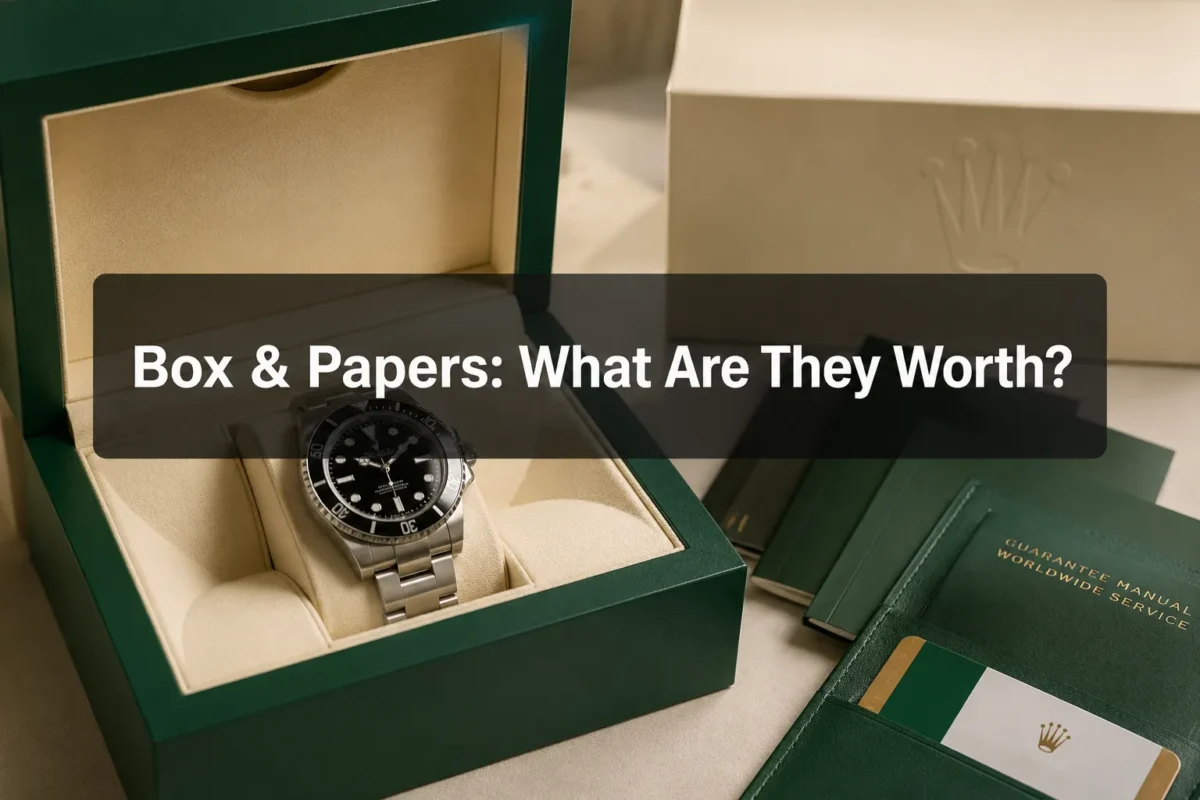
A luxury watch box and papers set refers to every original component that accompanied the timepiece when it left the boutique: the outer shipping box, the inner presentation box, the warranty card or papers, instruction booklets, and any accessories like spare links or a hang tag. Collectors and dealers call this a Full Set Complete package, and it forms the benchmark against which “watch only” listings are measured.
The specific contents vary by manufacturer:
- Rolex includes an outer green box, an inner presentation box, a warranty card (or digital eRolex card on newer models), a leather wallet, booklets, and often a hang tag.
- Patek Philippe ships with a wooden or leather box, an extract from the archives or warranty certificate, and detailed literature.
- Audemars Piguet, Omega, and Cartier follow a similar structure, pairing a branded box with a signed warranty card and instruction materials.
Buyers evaluating any Investment-Grade Timepiece should treat this documentation as inseparable from the watch itself. A reference number on the case must match the reference printed on the card, and the case serial should align with any accompanying service records. For a sense of how this plays out on real inventory, examine listings such as the Rolex Submariner 126610LN, where full documentation is standard practice for any Certified Authentic listing.
Box & papers for luxury watches: how much do they really add to resale value?
Box & papers for luxury watches typically add between 10 and 25 percent to resale value on mainstream models, according to multiple 2026 market analyses, with the exact premium shifting by brand tier and reference popularity. The card and documentation, not the cardboard box, drive the majority of that uplift.
Recent brand-tier breakdowns show a consistent pattern:
- Entry-luxury brands (Tudor, TAG Heuer, entry Omega): roughly 10 to 20 percent premium for a complete set.
- Mid-tier brands (Breitling, IWC, higher-end Omega): roughly 15 to 25 percent premium.
- Top-tier houses (Rolex, Patek Philippe, Audemars Piguet): frequently 20 to 35 percent or higher.
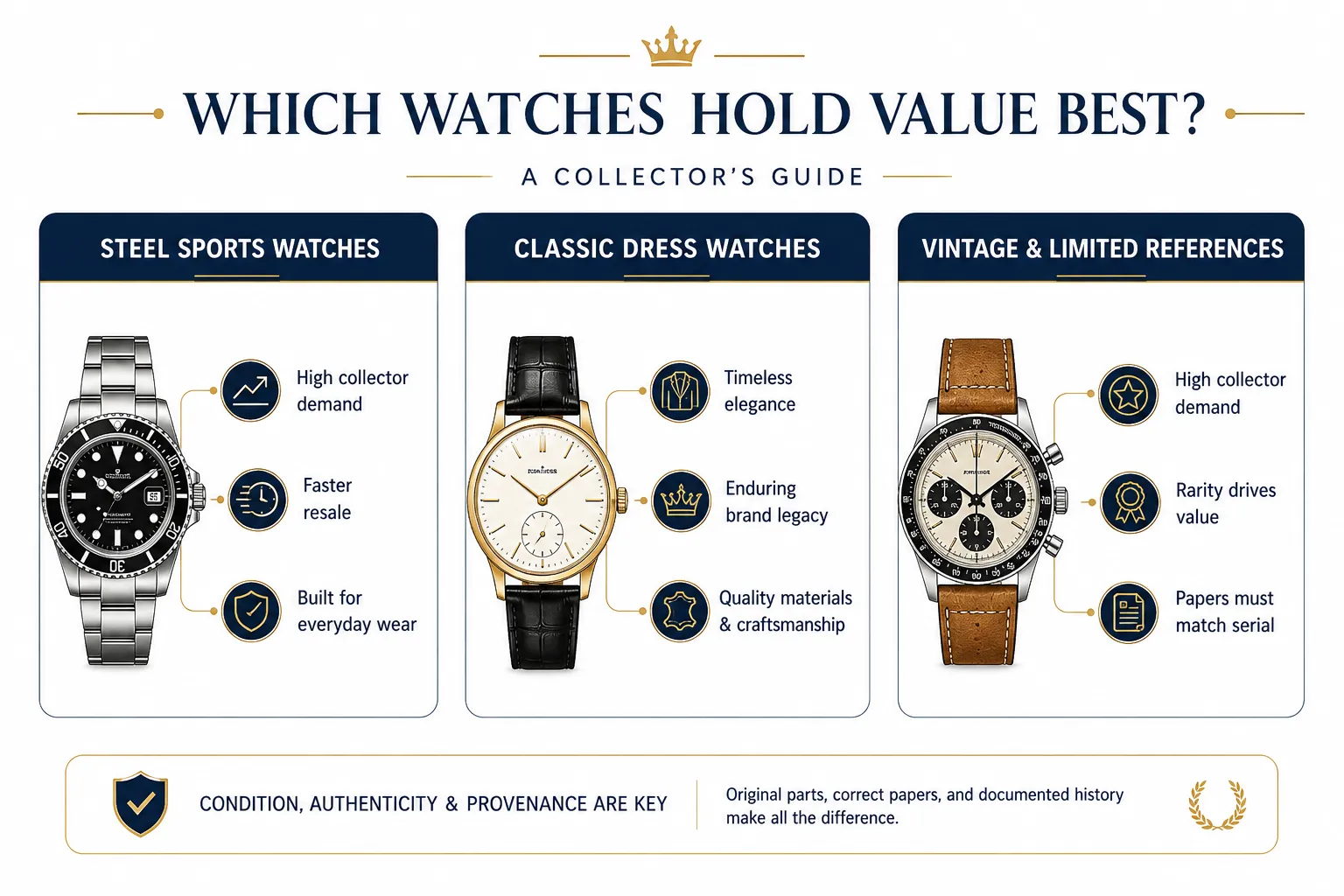
Category matters as much as brand. Analysis compiled in May 2026 breaks the premium down by watch type:
| Watch category | Typical box & papers premium |
|---|---|
| Hyped steel sports (Submariner, GMT-Master, Daytona) | 15 to 25 percent |
| Standard sports references (Explorer, sport Datejust) | 10 to 18 percent |
| Dress watches (Datejust 36, Cartier Tank, Cellini) | 5 to 12 percent |
| Limited editions | 20 to 40 percent |
| Vintage references (50+ years) | 25 to 100 percent or more |
A concrete example: a modern Rolex Explorer reference 124270 was reported in May 2026 at roughly $6,000 to $7,500 watch-only versus $7,000 to $8,500 with full documentation, a 14 to 16 percent uplift. Chrono24’s reference-level case studies show similar patterns, including a Submariner 16610 rising about 17.8 percent with box and papers and a pre-ceramic GMT-Master II 16710 “Pepsi” commanding roughly 23.3 percent more. A Cartier Santos 100XI showed a comparable 20.8 percent premium when sold complete.
At the grail tier, the numbers grow sharply. Auction and dealer reporting in 2026 notes that fresh-to-market examples of the Patek Philippe Nautilus 5711 or the Audemars Piguet Royal Oak 15202-style references with complete sets can exceed 50 percent premiums over comparable naked watches in similar condition. Provenance and completeness are what separate a good deal from a record-setting sale.
Can you sell a luxury watch without box and papers? Price difference explained
Yes, a luxury watch can be sold without its original box and papers, and the transaction remains entirely legitimate. The watch itself, verified by its case, movement, and serial number, retains most of its intrinsic value, but the sale price will typically come in 20 to 40 percent lower than a comparable full set.
Dealers and resellers increasingly frame this the other way around: rather than treating box and papers as a bonus, they price a “naked” watch as a discount against the full-set benchmark. This is particularly pronounced with stainless steel sports models, where buyers expect completeness and penalize its absence.
Practical differences to expect:
- Speed of sale: full-set watches typically sell faster and attract more competing offers.
- Negotiating leverage: a missing card gives buyers grounds to push for a lower offer, even when the watch is mechanically perfect.
- Financing and trade-in value: many authorized dealers and boutiques value completeness heavily when calculating trade-in credit.
Choose to sell without box and papers if: you need liquidity quickly and are comfortable accepting a discount, or the watch is a common reference where naked examples still move steadily. Avoid selling without them if: the reference is discontinued, limited, or part of a hyped category where completeness materially changes buyer perception.
Does every luxury watch come with a box and papers?
Every luxury watch sold new through an authorized dealer or boutique comes with a full box and papers set as standard, since manufacturers include this documentation as part of the retail package. What varies is whether that documentation survives intact through resale.
Some nuances worth understanding:
- Certain manufacturers, including newer Rolex references, now issue digital warranty cards (eRolex) rather than paper cards, which changes how “papers” are defined but does not remove the requirement.
- Gray-market or private-party sellers sometimes offer watches described as “watch only,” meaning the original set was separated, lost, or sold off independently at some point after the original purchase.
- Certified pre-owned programs run by brands or authorized dealers typically restore or reissue documentation as part of their certification process.
A watch still Under Factory Warranty should always include its original papers, since the warranty itself is tied to that documentation. Buyers purchasing through a trusted platform should expect any listing described as Full Set Complete to include every original component, verified before sale.
Are luxury watch boxes worth keeping? Who needs to keep watch boxes and papers
Yes, luxury watch boxes and papers are worth keeping for anyone who might eventually sell, trade, insure, or service the watch, because completeness directly affects resale value, liquidity, and the ease of future authentication. The people who benefit most are collectors, investors, and owners who view the watch as a long-term asset rather than a disposable accessory.
Groups who should prioritize retention:
- Collectors and investors building a long-term holding, since box and papers preserve maximum resale flexibility.
- First-time luxury buyers who may want to upgrade or trade in later.
- Heirs and estate planners, since documentation simplifies valuation and transfer.
- Anyone insuring a watch, since insurers and appraisers often request original paperwork to establish provenance and purchase price.
Owners who wear a watch daily and have no intention of ever selling face lower stakes, but even then, original papers support insurance claims and simplify authentication if the watch is ever serviced by an authorized center. Luxury Watch Experts generally recommend storing the set in a dry, temperature-stable location away from direct sunlight, since UV exposure can fade printed cards over time.
What happens if you lose your box and papers, and how to replace them
Losing a watch’s box and papers does not affect the mechanical function or authenticity of the watch itself, but it typically reduces resale value by 20 to 40 percent and can slow down a sale, since buyers lose an easy reference point for verifying history. The watch remains sellable; it simply moves into the “watch only” category.
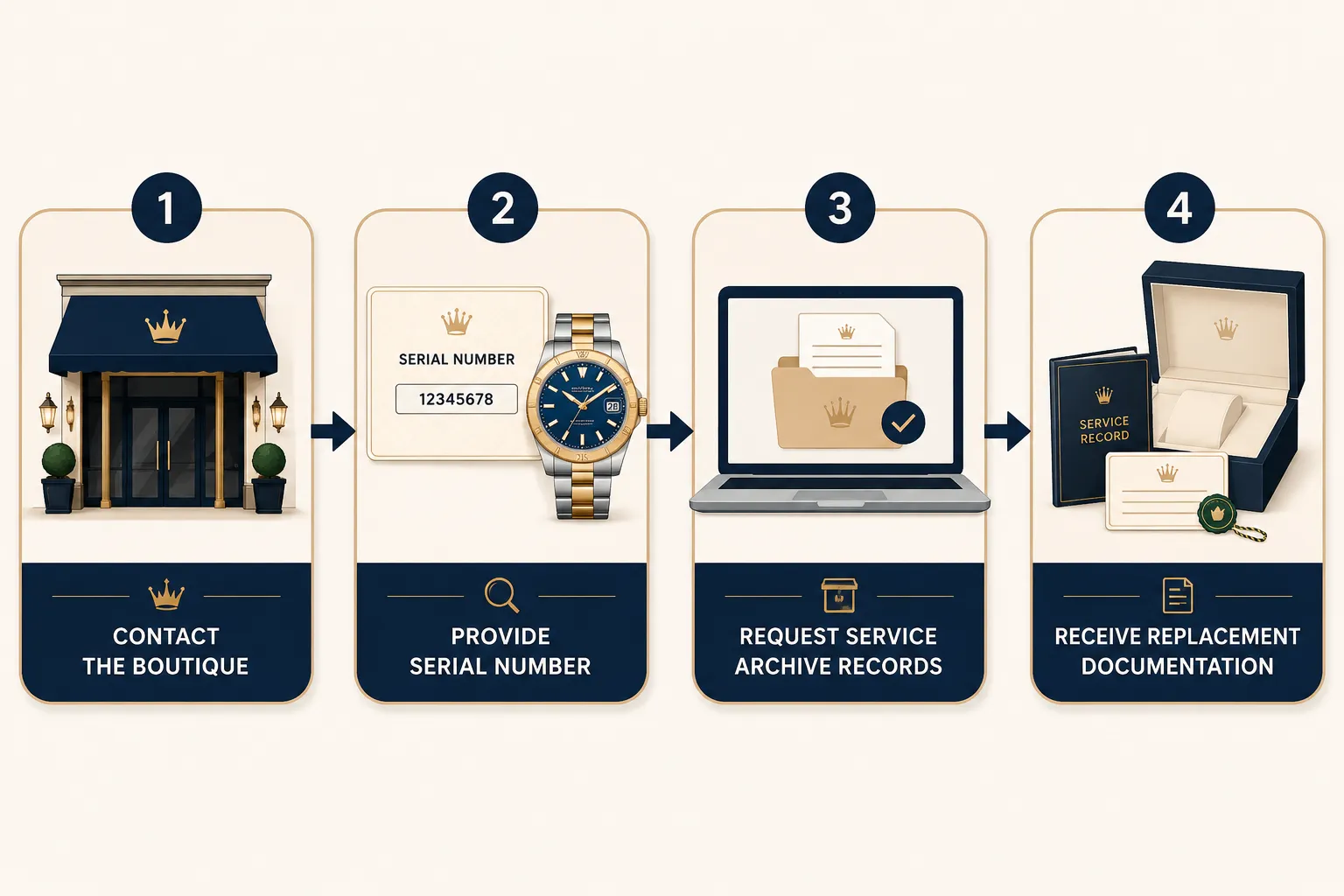
Steps to pursue replacement documentation:
- Contact the original boutique or authorized dealer where the watch was purchased, providing the case serial number.
- Request archive or service records from the manufacturer, since many brands (notably Patek Philippe) maintain historical production archives.
- Ask about a replacement warranty extract rather than a full reissue, since most brands will not recreate an original card exactly but can provide a certificate confirming production details.
- Retain any service invoices, since a documented service history from an authorized center can partially offset the absence of original papers.
- Work with a specialist dealer experienced in provenance research if the manufacturer’s archive does not respond, since firms familiar with vintage and discontinued references can often source verification through other channels.
A missing outer box is a much smaller issue than missing papers, since the card carries the reference number, case serial, and purchase date that establish provenance. If uncertain how a specific piece should be handled, reaching out through a dedicated request service for rare and collectible luxury watches can help identify the right path forward.
Should collectors keep watch boxes unopened?
Serious collectors generally should not keep watch boxes sealed or unopened, because a watch left unworn and unchecked for extended periods can develop gasket, lubrication, or movement issues that are more costly to resolve than any marginal preservation benefit from an untouched box. The value of box and papers comes from completeness and matching documentation, not from factory shrink-wrap.
That said, a few practical habits protect long-term value:
- Store the outer and inner boxes in a stable environment, away from humidity and direct light.
- Keep booklets and cards in their original wallet or pouch to prevent creasing or fading.
- Photograph the full set periodically, including serial numbers, to maintain a personal provenance record.
Edge case: unworn, factory-sealed pieces purchased purely as speculative holds (common with certain limited editions) are a different category, and some collectors do choose to leave those completely untouched to preserve a “time capsule” condition. For a watch intended to be worn and enjoyed, however, functional use with careful box storage is the standard approach among experienced buyers.
Common mistakes people make with luxury watch boxes and papers
The most common mistake is treating the outer box as disposable while ignoring the card, when in reality the paperwork carries most of the resale value. A close second is storing papers loosely, allowing them to fade, tear, or become separated from the watch entirely.
Frequent errors to avoid:
- Discarding the outer shipping box, assuming only the inner presentation box matters. Some buyers specifically request the full nested set.
- Letting service centers hold onto papers during a repair without documenting what was submitted.
- Failing to verify that the card’s reference and serial number match the case before purchase, which can indicate a mismatched or swapped set.
- Storing cards in humid environments, causing ink fading or paper degradation that reduces perceived authenticity.
- Assuming a photocopy or scan is acceptable for a future sale, when buyers and dealers expect the original physical document.
A quick example: a buyer purchasing a Rolex Daytona 126518LN should always confirm the warranty card’s serial matches the case back or movement serial before finalizing payment, since a mismatch is one of the clearest red flags in the secondary market.
Fake luxury watch boxes and papers: how to spot them
Counterfeit boxes and papers exist across nearly every major luxury brand, and spotting them requires close attention to printing quality, typography, hologram security features, and serial number consistency. No single visual check is definitive, which is why reputable dealers combine paperwork review with technical inspection of the watch itself.
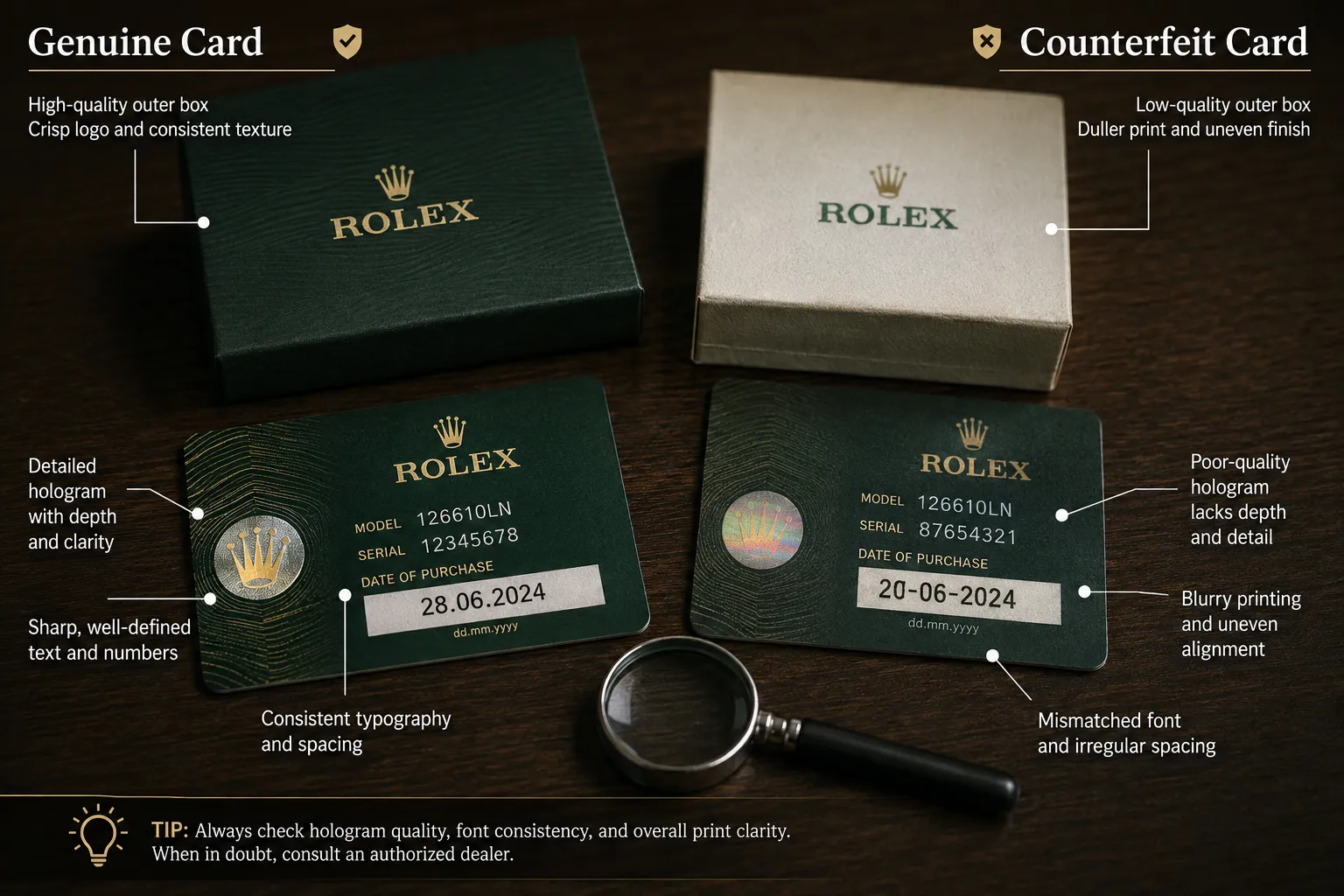
Warning signs to check:
- Typography inconsistencies: genuine cards use precise, uniform fonts; counterfeits often show slightly blurred or misaligned lettering.
- Hologram or security foil quality: authentic cards from brands like Rolex include fine security features that are difficult to replicate cleanly.
- Serial number mismatch: the card’s reference and serial should align exactly with the case back and movement.
- Paper stock and finish: original cards use specific weight and texture; counterfeit paper often feels thinner or glossier than expected.
- Box hardware and stitching: genuine presentation boxes use consistent hinge alignment and stitching; counterfeit boxes frequently show sloppy glue lines or uneven leather grain.
Common mistake: assuming that a convincing box and card automatically confirm a watch is genuine. Several 2026 market guides explicitly warn that box and papers do not, by themselves, prove authenticity, since forged paperwork can accompany a genuine watch with mismatched history, or convincing packaging can accompany a counterfeit movement entirely. This is precisely why platforms offering Authenticity Guaranteed listings pair documentation review with hands-on technical verification by Luxury Watch Experts before any sale.
Why box and papers matter for luxury watch authentication
Box and papers serve as a strong supporting layer of provenance in luxury watch authentication, but they function best alongside, not instead of, physical inspection of the case, movement, and finishing. Documentation confirms a chain of ownership and origin; it does not replace verification of the watch’s mechanical and structural authenticity.
A rigorous authentication process typically includes:
- Cross-referencing the card’s serial and reference against the case back and movement.
- Reviewing service history and any manufacturer stamps from authorized centers.
- Physically inspecting case finishing, dial printing, and movement decoration against known genuine examples.
- Confirming the watch is not reported lost or stolen through relevant industry databases.
For buyers seeking a piece from an Exclusive Collection of Rare & Highly Sought After references, this combination of paperwork and technical review is what separates a confident purchase from a costly mistake. It’s also why buying through established, Trusted Worldwide dealers matters: pieces such as the Patek Philippe Nautilus 7118 or a Rolex Datejust 126334 carry substantially more buyer confidence when both the paperwork and the watch itself have passed independent verification.
Frequently Asked Questions
Does box and papers increase a Rolex’s value more than other brands? Rolex often sees premiums at the higher end of the mainstream range, commonly 15 to 25 percent for popular steel sports references, though the exact figure depends on the specific model and market conditions at the time of sale.
Is a warranty card the same as the box? No. The warranty card (or papers) is the printed or digital document confirming the watch’s reference, serial number, and purchase date. The box is the physical case the watch was shipped in. Most of the added resale value comes from the card, not the box.
Can I buy a replacement box from the manufacturer? Some manufacturers sell generic replacement boxes, but these will not carry the same provenance value as the original box that shipped with that specific watch. Replacement papers are generally handled through archive requests rather than reissued cards.
Do vintage watches need papers to sell well? Vintage watches can sell without papers, but matching original papers can add 25 to 100 percent or more to value for desirable references, since documentation is much rarer for older pieces and significantly boosts buyer confidence.
Should I insure my box and papers separately from the watch? Box and papers are typically covered under a scheduled watch insurance policy alongside the timepiece itself, though owners should confirm with their insurer that documentation loss is addressed in the policy terms.
What if my dealer only offers a “watch only” listing? A watch-only listing is not a red flag on its own, but buyers should expect a corresponding price reduction and should ask directly why the original set is unavailable before proceeding.
Are digital warranty cards as valuable as paper cards? Digital cards, such as Rolex’s eRolex system, are increasingly accepted as equivalent to paper cards for verification purposes, since they are tied directly to the manufacturer’s records and are harder to counterfeit.
Does box and papers matter for insurance claims? Original papers can simplify insurance claims by documenting purchase price, date, and authenticity, though a professional appraisal is often still required regardless of documentation.
Conclusion
Box & papers for luxury watches genuinely move the needle on resale value, typically adding 10 to 25 percent for mainstream references and considerably more for hyped, limited, or vintage pieces. The card, not the cardboard, carries most of that weight, and completeness affects not just price but how quickly a watch finds its next owner.
Collectors and buyers should treat original documentation as a permanent part of the asset: store it carefully, verify that serials match before any purchase, and never assume packaging alone proves authenticity. For those buying or selling, working with a dealer that pairs paperwork review with technical verification remains the safest path to a confident transaction.
Explore Mio Jewelry’s current inventory of Certified Authentic timepieces, each offered with full documentation review, White-Glove Service, and Fully Insured Overnight Shipping, backed by a clear return policy for complete peace of mind.