

Complications & Tech
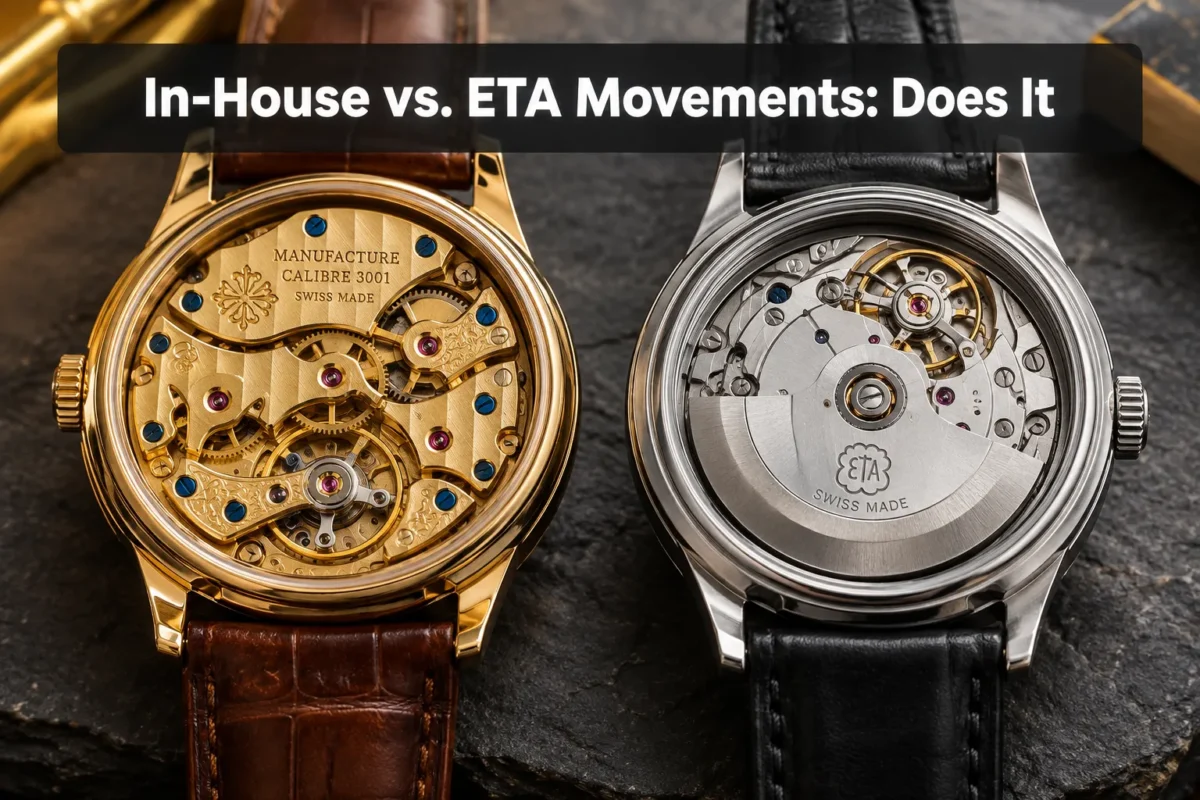
In-House vs. ETA Movements: Does It Really Matter?
Sep
Last updated: September 16, 2026
Quick Answer
In-house vs. ETA movements matters most for prestige, exclusivity, and resale story, not necessarily for day-to-day accuracy or reliability. A well-regulated ETA or Sellita caliber can keep time just as precisely as a manufacture movement costing several times more. The real difference shows up in servicing costs, parts availability, and how much a collector values brand-exclusive engineering over proven, widely serviceable mechanics.
A watch powered by a modified ETA caliber can run for decades with routine servicing at a fraction of the cost of maintaining an in-house movement, and it can keep time within a few seconds a day when properly regulated. Serious collectors have learned that the movement’s origin says less about performance than its finishing, regulation, and the brand’s quality control. This guide breaks down exactly where in-house and ETA movements differ, and where the distinction is mostly marketing.
Key Takeaways
- In-house movements are calibers designed, engineered, and finished entirely within a single brand’s manufacture.
- ETA movements are Swiss-made base calibers supplied to dozens of brands, often finished or modified by the buyer.
- Accuracy depends on regulation and grade, not on whether a movement is in-house or outsourced.
- In-house watches typically cost 30 to 50 percent more than a comparable ETA-based model with similar specifications.
- ETA and Sellita movements are easier and cheaper to service because parts and trained watchmakers are widely available.
- In-house movements often require brand-authorized service centers, which can mean longer wait times and higher fees.
- Resale value favors in-house calibers from top-tier brands such as Rolex, Patek Philippe, and Audemars Piguet.
- Some “in-house” movements are modified ETA bases dressed with a custom rotor or module, so the label deserves scrutiny.
- First-time buyers rarely need to prioritize movement origin over authenticity, condition, and brand reputation.
What Is an In-House Movement in Watches?
An in-house movement is a mechanical or automatic caliber that a watch brand designs, engineers, machines, and assembles under its own roof, without relying on a third-party movement maker. The term signals that a manufacture controls every stage of production, from the mainspring to the final finishing.
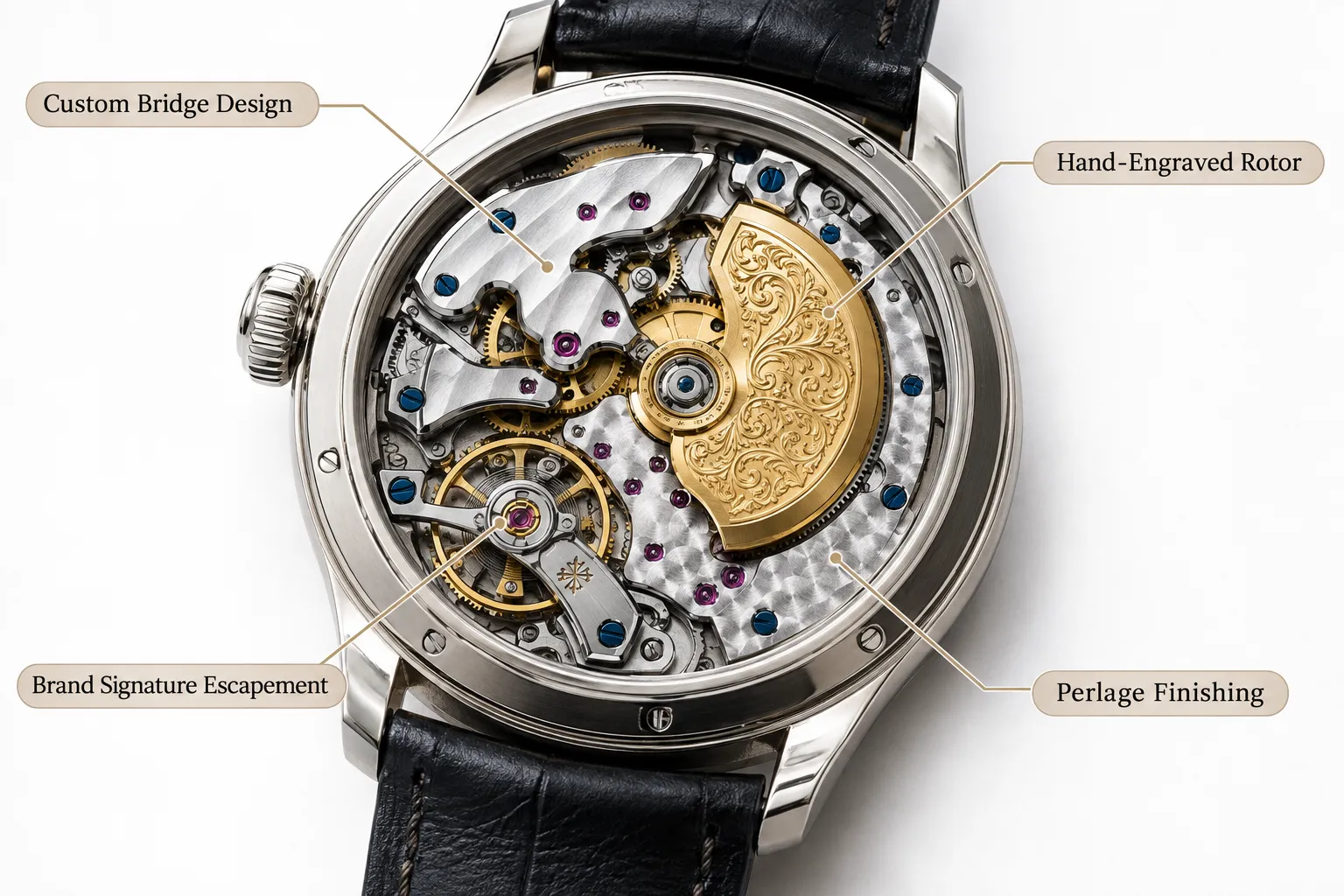
Brands that build in-house movements typically invest heavily in research, tooling, and skilled watchmakers to maintain full control over quality and design. This vertical independence is why in-house calibers are closely tied to a brand’s identity and heritage.
Common traits of a true in-house movement include:
- Proprietary architecture designed exclusively for the brand, not licensed to competitors.
- Custom finishing techniques, such as hand-beveled bridges, perlage, or engraved rotors.
- Unique complications built to the brand’s own specifications, from perpetual calendars to tourbillons.
- Brand-specific service requirements, since parts are rarely shared with outside watchmakers.
Choose an in-house watch if the brand’s engineering story, exclusivity, and finishing matter as much as the timekeeping itself. Rolex’s Caliber 3235, found in models like the Rolex Datejust 126334, and Patek Philippe’s calibers inside the Patek Philippe Nautilus 5719 are examples of manufacture movements built entirely in-house.
What Does ETA Movement Mean?
An ETA movement is a Swiss-made caliber produced by ETA SA, a movement manufacturer owned by the Swatch Group, and supplied to independent brands and larger houses alike. ETA has been a foundational supplier to the Swiss watch industry for decades.
Brands that use ETA movements can buy them as raw “ébauche” kits and finish them internally, or purchase fully finished calibers ready for casing. Sellita, a Swiss competitor, produces closely related movements and has become a common alternative as ETA has tightened supply to outside brands over the years.
Key facts about ETA movements:
- They power everything from entry-level Swiss watches to respected mid-tier and even some luxury pieces.
- Parts are widely stocked, so independent watchmakers can service them without brand authorization.
- Popular calibers include the ETA 2824-2 (three-hand automatic) and the ETA 7750 (automatic chronograph).
- Sellita’s SW200 and SW300 series are drop-in equivalents to ETA’s most common calibers.
Decision rule: if predictable, affordable long-term maintenance matters more than brand-exclusive engineering, an ETA-based watch is the practical choice.
In-House vs. ETA Movements: What Is the Real Difference?
The core difference between in-house and ETA movements is ownership and control: in-house calibers are built entirely by one brand, while ETA calibers are mass-produced by a third party and used across many brands. This distinction affects cost, service, and exclusivity far more than it affects everyday accuracy.
Here is a direct side-by-side comparison for collectors evaluating both paths:
| Factor | In-House Movement | ETA / Sellita Movement |
|---|---|---|
| Design ownership | Built and owned by a single brand | Supplied to many brands |
| Typical cost premium | 30 to 50 percent higher for comparable specs | Lower base cost |
| Service network | Often brand-authorized only | Widely available independent watchmakers |
| Parts availability | Limited to brand or select partners | Broadly stocked worldwide |
| Accuracy potential | High, depends on regulation and grade | High, depends on regulation and grade |
| Exclusivity and prestige | Strong, tied to brand identity | Moderate, shared across brands |
| Resale influence | Often stronger at top-tier brands | Neutral to positive when reputation is strong |
Common mistake: assuming “in-house” always means better performance. In reality, a properly finished ETA-based caliber can match or exceed a poorly regulated in-house movement in daily accuracy. The manufacturing label is a starting point for research, not a guarantee of superiority. Buyers exploring both paths should review the Watch Education Guide for a deeper breakdown of movement types, parts, and buying considerations.
Do In-House Movements Last Longer Than ETA Movements?
In-house movements do not inherently last longer than ETA movements; longevity depends on build quality, materials, and how consistently the watch receives servicing, not on who manufactured the caliber. Both movement types can run reliably for decades when properly maintained.
What actually determines a movement’s lifespan:
- Material quality, including the mainspring alloy and jewel bearings.
- Finishing precision, which affects friction and wear over time.
- Servicing frequency, generally every 3 to 5 years for either type.
- Storage conditions, since humidity and magnetism degrade any movement regardless of origin.
Edge case: some vintage ETA calibers from the 1970s and 1980s are still running smoothly today because parts remain available and watchmakers understand them intimately. Meanwhile, an in-house movement from a brand that later discontinued a caliber line can become harder to service, which indirectly shortens its practical lifespan even if the mechanics are sound.
Is an In-House Movement Worth the Extra Cost?
An in-house movement is worth the extra cost for collectors who value brand-exclusive engineering, heritage, and long-term resale strength, but it is not necessary for buyers who simply want a reliable, accurate watch. The premium pays for exclusivity and craftsmanship, not automatically for better timekeeping.
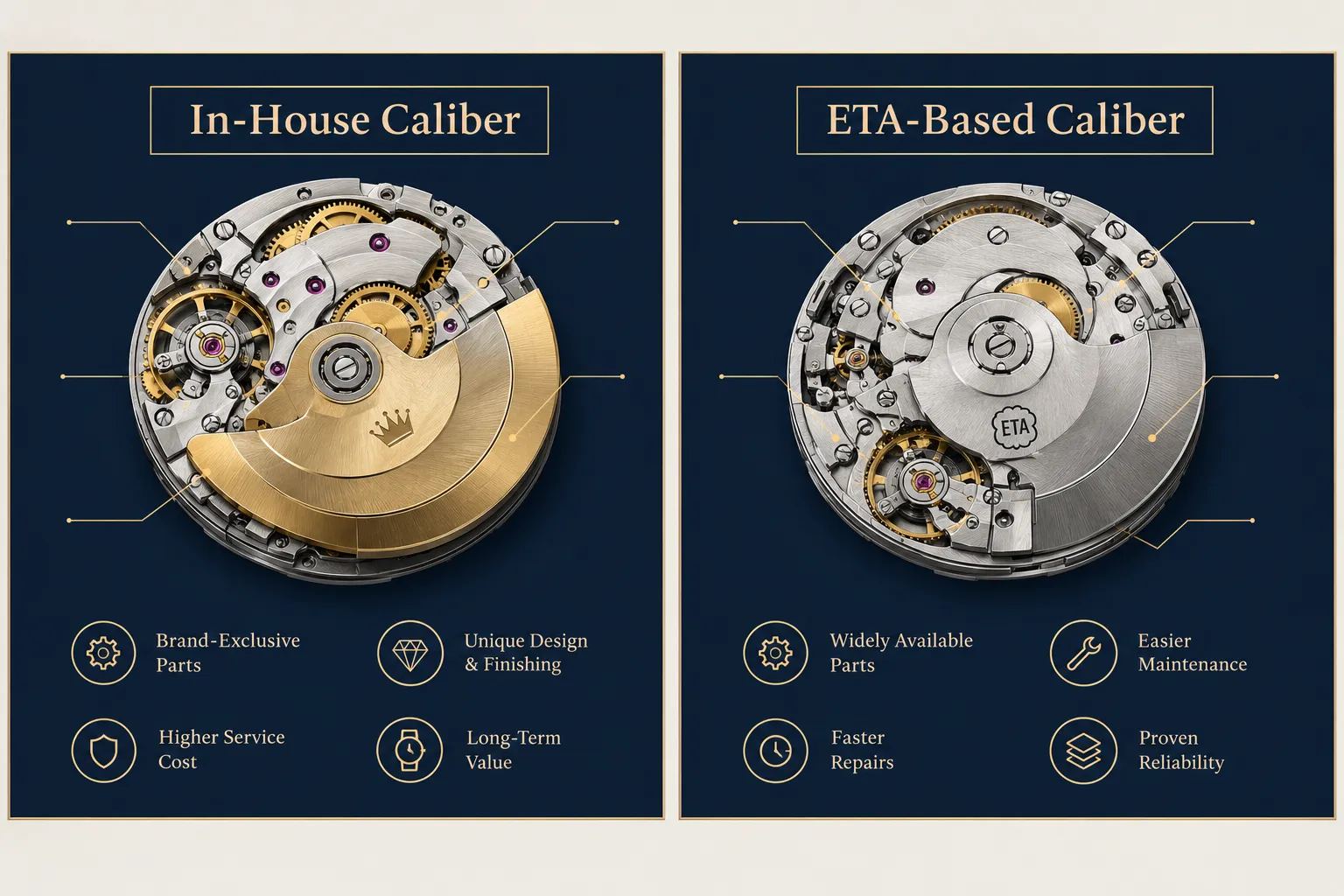
Consider this decision framework:
- Choose in-house if: the brand’s movement design is a defining reason for the purchase, the watch is Investment-Grade, and resale value in the secondary market matters.
- Choose ETA-based if: budget efficiency, easy servicing, and proven reliability outweigh the appeal of brand-exclusive mechanics.
- Choose either if: the watch carries a Full Set Complete with box, papers, and warranty card, and comes from a source offering an Authenticity Guaranteed purchase.
A recurring industry observation holds true today: buyers often pay 30 to 50 percent more for an in-house model versus a similar-spec modified ETA watch, even when the timekeeping performance is nearly identical. That premium reflects prestige and manufacturing independence, not a measurable accuracy advantage.
Which ETA Movement Watches Are Reliable, and What Problems Should You Know About?
ETA movement watches from established brands are generally very reliable, with the ETA 2824-2 and ETA 7750 standing among the most trusted automatic calibers in Swiss watchmaking history. Reliability comes from decades of refinement and enormous production volume, which means problems are well understood and easy to fix.
Watches known for dependable ETA or Sellita-based movements include many models from Tag Heuer, Breitling’s earlier generations, Longines, and Tudor’s older references. The Tag Heuer Cbn2a5a Fc6481 reflects the brand’s long-standing use of Swiss-supplied and Swiss-modified movement architecture across its collections.
Common problems collectors should watch for:
- Power reserve inconsistency on older, unserviced units, usually fixed with a routine service.
- Rotor noise or looseness, often a sign the movement is due for lubrication.
- Amplitude drop after magnetism exposure, which affects any mechanical movement, not just ETA calibers.
- Counterfeit or “Frankenwatch” builds using genuine ETA movements in unauthorized cases, which is why buying from a source offering a full Authenticity Guarantee matters.
Best In-House Movement Watch Brands to Know
The brands most associated with true in-house movement mastery are Rolex, Patek Philippe, Audemars Piguet, Vacheron Constantin, and Jaeger-LeCoultre, each of which has built decades of proprietary caliber development. These names represent the gold standard for manufacture movement engineering.
Notable examples worth studying:
- Rolex builds nearly every movement in-house, including the calibers found in the Rolex Submariner 126613ln and the Rolex Daytona 126508 0004.
- Patek Philippe develops grand complications entirely in-house, as seen in the Patek Philippe Complications 5170p 001.
- Audemars Piguet engineers its own calibers for the Royal Oak line, including the Audemars Piguet Royal Oak 15551bc.
- Vacheron Constantin and Jaeger-LeCoultre both maintain long-standing manufacture traditions, producing highly finished proprietary calibers for their historical collections.
Common mistake: assuming every “manufacture” claim from a smaller brand matches this level of vertical integration. Some brands market a modified ETA base with a custom rotor as an in-house achievement, which is a meaningfully different engineering commitment than building a caliber from scratch.
Can You Service an ETA Movement Yourself?
A trained watchmaker can service an ETA movement without needing brand authorization, because parts, technical documents, and training resources are widely available across the independent watchmaking industry. This is one of the clearest practical advantages of ETA-based watches.
What this means for owners:
- Independent watchmakers worldwide stock ETA and Sellita parts, so repairs rarely require shipping a watch back to the original brand.
- Service costs for ETA-based watches are typically lower than brand-authorized in-house servicing.
- DIY servicing by an untrained hobbyist is not recommended, even on a simple ETA caliber, since improper reassembly can damage the escapement or disturb timing precision.
- Vintage ETA calibers remain some of the easiest movements to source parts for, even decades after production ends.
Edge case: some brands modify ETA movements enough (adding a proprietary module or altering the escapement) that only brand-trained watchmakers can properly service the finished product, even though the base caliber is ETA. Always confirm serviceability before assuming an “ETA-powered” watch is universally easy to repair.
Why Do Luxury Brands Use In-House Movements?
Luxury brands develop in-house movements primarily to establish technical independence, protect brand identity, and differentiate themselves in a competitive market, not because outsourced movements are inferior. Building a caliber from scratch is a statement of engineering capability and heritage.
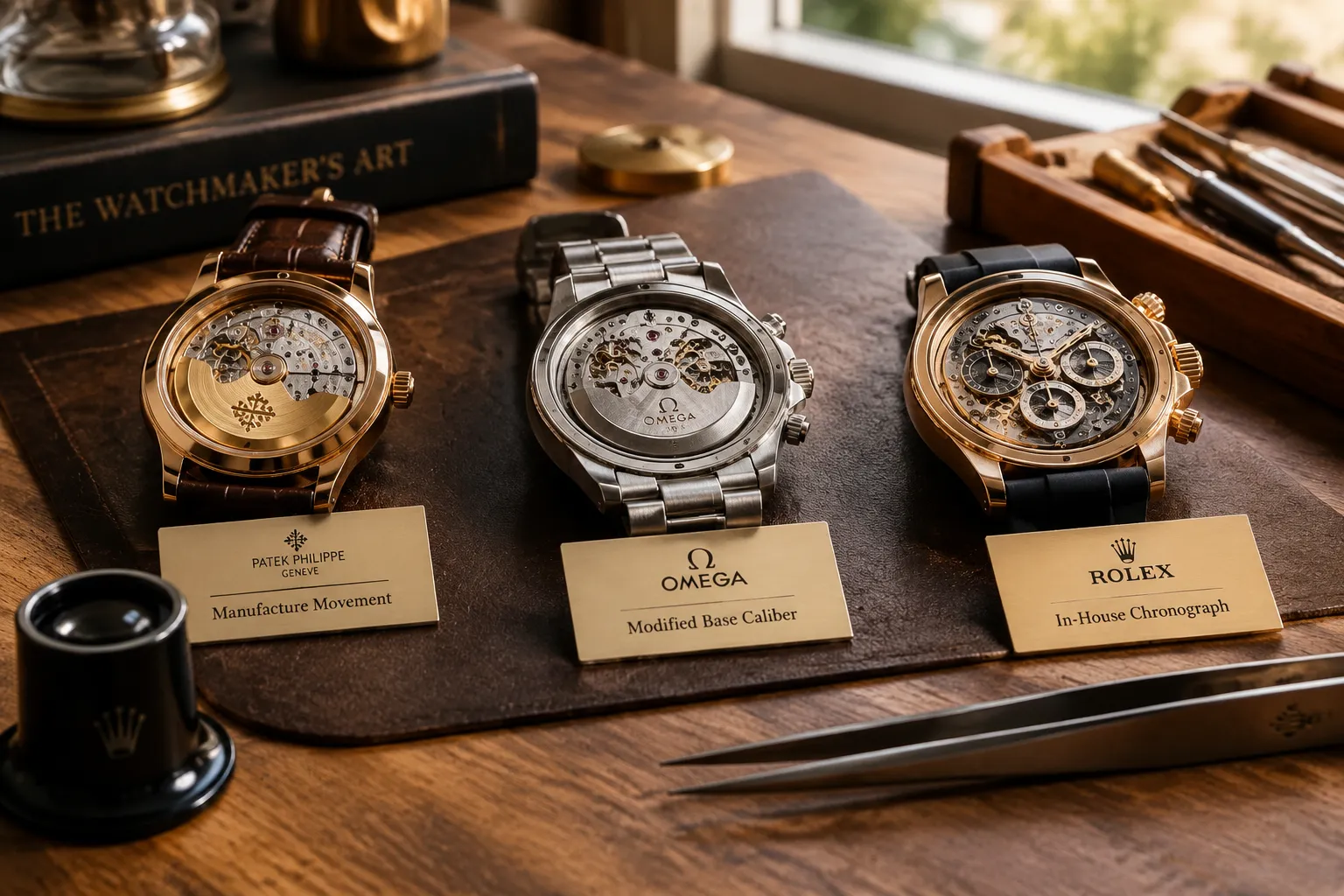
Additional reasons brands pursue in-house development:
- Supply security, since relying on an outside supplier like ETA carries risk if that supplier restricts availability to outside brands.
- Design freedom, allowing complications, case shapes, and power reserves tailored precisely to the brand’s vision.
- Marketing value, since “manufacture movement” carries prestige with collectors and reinforces a brand’s craftsmanship story.
- Vertical control over quality, letting a brand set its own finishing standards rather than depend on a supplier’s specifications.
This is also why many brands describe themselves as Luxury Watch Experts in manufacture development, positioning proprietary movement work as core to their long-term identity rather than a one-time marketing exercise.
Does Movement Type Affect Watch Resale Value?
Movement type can affect watch resale value, but brand reputation, rarity, condition, and completeness of the set typically matter more than whether a caliber is in-house or ETA-based. In-house movements from top-tier manufactures do tend to support stronger long-term value retention.
Factors that influence resale beyond movement origin:
- Brand strength in the secondary market, since Rolex, Patek Philippe, and Audemars Piguet consistently hold value regardless of movement debates.
- Full Set Complete status, including original box, papers, and accessories.
- Whether the watch remains Under Factory Warranty, which reassures buyers about mechanical condition.
- Rarity, since discontinued references or limited productions often become Rare & Highly Sought After regardless of movement supplier.
Example: two comparable chronographs, one with an in-house movement and one with a modified ETA 7750, may sell within a similar price band if both carry equally strong brand recognition and documented service history. The movement label alone rarely swings resale value dramatically outside of top-tier manufacture brands.
ETA vs. In-House Accuracy and Precision: Who Really Wins?
Neither ETA nor in-house movements have an inherent accuracy advantage; precision depends on the caliber’s grade, regulation, and quality control, not on who manufactured it. High-grade ETA and Sellita movements, when properly regulated, can run within roughly plus or minus 5 to 10 seconds per day, matching many entry-level in-house calibers.
What actually drives accuracy:
- Regulation quality, meaning how carefully the balance wheel and escapement are adjusted at the factory or by a watchmaker.
- Movement grade, since ETA offers standard, elaboré, and top/chronometer grades with increasingly tight tolerances.
- COSC certification, an independent Swiss chronometer standard that both in-house and ETA-based movements can achieve.
- Environmental factors, including temperature swings and magnetic exposure, which affect any mechanical movement equally.
Common mistake: assuming an expensive in-house watch will always beat a COSC-certified ETA-based watch in timekeeping. In practice, a well-regulated ETA chronometer can outperform a poorly maintained in-house caliber on a given day.
What Watches Use ETA Movements?
Many respected Swiss and international brands use ETA or closely related Sellita movements, spanning entry-level to mid-tier luxury segments. This broad adoption is part of why ETA calibers remain some of the most tested and understood movements in the industry.
Brands and categories commonly associated with ETA or ETA-derived movements include:
- Mid-tier Swiss brands that build their reputation on finishing and design rather than in-house caliber development.
- Chronograph specialists using the ETA 7750 base for automatic chronograph functions.
- Independent and boutique brands that rely on ETA or Sellita to keep production costs manageable while focusing resources on case design and dial artistry.
- Vintage Swiss watches from the 1970s through 1990s, many of which still run on original ETA calibers today.
Buyers researching a specific model should always confirm the exact caliber reference, since brands sometimes shift between ETA, Sellita, and in-house options across different production years of the same collection.
In-House Movement Watches Under $5,000: What to Expect
A genuine in-house movement watch under $5,000 is possible but relatively rare, since manufacture-level engineering typically carries higher production costs that push retail prices upward. Buyers at this price point should expect either a modest in-house caliber from a mid-tier brand or a heavily modified base movement marketed as proprietary.
What to look for in this price range:
- Confirm the caliber name and specifications directly, rather than relying on marketing language like “manufacture” alone.
- Check independent reviews for known reliability issues with the specific in-house caliber.
- Compare against a comparable ETA-based alternative to understand what the in-house premium actually buys.
- Verify authenticity and documentation, since lower price points can attract counterfeit risk if purchased outside a Trusted Worldwide dealer network.
Decision rule: at this budget, prioritize a well-regulated, well-reviewed ETA or Sellita watch from a reputable brand over an unproven in-house caliber with limited service history, unless the specific in-house model has an established reliability track record.
Does In-House Movement Really Matter for Beginners?
For beginners, in-house movement status rarely matters as much as authenticity, condition, and buying from a trusted source. A first luxury watch purchase should prioritize confidence in what is being bought over debates about who manufactured the caliber inside it.
Practical guidance for first-time buyers:
- Focus first on Certified Authentic documentation and a dealer offering a genuine authenticity guarantee.
- Prioritize brand reputation and proven reliability over movement marketing claims.
- Understand that both in-house and ETA-based watches can deliver Prestige and Performance when properly selected and maintained.
- Save deeper movement comparisons for a second or third purchase, once personal preferences around brand identity and finishing become clearer.
Beginners exploring their first serious purchase can browse a curated Exclusive Collection of luxury watches to compare in-house and ETA-based options side by side before deciding what matters most for their goals.
Frequently Asked Questions
Is an ETA movement considered low quality? No. ETA movements are Swiss-made and widely respected across the watch industry. Quality depends on the specific caliber grade and how well it is regulated, not simply on the ETA name.
Can a watch use both an ETA base and in-house parts? Yes. Many brands purchase an ETA or Sellita base caliber, called an ébauche, and add proprietary modules, rotors, or finishing, then market the result under their own caliber name.
Do Rolex watches use ETA movements? No. Rolex builds all of its current movements in-house, including calibers found across its Datejust, Submariner, and Daytona collections.
Which is easier to find replacement parts for, ETA or in-house? ETA and Sellita movements generally have easier part availability because production volumes are far higher and independent watchmakers commonly stock components.
Does an in-house movement guarantee better craftsmanship? Not automatically. Craftsmanship depends on the brand’s finishing standards and quality control, not solely on whether the movement was built in-house.
Should a first-time luxury buyer avoid ETA-based watches? No. A well-reviewed ETA-based watch from a reputable brand is a sound choice for a first purchase, especially when budget and easy servicing are priorities.
How often should either movement type be serviced? Most mechanical movements, in-house or ETA-based, benefit from professional servicing roughly every 3 to 5 years, depending on usage and manufacturer recommendations.
Does movement origin affect insurance or appraisal value? Appraisals typically weigh brand, rarity, condition, and documentation more heavily than movement origin, though in-house calibers from top manufactures can support stronger valuations over time.
Conclusion
In-house vs. ETA movements is a meaningful distinction for prestige, exclusivity, and long-term resale positioning, but it is not the deciding factor for daily accuracy or basic reliability. A properly regulated ETA or Sellita caliber can keep time as precisely as many in-house movements, and it often costs far less to service over a lifetime of ownership. In-house calibers earn their premium through brand-exclusive engineering, heritage, and the story collectors are willing to pay for.
The smartest next step is matching movement type to personal priorities. Buyers chasing manufacture prestige and long-term collectibility should look toward brands with a proven in-house track record. Buyers prioritizing cost efficiency and easy global servicing should feel confident choosing a well-reviewed ETA-based watch from a reputable name.
Whichever direction fits best, authenticity and documentation matter more than the movement debate itself. Every timepiece should arrive Certified Authentic, with a Full Set Complete when possible, and backed by white-glove service from a dealer offering Fully Insured Overnight Shipping and Immediate Availability. For guidance comparing specific references, explore the Watch Education Guide or connect with a specialist who can walk through in-house and ETA options side by side before making a final decision.