

Brand History & Storytelling
Rolex “Paul Newman” Daytona: The Watch That Changed Collecting Forever
Sep
Last updated: September 18, 2026
Quick Answer
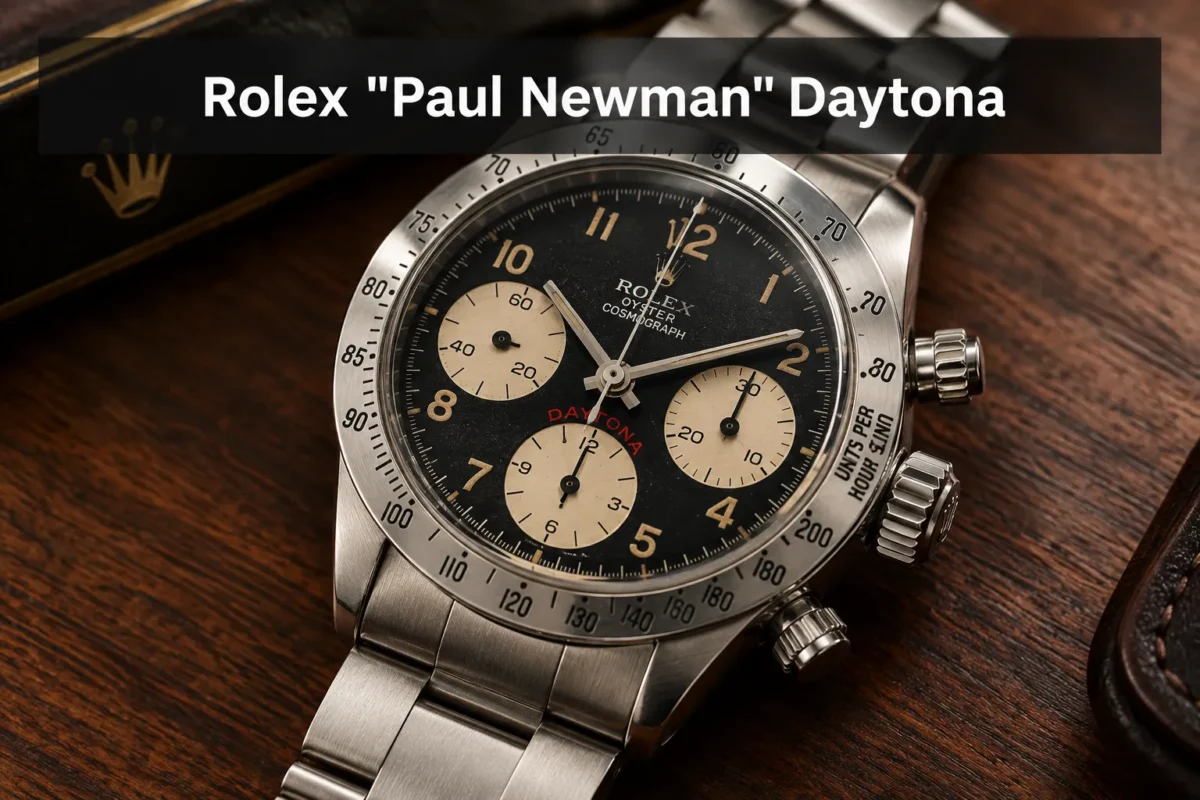
The Rolex “Paul Newman” Daytona is a vintage Cosmograph Daytona chronograph fitted with a rare “exotic” dial featuring Art-Deco numerals and contrasting sub-dial rings, named for actor Paul Newman, who wore one for decades. Newman’s personal Ref. 6239 sold for $17.75 million at Phillips in 2017, a record that redefined how the world values vintage watches. Today, authentic examples trade from roughly $150,000 into the millions depending on reference, dial color, and provenance.
Key Takeaways
- A Rolex “Paul Newman” Daytona is defined by its exotic dial: Art-Deco numerals, contrasting outer sub-dial tracks, and specific references including 6239, 6241, 6262, 6263, 6264, and 6265.
- The 2017 sale of Paul Newman’s own Ref. 6239 for $17.75 million remains the benchmark auction result and the reason vintage watches now command fine-art level attention.
- Prices for authentic exotic-dial Daytonas typically range from $150,000 to over $2,000,000 depending on reference, dial color, and completeness of set.
- Rarity comes from limited original production, dial fading and fragility over decades, and the fact that genuine exotic dials were never the standard configuration Rolex shipped.
- Common problems include dial repainting, “Frankenwatch” component swapping, mismatched serial numbers, and aftermarket lume touch-ups.
- Buyers should only purchase from established dealers or major auction houses that offer written authentication and provenance documentation.
- Modern steel Daytonas remain far more accessible and still carry strong resale value, making them a practical entry point before stepping into vintage exotic-dial territory.
What Is a Rolex “Paul Newman” Daytona?
A Rolex “Paul Newman” Daytona is a vintage Cosmograph Daytona chronograph produced mainly in the 1960s and 1970s, fitted with a distinctive “exotic” dial rather than the standard dial Rolex used on most Daytonas of that era. The nickname comes from actor Paul Newman, a lifelong racing enthusiast who wore this dial variant almost daily for decades.
The name has since grown far beyond one celebrity’s personal watch. It now describes an entire family of references collectors chase specifically because of the dial, not because Newman himself owned every example.
Paul Newman Daytona Dial Exotica Explained
The “exotica” dial is what actually makes a Paul Newman Daytona a Paul Newman Daytona, independent of who wore it. It features Art-Deco block numerals on the sub-dials, a contrasting color ring around each sub-dial (often cream or white against a black or silver main dial), and a distinctly graphic, high-contrast look compared to the plainer standard dial Rolex used far more commonly.
Key identifying traits of the exotic dial include:
- Art-Deco numerals on the 30-minute, 12-hour, and small seconds sub-dials, replacing the simpler baton markers of standard dials.
- Contrasting sub-dial rings, usually a different color than the main dial surface, which is why collectors call these “panda” (black on white) or “reverse panda” (white on black) configurations.
- Applied or printed “Daytona” script in a font style specific to the era.
- Red or colored “Cosmograph” text, seen on certain rarer variants that command additional premiums.
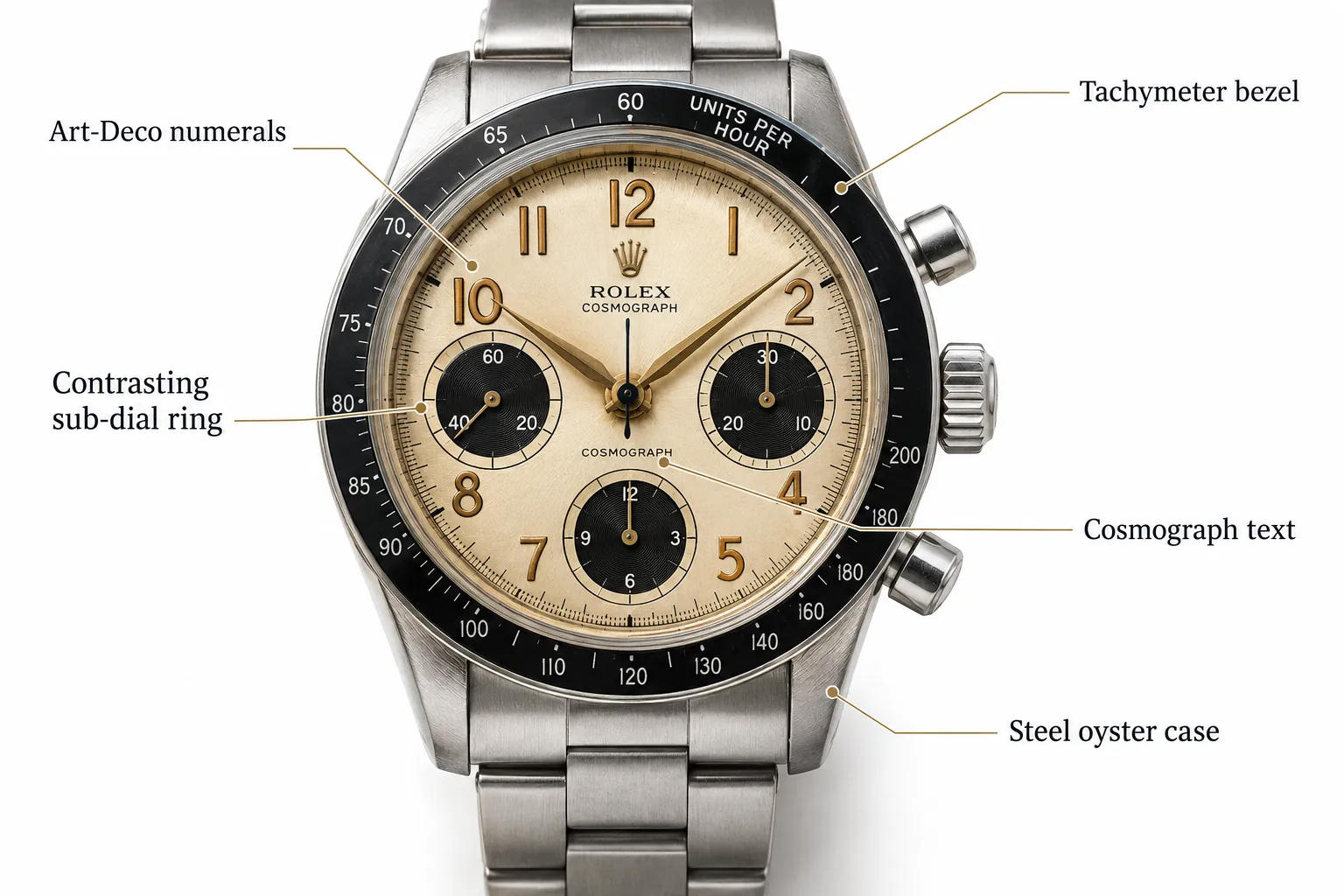
Choose the exotic-dial designation as your starting filter if you are new to this category. Nearly everything else, from reference number to case metal to provenance, builds on top of that one defining feature.
Why Is the Paul Newman Daytona So Expensive?
The Paul Newman Daytona commands extraordinary prices because it combines genuine mechanical rarity with one of the most famous provenance stories in modern auction history. Paul Newman’s own Ref. 6239 sold for $17,752,500 including premium at Phillips in October 2017, setting a world record for any wristwatch at auction at the time and instantly turning this dial variant into the defining trophy of modern watch collecting.
Several 2026 retrospectives point to that single sale as the moment that changed watch collecting forever, arguing that it pushed a tool watch into fine-art price territory and reshaped how the general public perceives vintage watches at large, according to Men’s Journal’s analysis of Paul Newman’s lasting influence on collecting.
The watch’s continued influence rests on three factors:
- A record that still stands. Paul Newman’s personal Ref. 6239 remains the reference point collectors cite when discussing the ceiling of the market.
- Celebrity provenance with substance. Newman wore his Daytona for decades and gave it to his daughter’s boyfriend, creating a documented chain of ownership rather than a manufactured story.
- Cultural crossover. The sale pulled watch collecting into mainstream financial and lifestyle media, validating it as a serious asset category alongside classic cars and fine art.
Common mistake: Assuming every Paul Newman Daytona will approach Newman’s own result. His personal watch benefited from irreplaceable provenance. A comparable dial and reference without that ownership history will trade at a fraction of the price, though still at a significant premium over standard Daytonas.
How Much Does a Paul Newman Daytona Cost Today?
Authentic Paul Newman Daytonas generally range from roughly $150,000 to well over $2,000,000, with price driven primarily by reference number, dial color, and completeness of the original set. A 2026 pricing overview breaks this down clearly by reference, and recent auction results confirm the spread is wide and growing at the top end.
| Reference | Typical Condition | Estimated Price Range |
|---|---|---|
| 6239 exotic dial | Good condition, no box/papers | $150,000, $400,000 |
| 6263 exotic dial | Full set, good condition | $200,000, $600,000 |
| 6265 exotic white dial | Strong original condition | $300,000, $800,000 |
| Rare colorway (lemon, red register) | Exceptional, documented | $500,000, $2,000,000+ |
These figures come from a 2026 collector’s guide to Paul Newman Daytona references and value, and align with recent sale results.
Recent auction activity backs up this range. At Sotheby’s spring 2026 Important Watches sale, a yellow-gold Daytona “Paul Newman” Ref. 6239 achieved approximately 1.2 million CHF, a new benchmark for that metal and reference combination, as detailed in Sotheby’s own review of the five most expensive Rolex Daytona watches sold at auction. Meanwhile, a Sotheby’s Hong Kong sale offered a steel Ref. 6239 exotic-dial Daytona with an estimate of 600,000-1,200,000 HKD, confirming demand across both Western and Asian markets.
Historical guides also show that not every result reaches trophy status. One selling guide cites three separate Paul Newman Daytonas trading between $137,500 and $275,000, including a steel Ref. 6239 that sold for $275,000 in 2018, illustrated in Fortuna Auction’s Rolex selling guide. This range reflects watches without exceptional provenance, still commanding a strong premium purely from originality and dial rarity.
Paul Newman Daytona vs Regular Daytona: What’s the Difference?
The core difference between a Paul Newman Daytona and a regular vintage Daytona is the dial. Standard dials use simple baton markers and matching sub-dial colors, while Paul Newman dials use Art-Deco numerals and contrasting sub-dial rings, and this single design detail can multiply the watch’s value many times over.
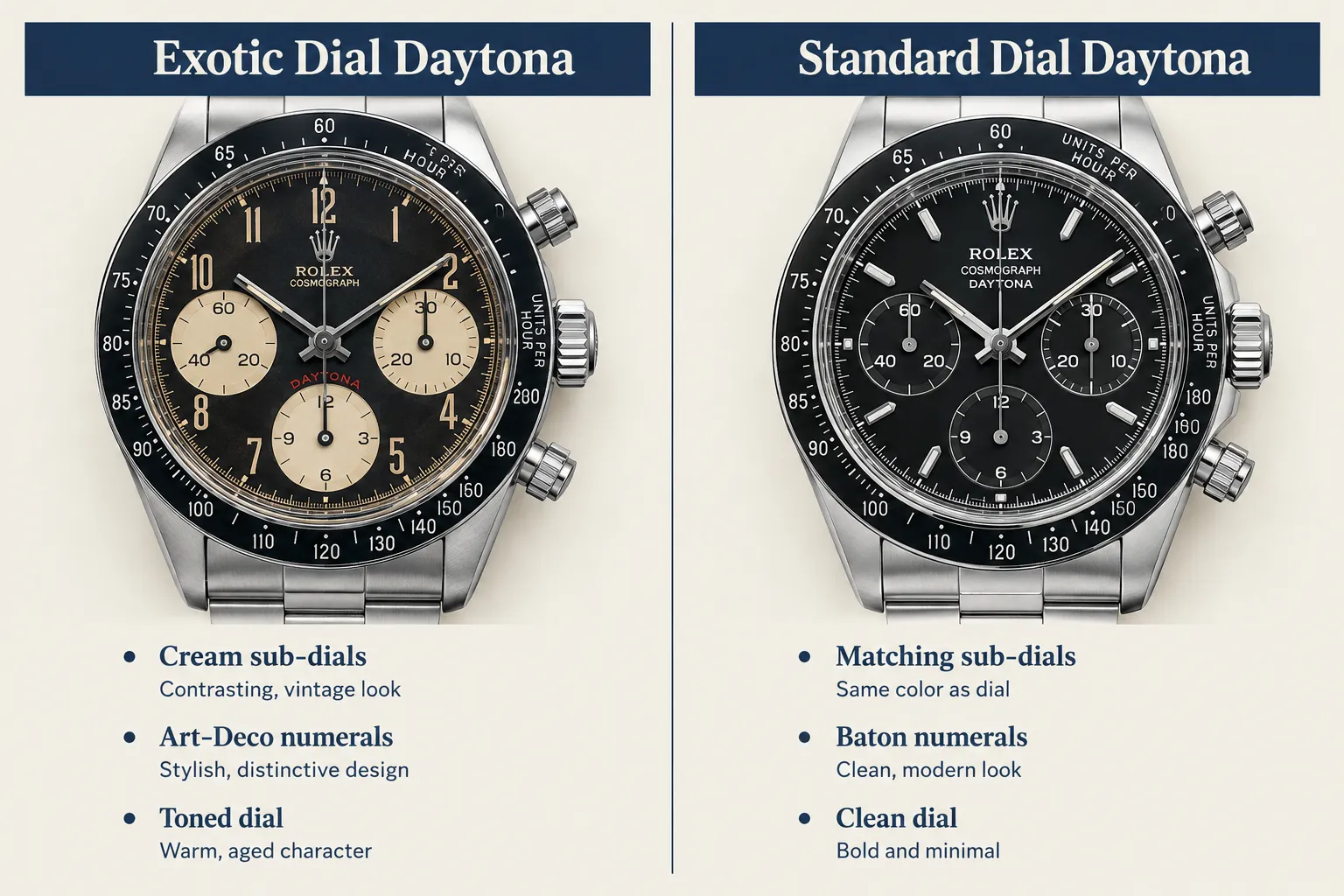
Here is how the two variants compare on the same vintage reference:
| Feature | Standard Dial Daytona | Paul Newman Exotic Dial |
|---|---|---|
| Sub-dial numerals | Simple baton markers | Art-Deco block numerals |
| Sub-dial color | Matches main dial | Contrasts main dial |
| Original production volume | Far more common | Deliberately rare |
| Collector demand | Strong | Exceptional |
| Typical price multiple | Baseline | Often 3x to 10x baseline |
Decision rule: Choose an exotic-dial Paul Newman configuration if dial rarity and long-term appreciation matter more to you than immediate liquidity. Choose a standard-dial vintage Daytona, or a modern production model, if you want a more attainable entry point with easier resale at predictable prices. Modern references such as the 126518LN in white gold or the 126506 platinum Daytona offer contemporary Daytona ownership without the six-figure vintage premium.
What Makes the Paul Newman Daytona Rare?
The Paul Newman Daytona is rare because Rolex produced the exotic dial in far smaller numbers than the standard dial, and decades of wear, sun exposure, and servicing have destroyed or altered many surviving examples. What remains in original, unmolested condition represents a shrinking pool relative to collector demand.
Paul Newman Daytona Production Years
Exotic-dial Daytonas were fitted primarily across references produced from the mid-1960s through the late 1980s. Contemporary collector guides identify the core family as references 6239, 6241, 6262, 6263, 6264, and 6265, spanning roughly 1963 through the mid-1980s before Rolex transitioned the Daytona line to automatic movements, according to the collector’s reference guide on Paul Newman Daytona history.
Rarity within this window comes from several compounding factors:
- Limited original fitment. Exotic dials were never the default configuration; most period Daytonas left the factory with standard dials.
- Fragile printing. The paint and lacquer used on original dials age unevenly, and many dials cracked, faded, or were replaced during routine servicing decades ago.
- Survivorship bias. Many original dials were swapped out for cosmetic reasons before collectors understood their significance, permanently reducing the surviving population.
- Reference-specific scarcity. Certain color combinations, such as the “lemon” dial or red-register variants, were produced in extremely small numbers, pushing them into seven-figure territory.
Edge case: A technically correct reference number does not guarantee an original dial. Always confirm the dial itself is period-correct and unaltered, since a genuine case paired with a later replacement dial changes both authenticity status and value substantially.
How to Spot a Fake Paul Newman Daytona
Spotting a fake or altered Paul Newman Daytona requires checking the dial print, case engravings, movement serial consistency, and full documentation together, because forgers and “Frankenwatch” assemblers typically get at least one of these details wrong. No single feature proves authenticity on its own.
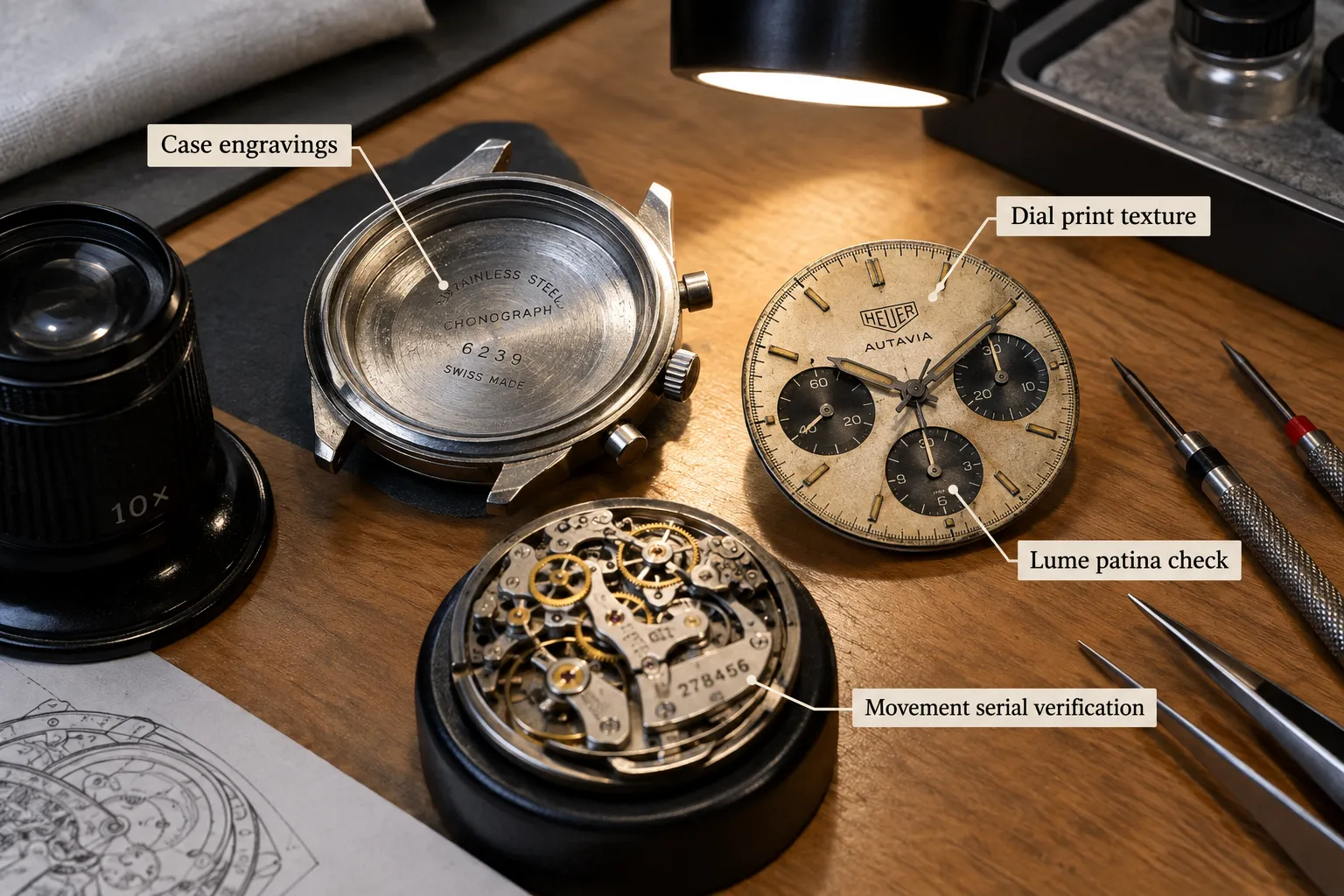
Work through this checklist before committing to a purchase:
- Verify dial font and spacing. Genuine Art-Deco numerals follow consistent period-specific proportions; reproduction dials often show slightly wrong letterforms or spacing.
- Cross-check case and movement serials. Numbers stamped between the lugs and inside the case back should align with the expected production era for that reference.
- Inspect lume plots. Original tritium lume ages with a specific patina; freshly applied or mismatched lume on numerals is a red flag.
- Confirm bezel and pusher originality. Replacement bezels or non-period pushers reduce both authenticity confidence and value.
- Request written authentication. Any reputable seller should provide documentation confirming the dial, case, and movement are period-matched, not assembled from parts.
Common mistake: Relying on photos alone. Dial texture, lume patina, and case engraving depth are extremely difficult to judge from images, which is why in-person inspection or a trusted intermediary matters for purchases at this price level.
Working only with Luxury Watch Experts who guarantee Authenticity Guaranteed on every listing removes most of this risk before it becomes a problem.
Paul Newman Daytona Investment Value: Is It Worth Buying?
The Paul Newman Daytona has performed as one of the strongest alternative assets in the vintage watch category, driven by a shrinking supply and headline auction results that keep reinforcing demand. It is worth buying for collectors who understand the category, can verify authenticity, and are prepared to hold for the long term rather than trade short-term.
Industry trend analysis positions the broader Daytona line, and vintage Paul Newman variants specifically, as a market “juggernaut,” with high-profile auction sales continuing to drive collectibility and reinforce the perception of rare vintage watches as relatively stable alternative assets, as noted in Fortuna Auction’s Rolex market analysis. Fresh-to-market examples continue to validate this. A Ref. 6239 originally owned by a NASA engineer is entering the public market for the first time at Heritage Auctions’ September 2026 Watches & Fine Timepieces sale, a strong signal that first-owner provenance still drives global bidding interest.
Worth considering before buying:
- Choose vintage exotic-dial Daytonas if you have $150,000 or more allocated to a single timepiece, want long-term capital appreciation, and can verify authenticity through a trusted dealer or major auction house.
- Choose a modern Daytona instead if you want Rolex ownership now, prefer factory warranty coverage, and are not focused on speculative appreciation. Even at a market correction, modern production Daytonas trade around $37,995 on the secondary market, remaining Rolex’s most expensive regular-production model and confirming the line’s broader trophy status well below vintage exotic-dial pricing.
For collectors ready to diversify a portfolio or free up capital before a major vintage acquisition, working with a platform that offers a free 24-hour quote to sell your luxury watch provides a practical, low-friction path to fund the next purchase.
Where to Buy an Authentic Paul Newman Daytona
The safest way to buy an authentic Paul Newman Daytona is through an established luxury watch dealer or major auction house that offers Certified Authentic verification, complete documentation, and a transparent return or guarantee policy. Private sales without third-party authentication carry meaningfully higher risk at this price point.
Paul Newman Daytona for Beginners Collectors
First-time buyers entering vintage Daytona collecting should start by studying reference numbers and dial variations before spending, then build toward exotic-dial territory once comfortable identifying originality. A practical path looks like this:
- Study standard-dial vintage Daytonas and modern references first to understand proportions, case finishing, and movement types.
- Work with Luxury Watch Experts who specialize in investment-grade timepieces and can walk through authentication line by line.
- Prioritize Full Set Complete examples, meaning original box, papers, and documentation, since completeness materially affects both trust and resale value.
- Confirm whether the piece is Under Factory Warranty (for modern models) or backed by a dealer’s own authenticity guarantee (for vintage pieces).
Paul Newman Daytona Waiting List: How Long?
There is no factory waiting list for a Paul Newman Daytona, since Rolex has not produced this dial variant in decades. Availability depends entirely on the secondary and auction markets, where Rare & Highly Sought After examples can surface unpredictably and often sell within days of listing when priced correctly.
By contrast, modern Daytona references such as the 126505 in Everose gold, the 126508 platinum Daytona, or the diamond-set 126555TBR often carry genuine authorized-dealer waiting lists, which is part of why serious collectors turn to trusted secondary specialists for Immediate Availability instead of waiting years at retail.
Paul Newman Daytona Common Problems and Issues
The most common problems with Paul Newman Daytonas involve dial originality, component mismatching, and condition issues tied to decades of ownership rather than mechanical defects. Buyers should treat every one of these as a dealbreaker unless fully explained and documented.
Watch for these recurring issues:
- Redialed or refinished dials sold as original, which erases most of the collector premium.
- “Frankenwatch” assembly, where a correct case is paired with mismatched hands, bezel, or crystal from a different era or reference.
- Serial number mismatches between the case, movement, and accompanying paperwork.
- Over-polished cases that soften original edges and reduce both authenticity and value.
- Non-functioning or heavily serviced movements with replacement parts not disclosed at time of sale.
Quick example: Two visually similar Ref. 6263 exotic-dial Daytonas can differ in value by hundreds of thousands of dollars if one has an original, untouched dial and the other has a later service replacement, even though both function correctly and look nearly identical to an untrained eye.
Frequently Asked Questions
What is a Paul Newman Daytona Rolex, in simple terms? It is a vintage Rolex Cosmograph Daytona fitted with a rare “exotic” dial featuring Art-Deco numerals and contrasting sub-dial colors, named after actor Paul Newman, who wore this dial style for decades.
Why is the Paul Newman Daytona so expensive? Its price reflects genuine rarity combined with a record-setting provenance story, most notably Paul Newman’s own watch selling for $17.75 million in 2017, which permanently elevated the entire category.
How much does a Paul Newman Daytona cost today? Authentic examples typically range from about $150,000 to well over $2,000,000, depending on reference number, dial color, condition, and documented history.
What is the difference between a Paul Newman Daytona and a regular Daytona? The Paul Newman version has an exotic dial with Art-Deco numerals and contrasting sub-dial rings, while standard vintage Daytonas use simple matching baton markers.
How can I spot a fake Paul Newman Daytona? Check dial font accuracy, case and movement serial consistency, lume patina, and request written authentication from a reputable dealer or auction house before purchasing.
Is a Paul Newman Daytona a good investment? It has historically performed well for patient collectors who verify authenticity and buy through trusted channels, though it suits long-term holding rather than short-term flipping.
Is there a waiting list for a Paul Newman Daytona? No factory waiting list exists since Rolex no longer produces this dial. Availability depends on secondary market and auction listings, which can be unpredictable.
What years were Paul Newman Daytonas produced? The core exotic-dial references span roughly the mid-1960s through the mid-1980s, across references including 6239, 6241, 6262, 6263, 6264, and 6265.
What makes the Paul Newman Daytona rare? Limited original dial fitment, decades of dial fading and replacement during servicing, and shrinking survivorship of untouched original examples all contribute to its rarity.
Where should I buy an authentic Paul Newman Daytona? Buy only from established luxury watch dealers or major auction houses offering documented authentication, provenance records, and a clear authenticity guarantee.
Conclusion
The Rolex “Paul Newman” Daytona earned its place in collecting history through a rare combination of genuine mechanical scarcity and one of the most compelling provenance stories in auction history. The 2017 sale of Paul Newman’s own watch did not just set a record; it reframed how collectors, investors, and the general public think about vintage watches as serious, appreciating assets.
For collectors ready to enter this category, the path forward is straightforward: study reference numbers and dial variations first, verify authenticity through trusted specialists, and prioritize Full Set Complete examples with documented history over speculative bargains. Those not yet ready for a six-figure vintage commitment can still experience Prestige and Performance through a modern Daytona reference, with the option to trade up later.
Serious buyers should work exclusively with dealers who back every claim with Certified Authentic verification, offer White-Glove Service from inquiry through delivery, and provide Fully Insured Overnight Shipping on Investment-Grade Timepieces. That standard of trust is what separates a confident acquisition from a costly mistake in a market where the details decide everything.