

Brand Deep Dives
Rolex vs. Omega: Which Brand Is Right for You?
Nov
Last updated: November 6, 2026
Quick Answer
Rolex and Omega both produce exceptional Swiss timepieces, but they serve different priorities. Rolex offers stronger resale value, tighter supply, and broader cultural recognition. Omega offers comparable (sometimes superior) technical performance, greater retail availability, and a lower entry price for similar craftsmanship. The right choice depends on whether you prioritize investment performance or immediate ownership of a technically remarkable watch.
Key Takeaways
- Rolex vs. Omega comes down to scarcity and perception versus accessibility and technical parity.
- Rolex generally commands higher resale premiums and holds value better on the secondary market.
- Omega’s Co-Axial escapement and Master Chronometer certification rival or exceed Rolex’s anti-magnetic and chronometer standards.
- Both brands offer five-year international warranties as of recent years.
- Rolex retail scarcity is deliberate; Omega is far easier to walk in and purchase immediately.
- First-time luxury buyers often do better starting with Omega for value, or a steel Rolex Datejust for long-term appeal.
- Neither brand is automatically “better”, the right pick depends on goals, budget, and daily wear habits.
- Full set documentation, box, and papers materially affect resale value for both brands.
What’s the Actual Difference Between Rolex and Omega?
Rolex and Omega differ most in positioning, scarcity, and brand culture rather than raw manufacturing quality. Both are genuine Swiss haute horlogerie houses with in-house movement production, but they occupy different tiers of market perception.
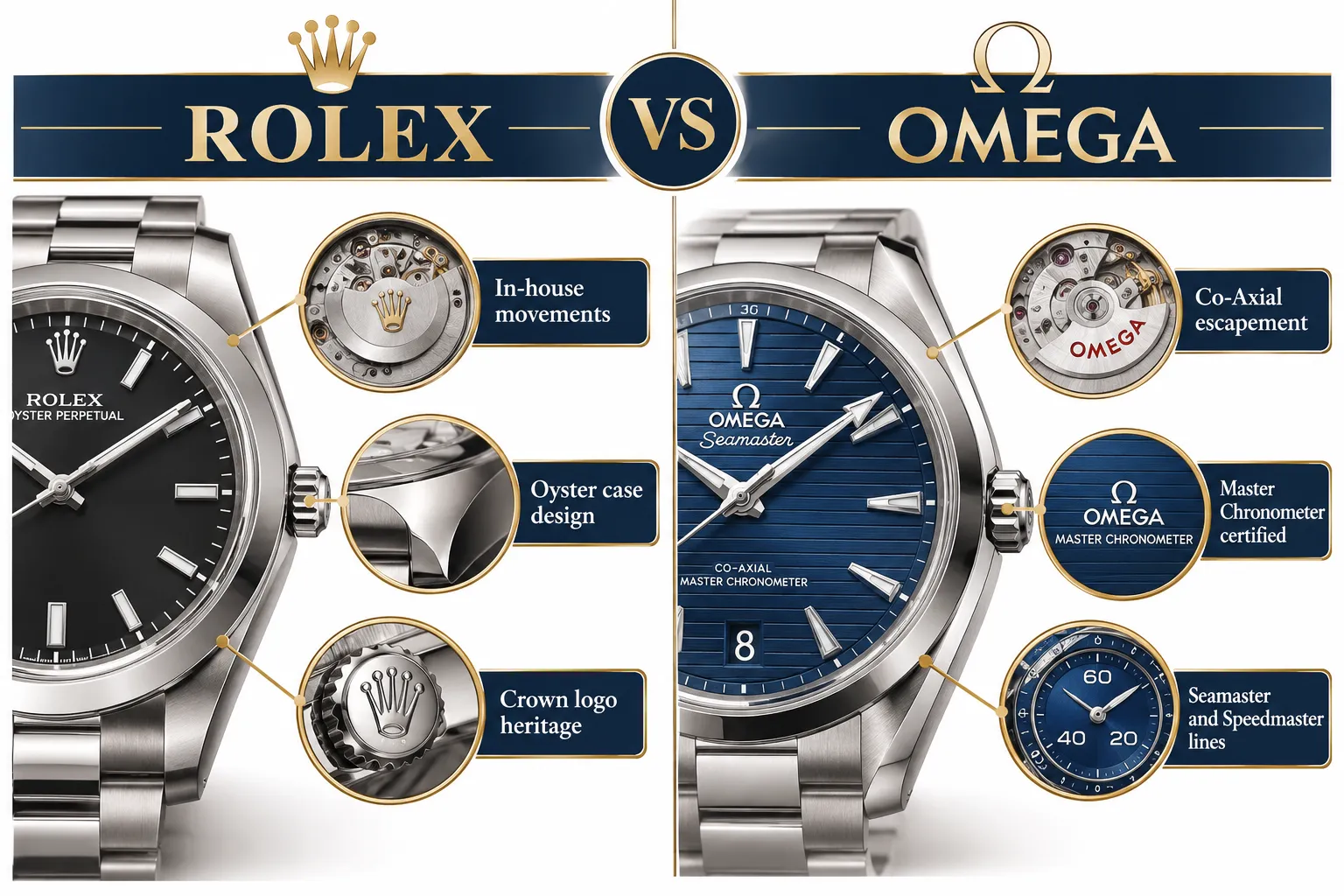
Rolex, headquartered in Geneva, built its identity around the Oyster case, waterproof design, and a tightly controlled distribution model that limits supply even as global demand climbs. Omega, based in Biel, pairs a deep heritage in space exploration and ocean diving with the Co-Axial escapement, a technical innovation licensed from master watchmaker George Daniels that reduces friction and extends service intervals.
- Rolex emphasizes exclusivity, waiting lists, and understated design consistency across decades.
- Omega emphasizes storytelling (moon landings, James Bond, deep-sea diving) and openly markets technical specifications.
- Both brands manufacture their own movements, cases, and bracelets in-house, a mark of true vertical integration few competitors can claim.
Choose Rolex if brand recognition and long-term resale strength matter most. Choose Omega if you want comparable engineering with easier access and a lower price of entry.
Is Rolex More Expensive Than Omega?
Yes. Rolex is generally more expensive than Omega at every comparable tier, both at retail and on the secondary market. A steel Rolex Datejust or Submariner typically starts where Omega’s mid-range Seamaster or De Ville Prestige collection sits, and climbs considerably higher for precious metal or diamond-set references.
A rough 2026 retail comparison:
| Category | Rolex (approx. retail) | Omega (approx. retail) |
|---|---|---|
| Entry steel sport watch | $9,000,$12,000 | $4,500,$6,500 |
| Mid-tier steel/gold combination | $15,000,$25,000 | $7,000,$10,000 |
| Solid gold dress watch | $30,000,$45,000+ | $15,000,$25,000 |
These figures are general market estimates for 2026 and will vary by reference, metal, and dealer. Precious metal Rolex Day-Date models, such as the Rolex Day-Date 228238 with a diamond-paved dial, sit well above Omega’s comparable gold dress pieces like the Omega De Ville Prestige Power Reserve Co-Axial.
Common mistake: Assuming Omega is a “budget” alternative to Rolex. Omega is a full luxury house with its own premium tiers, it is simply positioned below Rolex in overall pricing, not in craftsmanship.
Which Watch Holds Its Value Better, Rolex or Omega?
Rolex holds its value better than Omega in almost every segment of the secondary market. Certain steel sport Rolex references routinely sell above original retail price, a phenomenon rarely seen with Omega.
Why this happens:
- Rolex intentionally restricts production and allocation, creating sustained demand that outpaces supply for flagship steel sport models.
- Omega produces in higher volumes and sells more openly, which keeps secondary prices closer to retail or at a modest discount.
- Discontinued or limited Rolex references (vintage Daytonas, early GMT-Masters) appreciate significantly over time.
- Omega’s appreciation is more selective, vintage Speedmasters tied to space history and rare dial variants do hold strong value, but the broader catalog depreciates like most watch brands.
Decision rule: Choose Rolex steel sport models if resale appreciation is a primary goal. Choose Omega if you’re buying purely for ownership enjoyment and are comfortable with standard depreciation curves.
Rolex vs. Omega for Someone Buying Their First Luxury Watch
For a first luxury watch, Omega often provides a smoother entry point, while a steel Rolex Datejust offers the strongest long-term flexibility. Both are legitimate starting points depending on budget and patience.
Consider this decision framework:
- Budget under $8,000: Omega Seamaster or De Ville gives genuine Swiss mechanical quality without compromise.
- Budget $9,000,$15,000 and willing to wait: A Rolex Datejust, such as the Rolex Datejust 126334 in dark rhodium index Oyster, offers daily versatility and durable value.
- Want immediate purchase with no allocation wait: Omega is almost always available off the shelf.
- Want long-term investment potential: Rolex steel sport models remain the stronger bet.
Edge case: First-time buyers chasing hype models (Daytona, GMT-Master “Pepsi”) will face long waitlists and grey-market markups. A seasoned luxury watch expert can help source these pieces as Certified Authentic, Full Set Complete, and Under Factory Warranty without the guesswork of unverified sellers.
Why Is Rolex So Hard to Get Compared to Omega?
Rolex restricts production volume deliberately, creating structural scarcity that Omega does not replicate at the same scale. This scarcity is a calculated brand strategy, not a manufacturing limitation.
Key reasons for the gap:
- Rolex caps annual output despite extremely high global demand, particularly for steel sport references.
- Authorized dealers maintain waiting lists, often reserving stock for established clients first.
- Omega, while also a prestige brand, produces and distributes more openly, so walk-in purchases of most references are realistic.
- This scarcity is precisely what fuels Rolex’s secondary-market premiums discussed above.
Buyers seeking immediate access to sought-after Rolex references, rather than years on a dealer waitlist, often turn to reputable secondary-market specialists offering immediate availability and fully insured overnight shipping on rare and highly sought after pieces.
Do Omega Watches Last as Long as Rolex?
Yes. Omega watches are built to the same durability standards as Rolex when it comes to case construction, water resistance, and movement longevity. Both brands manufacture movements designed to perform reliably for decades with proper servicing.
What determines longevity for either brand:
- Regular servicing every 5-10 years, regardless of brand.
- Case and bracelet material (steel and precious metals both resist wear well with care).
- Storage conditions and exposure to shocks, moisture, and magnetism.
- Omega’s Master Chronometer certification actually tests for resistance to magnetic fields up to 15,000 gauss, a standard that in some respects exceeds Rolex’s internal testing protocols.
Common mistake: Assuming Rolex is inherently “tougher.” In practice, both brands produce watches intended to function reliably for multiple generations with appropriate maintenance.
Rolex vs. Omega Accuracy and Reliability
Both Rolex and Omega meet or exceed official Swiss chronometer standards, and both offer movements engineered for long-term precision with minimal drift. The difference lies in certification depth rather than everyday performance.
- Rolex certifies its movements as Superlative Chronometers, accurate to -2/+2 seconds per day after casing.
- Omega’s Master Chronometer certification (co-developed with METAS, the Swiss Federal Institute of Metrology) tests accuracy, power reserve, and magnetic resistance under real-world conditions, with a similar daily accuracy tolerance.
- Both standards sit well above the generic Swiss chronometer benchmark most competitors use.
Quick example: An Omega Seamaster Diver 300M, such as the Omega Seamaster Diver 300M Co-Axial, and a Rolex Submariner will both keep time within a few seconds per day in normal wear, the practical difference is negligible for most owners.
How Much Should I Expect to Spend on a Rolex vs. Omega?
Expect to spend roughly 40-60% more for a Rolex than for a comparably positioned Omega at retail, with the gap widening further on the secondary market for in-demand steel sport references. Precious metal and diamond-set pieces widen this gap considerably.
Budget guidance for 2026:
- Omega entry tier: $4,000,$7,000 for Seamaster and De Ville steel models.
- Rolex entry tier: $9,000,$13,000 for Datejust and Oyster Perpetual models in steel.
- Omega gold/precious metal: $12,000,$25,000, depending on complication and metal weight.
- Rolex gold/precious metal: $25,000,$50,000+, with diamond-set Day-Date references like the Rolex Day-Date 228238 silver diagonal in yellow gold reaching the higher end.
Decision rule: Set a firm budget first, then decide which brand’s entry tier fits it comfortably. Stretching into a brand’s lowest tier rarely delivers the same satisfaction as owning a mid-tier piece from the other brand.
What Are People Wrong About When Choosing Between Rolex and Omega?
The most common misconception is that Rolex is always “better” and Omega is a consolation prize. In reality, the two brands excel in different areas, and the right choice depends on personal priorities, not brand hierarchy alone.
Other frequent misunderstandings:
- “Omega can’t match Rolex technically.” False, Omega’s Co-Axial escapement and METAS certification are genuine engineering advantages.
- “Any Rolex is a guaranteed investment.” False, only specific steel sport references consistently appreciate; many Rolex models depreciate like typical luxury goods.
- “Buying secondary market means buying unauthenticated.” False, working with a dealer who offers Certified Authentic pieces with full documentation eliminates this risk entirely.
- “Omega watches are less prestigious for formal settings.” False, Omega’s De Ville Prestige line, including pieces like the Omega De Ville Prestige Watch 424.10.27.60.57.001, is entirely appropriate for formal and executive settings.
Can You Wear a Rolex or Omega Every Day?
Yes, both Rolex and Omega are engineered for daily wear, including sport, travel, and formal use, provided the specific model’s water resistance and case material suit the owner’s lifestyle. Durability was a founding design principle for both brands.
- Steel sport models from either brand (Rolex Submariner, Omega Seamaster) tolerate daily knocks, water exposure, and frequent wear exceptionally well.
- Precious metal dress models, such as the Rolex Day-Date 228235 in Everose gold, can also be worn daily but warrant more careful handling to preserve finish.
- Both brands recommend periodic servicing intervals rather than constant removal, since movement components are designed for continuous wear.
Edge case: Heavy manual labor, frequent magnetic field exposure (MRI machines, industrial equipment), or extreme temperature swings call for a steel sport reference over a delicate dress piece, regardless of brand.
Are There Better Luxury Watch Brands Than Rolex and Omega?
Patek Philippe, Audemars Piguet, and Vacheron Constantin are often considered to sit above Rolex and Omega in haute horlogerie prestige, though “better” depends entirely on what a buyer values. Rolex and Omega remain the two most recognized and most liquid luxury watch brands globally.
- Patek Philippe and Audemars Piguet lead in complicated movements and exclusivity, but at significantly higher price points and even tighter allocation.
- Rolex and Omega offer far greater liquidity on the resale market, meaning they’re easier to buy, sell, and trade with confidence.
- For buyers who want trusted worldwide recognition combined with strong resale infrastructure, Rolex and Omega remain the most practical choices.
Rolex vs. Omega Resale Value After 5 Years
After five years, Rolex steel sport models typically retain or exceed their original retail value, while most Omega models retain a meaningful but lower percentage of retail, generally in the 50-75% range depending on reference and condition. Full set documentation significantly affects both outcomes.
Factors that influence five-year resale for either brand:
- Completeness of box, papers, and original purchase receipt (Full Set Complete listings command the strongest resale prices).
- Whether the watch remains Under Factory Warranty at time of resale.
- Overall condition, service history, and originality of parts.
- Rarity of the specific reference, discontinued dial colors or limited editions outperform standard production runs.
Quick example: A Rolex Datejust with diamond-set markers, like the Rolex Datejust 278273 in black mother-of-pearl diamond, tends to hold value better than a comparable Omega dress watch simply due to sustained demand for the Datejust name.
Which Brand Has Better Customer Service, Rolex or Omega?
Both Rolex and Omega maintain strong authorized service networks, but Omega is generally viewed as more accessible for routine service and retail interactions, while Rolex’s boutique experience is more exclusive and relationship-driven. Neither brand’s customer service is a weak point.
- Rolex authorized dealers often prioritize established clients for both purchases and service scheduling.
- Omega boutiques tend to offer faster walk-in service and more flexible scheduling for routine maintenance.
- Independent luxury watch specialists offering white-glove service can bridge gaps in access for either brand, particularly for buyers who want guidance without navigating waitlists directly.
What’s the Difference in Warranty Between Rolex and Omega Watches?
Both Rolex and Omega currently offer a five-year international warranty on new watches purchased through authorized dealers, a standard both brands adopted in recent years to match evolving luxury industry expectations.
- Rolex’s warranty covers manufacturing defects and includes complimentary service adjustments within the warranty period.
- Omega’s warranty similarly covers manufacturing defects, with Master Chronometer models benefiting from Omega’s rigorous pre-sale testing protocols.
- Pre-owned purchases from reputable dealers can still carry remaining factory warranty if the original purchase date falls within the five-year window, which is why buying watches explicitly listed as Under Factory Warranty carries real value.
A Practical Example: Everyday Steel Watches Compared
A useful real-world comparison is the Rolex Oyster Perpetual 36 against the Omega Aqua Terra 38, two watches frequently cross-shopped by first-time luxury buyers. Both are versatile, daily-wearable steel watches suited to office and casual settings alike.
- The Oyster Perpetual 36 offers Rolex’s signature Oyster case, in-house movement, and stronger long-term resale recognition.
- The Aqua Terra 38 offers Omega’s Co-Axial Master Chronometer movement, comparable finishing, and a notably lower price point.
- Both are excellent “one watch for everything” options; the decision often comes down to brand preference and budget rather than technical superiority.
Structured Guidance: Who Should Pick Which Brand?
The right brand depends on whether a buyer’s top priority is resale performance, technical specification, availability, or budget. Below is a direct decision framework.
- Choose Rolex if: resale value, brand recognition, and long-term holding potential matter most, and a waiting period is acceptable.
- Choose Omega if: immediate availability, strong technical specifications, and lower cost of entry matter most.
- Choose either, as a first watch, if: daily wearability and genuine Swiss craftsmanship are the primary goals, and investment performance is secondary.
- Consider another brand entirely if: complicated movements or ultra-exclusive allocation define the goal more than brand liquidity.
For collectors exploring sport references beyond these two staples, pieces like the Rolex Yacht-Master 226658 in black dial or the Omega Speedmaster Co-Axial Chronograph represent strong middle-ground options worth comparing side by side.
FAQ
Is Omega owned by the same company as Rolex? No. Rolex is privately held through the Hans Wilsdorf Foundation, while Omega is part of the Swatch Group, a publicly traded conglomerate that owns multiple watch brands.
Which brand is easier to resell quickly? Rolex is generally easier to resell quickly due to higher demand and stronger secondary-market liquidity, particularly for steel sport references.
Does Omega use in-house movements like Rolex? Yes. Omega manufactures its own Co-Axial movements in-house, matching Rolex’s commitment to vertical integration and proprietary engineering.
Are vintage Omega watches valuable? Yes, certain vintage Omega references, especially Speedmasters tied to space exploration history, can command strong prices among collectors.
Can a Rolex or Omega be a good investment? Select steel sport Rolex references have historically outperformed retail price, but most watches from either brand should be viewed primarily as luxury goods, not guaranteed investments.
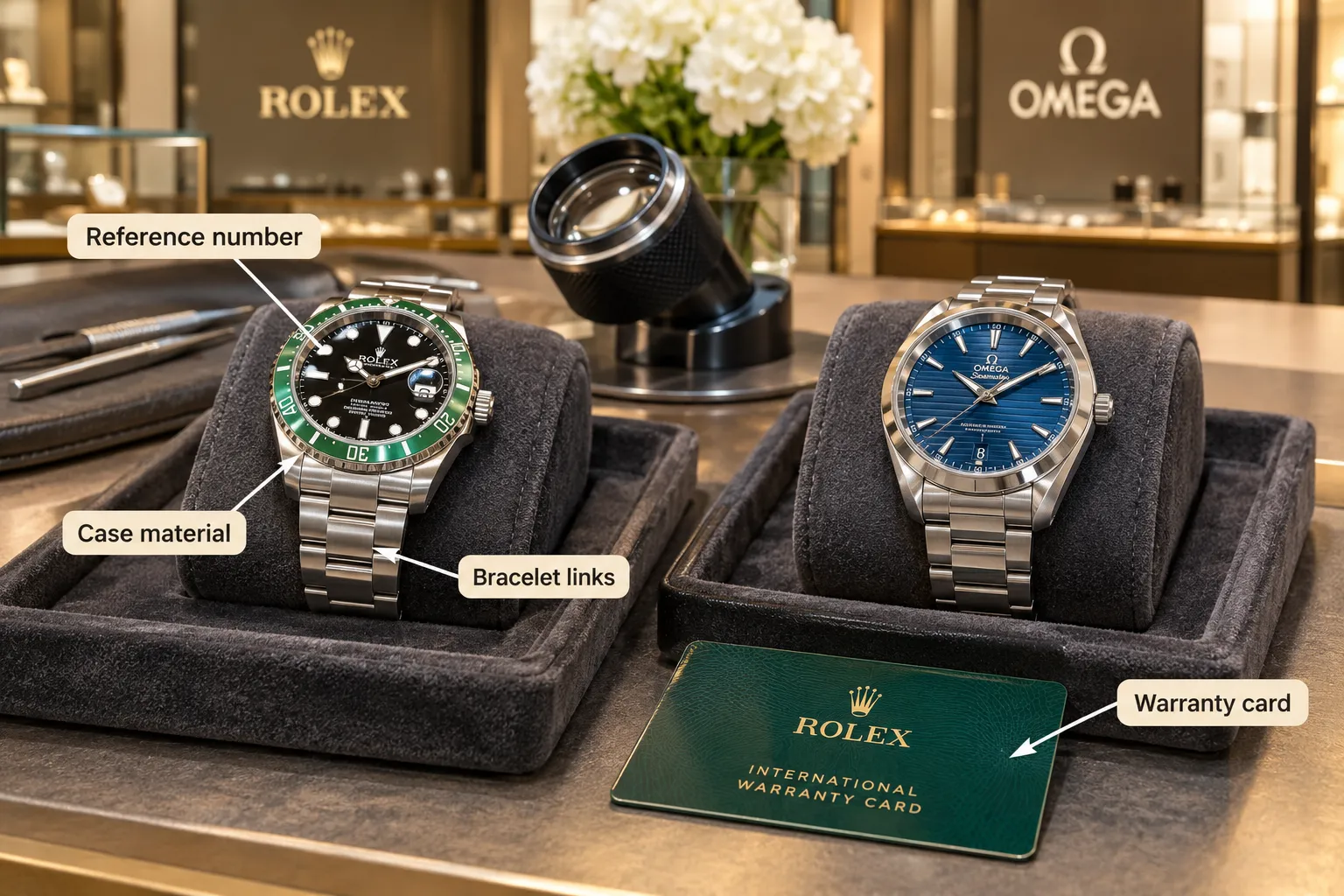
What should I check before buying a pre-owned Rolex or Omega? Verify authenticity, confirm reference number against documentation, inspect for Full Set Complete status (box and papers), and confirm whether factory warranty remains active.
Is Omega considered a status symbol like Rolex? Yes, though to a somewhat lesser degree. Omega carries strong recognition, particularly through its association with space exploration and film, but Rolex remains more universally recognized across cultures.
How often should a Rolex or Omega be serviced? Most manufacturers recommend service every 5 to 10 years, depending on usage and movement type, to maintain accuracy and water resistance.
Conclusion
Rolex vs. Omega is not a contest with a single winner. Rolex delivers unmatched scarcity, resale strength, and global brand equity for buyers focused on long-term value. Omega delivers comparable Swiss engineering, broader availability, and meaningful savings for buyers who want prestige without the waitlist.
The smartest next step is matching the decision to personal priorities rather than brand reputation alone. Buyers chasing resale performance should focus on steel sport Rolex references. Buyers prioritizing immediate ownership and technical specification should look closely at Omega’s Master Chronometer collection. Either path, when sourced through a trusted dealer offering Certified Authentic, Investment-Grade Timepieces with full documentation, leads to confident, lasting ownership.
Serious buyers are encouraged to review current exclusive collection listings, compare specific reference numbers side by side, and consult with experienced luxury watch experts before finalizing a purchase of this caliber.