

Complications & Tech
Minute Repeaters: The Most Impressive Complication Explained
Nov
Last updated: November 4, 2026
Quick Answer
A minute repeater is a mechanical watch complication that chimes the exact time on demand, striking hours, quarter-hours, and minutes through tuned gongs activated by a slide or push piece. It remains the most difficult and expensive complication to produce because it requires near-perfect acoustic engineering inside a case smaller than a matchbox. Modern references from Audemars Piguet, Jaeger-LeCoultre, Patek Philippe, and Piaget now command six and seven figures, making the minute repeater the definitive marker of horological mastery.
Key Takeaways
- A minute repeater chimes the time acoustically using hammers striking gongs, following a fixed hours-quarters-minutes sequence.
- Prices typically start around $150,000 and climb well past $1 million for grand complications with added features.
- Minute repeaters differ fundamentally from tourbillons, which solve a timekeeping problem rather than an acoustic one.
- Brands like Audemars Piguet, Jaeger-LeCoultre, Piaget, Jacob & Co., and Patek Philippe each take distinct engineering approaches to sound quality.
- An “all-or-nothing” safety mechanism prevents damage if the slide is only partially engaged.
- You cannot find a genuine minute repeater under $10,000; this complication sits at the top of the price ladder, not the entry point.
- Service and repair require specialist watchmakers, since few technicians worldwide are trained on chiming mechanisms.
- Collectors buy minute repeaters for craftsmanship and rarity rather than practical timekeeping needs.
What Exactly Is a Minute Repeater in a Watch
A minute repeater is a striking complication that announces the exact time in sound, on command, by chiming hours, quarter-hours, and minutes through a sequence of hammer strikes on tuned gongs. Unlike an alarm or a chronograph, it does not operate automatically; the wearer activates it manually, usually by pushing a slide along the case side.
The complication dates back centuries, originally built so owners could tell the time in the dark without a candle. Today, that practical purpose has faded, but the mechanical theater has only grown more prized. Jaeger-LeCoultre describes its repeater calibres as reading the exact time before striking it with small “trebuchet” hammers, producing distinct tones for each unit of time, which is why enthusiasts often call the complication a miniature musical instrument rather than a mere timekeeping tool, as noted in Jaeger-LeCoultre’s own technical overview.
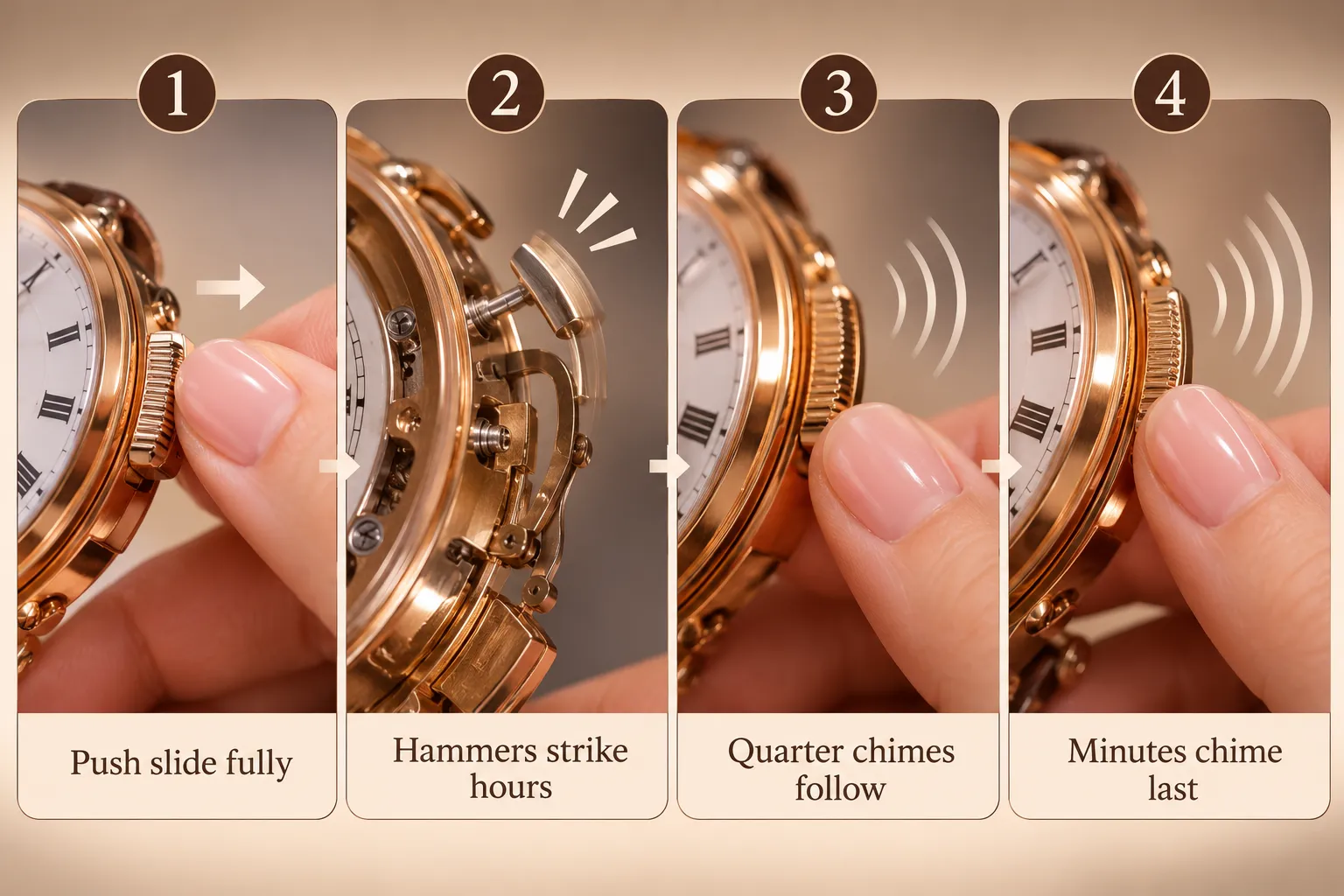
A chime at 7:47, for example, strikes seven low tones for the hours, three double tones for the quarters, and two high tones for the remaining minutes, a sequencing method explained clearly by Cortina Watch’s breakdown of the mechanism.
How Does a Minute Repeater Actually Work Mechanically
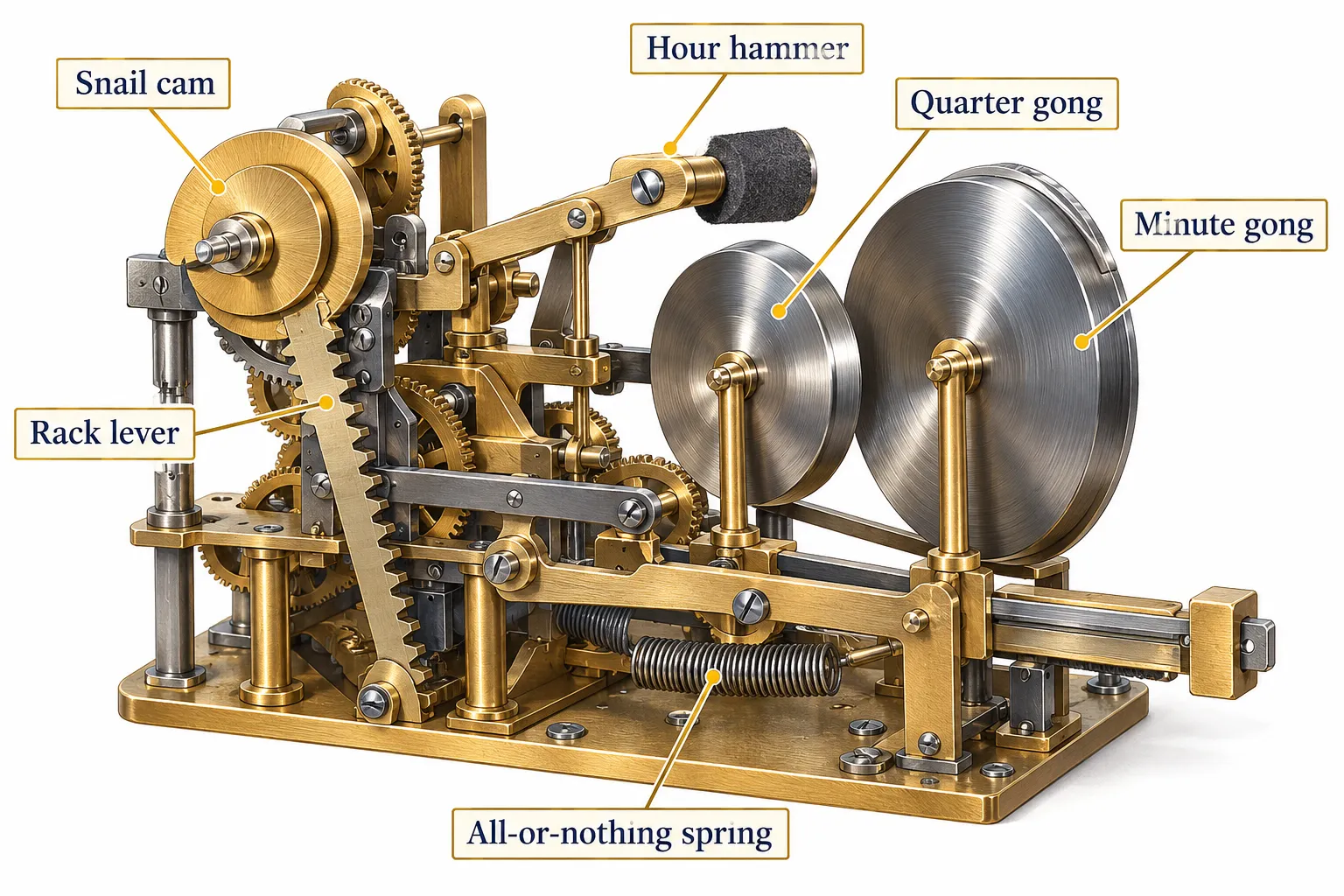
A minute repeater works by using a rack-and-snail cam system to physically “read” the position of the hour, quarter, and minute wheels, then releasing a set of hammers that strike gongs coiled around the movement’s perimeter. The entire sequence takes only a few seconds but relies on dozens of interacting parts working in exact order.
The process, step by step:
- The wearer slides the activation piece along the case side.
- A rack lever drops against a snail-shaped cam tied to the hour wheel, counting the hours.
- A second rack reads the quarter-hour cam.
- A third rack reads the minutes elapsed since the last quarter.
- Hammers strike the gongs in sequence: low tone for hours, two-tone chime for quarters, high tone for minutes.
Jaeger-LeCoultre notes that its calibres use an “all-or-nothing” mechanism, which only begins the chiming sequence once the slide is fully engaged, protecting the gear train from damage caused by a half-pressed activation, a safety feature detailed in its official minute repeater explainer. This single design detail is why minute repeaters are so rarely found broken from user error, even after decades of use.
How Much Does a Minute Repeater Watch Cost
A genuine minute repeater watch typically starts around $150,000 and frequently exceeds $500,000 to $1 million for pieces combining the complication with a tourbillon, perpetual calendar, or precious materials. Price depends heavily on brand heritage, case metal, movement finishing, and limited-edition status.
Recent examples illustrate the spread clearly. Audemars Piguet’s November 2026 expansion of the Royal Oak and Code 11.59 lines added five new Supersonnerie references, all built on the Calibre 2953 with a 72-hour power reserve, as covered by Hypebeast’s report on the new Supersonnerie models. Jacob & Co.’s 40th-anniversary minute repeater, limited to just 12 pieces and built around the manually wound Caliber JCCM04 with 308 components, represents the ultra-rare end of the market, according to Hypebeast’s coverage of the anniversary release. Patek Philippe’s ref. 5531G-013 “Milan After Dark” enamel edition, produced in only five pieces, sits firmly among the most collectible repeaters ever offered, as reported in coverage of the brand’s 2026 Watch Art Grand Exhibition in Milan.
For buyers who want to explore grand complications in this price tier, MioJewelry’s Patek Philippe grand complications collection offers Certified Authentic pieces with Full Set Complete documentation.
What’s the Difference Between a Minute Repeater and a Tourbillon
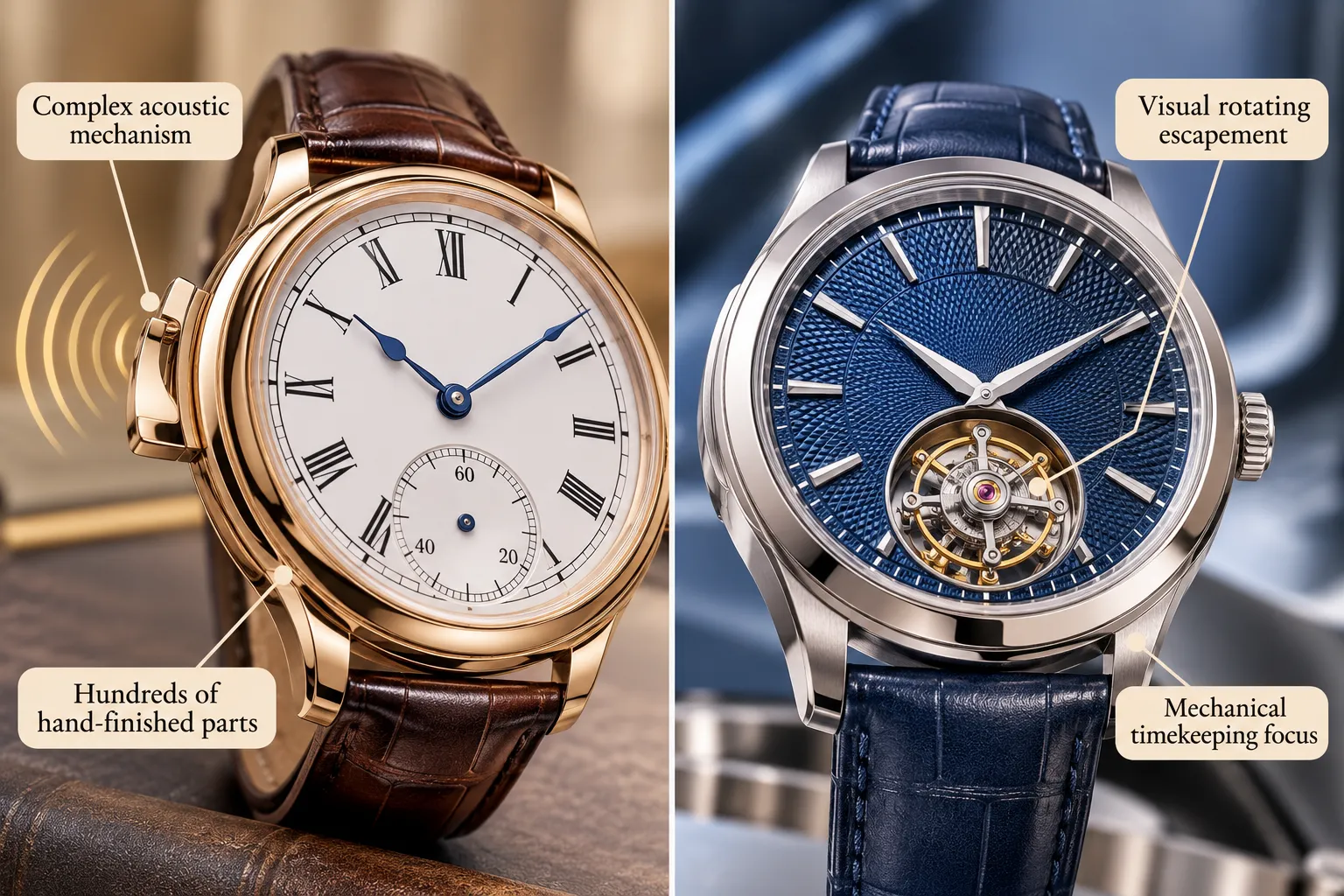
A minute repeater solves an acoustic problem; a tourbillon solves a gravitational timekeeping problem. The two complications are often paired in the same watch, but they address entirely different engineering challenges.
| Feature | Minute Repeater | Tourbillon |
|---|---|---|
| Purpose | Chimes time acoustically on demand | Counteracts gravity’s effect on rate accuracy |
| Visibility | Mostly heard, sometimes partly seen through dial openings | Visually prominent rotating cage |
| Activation | Manual, via slide or push piece | Runs continuously, automatic |
| Complexity driver | Acoustic tuning, hammer timing, case resonance | Precision pivot and cage balance |
| Typical pairing | Often combined with tourbillon in grand complications | Often combined with repeater or perpetual calendar |
H. Moser & Cie. frames the minute repeater as the “queen of complications” precisely because it demands both exact mechanical time-reading and musically pleasing sound, a dual challenge the tourbillon does not share, as explained in the brand’s knowledge piece on repeaters.
Why Are Minute Repeaters So Hard and Expensive to Make
Minute repeaters are hard to make because they demand two simultaneous mastery levels: flawless mechanical time-reading and tuned acoustic performance inside a space smaller than a coin. A single poorly finished gong, hammer, or soundboard can turn a world-class movement into a muted, unpleasant chime.
Audemars Piguet spent eight years developing its Supersonnerie technology with watchmakers, musicians, and researchers from EPFL to solve this exact problem, mounting gongs on a dedicated soundboard rather than the mainplate to boost volume and clarity without distortion, according to Haute Time’s coverage of the Supersonnerie Code 11.59 release. That approach reframes the complication as something closer to acoustic art than a time-telling feature, a point also made in Man of Many’s review of the 2026 Royal Oak Supersonnerie.
Piaget took a different route with its 2026 Polo Minute Repeater, built on the ultra-thin Calibre 1290P and tuned so its notes strike in G-sharp and A-sharp in the fifth octave, activated via a slide at 9 o’clock, as detailed by T3’s report on the world’s thinnest minute repeater. Fitting a resonant chiming mechanism into an ultra-thin case multiplies the engineering difficulty considerably.
Who Actually Buys and Wears Minute Repeater Watches
Minute repeater buyers are typically seasoned collectors, luxury investors, and executives who already own strong watch collections and are seeking the pinnacle complication rather than a first luxury purchase. These buyers value craftsmanship, rarity, and provenance over practical function.
Common buyer profiles include:
- Collectors completing a “grand slam” of complications (tourbillon, perpetual calendar, minute repeater)
- High-net-worth individuals diversifying into investment-grade timepieces
- Entrepreneurs marking milestones with a signature acquisition
- Repeat luxury buyers upgrading from chronographs or simple complications
MioJewelry’s team of Luxury Watch Experts regularly guides first-time high-complication buyers through authentication, provenance checks, and Full Set Complete verification before acquisition, ensuring every piece is Certified Authentic and Authenticity Guaranteed.
Is a Minute Repeater Worth It or Just Hype
A minute repeater is worth the investment for serious collectors who value mechanical artistry, rarity, and long-term appreciation, but it is not worth it for buyers seeking a practical, everyday timekeeping tool. The complication’s value lies in craftsmanship and scarcity, not daily utility.
Decision rule: choose a minute repeater if you already own foundational complications and want the rarest mechanical achievement available; skip it if your priority is accurate daily timekeeping or a first luxury watch purchase. Patek Philippe’s continued emphasis on minute repeaters as centerpieces of its Watch Art Grand Exhibitions, including the ref. 5531 World Time Minute Repeater, confirms sustained collector demand rather than fading hype.
What Other Watch Complications Should I Know About
Beyond minute repeaters, the most respected complications include the tourbillon, perpetual calendar, annual calendar, and chronograph, each solving a distinct mechanical or functional problem. Understanding these helps buyers calibrate expectations before stepping up to a repeater.
- Annual calendar: tracks date and month, adjusting automatically for most months; see MioJewelry’s Patek Philippe Complications Annual Calendar watch.
- Perpetual calendar with moonphase: adjusts for leap years and tracks lunar cycles; explore the Patek Philippe Complications Moonphase watch.
- Grand complication combining multiple functions: the 6300 series grand complications pair minute repeaters with perpetual calendars and tourbillons.
- Ladies’ complications: see the Patek Philippe Rose Gold Ladies Complications 4968.
Can You Get a Minute Repeater for Under 10,000 Dollars
No, a genuine minute repeater watch cannot be purchased for under $10,000; the complication’s hand-finishing, acoustic engineering, and low production volumes keep entry prices far above $150,000. Any listing claiming a true minute repeater at that price should be treated as a red flag for authenticity.
Common mistake: confusing a minute repeater with a simpler striking function, such as a basic alarm or a decorative “chime” module with no acoustic precision. True repeaters require rack-and-snail cam systems and tuned gongs, components not found in budget watches. Buyers should always confirm authenticity through a trusted dealer offering Authenticity Guaranteed documentation.
What Happens if a Minute Repeater Breaks
If a minute repeater malfunctions, the watch should go directly to a specialist watchmaker trained in chiming complications, since standard watch technicians rarely have the tools or experience to service gongs, hammers, and the rack-and-snail system safely. Attempting a repair without specialized training risks permanent damage.
Edge case: a repeater that sounds muffled or uneven is not always “broken” in a mechanical sense; it may simply need gong repositioning or soundboard adjustment, a tuning issue rather than a failure. This is precisely why brands like Audemars Piguet invested years refining soundboard architecture rather than treating acoustic performance as an afterthought.
How Do You Even Use a Minute Repeater Watch
To use a minute repeater, the wearer engages the slide or push piece fully along the case side, which triggers the rack-and-snail cams to read the current time before the hammers chime hours, quarters, and minutes in sequence. The entire process takes just a few seconds and requires no winding beyond the watch’s normal power reserve.
Quick example: a wearer at a quiet dinner table slides the activator on a Jaeger-LeCoultre Reverso Tribute Minute Repeater, hears seven low tones, two double-tone quarters, and three high tones, and instantly knows it reads 7:33, all without glancing at the dial.
Do Minute Repeaters Keep Accurate Time Over Years
Yes, minute repeaters keep time with the same accuracy as the base movement they are built on, since the chiming mechanism operates independently of the timekeeping gear train. Regular servicing every five to seven years is recommended to preserve both rate accuracy and chime clarity.
Choose a repeater with a longer power reserve, such as Audemars Piguet’s Calibre 2953 with its 72-hour reserve, if you plan to wear the watch intermittently rather than daily, since repeaters left unwound for extended periods may need more frequent resets.
What’s Easier to Make Than a Minute Repeater
Nearly every other mechanical complication is easier to produce than a minute repeater, including chronographs, date complications, and even tourbillons, because none require simultaneous mechanical time-reading and acoustic tuning. A chronograph, for example, only needs precise start-stop-reset timing, not sound engineering.
This relative difficulty explains why brands market minute repeaters at a premium far beyond other grand complications, and why Piaget’s achievement of fitting one into an ultra-thin case drew significant industry attention.
How Do Minute Repeaters Work in Loud Places
Minute repeaters are designed primarily for quiet environments, since their chime volume, while improved by technologies like Supersonnerie, still cannot compete with loud ambient noise such as traffic or crowds. In a noisy restaurant or street, the chime may be difficult or impossible to hear clearly.
Audemars Piguet’s Supersonnerie technology was specifically engineered to amplify chime volume and clarity using a resonance-optimized caseback and dedicated soundboard, a notable improvement over traditional repeaters that often sounded muted when cased in solid metal. Even so, minute repeaters remain best appreciated in quiet, intentional listening moments rather than as a practical tool for checking time at a loud event.
Conclusion
Minute repeaters remain the single most demanding complication in mechanical watchmaking, requiring exact time-reading mechanics fused with genuine acoustic engineering. From Jaeger-LeCoultre’s Reverso Tribute to Audemars Piguet’s Supersonnerie line and Patek Philippe’s Watch Art showpieces, 2026’s releases confirm that brands are still pushing this complication’s boundaries rather than resting on tradition.
For collectors ready to pursue a minute repeater or any grand complication, the next step is working with Luxury Watch Experts who can verify Full Set Complete documentation, confirm the piece is Under Factory Warranty where applicable, and arrange Fully Insured Overnight Shipping for Immediate Availability. MioJewelry’s Exclusive Collection of Rare & Highly Sought After timepieces, Trusted Worldwide by serious buyers, offers a discreet, White-Glove Service path into this rarefied segment of Investment-Grade Timepieces.
Frequently Asked Questions
What exactly is a minute repeater in a watch
A minute repeater is a complication that chimes the exact time on demand using hammers striking tuned gongs, following a fixed sequence of hours, quarter-hours, and minutes, activated manually by a slide or push piece.
How much does a minute repeater watch cost
Genuine minute repeaters start around $150,000 and often exceed $1 million for pieces combining additional complications like tourbillons or perpetual calendars, with limited editions commanding even higher premiums.
Can you get a minute repeater for under 10000 dollars
No, authentic minute repeaters cannot be found under $10,000 due to the extreme hand-finishing and acoustic engineering required; any such listing should be treated with suspicion.
What’s the difference between a minute repeater and a tourbillon
A minute repeater chimes the time acoustically on demand, while a tourbillon continuously counteracts gravity’s effect on rate accuracy; they address entirely different engineering problems and are sometimes combined.
Why are minute repeaters so expensive to make
They require simultaneous mastery of mechanical time-reading and acoustic tuning inside a tiny case, a dual challenge that few watchmakers worldwide can execute to a musically pleasing standard.
Who buys minute repeater watches
Primarily experienced collectors, luxury investors, and executives who already own foundational complications and are seeking the rarest mechanical achievement for their collection.
What happens if a minute repeater breaks
The watch should be sent to a specialist watchmaker trained specifically in chiming complications, since general watch technicians typically lack the training to safely service hammers, gongs, and rack-and-snail systems.
How do you use a minute repeater watch
The wearer fully engages the slide or push piece along the case side, which triggers the mechanism to read and chime the current time in hours, quarters, and minutes within a few seconds.