

Blog
The Difference Between New, Pre-Owned, and Vintage Luxury Watches
Mar
Last updated: March 27, 2026
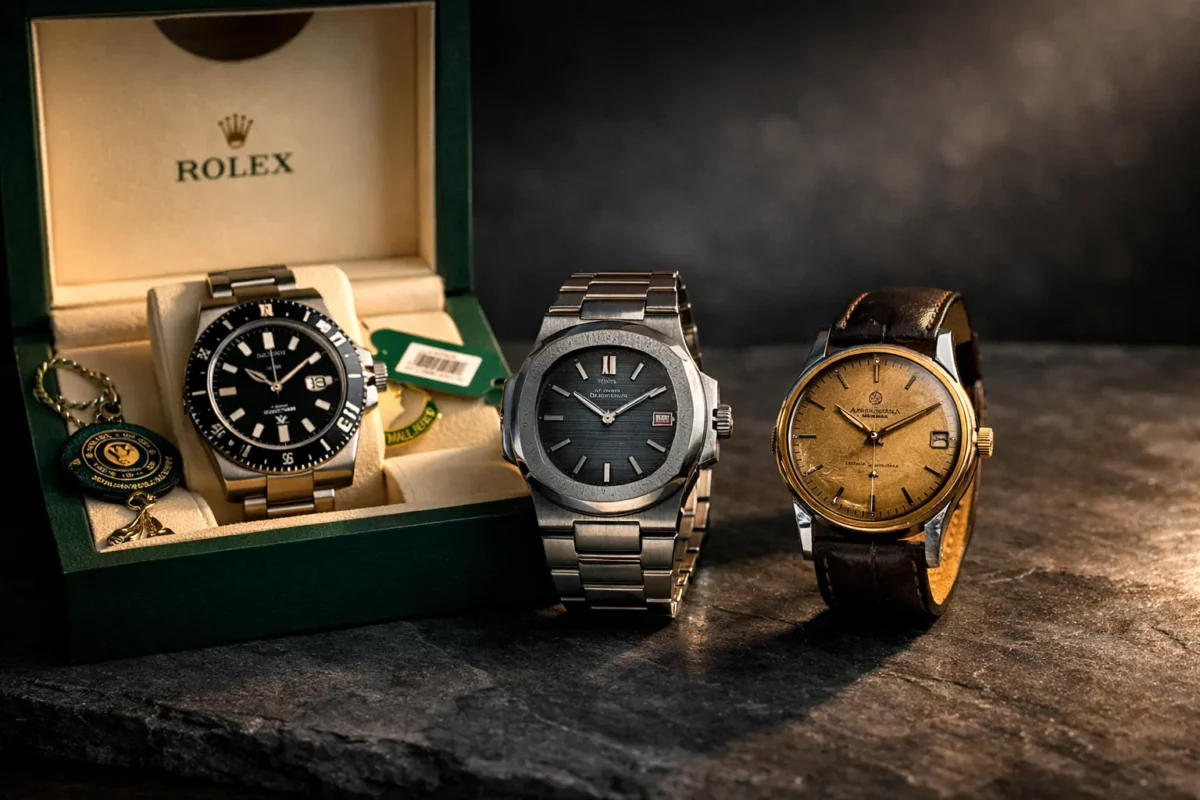
Quick Answer: New luxury watches offer factory warranties and full documentation but carry an immediate premium. Pre-owned watches deliver the same craftsmanship at reduced cost, often with strong resale value. Vintage watches — generally 30 or more years old — represent horological history and can command significant collector premiums, but require specialized expertise to evaluate. Understanding the difference between new, pre-owned, and vintage luxury watches is essential before committing to any serious purchase.
Key Takeaways
- New watches come with manufacturer warranties, complete box and papers, and zero wear history — but retail pricing rarely reflects secondary market value.
- Pre-owned watches typically sell at a discount to retail and can represent exceptional value, especially for discontinued or hard-to-allocate references.
- Vintage watches (generally 30+ years old) are driven by collector demand, rarity, and originality — condition and provenance matter enormously.
- A “full set complete” (box, papers, tags, and accessories) adds measurable value across all three categories.
- Authenticity verification is non-negotiable. Work only with trusted, certified dealers.
- Investment potential varies significantly by category, brand, reference, and condition.
- Servicing costs for vintage pieces can be substantially higher than for modern watches.
- The pre-owned market has matured considerably — certified pre-owned programs from reputable dealers now offer protections comparable to new purchases.
What Exactly Defines a New, Pre-Owned, or Vintage Luxury Watch?
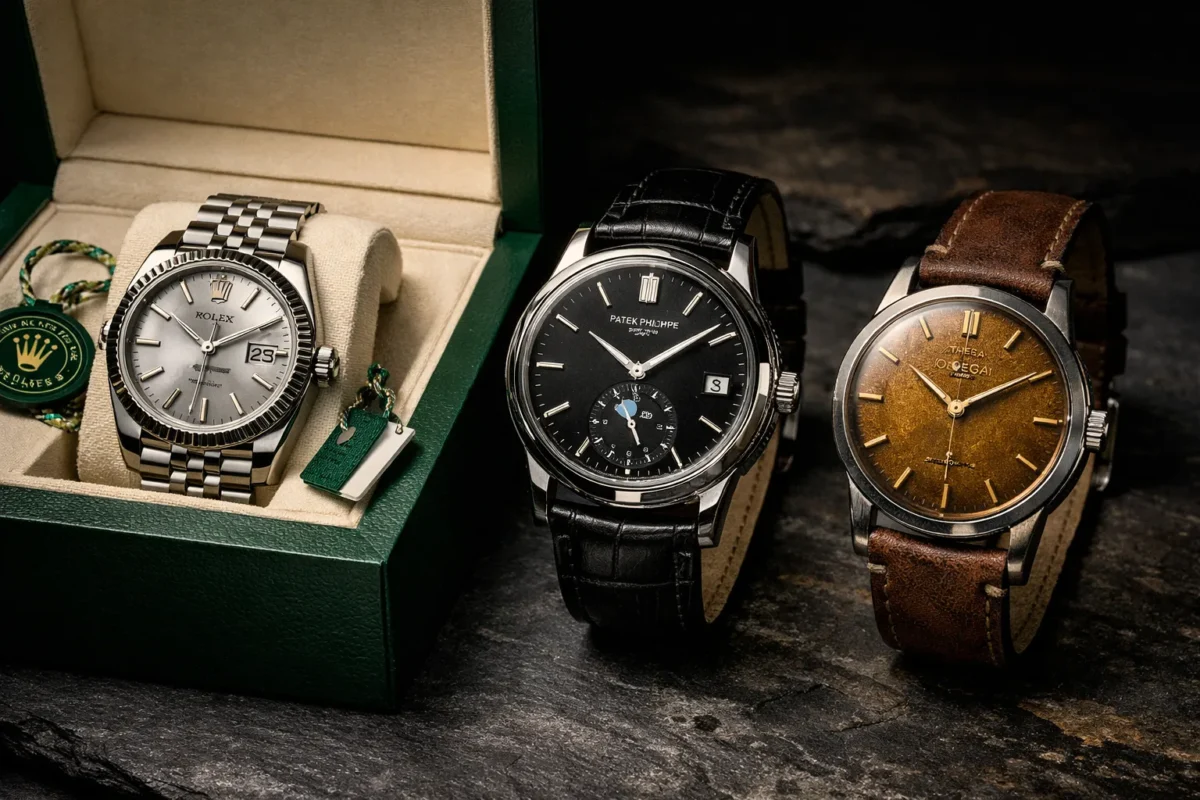
These three categories are distinct, and the differences go well beyond age. Each carries its own pricing logic, documentation standards, and buyer expectations.
New: A watch sold directly by an authorized dealer or the manufacturer, never worn, with all original packaging, warranty card, and documentation intact. The warranty is active and transferable. Retail price is set by the brand.
Pre-owned: Any watch that has had at least one previous owner. This includes lightly worn examples with full box and papers (“full set”), as well as watches sold without documentation. Age can range from a few months to several decades.
Vintage: The industry generally applies this term to watches produced 30 or more years ago — though some collectors and auction houses use a 25-year threshold. What distinguishes vintage from simply “old pre-owned” is collector recognition: a vintage watch carries historical significance, design heritage, and often, irreplaceable original parts.
“A vintage Rolex Daytona ref. 6263 from the early 1970s isn’t just a used watch — it’s a document of horological history, and the market prices it accordingly.”
Why Does the Difference Between New, Pre-Owned, and Vintage Luxury Watches Matter for Buyers?
The category you buy in determines your price, your risk profile, your documentation, and your potential return. Getting this wrong is one of the most common mistakes first-time luxury watch buyers make.
For investment-minded buyers: Pre-owned and vintage watches in strong references (Rolex Submariner, Patek Philippe Nautilus, Audemars Piguet Royal Oak) have historically held or increased in value. New watches, by contrast, typically depreciate the moment they leave an authorized dealer — unless the reference is heavily allocated or discontinued. For deeper context, the High-Value Luxury Watch Models Investment Guide covers specific references worth tracking.
For first-time buyers: A new watch offers simplicity — full warranty, no questions about condition or history. But the premium paid for that peace of mind can be substantial.
For serious collectors: Vintage is often the only path to references that no longer exist. A 1960s Omega Constellation or an early Patek Philippe Calatrava cannot be purchased new. The history of wrist watches provides useful context for understanding why certain eras produced such enduring designs.
Choose new if: You want a factory warranty, zero wear history, and the full brand experience. Choose pre-owned if: You want value, immediate availability on hard-to-allocate references, or a specific discontinued model. Choose vintage if: You’re a collector seeking historical significance, original patina, or a reference that simply cannot be sourced new.
How Are New Luxury Watches Priced and What Do You Actually Get?
New luxury watches are priced at manufacturer-set retail, which authorized dealers are contractually obligated to honor. What you receive in return is comprehensive.
What comes with a new luxury watch:
- Original manufacturer’s box (outer and inner)
- Warranty card, stamped and dated by the dealer
- Instruction manual and chronometer certificate (where applicable)
- Hang tags and any additional bracelet links
- Full manufacturer warranty (typically 2–5 years depending on brand)
The challenge with buying new in 2026 is allocation. Brands like Rolex, Patek Philippe, and Audemars Piguet produce far fewer pieces than the market demands for their most desirable references. Waitlists at authorized dealers can stretch years. This supply constraint is precisely why the secondary market for certain new-condition watches trades at a significant premium above retail.
Common mistake: Assuming that buying new always means paying less than pre-owned. For highly allocated references — the Rolex Submariner ref. 126610LN, for example — pre-owned prices in excellent condition may reflect market demand more accurately than the retail sticker.
For buyers who want to understand what drives pricing at the brand level, why Swiss watches are so expensive is a useful read.
What Should Buyers Know About Pre-Owned Luxury Watches?
Pre-owned luxury watches represent the most accessible entry point into serious horology. The category is broad, and condition grading matters more here than anywhere else.
Condition grades commonly used in the market:
| Grade | Description |
|---|---|
| Unworn / Mint | Never worn, may lack papers or box |
| Excellent | Minimal wear, sharp edges, no deep scratches |
| Very Good | Light surface marks, fully functional |
| Good | Visible wear, may need service |
| Fair | Heavy wear, possible replacement parts |
A pre-owned watch described as “full set complete” — with original box, papers, hang tags, and accessories — commands a meaningful premium over the same reference sold without documentation. This is not cosmetic. Papers verify authenticity, establish production date, and protect resale value.
What to verify before buying pre-owned:
- Reference number and serial number match the accompanying papers
- Dial, hands, and case are original (not refinished or replaced)
- Movement has been recently serviced or is due for service
- The seller is a certified, reputable dealer with a clear return policy
Reputable dealers offer certified pre-owned programs with authenticity guarantees. MioJewelry’s online luxury watch store features investment-grade pre-owned timepieces with full authentication and Authenticity Guaranteed on every piece.
Edge case: A watch with aftermarket parts — a replacement dial, non-original crown, or polished case — can look excellent but carries significantly reduced collector value. Always ask explicitly whether all components are original.
What Makes a Watch Truly Vintage, and Why Do Collectors Pay a Premium?
Vintage watches occupy a category defined by age, originality, and historical significance. The premium collectors pay is not nostalgia — it’s a function of scarcity, irreproducibility, and documented provenance.

A watch qualifies as vintage when it meets several criteria simultaneously:
- Age: Generally 30+ years from production date
- Originality: Dial, hands, case, and movement are unmodified and unpolished
- Significance: The reference holds collector recognition — either for design, movement, or historical context
- Condition: Original patina (the natural aging of lume and dial) is considered desirable, not a defect
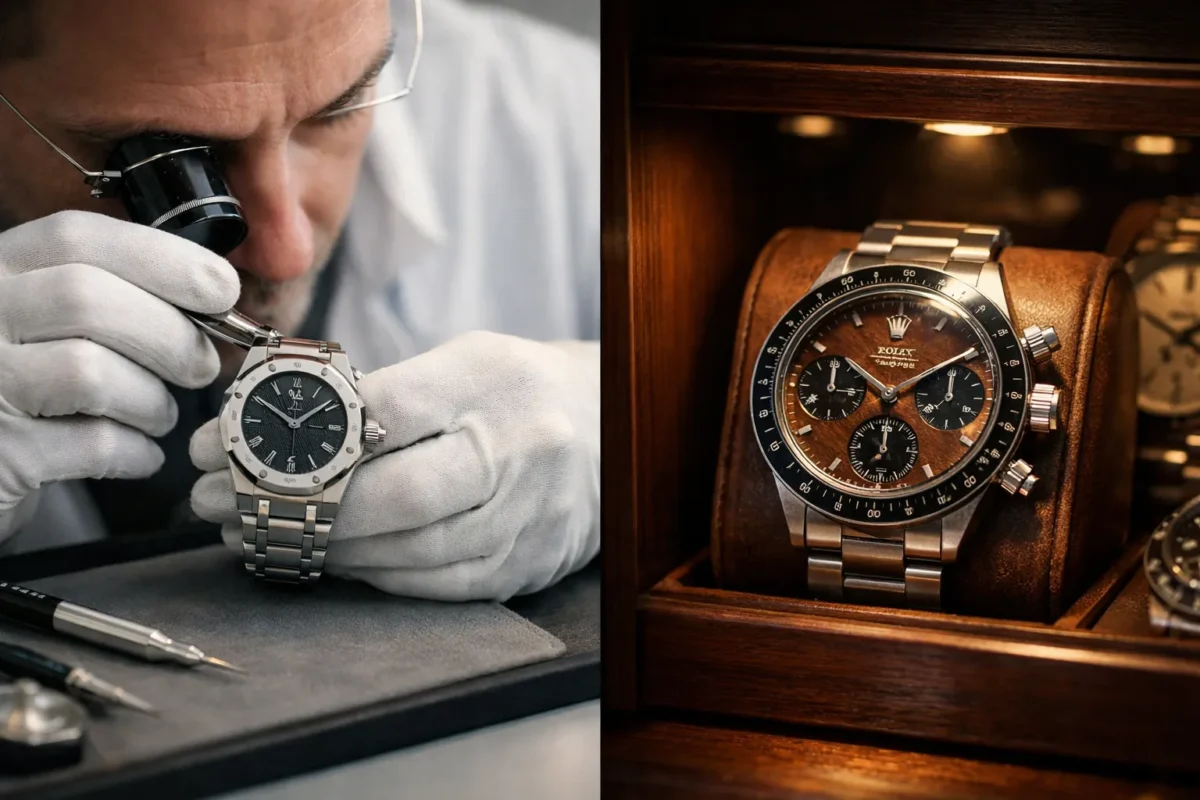
The most sought-after vintage references in 2026 include early Rolex Daytona “Paul Newman” dials, Patek Philippe Calatrava references from the 1940s–1960s, and Omega Speedmaster Pre-Moon examples. These pieces are rare, highly sought after, and command prices that reflect genuine scarcity rather than brand marketing.
Why patina matters: A vintage dial with original tritium lume that has aged to a warm cream or “tropical” brown tone is more desirable — and more valuable — than a replaced or refinished dial. Originality is the single most important factor in vintage watch valuation.
Servicing considerations: Vintage movements require watchmakers with specialized expertise. Parts may need to be custom-made or sourced from donor movements. Service costs can be substantial. For buyers new to watch maintenance, understanding how to properly store and protect luxury watches is a practical starting point.
How Do Investment Returns Compare Across New, Pre-Owned, and Vintage?
Investment performance varies significantly by category, reference, and market timing. No category guarantees appreciation, but historical patterns offer useful guidance.
General patterns (based on secondary market behavior):
- New watches from highly allocated brands (Rolex, Patek, AP) have historically appreciated, but this is reference-specific and market-dependent. Most new watches depreciate.
- Pre-owned watches in complete condition and strong references have shown resilience. The secondary market for certified pre-owned has matured significantly, with liquidity improving across major platforms and dealers.
- Vintage watches at the top tier (significant references in original condition) have outperformed many traditional asset classes over multi-decade periods, according to auction results tracked by Christie’s and Phillips. However, this applies to a narrow segment of the market — not all vintage watches appreciate.
Key variables that affect investment value:
- Reference number (some are far more collectible than others)
- Completeness (box and papers add 10–30% in many cases)
- Condition and originality
- Provenance (documented ownership history)
- Brand positioning and long-term desirability
For buyers approaching this as a serious financial decision, the luxury watch investment guide covers specific references and brand trajectories in detail.
Decision rule: If capital preservation is the primary goal, focus on pre-owned full-set examples of established references from Rolex, Patek Philippe, or Audemars Piguet. If long-term appreciation is the goal and expertise is available, select vintage pieces with documented provenance and original components.
What Are the Biggest Risks in Each Category — and How Do You Avoid Them?
Every category carries specific risks. Knowing them in advance separates informed buyers from expensive lessons.
New watches:
- Risk: Paying significant above-retail premiums for allocated pieces that later normalize in price.
- Mitigation: Buy at authorized retail when possible. Avoid gray market markups unless the reference is genuinely scarce and the dealer is reputable.
Pre-owned watches:
- Risk: Undisclosed service history, replaced parts, or outright counterfeits.
- Mitigation: Purchase only from certified dealers with explicit authenticity guarantees. Request full service history. Verify serial and reference numbers independently.
Vintage watches:
- Risk: Restored or “frankenwatch” pieces assembled from multiple donor watches. Refinished dials. Incorrect or replaced movements.
- Mitigation: Work with specialists who have deep vintage expertise. Request independent authentication for high-value purchases. Understand that a polished case on a vintage watch is not a cosmetic issue — it destroys collector value.
MioJewelry’s team of luxury watch experts provides white-glove service and thorough authentication across all three categories. Buyers with specific requirements can submit special requests for rare and collectible watches directly.
How to Choose Between New, Pre-Owned, and Vintage: A Practical Framework
Understanding the difference between new, pre-owned, and vintage luxury watches is most useful when translated into a clear decision framework.
Step 1: Define your primary objective
- Wearing and enjoying daily: Pre-owned in excellent condition offers the best value.
- Brand experience and warranty: New is the appropriate choice.
- Collecting and long-term appreciation: Vintage or pre-owned in strong references.
Step 2: Set a realistic budget
- New luxury watches from top brands typically start at $5,000–$10,000 for entry-level references and extend well into six figures.
- Pre-owned opens up access to references above your new-watch budget.
- Vintage pricing is highly variable — set aside budget for potential service costs.
Step 3: Identify your reference
- Use resources like the Ultimate Guide to Choosing Your Perfect Luxury Watch to narrow down brands, complications, and case sizes before approaching a dealer.
- Understanding watch movements helps clarify what you’re buying technically.
Step 4: Verify authenticity and condition
- Never skip this step regardless of category.
- For pre-owned and vintage, request independent authentication or buy from a dealer with an explicit authenticity guarantee.
Step 5: Confirm documentation
- Full set (box, papers, tags) is always preferable.
- For vintage, original papers may not exist — but any available documentation adds value.
FAQ: New vs. Pre-Owned vs. Vintage Luxury Watches
Q: Is a pre-owned luxury watch worth buying? Yes. A pre-owned luxury watch in excellent condition from a reputable dealer offers the same quality as new at a meaningful discount — and in many cases, better availability on desirable references.
Q: What is the age threshold for a vintage watch? Most dealers and auction houses apply a 30-year threshold, though some use 25 years. The reference must also carry collector recognition — age alone does not make a watch vintage.
Q: Do pre-owned watches come with a warranty? They do not carry the original manufacturer warranty unless purchased under a certified pre-owned program. Reputable dealers typically offer their own warranty period — often 12–24 months — on pre-owned pieces.
Q: Does box and papers really matter that much? Yes. A complete set (box and papers) typically adds 10–30% to resale value depending on the reference. For vintage pieces, original papers can be the difference between a collector piece and a generic used watch.
Q: Can a vintage watch be a daily wearer? Yes, but with caveats. Vintage watches require more careful handling, are generally not water-resistant to modern standards, and need more frequent servicing. Many collectors reserve vintage pieces for occasional wear.
Q: How do I know if a pre-owned watch is authentic? Purchase from a certified dealer with a written authenticity guarantee. Verify the serial number against the reference and papers. Have high-value purchases independently authenticated by a qualified watchmaker.
Q: Which category appreciates most in value? Vintage watches in original condition and strong references have historically shown the strongest long-term appreciation, but this applies to a narrow segment. Pre-owned full-set examples of allocated references (Rolex, Patek, AP) have also performed well.
Q: What does “tropical dial” mean in vintage watches? A tropical dial refers to a vintage watch dial — typically black or brown — that has aged to a warm brown or caramel tone due to chemical changes in the lacquer over decades. Tropical dials are highly sought after and command significant premiums.
Q: Is it safe to buy a luxury watch online? Yes, when purchasing from an established, reputable dealer with clear authentication standards, a return policy, and insured shipping. MioJewelry offers fully insured overnight shipping and Authenticity Guaranteed on every piece.
Q: What’s the best first luxury watch to buy? For most buyers, a pre-owned example of an established reference — a Rolex Datejust, Omega Seamaster, or entry-level Cartier — offers the best combination of quality, value, and long-term wearability. See the complete guide to choosing your perfect luxury watch for a structured approach.
Conclusion: Making the Right Choice for Your Collection
The difference between new, pre-owned, and vintage luxury watches is not simply a matter of age or price. Each category represents a distinct value proposition, risk profile, and ownership experience.
New watches offer certainty — warranty, documentation, and the full brand experience — at a premium. Pre-owned watches offer access and value, with the secondary market now mature enough to provide strong buyer protections when working with the right dealer. Vintage watches offer something neither of the other categories can: a direct connection to horological history, original craftsmanship, and a scarcity that only increases with time.
Actionable next steps for serious buyers:
- Define your objective — wearing, collecting, or investing — before approaching any dealer.
- Research specific references using trusted resources before committing to a category.
- Work exclusively with certified, reputable dealers who provide written authenticity guarantees.
- Prioritize complete sets (box and papers) whenever possible.
- For vintage purchases, budget for professional servicing and independent authentication.
MioJewelry’s exclusive collection of investment-grade timepieces spans all three categories, with every piece backed by full authentication and white-glove client service. Whether you’re acquiring your first serious timepiece or expanding an established collection, the team is available to guide every step of the process.