

Brand History & Storytelling
The History of Rolex: From a London Bedsit to a $13B Empire
Sep
Last updated: September 7, 2026
Quick Answer: Rolex was founded in 1905 by Hans Wilsdorf and Alfred Davis in a modest London office. Over the following century, Wilsdorf moved the company to Geneva, pioneered the world’s first waterproof wristwatch case, and built a brand now valued by independent analysts at well over $13 billion. The history of Rolex: from a London bedsit to a $13B empire is a story of relentless technical ambition, disciplined brand stewardship, and an almost singular refusal to compromise on quality.
Key Takeaways
- Hans Wilsdorf co-founded Rolex in London in 1905 and relocated it to Geneva in 1919, largely to escape punishing British wartime import duties.
- The 1926 Oyster case, the world’s first truly waterproof wristwatch, established Rolex’s identity as a precision tool-watch maker.
- Rolex did not invent the automatic movement, but it perfected the self-winding rotor mechanism with the 1931 Perpetual, which became the industry standard.
- The Submariner launched in 1953 and the Daytona in 1963 are now among the most valuable and sought-after references in the secondary market.
- James Bond wore a Rolex Submariner in the early films, cementing the watch’s cultural status far beyond the dive community.
- Rolex has been owned by the Hans Wilsdorf Foundation since 1944, it is not publicly traded and has no private shareholders.
- Modern Rolex watches are significantly more accurate, durable, and valuable than their vintage counterparts, though vintage references command extraordinary premiums among collectors.
- Demand consistently outpaces supply, a deliberate policy that keeps authorized dealer wait lists long and secondary market premiums high.
- In 2026, Rolex is celebrating the centenary of the Oyster case and introduced Jubilee Gold, a new proprietary 18-carat alloy, alongside 58 new references at Watches & Wonders.
Who Founded Rolex and When Did It Start
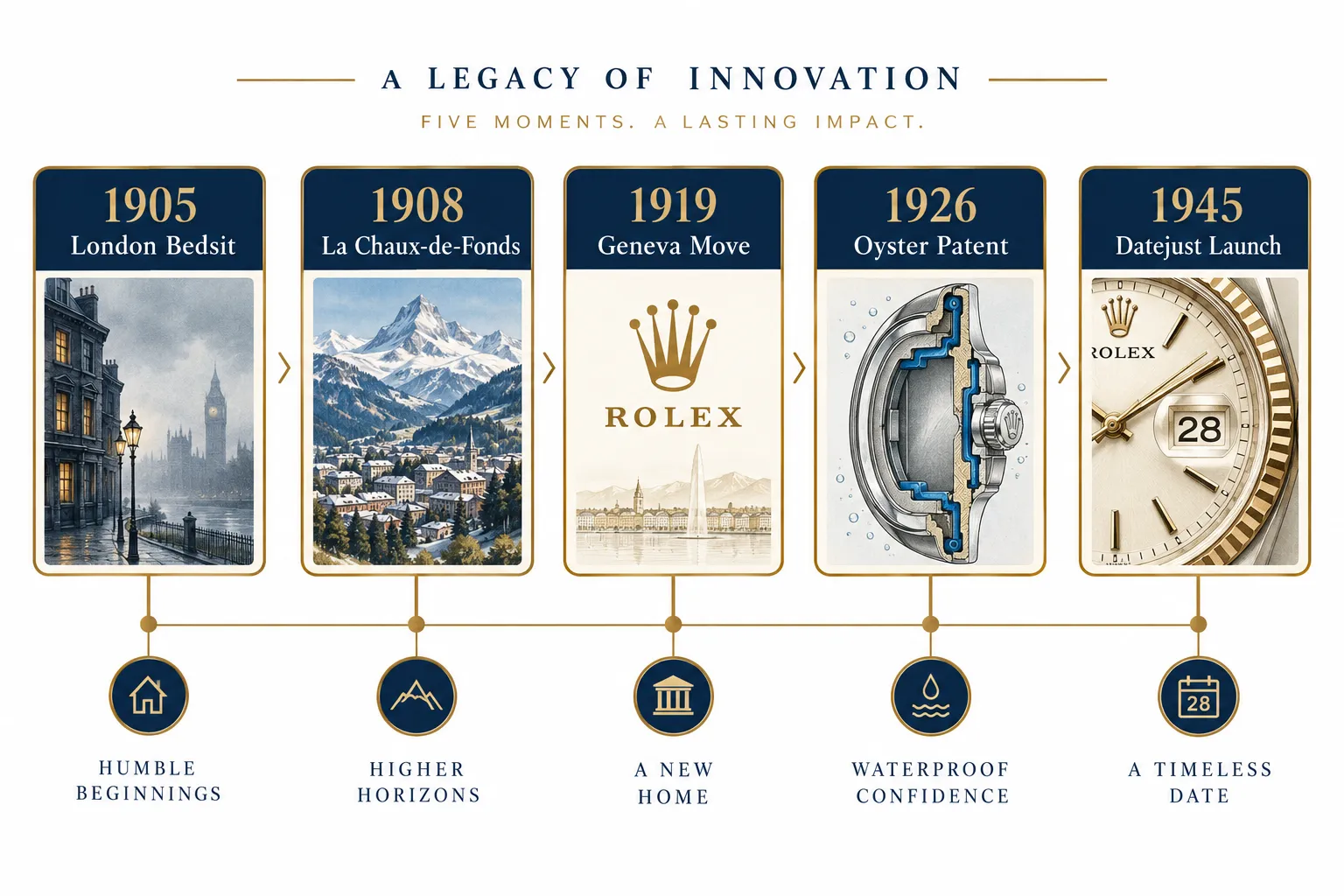
Rolex was co-founded by Hans Wilsdorf and his brother-in-law Alfred Davis in London in 1905. The company was initially registered as Wilsdorf & Davis and operated from a small Hatton Garden office, the “London bedsit” that gives the history of Rolex: from a London bedsit to a $13B empire its evocative starting point.
Wilsdorf was born in Bavaria in 1881 and moved to London after working for a Swiss watch parts supplier. He had a clear vision: to make the wristwatch, then considered a flimsy novelty worn mostly by women, into a precise, reliable instrument for men. At the time, pocket watches dominated, and the wristwatch was widely dismissed by the horological establishment.
Wilsdorf sourced movements from the Swiss manufacturer Aegler and had them cased and sold under the Rolex name, which he registered in 1908. He chose the name deliberately: it was short, easy to pronounce in any language, and fit neatly on a watch dial. The company’s early years were defined by Wilsdorf’s obsession with accuracy. By 1910, a Rolex wristwatch became the first wristwatch to receive a Class A precision certificate from the Official Watch Rating Centre in Bienne, Switzerland.
Why Did Hans Wilsdorf Move Rolex From London to Geneva
Wilsdorf relocated Rolex from London to Geneva in 1919, driven primarily by punishing British wartime import duties on Swiss watch movements that made the London operation financially unsustainable.
During World War One, the British government imposed heavy tariffs on imported goods, including Swiss watch components. These duties, combined with a postwar economic climate that made London an increasingly expensive base, left Wilsdorf with little choice. Geneva offered proximity to Swiss suppliers, a favorable tax environment, and a prestigious address that aligned with Wilsdorf’s ambitions for the brand.
The move proved transformative. In Geneva, Wilsdorf incorporated the Montres Rolex S.A. and gained direct access to the finest Swiss watchmaking talent and infrastructure. The city’s reputation for precision craftsmanship lent immediate credibility to the brand. Within a decade of the move, Rolex would file the patent that changed the watch industry forever.
How Did Rolex Get Famous for Being Reliable and Waterproof
Rolex’s reputation for reliability and waterproofing is rooted in the 1926 introduction of the Oyster case, the world’s first hermetically sealed wristwatch case. Hans Wilsdorf patented a system of screw-down crown, caseback, and bezel that locked out water, dust, and moisture with a level of security no wristwatch had previously achieved.
To prove the Oyster’s capability, Wilsdorf arranged one of the most effective marketing stunts in watchmaking history. In 1927, he equipped British swimmer Mercedes Gleitze with an Oyster for her attempt to swim the English Channel. Gleitze wore the watch around her neck for over ten hours in cold open water. When she emerged, the Rolex Oyster was functioning perfectly. Wilsdorf took out a full-page advertisement in the Daily Mail the following day, announcing the result to the world.
What made this different from competitors:
- Most watches of the era used simple snap-back cases that offered no meaningful water resistance.
- The Oyster’s triple-lock system, crown, caseback, and bezel all screwing down independently, created a sealed chamber for the movement.
- The design was so sound that its fundamental architecture remains the basis of every Rolex Oyster case produced today, including the current Rolex Sea-Dweller 126600 Oyster Perpetual.
In 2026, Rolex is marking the centenary of the Oyster patent under the “Oyster Story” theme, reinforcing the case as the single most important technical achievement in the brand’s history. The company also tightened its Superlative Chronometer standard in 2026, raising accuracy and testing requirements for all new watches as part of this centenary messaging.
What Made Rolex Watches Different From Other Brands in the Early 1900s
In the early twentieth century, Rolex distinguished itself through a combination of precision certification, marketing discipline, and genuine technical innovation, at a time when most watchmakers competed primarily on aesthetics or price.
Three factors set Rolex apart:
- Accuracy certification. Wilsdorf pursued independent chronometer certifications aggressively, using them as proof points in advertising. This was unusual. Most manufacturers relied on their own claims; Wilsdorf wanted third-party validation.
- The wristwatch as a serious instrument. While competitors focused on pocket watches, Wilsdorf bet entirely on the wristwatch’s future. He invested in making wristwatches accurate enough to be trusted by professionals.
- Controlled distribution and brand consistency. From the early years, Wilsdorf was careful about where and how Rolex was sold, avoiding the discount channels that eroded other brands’ prestige.
These principles, precision, professional credibility, and distribution control, are still the pillars of Rolex’s brand strategy in 2026.
Did Rolex Invent the Automatic Watch or the Chronograph
Rolex did not invent the automatic watch, but it made the self-winding mechanism practical for everyday use. The company introduced the Perpetual rotor in 1931, a 360-degree oscillating weight that winds the mainspring through the natural motion of the wearer’s wrist, and this design became the template that most of the industry eventually adopted.
Earlier self-winding mechanisms existed, notably Abraham-Louis Perrelet’s 18th-century pocket watch rotor and John Harwood’s 1923 wristwatch design. Rolex’s contribution was engineering a rotor that was efficient, reliable, and compact enough to work consistently in a small wristwatch case. The Perpetual mechanism was so well-designed that it remains, in evolved form, the basis of every modern Rolex automatic movement.
On the chronograph: Rolex did not invent the chronograph either. The Cosmograph Daytona, launched in 1963, used a Valjoux-based manual-wind movement for its first decades. However, Rolex’s contribution was building the Daytona into the world’s most recognized sports chronograph through association with motorsport, controlled supply, and decades of consistent positioning.
When Did Rolex Start Making the Submariner and Daytona
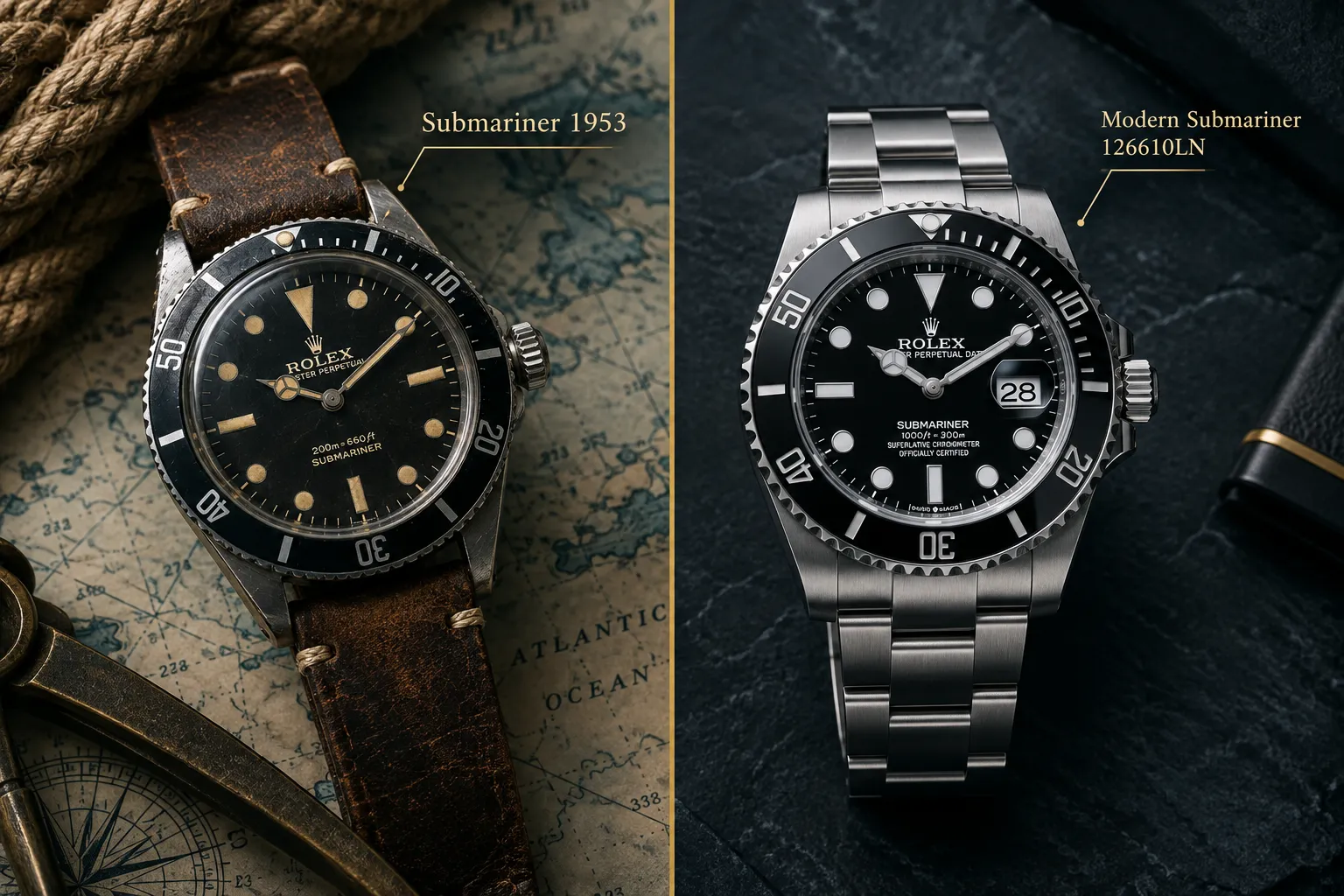
The Submariner was introduced in 1953 at the Basel Watch Fair, making it one of the earliest purpose-built dive watches in history. The Daytona, officially the Cosmograph Daytona, launched in 1963, named after the Daytona International Speedway in Florida and marketed to racing drivers who needed a precise elapsed-time tool.
The Submariner’s significance:
- The original reference 6204 was water-resistant to 100 meters, a substantial rating for 1953.
- It was adopted by professional divers, military units, and explorers almost immediately.
- Its clean, legible dial and rotating bezel set the visual template for virtually every dive watch that followed.
- The current Submariner reference 126610LN is water-resistant to 300 meters and houses Rolex’s in-house calibre 3235.
The Daytona’s significance:
- Early Daytona references, particularly the “Paul Newman” dial variants from the late 1960s, are now among the most valuable wristwatches ever sold at auction.
- Paul Newman’s personal Daytona reference 6239 sold at Phillips in 2017 for $17.75 million, setting a world record for any Rolex at auction.
- The current Cosmograph Daytona continues to carry some of the longest authorized dealer wait lists of any watch in production.
What Role Did James Bond Play in Making Rolex Popular
James Bond’s association with Rolex Submariner in the early films was a defining cultural moment that connected the watch to espionage, adventure, and masculine sophistication for a global audience.
Sean Connery wore a Rolex Submariner, most notably reference 6538, in the first five Bond films, beginning with Dr. No in 1962. This was not a formal product placement in the modern sense; the watch was chosen by costume designers as an appropriate prop for a spy who needed a robust, professional-grade instrument. The timing was significant: the Submariner was only nine years old, and the films gave it an aspirational identity that advertising alone could not have created.
The Bond association reinforced several qualities Rolex had been building since the 1920s: reliability under pressure, professional credibility, and understated authority. By the time Roger Moore took over the role in the 1970s (and Bond switched to Seiko and later Omega), the Submariner’s cultural position was already secure.
How Did Rolex Survive During World War Two
Rolex survived World War Two through a combination of Swiss neutrality, financial ingenuity, and a remarkable humanitarian gesture that simultaneously generated goodwill and revenue.
Switzerland’s neutral status protected Rolex’s Geneva manufacturing base from the disruptions that devastated watchmakers in occupied France and Germany. But Wilsdorf’s most celebrated wartime move was his offer to Allied prisoners of war. When POWs wrote to Rolex requesting watches, having lost their own to captivity, Wilsdorf supplied them on credit, asking only that they settle the account after the war ended. Thousands of watches were sent to POW camps across Europe and Asia. The vast majority of debts were honored when the war concluded, and the gesture generated enormous loyalty and press coverage.
This episode illustrates a consistent thread in the history of Rolex: from a London bedsit to a $13B empire, the brand’s ability to combine genuine generosity with shrewd long-term brand building.
How Did Rolex Become So Expensive and Valuable
Rolex became expensive and valuable through a deliberate, decades-long strategy of quality investment, supply discipline, and brand positioning, not simply because of marketing spend.
The key drivers of Rolex’s value:
- In-house manufacturing. Rolex began producing its own movements, cases, bracelets, and dials internally, removing dependence on outside suppliers and allowing tighter quality control. Today, Rolex is one of the most vertically integrated watchmakers in the world.
- Proprietary materials. Rolex developed its own stainless steel alloy (Oystersteel, a 904L grade), its own gold alloys (Everose, Yellow Gold, White Gold, and now Jubilee Gold introduced in 2026), and its own ceramic for bezels (Cerachrom). These are not available to competitors.
- Superlative Chronometer certification. Every Rolex leaving the factory is tested to a stricter standard than COSC chronometer certification, with an accuracy tolerance of -2/+2 seconds per day. In 2026, Rolex tightened this standard further as part of its Oyster centenary program.
- Controlled supply. Rolex produces an estimated 800,000 to one million watches per year, a figure the company does not officially confirm, and deliberately limits allocation to authorized dealers. This keeps demand structurally ahead of supply.
The result is a brand that independent valuation firms consistently place in the low-to-mid teens of billions of dollars. Retailers heavily dependent on Rolex allocations, such as Watches of Switzerland Group, reported approximately £1.65 billion in FY25 revenue, illustrating how central Rolex is to the entire high-end watch retail ecosystem.
For collectors seeking investment-grade timepieces from Rolex’s most enduring lines, the Rolex Datejust 126334 Blue Diamond Oyster and the Rolex Day-Date 228238 Champagne Baguette represent the brand’s enduring commitment to prestige and performance.
How Much Was a Rolex Worth in the 1950s vs Today
In the 1950s, a Rolex Submariner retailed for approximately $150 to $200 in the United States, a meaningful sum at the time, roughly equivalent to two weeks’ wages for an average American worker, but not in the realm of extreme luxury. A Datejust of the same era cost a similar amount.
Today, the entry-level Rolex Oyster Perpetual 36 starts at approximately $6,750 at retail (2026 pricing), while a new Submariner carries a retail price of around $10,000 to $14,000 depending on configuration. Precious metal references extend the range considerably: a diamond-paved Day-Date 36 in gold retails for approximately $98,100.
The secondary market tells an even more dramatic story:
- A vintage Submariner reference 6200 from the early 1950s in good condition can fetch $30,000 to $80,000 or more at auction, depending on dial condition and provenance.
- “Tropical” dials, vintage dials that have developed a brown or chocolate patina through oxidation, command significant premiums among serious collectors.
- The Paul Newman Daytona, as noted above, reached $17.75 million at auction in 2017.
The appreciation curve for Rolex watches, particularly across the 1970s to 2000s, has been one of the most consistent in the luxury goods market.
What Is the Difference Between Vintage Rolex and Modern Rolex Watches
Vintage and modern Rolex watches differ substantially in movement technology, materials, accuracy, and collector appeal, and the “better” choice depends entirely on what the buyer values.
| Factor | Vintage Rolex (pre-1990) | Modern Rolex (2000-present) |
|---|---|---|
| Movement accuracy | ±10-15 seconds/day typical | -2/+2 seconds/day (Superlative Chronometer) |
| Water resistance | 100m (Submariner); seals degrade with age | 300m (Submariner); modern gaskets and materials |
| Collector premium | Very high for rare references and original dials | Moderate; grows with age and discontinuation |
| Serviceability | Parts increasingly scarce; specialist required | Full Rolex service network available |
| Aesthetic character | Patina, “tropical” dials, gilt printing, unique | Consistent, factory-fresh finish |
| Documentation | Rarely complete; provenance research required | Full Set Complete, card, box, papers standard |
Choose vintage if: the character of aged dials, historical references, and collector cachet matter more than precision and convenience. Choose modern if: reliability, accuracy, warranty coverage, and Authenticity Guaranteed documentation are priorities.
For buyers seeking a modern Rolex with the heritage aesthetic of the Datejust line, the Rolex Datejust 126334 Slate Roman Jubilee and Rolex Datejust 126334 Green Index Oyster represent the current generation’s refinement of a design that has been in continuous production since 1945.
Why Are Rolex Watches So Hard to Buy Now
Rolex watches are difficult to buy at retail because Rolex deliberately produces fewer watches than the market demands, allocates them through a tightly controlled authorized dealer network, and does not sell directly to consumers. This is not a supply chain failure, it is a structural policy.
The mechanics of the shortage:
- Rolex allocates watches to authorized dealers (ADs) in quantities that the brand controls. Dealers cannot simply order more.
- ADs typically maintain waiting lists, and allocation priority often goes to clients with documented purchase history at that specific boutique.
- The secondary market absorbs the excess demand at premiums that can range from 20% above retail (for steel sports models) to 200% or more for highly sought references like the steel Daytona or Pepsi GMT-Master II.
The 2026 price increases, approximately 1-6% from January and a further 5% on gold watches from June, reflect both rising input costs and Rolex’s ability to adjust pricing without losing demand. If anything, modest price increases tend to reinforce the perception of exclusivity.
This dynamic has been consistent since the 1970s, when Rolex began transitioning from a well-regarded Swiss manufacturer into the dominant force in luxury watch retail.
What Happened to Rolex After Hans Wilsdorf Died, and Is Rolex Still Family Owned
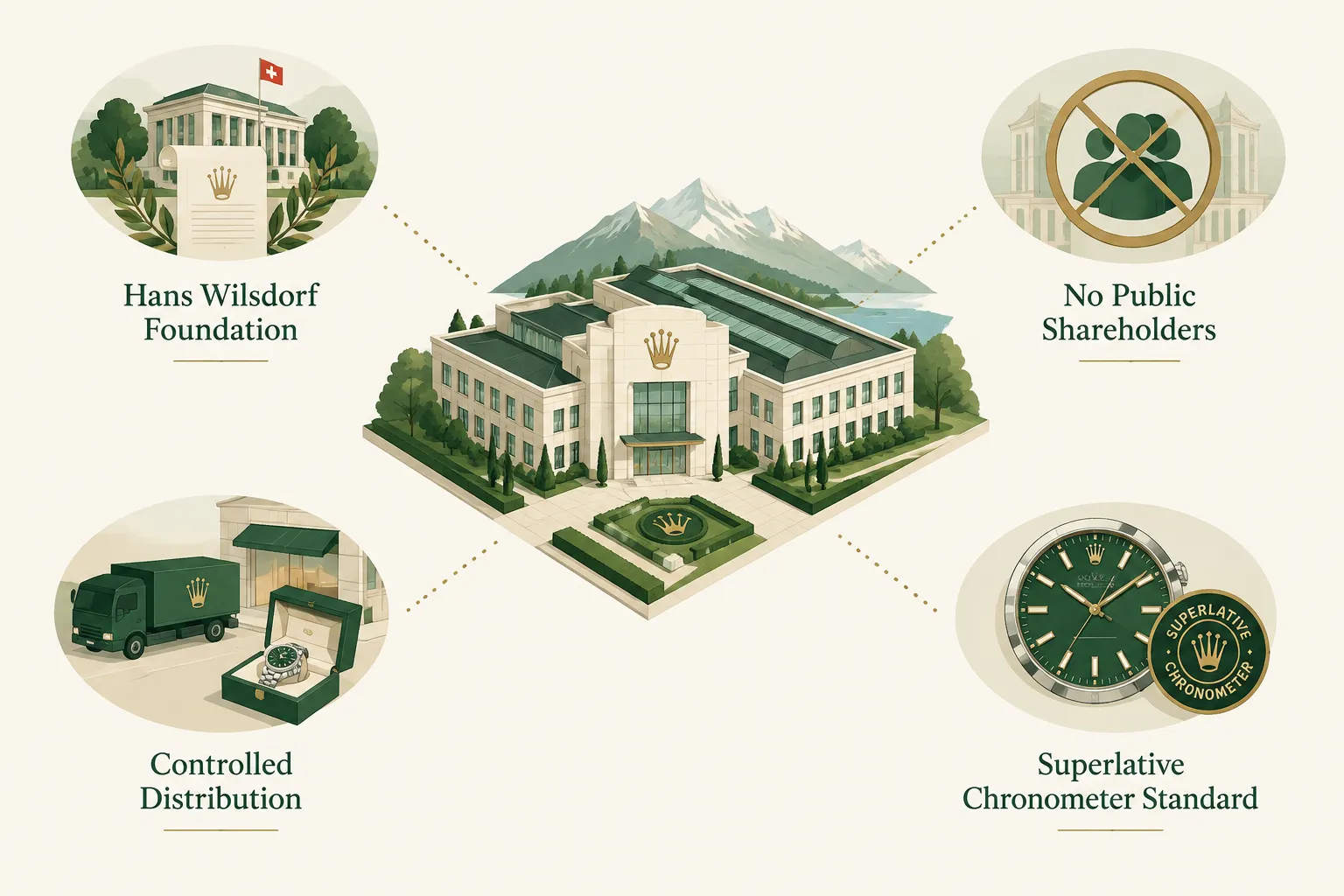
Hans Wilsdorf died in 1960, having already secured Rolex’s future through a legal structure that remains unique in the watch industry. In 1944, Wilsdorf transferred ownership of Rolex to the Hans Wilsdorf Foundation, a private charitable trust based in Geneva. Wilsdorf had no children, and this arrangement ensured that no individual heirs, shareholders, or corporate acquirers could ever take control of the brand.
What this means in practice:
- Rolex is not publicly traded. There are no shares to buy, no quarterly earnings reports, and no pressure from financial markets.
- The Foundation’s profits fund charitable causes in Geneva and beyond, though the specific beneficiaries are not publicly disclosed.
- The company is run by professional management. André Heiniger led Rolex from 1963 to 1992, followed by his son Patrick Heiniger until 2008, and Jean-Frédéric Dufour since 2014.
- This structure gives Rolex a planning horizon measured in decades, not quarters, a competitive advantage that shapes every decision from product development to distribution policy.
In August 2026, Rolex announced the acquisition of Bucherer, one of Europe’s largest multi-brand watch retailers and a long-standing Rolex distribution partner. The move extends Rolex’s control over how its watches are presented and sold at retail, consistent with the brand’s century-long emphasis on controlling every element of the client experience. White-Glove Service and the presentation of Exclusive Collections remain central to how Rolex expects its products to be encountered by buyers.
So: Rolex is not family-owned in the traditional sense, and it is not corporate-owned. It is foundation-owned, a structure that has proven to be one of the most effective models for long-term luxury brand stewardship in history.
The History of Rolex: From a London Bedsit to a $13B Empire in the Modern Era
The contemporary chapter of the history of Rolex: from a London bedsit to a $13B empire is defined by the brand’s ability to maintain scarcity, technical authority, and cultural relevance simultaneously, while operating as one of the most profitable companies in Switzerland.
In 2026, Rolex presented 58 new references at Watches & Wonders Geneva, organized under the “Oyster Story” centenary theme. Headline introductions included a Rolesium Cosmograph Daytona with a Grand Feu enamel dial and sapphire caseback, a ground-up redesign of the Yacht-Master II, and the introduction of Jubilee Gold, a new proprietary 18-carat gold alloy used on flagship Day-Date 40 models. The Rolex Day-Date 228235 Sundust Roman in Everose Gold exemplifies the kind of refined material and dial innovation that defines Rolex’s current product strategy.
The 2025 introduction of the Land-Dweller, a new model family that entered its first full production year in 2026, signals that Rolex is still capable of adding entirely new lines when the technical and market conditions are right. But the brand’s dominant approach remains consolidation: refining existing families, deepening material innovation, and gradually expanding a price ladder that now runs from approximately $6,750 to nearly $100,000 within the standard catalogue.
For serious collectors and investors, Rolex’s foundation ownership, vertical integration, and disciplined supply management make it the closest thing the watch world has to a permanent store of value. Investment-Grade Timepieces from Rolex are Trusted Worldwide precisely because the brand has spent 120 years earning that trust, one Oyster case, one certified movement, and one carefully chosen authorized retailer at a time.
Frequently Asked Questions
When was Rolex founded and where? Rolex was founded in 1905 in London by Hans Wilsdorf and Alfred Davis, operating initially from a small Hatton Garden office under the name Wilsdorf & Davis. The Rolex name was registered in 1908.
Why did Rolex move from London to Geneva? Rolex moved to Geneva in 1919 primarily because British wartime import duties on Swiss watch movements made the London operation financially unviable. Geneva offered lower costs, proximity to Swiss suppliers, and a prestigious address.
Did Rolex invent the waterproof watch? Rolex created the first commercially successful waterproof wristwatch case with the 1926 Oyster patent. The triple-lock screw-down system for the crown, caseback, and bezel was genuinely novel and remains the foundation of every Rolex Oyster case today.
Who owns Rolex now? Rolex is owned by the Hans Wilsdorf Foundation, a private charitable trust established in Geneva in 1944. The company is not publicly traded and has no private shareholders.
Why is the Rolex Daytona so expensive and hard to find? The steel Daytona is one of the most allocated references in the Rolex catalogue, with authorized dealer wait lists extending years. Its combination of motorsport heritage, Paul Newman associations, and controlled supply has created a secondary market premium that often exceeds 100% above retail.
What is the Rolex Superlative Chronometer standard? The Superlative Chronometer is Rolex’s in-house accuracy certification, requiring a movement to perform within -2/+2 seconds per day after casing. This is stricter than the COSC chronometer standard of -4/+6 seconds per day. In 2026, Rolex tightened this standard further as part of its Oyster centenary program.
What is Jubilee Gold? Jubilee Gold is a new proprietary 18-carat gold alloy introduced by Rolex at Watches & Wonders 2026. It is used on flagship Day-Date 40 models and represents Rolex’s ongoing strategy of developing exclusive in-house materials that competitors cannot replicate.
What is the difference between the Datejust and the Day-Date? The Datejust, introduced in 1945, displays the date and is available in steel, two-tone, and precious metal configurations. The Day-Date, introduced in 1956, displays both the day of the week (spelled out in full) and the date, and is available exclusively in precious metals. The Day-Date is often called the “President’s watch” due to its association with heads of state.
Are vintage Rolex watches a good investment? Vintage Rolex watches, particularly early Submariner, Daytona, and GMT-Master references in original, unpolished condition with matching serial numbers, have historically appreciated significantly. However, condition, originality, and provenance are critical. Buyers should work with Luxury Watch Experts who can verify authenticity before committing.
How do I know if a Rolex is authentic? Authentic Rolex watches have a serial number engraved between the lugs at 6 o’clock, a model (reference) number between the lugs at 12 o’clock, a cyclops lens magnifying the date, and a caseback that is typically solid (not display). The crown logo is engraved at 6 o’clock on the dial. For complete verification, purchase from a source that offers Authenticity Guaranteed documentation and a full set with original box and papers.
What does “Full Set Complete” mean for a Rolex? Full Set Complete means the watch is accompanied by its original box, warranty card (papers), hang tags, and any supplementary booklets as issued by Rolex at the time of sale. A complete set commands a meaningful premium over a watch sold without documentation, and it simplifies authentication for future buyers.
What is the most expensive Rolex ever sold? Paul Newman’s personal Rolex Daytona reference 6239 sold at Phillips auction house in October 2017 for $17.75 million, making it the most valuable Rolex ever sold at public auction as of 2026.
Conclusion: What the Rolex Story Means for Today’s Buyer
The history of Rolex: from a London bedsit to a $13B empire is not simply a corporate biography. It is a masterclass in how technical credibility, disciplined brand management, and structural independence compound over time into something that transcends the product itself.
Hans Wilsdorf’s original instincts, pursue precision certification, control distribution, invest in genuine innovation rather than marketing theater, have been honored by every generation of Rolex management since. The result is a brand that in 2026 celebrates the centenary of its most important invention while simultaneously introducing new gold alloys, tightening its accuracy standards, and acquiring its largest retail partner.
Actionable next steps for serious buyers:
- If you are purchasing a modern Rolex, prioritize Full Set Complete examples with original box, papers, and warranty card. These retain value most effectively and are easiest to authenticate.
- If you are considering a vintage reference, work exclusively with Luxury Watch Experts who specialize in Rolex and can verify dial originality, case integrity, and movement authenticity.
- For investment-grade timepieces, focus on references with documented scarcity: steel sports models (Submariner, Daytona, GMT-Master II), precious metal Day-Dates, and early Datejust references in exceptional condition.
- Explore the current generation of Rolex’s most enduring lines, including the Rolex Datejust 126331 Sundust Diamond Jubilee in Steel and Everose Gold and the Rolex Day-Date 228239 Blue Roman in White Gold, as part of a curated collection built for both daily wear and long-term appreciation.
Rolex’s story is still being written. But its foundation, quite literally, is one of the most secure in the luxury world.