

Complications & Tech
Perpetual Calendars Explained Simply: A Collector’s Guide to the Watchmaking Pinnacle
Jun
Last updated: June 1, 2026
Quick Answer
A perpetual calendar is a mechanical watch complication that automatically tracks the date, day, month, and leap year cycle without manual correction until the year 2100. It “knows” that February has 28 or 29 days and that some months have 30 versus 31, adjusting itself accordingly. These watches typically cost between $30,000 and $500,000+, and they are considered one of the three most prestigious complications in haute horlogerie alongside the minute repeater and tourbillon.
Key Takeaways
- A perpetual calendar (often abbreviated QP, from the French quantième perpétuel) automatically adjusts for short months and leap years.
- Most mechanical perpetual calendars stay accurate until March 1, 2100, when the Gregorian calendar skips a leap year.
- Entry-level perpetual calendars start around $30,000; Patek Philippe, Audemars Piguet, and Vacheron Constantin models often exceed $80,000–$200,000.
- An annual calendar handles 30/31-day months but not February. A perpetual calendar handles everything including leap years.
- If the watch stops for more than 24–48 hours, the calendar must be reset manually, which is the trickiest part of ownership.
- Setting one incorrectly (especially between 8 PM and 4 AM) can damage the movement.
- Mechanical perpetual calendars are prized for craftsmanship; quartz/digital versions are more accurate but lack collector value.
- Best for serious collectors, long-term holders, and high-net-worth buyers who appreciate mechanical art over daily convenience.
What Exactly Is a Perpetual Calendar and How Does It Work
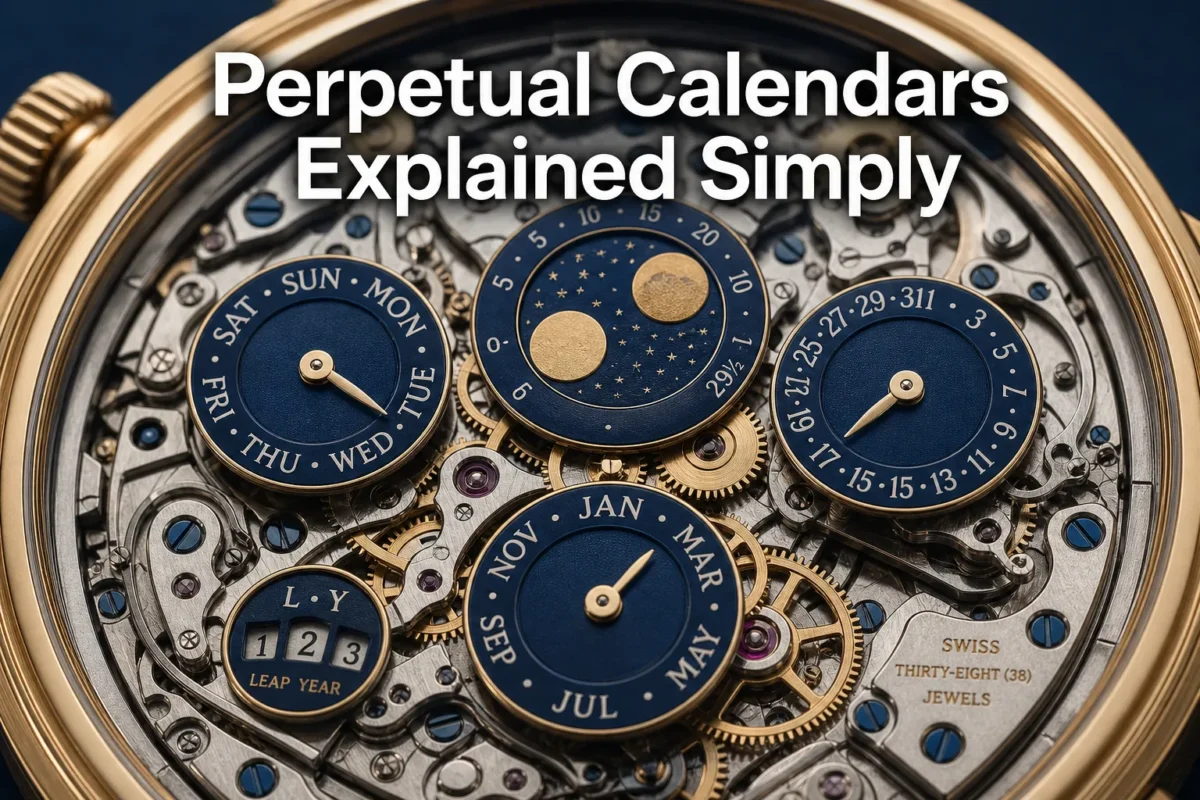
A perpetual calendar is a mechanical complication that displays the correct date every day of the year, including leap years, without needing manual adjustment. It does this through a system of gears, cams, and levers, most notably a 48-month cam that rotates once every four years and tells the movement how many days each month contains.
Inside the watch, a small star-shaped or kidney-shaped cam represents the four-year cycle. As each month ends, a lever “reads” the depth of the cam at that position. A deep notch signals a short month (February or a 30-day month), and a shallow notch signals a 31-day month. The movement then advances the date the correct number of steps at midnight.
This is a purely mechanical memory system. No batteries, no electronics, no software updates. The watch is essentially a tiny analog computer that has been pre-programmed to understand the Gregorian calendar.
Quick example: On the night of February 28 in a non-leap year, the cam tells the movement to skip from 28 directly to March 1. On February 29 of a leap year, it allows one extra step before jumping to March 1.
Are Perpetual Calendars Accurate Forever or Do They Need Adjustments
Most perpetual calendars are accurate until February 28, 2100, after which they will need a single manual correction. They are not literally perpetual, just very long-running.
The Gregorian calendar skips a leap year every 100 years, except every 400 years. So the year 2000 was a leap year, but 2100, 2200, and 2300 will not be. Standard perpetual calendar movements aren’t built to account for this 100-year exception. When March 1, 2100 arrives, owners (or their grandchildren) will need to advance the watch by one day.
A rare subset called secular perpetual calendars (made by brands like Svend Andersen and Franck Muller) accounts for this and stays accurate for centuries longer. These are exceptionally rare and expensive.
Decision rule: If you want a watch that’s accurate within your lifetime, a standard perpetual calendar is overkill in the best possible way — you will never need to correct it for the calendar logic itself.
How Much Do High-End Perpetual Calendar Watches Typically Cost
Perpetual calendar watches typically range from about $30,000 on the low end to well over $500,000 for grand complications. Pricing depends on the brand, metal, movement finishing, and whether the calendar is paired with other complications like a minute repeater or tourbillon.
Here’s a realistic price snapshot by tier:
| Tier | Price Range (USD) | Example Brands |
|---|---|---|
| Entry-level QP | $30,000 – $50,000 | IWC, Frederique Constant, Montblanc |
| Mid-tier | $50,000 – $120,000 | Jaeger-LeCoultre, A. Lange & Söhne (steel), Blancpain |
| High-end | $120,000 – $300,000 | Patek Philippe, Audemars Piguet, Vacheron Constantin |
| Grand complications | $300,000 – $2,000,000+ | Patek Philippe Grandmaster Chime, F.P. Journe, Greubel Forsey |
For context, the Patek Philippe Ref. 5236P-010 in-line perpetual calendar and Ref. 6159G-001 sit firmly in the high-end tier and are widely considered benchmarks of the complication.
Which Watch Brands Make the Best Perpetual Calendar Timepieces
The most respected perpetual calendar makers are Patek Philippe, Audemars Piguet, Vacheron Constantin, and A. Lange & Söhne, often called the “Holy Trinity plus Lange.” Each has built decades-long reputations specifically for this complication.
- Patek Philippe is widely regarded as the gold standard. The Ref. 3940, 5140, 5327, and 5236P-010 are legendary, and their perpetual calendar chronographs are among the most collectible watches ever made.
- Audemars Piguet offers the Royal Oak Perpetual Calendar line, which combines sport-watch styling with the complication — a rare and desirable combination.
- Vacheron Constantin produces the Patrimony and Traditionnelle perpetual calendars known for elegant restraint.
- A. Lange & Söhne brings German precision and the famous outsized date display.
- IWC, particularly the Da Vinci and Portugieser lines, offers the most accessible entry point to the complication via the Kurt Klaus-designed mechanism.
For deeper context on movements and how they affect value, see this guide to mechanical, automatic, and quartz watch movements.
What’s the Difference Between a Perpetual and Annual Calendar
The key difference: an annual calendar correctly handles months with 30 and 31 days but must be manually adjusted once a year on March 1. A perpetual calendar also handles February and leap years, requiring no adjustment for nearly a century.
Patek Philippe actually invented the modern annual calendar in 1996 as a more affordable, more practical middle ground. The mechanism is mechanically simpler, so annual calendars typically cost $40,000–$80,000 versus $80,000+ for a perpetual.
| Feature | Annual Calendar | Perpetual Calendar |
|---|---|---|
| Adjusts for 30/31-day months | Yes | Yes |
| Adjusts for February | No | Yes |
| Handles leap years | No | Yes |
| Manual correction frequency | Once per year (March 1) | Once in 2100 |
| Typical price | $40K–$80K | $80K–$500K+ |
| Mechanical complexity | Moderate | Very High |
If you want to see an annual calendar up close, the Patek Philippe 5905R-010 and 5905/1A-001 are excellent reference points.
Choose an annual calendar if: you want most of the prestige and visual complexity at a lower price, and you don’t mind one manual reset each March.
Choose a perpetual calendar if: you want the full horological pinnacle and plan to hold the watch as a serious collectible or heirloom.
Can a Perpetual Calendar Handle Leap Years Automatically
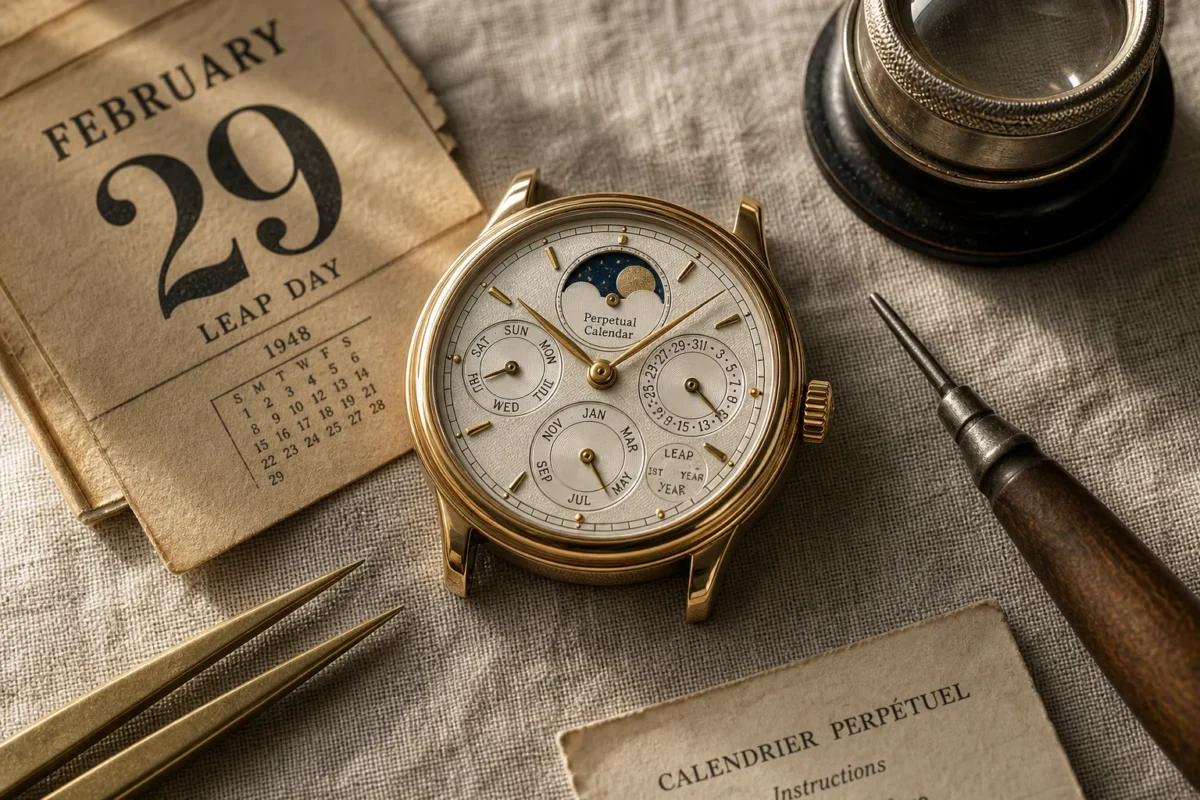
Yes. Handling leap years is the defining feature of a perpetual calendar. The 48-month cam inside the movement physically encodes the four-year cycle, so the watch automatically gives February 29 days every fourth year.
Most perpetual calendars include a small leap year indicator on the dial, usually a sub-dial showing positions 1, 2, 3, and 4 (or sometimes the actual year). Position 4 (or the year ending in 0, 4, or 8) signals a leap year. This indicator lets you verify the watch is on the correct year in the cycle when setting it.
Common edge case: if you buy a vintage perpetual calendar and the leap year indicator is off, the watch will still tick correctly day-to-day, but it will get February wrong every four years. A watchmaker can recalibrate it.
Are Mechanical or Digital Perpetual Calendars More Reliable
Digital and quartz perpetual calendars are more accurate in absolute terms, but mechanical perpetual calendars are far more valuable, more collectible, and more enduring as objects. The choice depends on whether you value precision or craftsmanship.
A quartz perpetual calendar (Citizen, Seiko, Casio) keeps time to within 15 seconds per month and handles the calendar effortlessly for a fraction of the price. But the movement is essentially disposable: in 30 years, parts won’t be available, and the watch has no collector value.
A mechanical perpetual calendar runs at -2 to +4 seconds per day, requires servicing every 5–7 years (typically $1,500–$5,000), but can be maintained for centuries. Pieces from the 1940s are still running today.
A mechanical perpetual calendar isn’t a timekeeping tool. It’s a piece of functional sculpture that happens to tell time and date with extraordinary intelligence.
What Are Common Mistakes People Make When Setting a Perpetual Calendar Watch
The biggest mistake is adjusting the calendar between 8:00 PM and 4:00 AM, when the movement is mid-cycle through its automatic date change. Forcing the date during this window can break delicate components, leading to repair bills of $3,000–$10,000.
Other frequent mistakes:
- Setting the day, date, and month in the wrong order. Most movements have separate pushers for each function, and skipping ahead too fast can desynchronize the cams.
- Winding the watch backward to “fix” the date instead of using the corrector pushers.
- Using a fingernail or paperclip instead of the dedicated stylus that comes with the watch. The corrector holes are tiny and easily damaged.
- Ignoring the leap year indicator when setting from a fully stopped state. You can put the date on the right day but the wrong year in the cycle.
- Setting it without checking the manual. Each brand’s procedure is slightly different.
Rule of thumb: if a perpetual calendar has fully stopped, take it to an authorized dealer for the initial reset. A 15-minute appointment is cheaper than a $5,000 repair.

Who Should Invest in a Perpetual Calendar Watch and Who Probably Shouldn’t
A perpetual calendar makes sense for serious collectors, long-term wearers, and high-net-worth buyers who appreciate horological craftsmanship and plan to keep the watch for decades or pass it down. It’s a poor fit for casual buyers who want a “daily beater” or who travel constantly across time zones.
Good fit if you:
- Already own several luxury watches and want to step into haute horlogerie
- Plan to hold the watch 10+ years or pass it to heirs
- Have a winder or wear the watch consistently
- Enjoy the ritual of mechanical timekeeping
- Are diversifying alternative assets at the $50K+ level
Poor fit if you:
- Want one watch you can grab and wear after months in a drawer
- Frequently cross date lines and need easy adjustments
- Prefer set-and-forget convenience
- Are buying primarily for resale flipping (perpetuals are slow movers)
For a first luxury watch, many advisors suggest starting with a Rolex Datejust or an IWC Portofino before stepping up to a perpetual calendar.
How Complicated Is the Internal Mechanism of a Perpetual Calendar
Extremely. A typical perpetual calendar movement contains between 275 and 500+ individual components, compared to roughly 130 parts in a standard automatic watch. Many of those parts are smaller than a grain of rice.
The mechanism layers several sub-systems:
- The base movement (timekeeping)
- The date wheel and pushers (day, date, month displays)
- The 48-month cam (the four-year memory)
- The leap year indicator gear train
- Often a moon phase complication (which adds another set of wheels)
- Sometimes a retrograde or pointer date display, adding more levers
Master watchmakers train for years specifically on calendar complications. Assembling and adjusting a perpetual calendar by hand can take weeks, and brands like Patek Philippe produce only a few thousand QP watches annually across all models.
This complexity is exactly why perpetual calendars cost what they do. You aren’t paying for materials — gold cases are maybe $5,000–$15,000 of cost. You’re paying for the engineering, finishing, and labor.
What Happens If You Don’t Wind a Perpetual Calendar Watch for a Long Time
If a perpetual calendar stops because it ran out of power, it freezes at whatever date and time it last showed. When you start it again, you must manually reset every calendar indicator to match the current real date, including the leap year cycle.
This is the single biggest practical drawback of owning one. Resetting a perpetual calendar can take 15–45 minutes of careful adjustment, depending on how far behind it is. If the date is far off (say, six months), you may need to advance through every day individually using the corrector pusher.
Two practical solutions:
- Wear the watch regularly (at least 2–3 days per week for automatics).
- Use a watch winder. A quality dual winder costs $300–$1,500 and keeps the watch perpetually wound when not on the wrist. For owners of multiple complicated watches, this is standard practice.
Some modern perpetual calendars have power reserves of 7–10 days or more (Lange’s Langematik Perpetual, IWC’s 51-series movements), giving you a longer buffer.
Are Perpetual Calendars Worth the Extra Cost Compared to Regular Watches
For the right buyer, yes. For most buyers, no. A perpetual calendar’s value isn’t in everyday utility — your phone tells you the date for free — but in craftsmanship, heritage, and long-term collectibility within the luxury watch market.
Where the value shows up:
- Resale and appreciation: Top-tier perpetual calendars from Patek Philippe and Audemars Piguet have historically held or appreciated in value over decades. Vintage QPs from the 1950s–70s regularly sell at auction for multiples of their original price.
- Mechanical art: Owning a perpetual calendar is owning a working example of one of the most demanding feats in mechanical engineering.
- Status and entry to high-end collecting: Within serious watch circles, a perpetual calendar signals genuine collector knowledge in a way a sports Rolex does not.
Where the value doesn’t show up:
- Daily wear convenience
- Resale liquidity (perpetuals can take months to sell privately)
- Compared to simpler complications like a chronograph for sheer wearability
If you’re building a serious watch collection and want guidance on rare pieces, working with a specialist via special requests is often the smartest path.
FAQ
What does QP mean on a watch? QP stands for quantième perpétuel, French for “perpetual calendar.” You’ll see it in catalog descriptions and watchmaker references.
Do perpetual calendars work in 2100? Standard perpetual calendars will need one manual correction on March 1, 2100 because that year is not a leap year. They will work correctly again afterward until 2200.
Can I wear a perpetual calendar daily? Yes, but choose a model with a robust case (steel or titanium) and a sapphire crystal. Avoid hard impacts, magnets, and water beyond the rated depth.
How often does a perpetual calendar need servicing? Every 5 to 7 years for full service, costing approximately $1,500 to $5,000 depending on the brand and movement complexity.
Is a moon phase the same as a perpetual calendar? No. A moon phase shows the lunar cycle and is often included in perpetual calendars, but it’s a separate complication. A watch can have a moon phase without being a perpetual calendar.
What’s the cheapest real perpetual calendar? Frederique Constant’s Slimline Perpetual Calendar starts around $9,000, making it the most accessible mechanical QP. IWC and Montblanc start around $25,000–$35,000.
Are perpetual calendars a good investment? Top-tier brands (Patek, AP, Vacheron, Lange) have strong long-term value retention, but perpetual calendars are illiquid. Treat them as 10-year+ holdings, not short-term flips.
Can a perpetual calendar tell me the year? Some models do display the full year in a small window, but most only show the position within the four-year leap cycle (1, 2, 3, or 4).
What happens if I drop a perpetual calendar? A hard impact can dislodge or damage the calendar cams and levers. Even if the watch keeps running, the calendar may misbehave. Always have it inspected by a certified watchmaker after a significant drop.
Should I buy new or pre-owned? Pre-owned perpetual calendars can offer 20–40% savings on retail and are often the only way to access discontinued references. Always buy from a reputable dealer with proper authentication and service history.
Conclusion: Next Steps for Buyers
A perpetual calendar is one of the most rewarding purchases a serious watch collector can make, but it is not a casual buy. The watch demands respect, regular wear or winding, and an owner who values craftsmanship over convenience.
Practical next steps:
- Define your budget. Entry-level QPs start at $9,000–$30,000. Holy Trinity pieces start at $80,000+.
- Try several in person. Dial layouts vary widely. Some collectors prefer the symmetry of a Patek 5327; others love the in-line display of the 5236P.
- Decide on annual vs. perpetual. If you’d be just as happy with a once-a-year reset, an annual calendar saves significant money.
- Plan for a winder. Budget $300–$1,500 for a quality winder, especially if you own multiple complicated watches.
- Work with a trusted dealer. Authentication, service history, and warranty matter enormously at this price level. Visit a reputable luxury watch shop or use special order services for rare references.
The right perpetual calendar can be worn for a lifetime and handed to the next generation still running, still accurate, still telling them that yes, March follows February — except in a leap year, when it patiently waits one more day.
Sources
- Patek Philippe official documentation on the Ref. 5236P and 6159G perpetual calendars (patek.com, 2024)
- Audemars Piguet Royal Oak Perpetual Calendar specifications (audemarspiguet.com, 2024)
- IWC Schaffhausen Kurt Klaus perpetual calendar mechanism overview (iwc.com, 2023)
- A. Lange & Söhne movement documentation, Langematik Perpetual caliber L922.1 (alange-soehne.com, 2023)