

Complications & Tech
What is a tourbillon — and is it worth the price?
Apr
Last updated: April 14, 2026
Quick Answer: A tourbillon is a mechanical watch complication invented in 1801 to counteract the effects of gravity on timekeeping accuracy. Today, tourbillon watches are among the most technically demanding — and expensive — timepieces in the world, with prices ranging from roughly $15,000 to well over $1,000,000. Whether one is “worth it” depends entirely on what you value: pure horological artistry, investment potential, or status as a collector.
Key Takeaways
- A tourbillon is a rotating cage that houses the escapement and balance wheel, designed to average out positional errors caused by gravity.
- Abraham-Louis Breguet patented the tourbillon in 1801 — making it one of watchmaking’s oldest and most revered complications.
- Modern tourbillon watches serve primarily as demonstrations of master craftsmanship rather than precision tools, since quartz and co-axial movements often outperform them in raw accuracy.
- Entry-level tourbillon watches from respected manufacturers start around $15,000–$20,000; grand complication tourbillons from Patek Philippe or A. Lange & Söhne can exceed $500,000.
- Tourbillons from top-tier maisons — particularly Patek Philippe, Vacheron Constantin, and A. Lange & Söhne — have demonstrated strong long-term value retention and appreciation.
- Not every tourbillon is equal: flying tourbillons, multi-axis tourbillons, and peripheral tourbillons each represent different levels of technical achievement.
- For serious collectors and high-net-worth buyers, a certified authentic tourbillon in full set condition represents one of the most compelling investment-grade timepieces available.
What Exactly Is a Tourbillon?
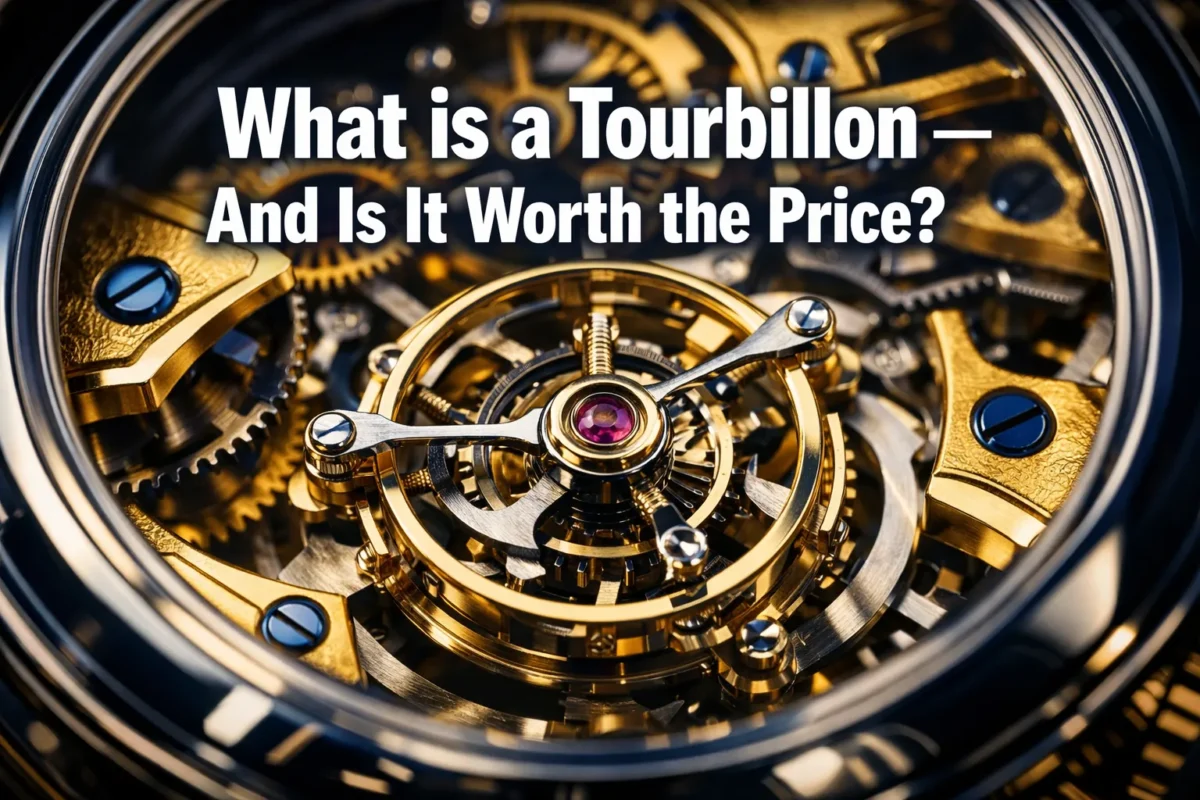
A tourbillon (pronounced toor-bee-yon, from the French for “whirlwind”) is a complication that mounts the escapement and balance wheel inside a rotating cage. That cage completes one full rotation — typically every 60 seconds — so that gravitational errors affecting the balance wheel are averaged out over time rather than compounding in a single position.
Abraham-Louis Breguet developed and patented this mechanism in 1801, originally to improve the accuracy of pocket watches, which spent most of their time in a vertical position inside a waistcoat pocket. Gravity, acting on the balance wheel in a fixed position, would cause the watch to run slightly fast or slow. The rotating cage solved this by cycling the escapement through every orientation continuously.
Why does this matter today? Modern wristwatches move constantly on the wrist, which naturally averages out positional errors on its own. The original problem the tourbillon solved is largely moot for a wristwatch. Yet the complication endures — not because it is necessary, but because building one demands extraordinary skill. A tourbillon cage can contain 70 or more individual components, many weighing less than a fraction of a milligram, all assembled by hand.
For deeper context on how different movement types compare, see this guide to watch movements: mechanical vs. automatic vs. quartz.
How Does a Tourbillon Mechanism Actually Work?
The tourbillon cage rotates continuously, driven by the watch’s mainspring through the gear train. Inside the cage sit the escapement (the pallet fork and escape wheel) and the balance wheel — the heart of any mechanical movement. As the cage turns, the balance wheel experiences gravity from every angle in sequence, preventing any single positional error from dominating.
The core components of a tourbillon:
- Carriage (cage): The rotating frame that holds all internal parts
- Balance wheel: Oscillates back and forth to regulate timekeeping
- Escape wheel: Releases energy from the mainspring in controlled increments
- Pallet fork: Engages and releases the escape wheel with each oscillation
- Fourth wheel: Drives the cage’s rotation, typically one revolution per minute
The engineering challenge is significant. The cage must be light enough not to drain the power reserve too quickly, yet rigid enough to hold precision tolerances. Every component must be finished to the highest standard — polished, beveled, and decorated — because the tourbillon is almost always displayed through an open dial or caseback.

What Are the Different Types of Tourbillon Watches?
Not all tourbillons are created equal. The type of tourbillon in a watch significantly affects its technical complexity, visual appeal, and price.
| Type | Description | Complexity Level |
|---|---|---|
| Classic Tourbillon | Cage rotates on one axis, typically once per minute | High |
| Flying Tourbillon | No upper bridge; the cage appears to float freely | Very High |
| Multi-Axis Tourbillon | Cage rotates on two or three axes simultaneously | Extreme |
| Peripheral Tourbillon | Cage rotates around the dial’s outer edge; no central arbor | Extreme |
| Micro-Tourbillon | Miniaturized version; cage and components are exceptionally small | Very High |
The flying tourbillon, developed by Alfred Helwig in 1920, removes the upper bridge that traditionally supports the cage. This creates a breathtaking visual effect — the mechanism appears to spin freely in mid-air — and demands even tighter engineering tolerances.
Multi-axis tourbillons address the theoretical limitation of the classic design: a single-axis tourbillon only compensates for gravity in one plane. A double or triple-axis version rotates on multiple planes simultaneously, offering more complete compensation. Brands like Jaeger-LeCoultre, Greubel Forsey, and Franck Muller are known for these extraordinary constructions.
How Much Do Tourbillon Watches Cost — And Why?
Tourbillon watches command significant premiums, and the price range is genuinely vast. Entry-level models from credible manufacturers begin around $15,000–$20,000. Grand complication tourbillons from the most prestigious maisons routinely exceed $300,000–$500,000, with some rare pieces surpassing $1,000,000 at auction.
Why are they so expensive?
- Assembly time: A skilled watchmaker may spend 200–400 hours assembling a single tourbillon movement.
- Component count: A tourbillon cage alone can contain 70+ parts, many requiring individual hand-finishing.
- Material costs: Platinum, 18k gold, and exotic alloys are common; some cages are made from titanium or silicon to reduce weight.
- Rarity: Production volumes are deliberately low, which sustains exclusivity and long-term value.
- Brand heritage: A tourbillon from Patek Philippe or A. Lange & Söhne carries the weight of centuries of horological tradition.
For those exploring investment-grade timepieces at various price points, this high-value luxury watch investment guide for 2026 offers a useful framework.
A practical price guide by tier:
- $15,000–$50,000: Entry tourbillons from TAG Heuer, Frederique Constant, and similar brands
- $50,000–$150,000: Mid-tier tourbillons from IWC, Jaeger-LeCoultre, Zenith
- $150,000–$500,000: Prestige tourbillons from Patek Philippe, Vacheron Constantin, A. Lange & Söhne
- $500,000+: Grand complications, multi-axis tourbillons, and rare limited editions
Are Tourbillon Watches Actually More Accurate?
This is one of the most honest conversations in horology. The short answer: not necessarily, and often not at all.
The tourbillon was designed to improve accuracy in pocket watches held in a fixed vertical position. A wristwatch moves constantly throughout the day, which naturally averages out positional errors. As a result, a well-regulated standard lever escapement — or a modern co-axial escapement — can match or exceed a tourbillon’s timekeeping performance in real-world wristwatch use.
A standard COSC-certified chronometer must achieve accuracy within -4/+6 seconds per day. Many tourbillon movements perform within similar tolerances, and some perform better — but the improvement, if any, is not attributable to the tourbillon alone. It reflects the overall quality of the movement’s regulation and finishing.
The honest conclusion: Tourbillon watches are not purchased for superior accuracy. They are purchased for the mastery of craft they represent, for their visual drama, and for their standing as horological art objects. Accuracy is a secondary consideration for any serious collector in this category.
Which Brands Make the Most Respected Tourbillon Watches?
The most respected tourbillon watches come from a small group of maisons with the in-house expertise and heritage to build them properly. Brand provenance matters enormously — both for collector credibility and long-term value retention.
The premier tier:
- Patek Philippe — The Patek Philippe 5327G Grand Complications exemplifies the maison’s approach: impeccable finishing, restrained design, and a movement that represents decades of accumulated expertise. Patek’s tourbillons are among the most sought-after and value-retentive in the world.
- A. Lange & Söhne — The Saxon manufacturer’s tourbillons feature three-quarter plates, hand-engraved balance cocks, and finishing standards that are arguably unmatched.
- Vacheron Constantin — As one of the oldest continuously operating watch manufacturers, Vacheron brings deep institutional knowledge to every tourbillon it produces.
- Greubel Forsey — A modern independent maison entirely dedicated to tourbillon development; their multi-axis designs are technically unrivaled.
- Jaeger-LeCoultre — Credited with the flying tourbillon’s popularization; their Gyrotourbillon remains a benchmark of multi-axis engineering.
Brands offering credible entry points:
- Zenith (El Primero-based tourbillons)
- IWC (Portuguese Tourbillon)
- Roger Dubuis
- TAG Heuer (Carrera Tourbillon)
For collectors exploring Patek Philippe’s broader complication range, the Patek Philippe 6159G Grand Complications and Patek Philippe 5330G World Time Complications represent the maison’s extraordinary breadth.
Is a Tourbillon Watch a Good Investment?

For the right buyer, yes — with important qualifications. Tourbillon watches from top-tier maisons have historically demonstrated strong value retention and, in many cases, meaningful appreciation over time. However, not every tourbillon appreciates equally, and condition, provenance, and completeness of set are decisive factors.
What drives investment value in tourbillon watches:
- Maker: Patek Philippe, A. Lange & Söhne, and Vacheron Constantin consistently outperform lesser-known brands at resale.
- Condition: Investment-grade pieces should be in excellent condition, ideally unworn or lightly worn.
- Full set: Box, papers, original certificate, and all accessories — what collectors call a “full set complete” — command significant premiums over watches sold without documentation.
- Reference rarity: Limited production references, discontinued references, or those with unusual dial configurations carry higher collector demand.
- Provenance: A documented ownership history, particularly from notable collectors, adds value.
Common mistake: Buying a tourbillon from a lesser-known brand purely for investment purposes. Without established collector demand and brand heritage, resale can be challenging and the price paid may not be recoverable.
For buyers considering the broader luxury watch market as part of a portfolio strategy, it is worth reading about choosing the perfect luxury watch before committing to a specific reference.
“A tourbillon from the right maison, in full set condition, is not merely a watch — it is a portable store of value with an aesthetic dividend that no financial instrument can replicate.”
What Should You Look for When Buying a Tourbillon Watch?
Buying a tourbillon watch requires more diligence than almost any other category of luxury goods. The prices are high, the fakes are sophisticated, and the differences between a genuine investment-grade piece and a disappointing purchase can be subtle.
A buyer’s checklist:
- Verify authenticity — Purchase only from dealers who provide Authenticity Guaranteed documentation. Certified Authentic pieces should come with verifiable serial numbers cross-referenced against manufacturer records.
- Confirm full set — Box, papers, warranty card, and all original accessories should be present. Full Set Complete watches retain value significantly better.
- Assess condition — Request detailed photographs of the dial, case, movement (through caseback), and all surfaces. Ask specifically about polishing history, as over-polished cases reduce collector value.
- Research the reference — Know the reference number, production years, and original retail price. Understand whether the reference is current or discontinued.
- Understand warranty status — Under Factory Warranty or with remaining manufacturer warranty coverage provides important protection and adds to resale value.
- Work with Luxury Watch Experts — Specialists with deep category knowledge provide guidance that generalist retailers cannot. White-Glove Service from a trusted dealer includes pre-purchase consultation, authentication support, and post-sale assistance.
- Confirm shipping and insurance — Any tourbillon purchase should be covered by Fully Insured Overnight Shipping with full declared value coverage.
For buyers who already own a tourbillon and are considering a sale or trade, MioJewelry’s luxury watch selling service offers a trusted, discreet process.
Tourbillon vs. Other High Complications: How Does It Compare?
Serious collectors often weigh tourbillons against other grand complications when building a collection. Each complication has a distinct character and appeal.
| Complication | Primary Function | Typical Price Premium | Collector Appeal |
|---|---|---|---|
| Tourbillon | Gravity compensation (visual artistry) | Very High | Extremely High |
| Minute Repeater | Audible time indication | Very High | Very High |
| Perpetual Calendar | Date/day/month/leap year | High | High |
| Rattrapante Chronograph | Split-seconds timing | High | High |
| Equation of Time | Solar vs. mean time display | High | Moderate–High |
The tourbillon stands apart because it is the only complication that is primarily a demonstration of mechanical mastery rather than a functional tool. A perpetual calendar tells you the date without adjustment. A minute repeater chimes the time on demand. A tourbillon simply spins — beautifully, endlessly, and at extraordinary cost.
For collectors interested in Patek Philippe’s perpetual calendar and annual calendar complications — which pair exceptionally well with tourbillon references in a collection — the Patek Philippe 5905R Annual Calendar offers a compelling entry into grand complication ownership.
Frequently Asked Questions About Tourbillon Watches
Q: What does “tourbillon” mean? A: Tourbillon is a French word meaning “whirlwind.” It describes the rotating cage that houses the watch’s escapement and balance wheel, which spins continuously to counteract gravitational effects on timekeeping.
Q: Who invented the tourbillon? A: Abraham-Louis Breguet, the Swiss-French watchmaker, invented and patented the tourbillon in 1801. Breguet remains one of the most influential figures in horological history.
Q: Are tourbillon watches more accurate than regular watches? A: Not reliably. In a wristwatch worn daily, the constant movement of the wrist already averages out positional errors. A tourbillon does not offer a meaningful accuracy advantage over a well-regulated standard movement in real-world use.
Q: Why do tourbillon watches cost so much? A: The price reflects the extraordinary skill and time required to build one. A single tourbillon cage can contain 70+ hand-finished components, and assembly alone may require hundreds of hours from a master watchmaker.
Q: Do tourbillon watches hold their value? A: Tourbillons from prestigious maisons — particularly Patek Philippe, A. Lange & Söhne, and Vacheron Constantin — have historically retained and appreciated in value. Lesser-known brands offer no such guarantee.
Q: What is a flying tourbillon? A: A flying tourbillon removes the upper bridge that supports the rotating cage, making the mechanism appear to float freely. It is more difficult to engineer than a classic tourbillon and is considered more visually dramatic.
Q: What is the difference between a tourbillon and a skeleton watch? A: A skeleton watch has a movement with material removed from the plates and bridges to reveal the mechanics beneath. A tourbillon is a specific complication within a movement. Many tourbillon watches also feature skeletonized dials to showcase the rotating cage.
Q: How do I spot a fake tourbillon? A: Counterfeit tourbillons often feature cages that rotate at irregular speeds, use low-quality finishing, or show obvious machining marks. Always purchase from a trusted dealer who provides Authenticity Guaranteed documentation and verifiable provenance.
Q: Is a tourbillon watch worth buying for a first luxury watch? A: For most first-time luxury buyers, a tourbillon is not the ideal starting point. Building familiarity with the market through a high-quality dress watch or sport watch first — then progressing to complications — is the approach most experienced collectors recommend.
Q: What brands offer the best value in tourbillon watches? A: Zenith and Jaeger-LeCoultre offer credible tourbillons at relatively accessible price points. For investment-grade pieces, Patek Philippe and A. Lange & Söhne represent the strongest long-term value propositions.
Q: Can I service a tourbillon watch myself? A: No. Tourbillon movements require service by trained watchmakers with specialist tools and training. Most manufacturers recommend service intervals of five to eight years, performed by an authorized service center.
Q: What does “full set complete” mean for a tourbillon watch? A: Full Set Complete means the watch is accompanied by its original box, papers, warranty card, hangtags, and all accessories as delivered from the manufacturer. This designation significantly increases collector and resale value.
Conclusion: Is a Tourbillon Watch Worth the Price?
The answer depends on what you are buying it for — and that question deserves an honest answer.
As a precision timekeeping instrument, a tourbillon is not necessary. Modern movements, including well-regulated automatic calibers and co-axial escapements, deliver accuracy that meets or exceeds most tourbillons in daily wear. If accuracy alone drives the decision, a tourbillon is not the rational choice.
As a statement of horological mastery, as a collectible of genuine rarity, and as an investment-grade asset with a documented history of value retention, a tourbillon from the right maison is among the most compelling acquisitions available to the serious collector. The craftsmanship is real. The heritage is real. The demand from the collector community is real.
For buyers ready to take the next step:
- Research specific references thoroughly before committing — understand production history, current market values, and what constitutes a fair price.
- Prioritize Full Set Complete pieces from Certified Authentic sources. Documentation matters enormously at resale.
- Work with Luxury Watch Experts who offer White-Glove Service, Fully Insured Overnight Shipping, and a clear return policy.
- Consider your collection holistically. A tourbillon pairs naturally with dress watches and grand complications that complement rather than duplicate it.
MioJewelry maintains an Exclusive Collection of investment-grade tourbillons and grand complications, with Immediate Availability on select references and Authenticity Guaranteed on every piece. Explore the full luxury watch collection or contact the team directly for discreet, expert guidance on your next acquisition.
References
- Breguet Museum Archives. “The Tourbillon: History and Invention.” Breguet.com. (2021)
- Donzé, Pierre-Yves. A Business History of the Swatch Group. Palgrave Macmillan. (2011)
- Forsey, Robert. “The Tourbillon: Art or Science?” Revolution Magazine. (2019)
- Haines, Martyn. “Tourbillon Watches: A Collector’s Perspective.” WatchTime Magazine. (2022)
- Meis, Reinhard. Pocket Watches: From the Pendant Watch to the Tourbillon. Schiffer Publishing. (1992)
- Phillips Auction House. “Important Watches” sale catalogues, Geneva. (2022, 2023)
- Sotheby’s. “Watches Online: Important Timepieces.” Auction results archive. (2023)