

Blog
What METAS Master Chronometer certification means
May
Last updated: May 6, 2026
Quick Answer
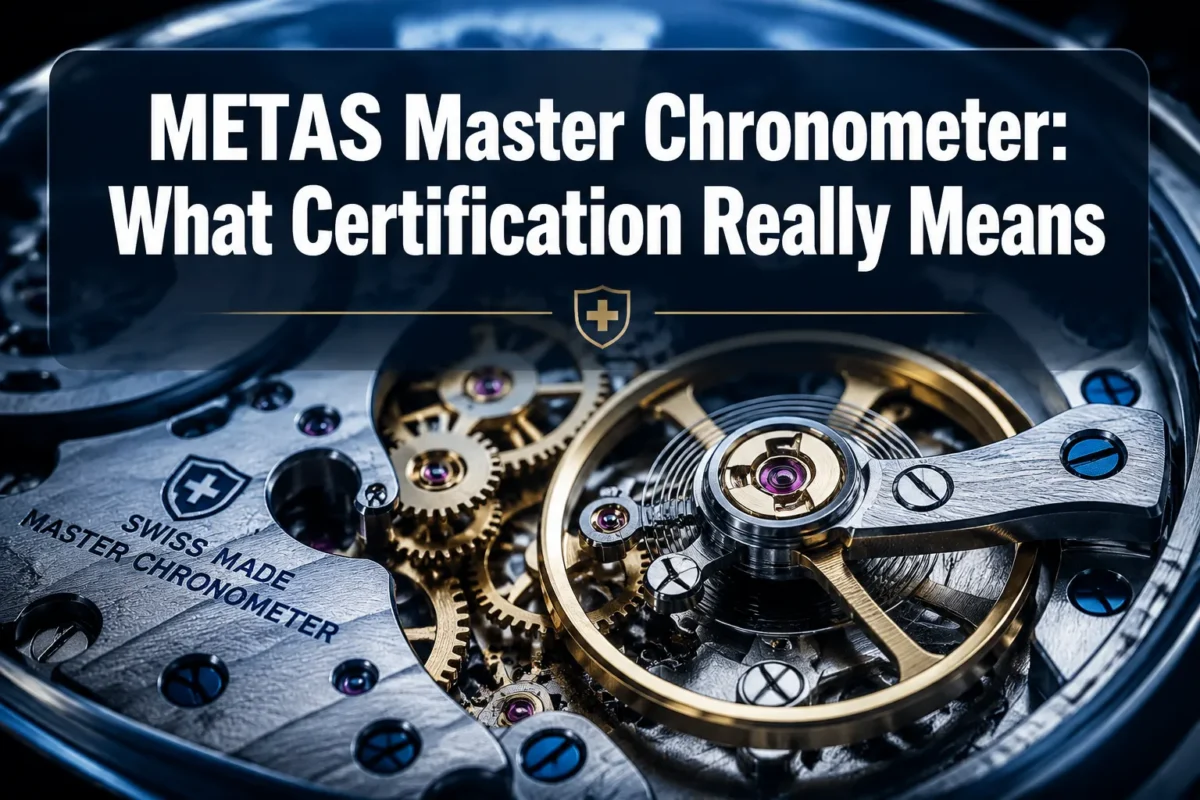
METAS Master Chronometer certification is the Swiss Federal Institute of Metrology’s independent verification that a watch movement meets eight specific performance standards, including resistance to magnetic fields up to 15,000 gauss and accuracy within 0/+5 seconds per day on the wrist. It is the most demanding third-party movement certification currently available in the luxury watch industry. As of 2026, Omega is the only major manufacture to have adopted METAS certification across its core collections.
Key Takeaways
- METAS stands for the Swiss Federal Institute of Metrology, a government-accredited testing body independent of any watch brand.
- The certification requires passing eight distinct tests, not a single accuracy check.
- Magnetic resistance of 15,000 gauss is the headline specification — roughly 200 times more resistant than a standard COSC-certified movement.
- Accuracy must fall within 0/+5 seconds per day on the wrist (not just on the timing machine), which is a stricter real-world standard than COSC.
- METAS certification applies to both the movement and the complete watch, meaning the case and bracelet are tested together.
- Omega introduced METAS certification in 2015 and has since applied it to collections including the Seamaster, Speedmaster, and Constellation lines.
- METAS certification does not replace COSC chronometer status — many Omega Master Chronometer movements hold both certifications simultaneously.
- For collectors and investors, METAS certification adds a verifiable, government-backed layer of authenticity and technical credibility to a timepiece.
- The certification is not permanent — movements must pass testing at the time of production, making documentation important for pre-owned buyers.
What METAS Master Chronometer Certification Means: The Foundation
METAS Master Chronometer certification means that a watch movement has been independently tested and verified by Switzerland’s federal metrology authority against a published set of eight performance criteria. It is not a marketing designation created by a brand — it is a government-issued technical verdict.
The Swiss Federal Institute of Metrology (METAS) is the same body responsible for Switzerland’s national measurement standards across industries ranging from pharmaceuticals to aerospace. When METAS certifies a watch movement, that certification carries institutional weight that no brand’s internal quality program can replicate.
Omega partnered with METAS in 2015 to develop the Master Chronometer standard. The goal was straightforward: create a certification rigorous enough to address the real-world performance challenges that modern wearers face, particularly the growing prevalence of magnetic fields from smartphones, laptop speakers, airport security equipment, and induction cooktops.
Why this matters for buyers: A METAS-certified watch has been tested by an entity with no commercial interest in the outcome. That independence is the foundation of the certification’s credibility.
The Eight Tests: What METAS Actually Measures
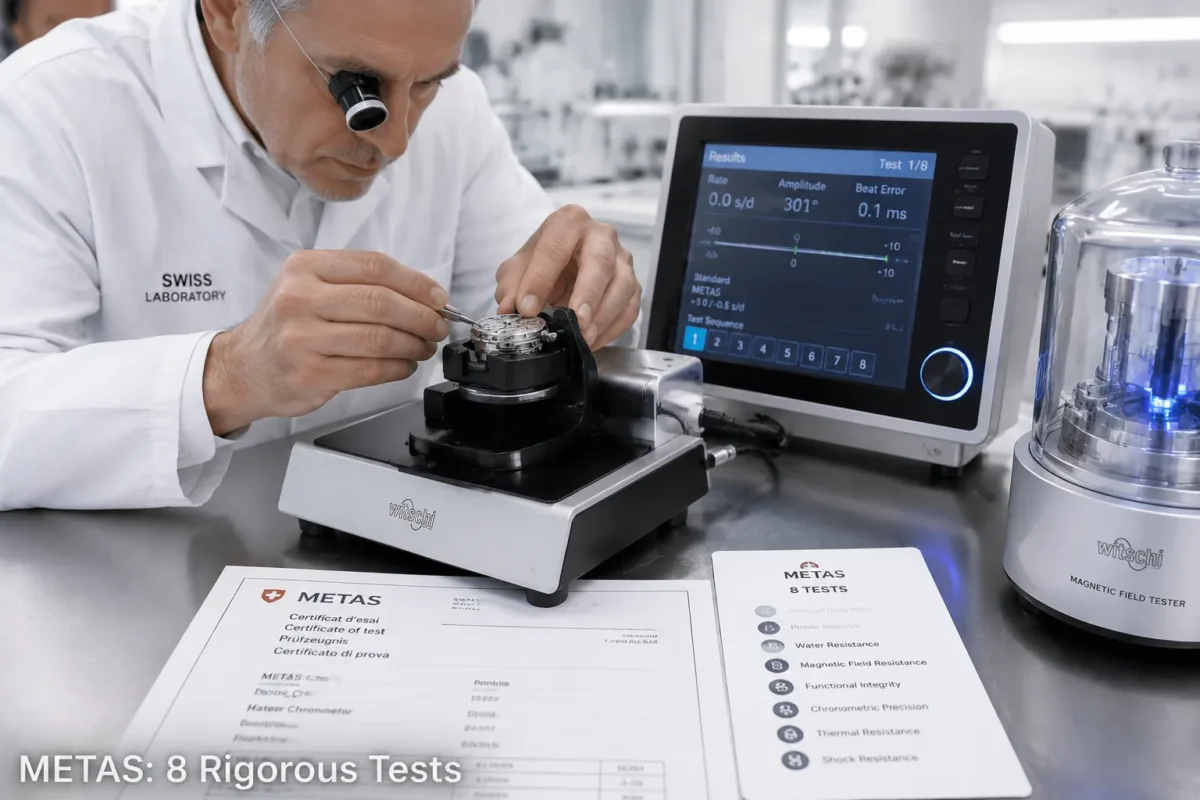
METAS Master Chronometer certification requires a movement to pass eight sequential tests. Failing any single test disqualifies the movement.
| Test | What It Measures |
|---|---|
| 1. Magnetic resistance (movement only) | Must function in a 15,000 gauss field |
| 2. Magnetic resistance (cased watch) | Complete watch tested in 15,000 gauss field |
| 3. Rate deviation after magnetization | Accuracy within 0/+5 sec/day post-exposure |
| 4. Water resistance | Verified to stated depth rating |
| 5. Crown position accuracy | Rate measured in all crown positions |
| 6. Six-position accuracy | Rate measured in six orientations |
| 7. Power reserve accuracy | Rate measured at full and depleted power |
| 8. Mean daily rate on the wrist | Accuracy within 0/+5 sec/day in real use |
Several of these tests deserve closer attention.
Test 1 and 2: The 15,000 Gauss Standard
Standard COSC chronometer testing does not include any magnetic resistance requirement. A COSC-certified movement can be rendered inaccurate by a moderately strong magnetic field — the kind produced by a MacBook speaker or a kitchen induction cooktop. METAS requires the movement to function normally inside a 15,000 gauss magnetic field, then maintain accuracy after exposure. This is not a theoretical benchmark; it reflects the actual magnetic environments modern wearers encounter.
Test 8: Wrist Accuracy, Not Bench Accuracy
Many watch certifications measure accuracy on a static timing machine. METAS requires the watch to achieve 0/+5 seconds per day as worn on the wrist, accounting for the motion, temperature variation, and positional changes of actual use. This is a meaningfully harder standard to meet.
Test 7: Power Reserve Accuracy
A movement’s rate can drift significantly as its mainspring depletes. METAS tests accuracy at both full power and near-empty power reserve, ensuring consistent performance throughout the full winding cycle.
“The METAS certification tests the watch as a system — not just the movement in isolation. That distinction separates it from every other certification currently available.” — Omega Technical Documentation, 2015
How METAS Compares to COSC Chronometer Certification
METAS Master Chronometer certification is not a replacement for COSC — it is an evolution beyond it. Understanding what METAS Master Chronometer certification means requires understanding where COSC ends and METAS begins.
COSC (Contrôle Officiel Suisse des Chronomètres) has been the Swiss watch industry’s standard for movement accuracy since 1973. It requires movements to achieve -4/+6 seconds per day across 16 days of testing in five positions and three temperatures. COSC tests the movement alone, not the cased watch.
METAS Master Chronometer tests the complete watch, adds magnetic resistance requirements, measures wrist accuracy rather than bench accuracy, and applies a tighter rate tolerance of 0/+5 seconds per day.
| Criterion | COSC Chronometer | METAS Master Chronometer |
|---|---|---|
| Testing body | Independent Swiss bureau | Swiss Federal Institute of Metrology |
| What is tested | Movement only | Movement + complete cased watch |
| Accuracy standard | -4/+6 sec/day | 0/+5 sec/day |
| Magnetic resistance | None required | 15,000 gauss |
| Number of tests | Rate across positions/temps | 8 distinct tests |
| Power reserve testing | No | Yes |
| Wrist accuracy tested | No | Yes |
Many Omega Master Chronometer movements carry both COSC and METAS certification. This means the movement first passes COSC testing, then the cased watch passes the full METAS battery. Collectors should note that “Chronometer” and “Master Chronometer” are not interchangeable terms.
Which Omega Watches Carry METAS Master Chronometer Certification?
As of 2026, METAS Master Chronometer certification is applied across Omega’s primary collections, including the Seamaster Planet Ocean, Seamaster Diver 300M, Speedmaster Moonwatch Professional (with the calibre 3861), Constellation, and De Ville Tresor lines.
The Omega De Ville Prestige collection represents one of the more elegant expressions of the Master Chronometer standard — a dress watch that carries the same rigorous movement certification as Omega’s sport and professional lines.
Choose a METAS-certified Omega if:
- Magnetic resistance is a practical concern (office environments, travel, tech-heavy lifestyles)
- You want third-party verified accuracy rather than brand-stated specifications
- Investment-grade documentation and certification matter for your collection
- You prefer a watch whose performance claims can be independently verified
A note on pre-owned METAS watches: The certification is issued at the time of production and is tied to the specific movement. When purchasing pre-owned, always request the original warranty card and box, as these documents confirm the certification was issued. Explore the MioJewelry Authenticity Guarantee to understand how certified pre-owned timepieces are verified before sale.
What METAS Master Chronometer Certification Means for Watch Investors
For collectors and investors, METAS certification functions as a form of technical due diligence built into the watch at the point of manufacture. It provides a verifiable, government-backed performance baseline that supports long-term value retention.

Several factors make METAS certification relevant to investment-grade timepiece selection:
Verifiable Third-Party Standards
Unlike a brand’s internal quality designation, METAS certification is issued by a federal body with published, publicly available testing protocols. Any buyer, appraiser, or insurer can review the exact criteria the watch met. This transparency adds credibility that supports resale value.
Documentation Completeness
A full-set METAS-certified watch — original box, papers, warranty card, and METAS certificate — commands a premium in the secondary market. Completeness of documentation is one of the primary value drivers for pre-owned luxury timepieces. For collectors building investment-grade holdings, full-set examples are the standard to pursue.
Omega’s Market Position
Omega occupies a distinctive position in the luxury watch market: prestigious enough to command strong secondary market prices, yet accessible enough to maintain broad collector demand. The addition of METAS certification has strengthened Omega’s technical credibility relative to competitors and supported pricing across its certified lines.
For those exploring broader luxury watch investment considerations, the MioJewelry watch education resource provides detailed guidance on evaluating timepieces across brands and complications.
How METAS Certification Compares to Other Industry Standards
Several other certification and quality programs exist in the luxury watch industry. Understanding where METAS sits among them clarifies its significance.
Rolex Superlative Chronometer
Rolex conducts its own in-house testing beyond COSC standards, claiming accuracy of -2/+2 seconds per day. However, this testing is performed internally by Rolex, not by an independent third party. The Rolex Datejust and other Rolex models carry the Superlative Chronometer designation, which reflects genuine technical achievement — but it is a brand-controlled standard, not an independent government certification.
Patek Philippe Seal
Patek Philippe replaced the Geneva Seal with its own Patek Philippe Seal in 2009, covering both movement and complete watch quality. The Seal includes accuracy testing, finishing standards, and functional requirements. It is administered by Patek Philippe itself. Models such as the Patek Philippe Calatrava and Grand Complications carry this designation.
Geneva Seal (Poinçon de Genève)
The Geneva Seal is administered by the Republic and Canton of Geneva, covering movement finishing and assembly quality. It does not include accuracy or magnetic resistance requirements.
IWC Internal Standards
IWC applies rigorous internal quality controls across its Portugieser, Portofino, and Pilot’s Watch lines, including the IWC Portugieser Automatic. These are brand-controlled standards without independent third-party certification.
The key distinction: METAS is the only current certification issued by a government-accredited national metrology institute that tests the complete cased watch against published magnetic resistance standards. No other certification currently matches that specific combination.
Common Misconceptions About METAS Certification
Several misunderstandings circulate among buyers encountering METAS certification for the first time.
Misconception 1: “METAS-certified means the watch is more accurate than a Rolex.”
Not necessarily. Rolex’s internal -2/+2 seconds per day standard is tighter than METAS’s 0/+5 seconds per day. METAS’s advantage is independence and magnetic resistance, not the narrowest possible accuracy band.
Misconception 2: “Any Omega watch is METAS-certified.”
Older Omega calibres produced before 2015 do not carry METAS certification. When purchasing a pre-owned Omega, verify the specific calibre and production date. The Master Chronometer designation will be stated on the dial and in the documentation.
Misconception 3: “METAS certification is permanent.”
The certification is issued at the time of production. A watch that has been serviced with non-original parts, or whose movement has been altered, may no longer meet the original certification criteria. Always purchase from trusted sources who can verify provenance and service history.
Misconception 4: “METAS replaces COSC.”
Many Master Chronometer movements hold both certifications. METAS is additive, not a substitute.
How to Verify METAS Certification When Buying
Whether purchasing new or pre-owned, verification of METAS certification follows a clear process.
- Check the dial text. Legitimate Master Chronometer watches display “Master Chronometer” on the dial, typically below the brand name or above the 6 o’clock position.
- Review the warranty card and box. Full-set examples include documentation referencing the specific calibre and its certifications.
- Confirm the calibre number. Cross-reference the movement calibre against Omega’s published list of METAS-certified calibres on the official Omega website.
- Purchase from an authenticated source. Working with established luxury watch dealers who provide documented provenance eliminates the risk of encountering non-certified or modified examples.
MioJewelry’s white-glove authentication process ensures every timepiece in the collection has been verified for authenticity, completeness, and condition before being offered to clients. Investment-grade timepieces deserve investment-grade verification.
FAQ: METAS Master Chronometer Certification
What does METAS stand for?
METAS stands for the Swiss Federal Institute of Metrology (in German: Eidgenössisches Institut für Metrologie). It is Switzerland’s national measurement standards authority, independent of any commercial entity.
Is METAS certification better than COSC?
METAS is more comprehensive than COSC. It tests the complete cased watch (not just the movement), adds magnetic resistance requirements, and applies a tighter wrist-accuracy standard. Many METAS-certified movements also hold COSC certification.
Which brands use METAS certification?
As of 2026, Omega is the primary brand using METAS Master Chronometer certification. No other major manufacture has adopted the METAS standard for its production watches.
Does METAS certification affect resale value?
Yes, positively. METAS certification adds a verifiable technical credential that supports buyer confidence in the secondary market. Full-set examples with original documentation command the strongest resale premiums.
Can a watch lose its METAS certification?
The certification is issued at production. A watch that has been modified, serviced with non-original parts, or whose movement has been altered may no longer meet the original certification criteria, though the certification itself is not formally revoked.
How does 15,000 gauss resistance compare to everyday magnetic exposure?
A standard refrigerator magnet produces roughly 50 gauss. A smartphone speaker produces approximately 200 gauss. Airport security equipment can reach 1,000 gauss. METAS’s 15,000 gauss standard provides substantial margin above any environment a wristwatch is likely to encounter in daily use.
Is the Omega Speedmaster Moonwatch METAS-certified?
The Speedmaster Moonwatch Professional with calibre 3861 (introduced in 2021) carries METAS Master Chronometer certification. Earlier Speedmaster models with the calibre 1861 do not.
Where can I buy a METAS-certified Omega with full documentation?
MioJewelry offers a curated selection of authenticated Omega timepieces with complete documentation. Contact the team directly for current availability and white-glove purchasing assistance.
Does METAS certification cover water resistance?
Yes. Water resistance verification is one of the eight METAS tests, confirming the watch meets its stated depth rating as a complete cased unit.
How long does METAS testing take?
The full eight-test METAS battery takes approximately two weeks per movement. This adds meaningful time and cost to the production process, which is one reason the standard has not been widely adopted beyond Omega.
Conclusion: Why METAS Certification Matters to Discerning Collectors
METAS Master Chronometer certification represents the most rigorous, independently verified performance standard currently available in the luxury watch market. For serious collectors and investors, it answers a question that brand marketing cannot: has this watch been tested by an entity with no stake in the outcome?
The eight-test battery, 15,000 gauss magnetic resistance requirement, and wrist-accuracy standard combine to create a certification that reflects how watches actually perform in the real world — not just on a timing machine in a controlled environment.
For buyers evaluating Omega’s Master Chronometer collection, the certification is not simply a technical footnote. It is a government-backed assurance of precision, durability, and authenticity that supports both daily confidence and long-term investment value.
Actionable next steps for serious buyers:
- Explore MioJewelry’s authenticated Omega collection for current METAS-certified availability.
- Review the MioJewelry Authenticity Guarantee to understand the verification standards applied to every timepiece.
- For broader luxury watch education, visit the MioJewelry watch education hub.
- Contact MioJewelry’s luxury watch experts for personalized guidance on METAS-certified timepieces that align with your collection goals and investment criteria.
Every investment-grade timepiece deserves this level of scrutiny. METAS certification ensures the watch has already passed it.
References
- Swiss Federal Institute of Metrology (METAS). Master Chronometer Certification Standard. METAS, 2015. https://www.metas.ch
- Omega SA. Master Chronometer: Technical Overview. Omega, 2015.
- COSC — Contrôle Officiel Suisse des Chronomètres. Chronometer Certification Criteria. COSC, 2023. https://www.cosc.swiss
- Patek Philippe SA. The Patek Philippe Seal. Patek Philippe, 2009.