

Complications & Tech, Blog
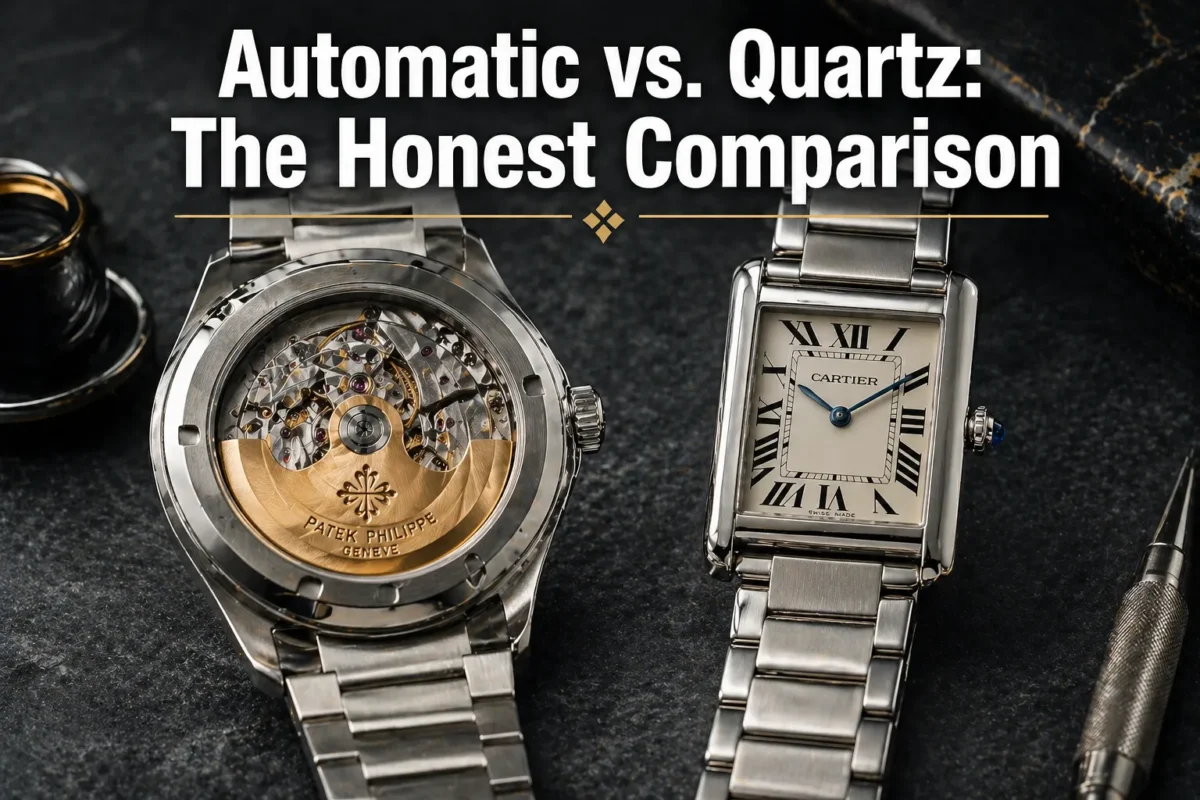
Automatic vs. quartz: the honest comparison
Apr
Last updated: April 27, 2026
Quick Answer
The automatic vs. quartz watch debate does not have a universal winner. Automatic watches offer mechanical artistry, heritage, and long-term investment value. Quartz watches deliver superior accuracy and low maintenance. The right choice depends on your purpose: collecting and investment favor automatics, while precision and practicality favor quartz.
Key Takeaways
- Automatic watches are powered by the wearer’s wrist movement and require no battery, making them self-sustaining mechanical marvels.
- Quartz watches use a battery-powered oscillating crystal and are accurate to within ±15 seconds per month, far exceeding most mechanical movements.
- Automatic watches from prestigious maisons — Rolex, Patek Philippe, IWC — consistently hold and appreciate in value over time.
- Quartz movements are less expensive to produce and service, making them accessible at every price tier.
- For serious collectors and luxury investors, the automatic movement is the standard of prestige and performance.
- Quartz complications (such as the Cartier Tank Must) can still represent significant value and desirability in the right context.
- Servicing an automatic watch typically costs more and requires more frequent attention than a quartz caliber.
- Both movement types can be found in certified authentic, investment-grade timepieces — the movement alone does not define quality.
- The resale market strongly favors automatic watches, particularly full-set complete examples with original box and papers.
- Understanding movement type is foundational to making an informed luxury watch purchase.
What Is the Core Difference Between an Automatic vs. Quartz Watch?
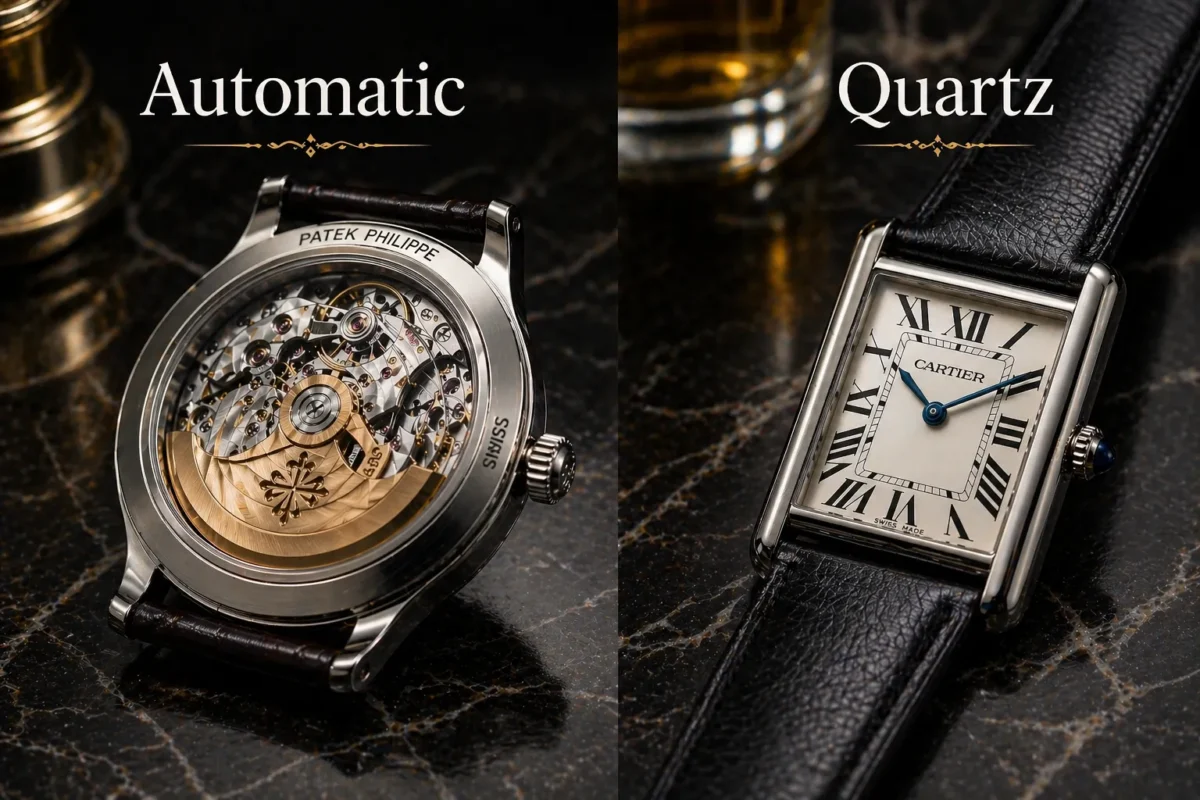
An automatic watch is powered entirely by mechanical energy, harvested through the natural motion of the wearer’s wrist. A quartz watch is powered by a battery that sends electrical current through a quartz crystal, creating a precise oscillation that regulates timekeeping.
This distinction shapes everything: cost, accuracy, maintenance, aesthetics, and long-term value.
How automatic movements work
Inside every automatic watch, a rotor spins freely as the wrist moves. That motion winds a mainspring, which stores energy and releases it through a series of gears to the escapement and balance wheel — the components that divide time into equal increments.
For a deeper look at the mechanics, see our guide on how automatic watches work.
Key characteristics of automatic movements:
- No battery required — powered entirely by kinetic energy
- Typical accuracy: ±5 to ±25 seconds per day, depending on caliber
- Power reserve: Generally 38 to 72 hours; some modern calibers exceed 10 days
- Visible craftsmanship: Many feature exhibition casebacks showing the movement
- Service interval: Typically every 5 to 7 years
How quartz movements work
A quartz crystal vibrates at exactly 32,768 Hz when an electrical current passes through it. A circuit counts those vibrations and advances the hands or display accordingly. The result is timekeeping accuracy that mechanical movements simply cannot match at equivalent price points.
Key characteristics of quartz movements:
- Battery-powered: Typically requires replacement every 1 to 3 years
- Typical accuracy: ±15 seconds per month (standard); ±5 seconds per year (high-grade)
- Low maintenance: No lubrication degradation at the same rate as mechanical calibers
- Service interval: Far less frequent than automatic; often only when issues arise
For a comprehensive breakdown of all movement types, our watch movements guide covers every caliber category in detail.
Which Movement Type Is More Accurate?
Quartz wins on accuracy, and it is not a close comparison. A standard quartz movement loses or gains roughly 15 seconds per month. A fine Swiss automatic movement — even a COSC-certified chronometer — is rated to ±4 seconds per day, which translates to roughly 2 minutes per year.
Accuracy comparison at a glance:
| Movement Type | Typical Accuracy | COSC / Certified Standard |
|---|---|---|
| Standard quartz | ±15 sec/month | N/A |
| High-precision quartz | ±5 sec/year | N/A |
| Standard automatic | ±10–25 sec/day | N/A |
| COSC-certified automatic | ±4 sec/day | Yes |
| Spring Drive (Seiko) | ±1 sec/day | Proprietary |
| Atomic/GPS quartz | ±1 sec/100,000 years | Synchronized |
Decision rule: If you need a watch to serve as a precise daily instrument — for timing medications, coordinating international calls, or professional use where seconds matter — quartz is the practical answer. If you are building a collection or making a statement of horological appreciation, the slight variance of an automatic movement is entirely irrelevant.
How Do Automatic vs. Quartz Watches Compare in Investment Value?
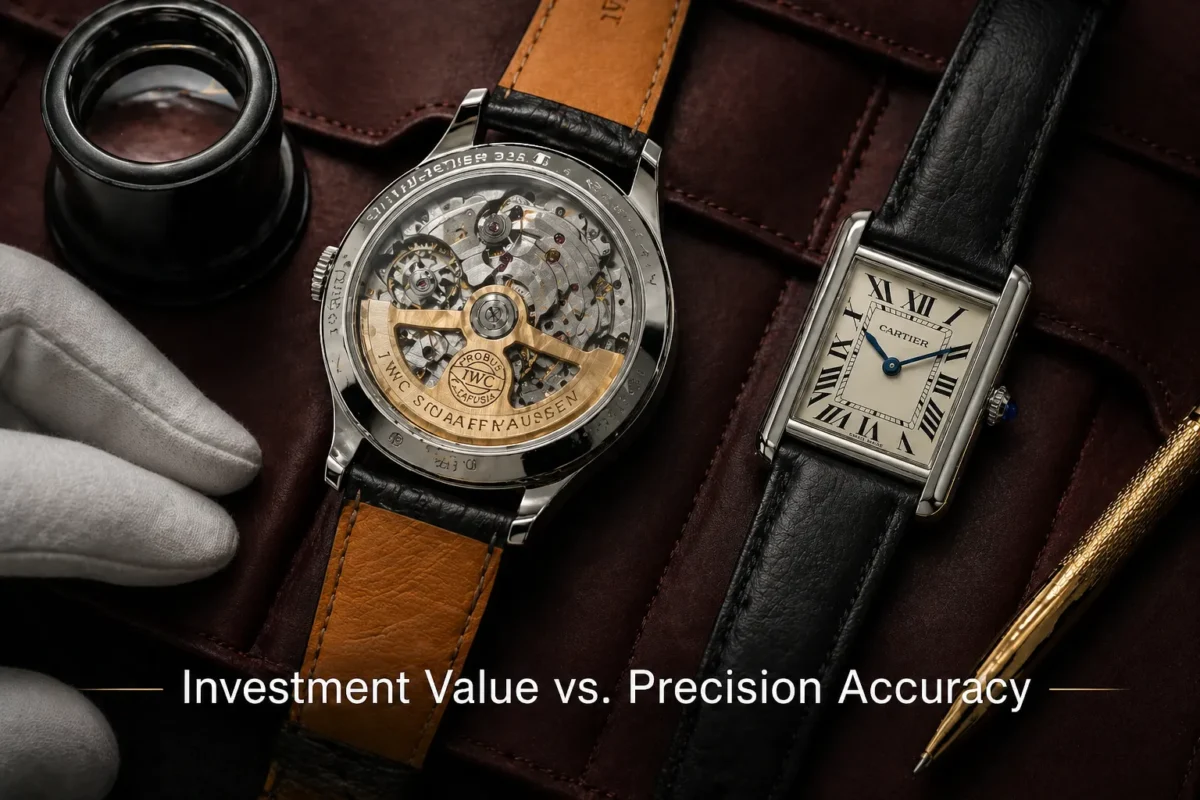
For investment-grade timepieces, automatic movements dominate the secondary market. The mechanical movement is the soul of a luxury watch’s collectibility.
The resale market for prestigious automatic watches — particularly references from Rolex, Patek Philippe, and IWC — reflects decades of consistent demand. A Rolex Datejust in full-set complete condition with original box and papers commands a meaningful premium over a comparable quartz piece from the same era.
Quartz watches can hold value in specific circumstances:
- Iconic design houses: The Cartier Tank Must Quartz is a recognized design icon and retains strong demand.
- Limited editions: Low-production quartz references with historical significance.
- Condition and completeness: A full-set quartz example from a prestigious maison will always outperform a stripped automatic from an unknown brand.
Pull quote: “The movement type matters — but brand, condition, reference, and completeness determine investment outcome.”
Common mistake: Assuming all automatic watches appreciate and all quartz watches depreciate. Movement type is one variable. Brand heritage, reference rarity, condition, and the presence of original documentation are equally decisive.
For broader context on what drives luxury watch pricing, read why Swiss watches are so expensive.
What Are the Maintenance Differences Between Automatic and Quartz Watches?
Automatic watches require more frequent and more costly servicing. Quartz watches are comparatively low-maintenance.
Automatic watch maintenance
An automatic movement contains hundreds of moving parts, all requiring lubrication. Over time, oils degrade, components wear, and accuracy suffers. A full service — disassembly, cleaning, re-lubrication, reassembly, timing adjustment — is typically recommended every 5 to 7 years.
Service costs vary significantly:
- Entry-level Swiss automatics: $200–$500
- Mid-range Swiss automatics: $500–$1,000
- Prestige calibers (Rolex, Patek, IWC): $800–$2,500+
If an automatic watch is not worn regularly, it will stop running and may need to be wound manually before wearing. Our guide on how to wind a wrist watch explains the correct technique to avoid crown damage.
Quartz watch maintenance
Quartz watches require:
- Battery replacement: Every 1 to 3 years, typically $10–$50 at a watchmaker
- Gasket inspection: Recommended every 2 to 3 years to maintain water resistance
- Full service: Far less frequent — often only when timekeeping degrades noticeably
Edge case: High-end quartz movements in luxury cases (such as those found in certain Patek Philippe Calatrava ladies’ models) still require professional battery replacement to preserve water resistance and avoid case damage. Never attempt battery replacement on a luxury quartz watch at a retail kiosk.
How Do Automatic and Quartz Watches Differ in Craftsmanship and Prestige?
The automatic movement is, by nearly universal consensus among collectors and connoisseurs, the superior expression of horological craft. The quartz movement, while technically impressive, does not carry the same cultural weight in the luxury segment.
This is not snobbery — it reflects genuine complexity. A fine Swiss automatic movement may contain 200 to 400 individual components, each finished by hand to exacting tolerances. The beveled edges, perlage decoration, and côtes de Genève striping visible through an exhibition caseback represent hundreds of hours of skilled labor.
The IWC Portugieser Automatic exemplifies this standard: its caliber 52010 movement delivers 7-day power reserve, PELLATON winding system, and finishing that rewards close examination. Similarly, the IWC Portofino Automatic presents classical elegance backed by serious mechanical substance.
Quartz movements in luxury watches are not without merit. The Cartier Tank’s quartz caliber is reliable, thin, and allows for a slimmer case profile that suits formal wear. The Cartier Tank Française Large Quartz demonstrates that a quartz movement can occupy the highest tiers of design prestige.
Choose automatic if: Craftsmanship, heritage, and the tradition of mechanical watchmaking matter to you. You appreciate the watch as an object of art as much as a timekeeping tool.
Choose quartz if: A slim profile, reliable accuracy, and minimal upkeep are priorities. You want a prestigious design without the servicing commitment.
What Does the Automatic vs. Quartz Watch Debate Mean for Luxury Collectors?
For serious collectors, the automatic vs. quartz watch question is largely settled: mechanical movements define the core of any investment-grade collection. That said, strategic inclusion of iconic quartz references adds diversity and historical perspective.
A well-curated collection might include:
- Cornerstone automatics: Rolex Datejust, Patek Philippe Nautilus, IWC Portugieser — pieces that anchor value and represent the pinnacle of Swiss craft
- Design icons in quartz: Cartier Tank Must, select Omega De Ville Prestige ladies’ references — pieces where the design narrative transcends movement type
- Complications: Chronographs, perpetual calendars, and tourbillons are almost exclusively found in automatic movements at the prestige level, such as the IWC Pilot Chronograph 41 Automatic
The Patek Philippe Golden Ellipse 5738/51G represents the kind of automatic investment that transcends market cycles — a hand-engraved, enameled dial in 18k white gold, powered by a caliber that reflects generations of manufacture expertise.
For collectors building their first serious collection, The Ultimate Guide to Choosing Your Perfect Luxury Watch provides a structured framework for evaluating references, conditions, and acquisition strategy.
Are Quartz Watches Ever Worth Buying at the Luxury Level?
Yes — in specific contexts, a luxury quartz watch is an entirely defensible purchase.
The case for luxury quartz:
- Formal dress wear: Ultra-thin quartz movements allow for cases under 6mm, ideal beneath a shirt cuff
- Travel and daily reliability: No concern about power reserve depletion during infrequent wear
- Design-first priorities: When the case, dial, and bracelet are the primary attraction
- Entry into a prestigious maison: A quartz reference from Cartier or Omega can serve as an introduction to a brand’s design language before committing to a higher-priced automatic
The Cartier Tank Must Quartz Large is a compelling example: it carries one of the most recognized case shapes in watchmaking history, wears beautifully, and represents genuine value within the Cartier universe.
Common mistake: Dismissing quartz watches entirely based on movement type alone. At the luxury level, a quartz watch from a prestigious maison is still a certified authentic, investment-grade timepiece when purchased in full-set complete condition with proper documentation.
What Should You Know Before Buying an Automatic or Quartz Watch?
Before committing to either movement type, consider these practical criteria:
For automatic watch buyers:
- Confirm the watch has been recently serviced or is under factory warranty
- Request full-set complete documentation: original box, papers, warranty card, and service records
- Verify the reference number against official manufacture specifications
- Understand the power reserve and whether you will wear the watch regularly enough to keep it wound
- Purchase only from trusted, established dealers who offer authenticity guarantees
For quartz watch buyers:
- Confirm the battery has been recently replaced and water resistance re-tested
- Verify gasket condition, especially on watches claiming any water resistance rating
- Ensure the crown seals properly — a common failure point on older quartz references
- Confirm authenticity through reference number verification and hallmark inspection
At MioJewelry, every timepiece — automatic or quartz — is offered as a certified authentic, investment-grade timepiece with full documentation where applicable. White-glove service, fully insured overnight shipping, and authenticity guaranteed are standard across the entire exclusive collection.
Frequently Asked Questions
Q: Is an automatic watch always better than a quartz watch? Not always. Automatic watches offer superior craftsmanship, prestige, and investment potential. Quartz watches offer better accuracy and lower maintenance. “Better” depends entirely on the buyer’s priorities.
Q: How long do automatic watches last compared to quartz? A properly serviced automatic watch can last generations — many vintage examples from the 1950s and 1960s still run accurately today. Quartz watches also last decades, but the movement electronics can degrade over very long periods in ways that mechanical components do not.
Q: Do automatic watches need to be wound every day? Not necessarily. Most modern automatic watches wind themselves through wrist movement during normal daily wear. If left unworn for more than 40 to 72 hours (depending on power reserve), they will stop and require manual winding or a watch winder to restart.
Q: Are quartz watches considered luxury watches? Yes. Many of the world’s most prestigious brands — Cartier, Patek Philippe, Omega — produce quartz references that are unambiguously luxury timepieces. Movement type does not determine luxury status; brand heritage, materials, finishing, and exclusivity do.
Q: Which movement type holds value better on the secondary market? Automatic watches from prestigious Swiss manufactures consistently outperform quartz references on the secondary market. However, iconic quartz designs from Cartier and select Patek Philippe ladies’ references maintain strong demand and stable resale values.
Q: How accurate is a typical automatic watch? A standard Swiss automatic movement is accurate to approximately ±10 to ±25 seconds per day. COSC-certified chronometer movements are rated to ±4 seconds per day. High-grade quartz movements are accurate to ±15 seconds per month — roughly 15 times more accurate than a standard automatic.
Q: Can you tell if a watch is automatic or quartz just by looking at it? Often, yes. The seconds hand on a quartz watch typically advances in a single “tick” per second. An automatic seconds hand sweeps continuously (or in very rapid increments, typically 6 to 10 beats per second). An exhibition caseback also immediately reveals movement type.
Q: Is it worth buying a luxury quartz watch as an investment? Selectively, yes. Iconic quartz references in full-set complete condition from maisons like Cartier can be sound acquisitions. They are generally not expected to appreciate at the same rate as prestigious automatic references, but they hold value reliably when purchased at fair market prices.
Q: What is a COSC-certified chronometer? COSC (Contrôle Officiel Suisse des Chronomètres) is an independent Swiss institute that tests and certifies watch movements. A COSC-certified automatic movement must achieve accuracy within ±4 seconds per day across multiple positions and temperatures over 16 days of testing.
Q: How often does a luxury automatic watch need servicing? Most Swiss manufactures recommend a full service every 5 to 7 years. Some modern calibers with improved lubricants and materials can extend that interval to 8 to 10 years. Always follow the specific manufacture’s recommendation for the reference in question.
Conclusion
The automatic vs. quartz watch comparison ultimately comes down to what a timepiece means to you. If it is a precision instrument first, quartz delivers unmatched reliability with minimal upkeep. If it is a statement of craft, heritage, and long-term value — as it is for most serious collectors and luxury investors — the automatic movement is the standard by which all others are measured.
Both movement types can represent extraordinary value when acquired correctly: certified authentic, in full-set complete condition, from a trusted source with a verifiable track record.
Actionable next steps:
- Define your purpose. Daily wear, formal occasions, investment, or all three? Let function guide the movement choice.
- Research the reference. Understand the specific caliber, production numbers, and service history before purchasing.
- Insist on completeness. Original box, papers, and service records are not optional for investment-grade acquisitions.
- Work with experts. Engage luxury watch professionals who offer authenticity guarantees and white-glove service.
- Explore the collection. Browse MioJewelry’s exclusive collection of investment-grade automatic and quartz timepieces, with immediate availability and fully insured overnight shipping.
For rare references not currently listed, MioJewelry’s special requests service connects discerning clients with rare and highly sought-after timepieces through a discreet, personalized acquisition process.
References
- Contrôle Officiel Suisse des Chronomètres (COSC). Chronometer Certification Standards. cosc.ch. (2023)
- IWC Schaffhausen. Calibre 52010 Technical Documentation. iwc.com. (2022)
- Federation of the Swiss Watch Industry FH. Swiss Watch Industry Export Statistics. fhs.swiss. (2024)
- National Institute of Standards and Technology (NIST). Frequency Standards and Timekeeping. nist.gov. (2022)