

Brand History & Storytelling
Is Rolex a Non-Profit? The Truth Behind Its Ownership Structure
Aug
Last updated: August 19, 2026
Quick Answer: Rolex SA is a for-profit company, but the entity that owns it, the Hans Wilsdorf Foundation, is a registered charitable, non-profit foundation under Swiss law. So is Rolex a non-profit? The honest answer is yes and no: the foundation above the company has no shareholders and channels dividends into philanthropy, while Rolex itself sells watches, pays taxes, and runs like any other Swiss manufacturer.
Key Takeaways
- Rolex the company is a for-profit business; its owner, the Hans Wilsdorf Foundation, is a non-profit organization.
- Hans Wilsdorf created the foundation because he had no heirs to inherit the brand he built.
- There are no shareholders and no public stock listing, unlike many other luxury brands.
- Rolex still turns a significant profit; estimates from Morgan Stanley and LuxeConsult place annual revenue near $10 billion.
- Rolex’s profits fund philanthropy, including the Rolex Awards for Enterprise and the Mentor and Protégé Arts Initiative.
- Rolex does not publish exact profit or donation figures; Swiss private companies rarely do.
- Compared with family-run Patek Philippe or Richemont-owned Vacheron Constantin, Rolex’s foundation model is unusual.
- The structure gives Rolex long-term independence, insulating the company from acquisition and stock-market pressure.
Is Rolex a Non-Profit Organization? The Short Answer
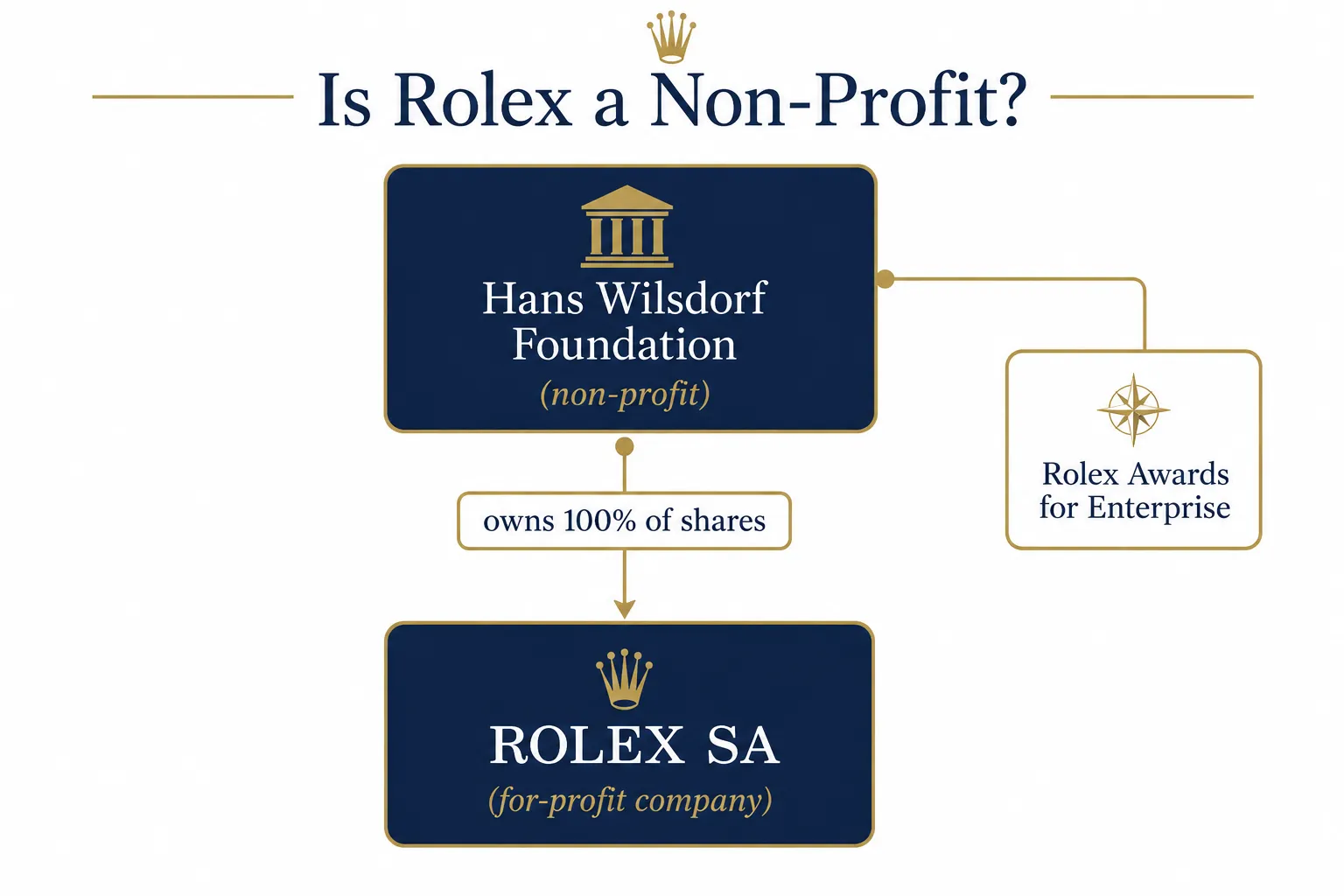
Rolex is not, by itself, a non-profit organization. Rolex SA is a private, for-profit company that manufactures and sells watches, but it operates under the ownership of the Hans Wilsdorf Foundation, which is legally organized as a Swiss non-profit foundation. This dual-layer setup is exactly why so many collectors search “is Rolex a non-profit” and land on a confusing answer.
Search “Is Rolex a non-profit reddit” and you will find the same debate collectors have had for years: the Rolex non-profit wikipedia entry confirms the foundation ownership, yet the company itself still sells watches for profit like any other Swiss watch brand. Both statements are true at once, and understanding why requires separating the company from its charitable owner.
- The company (Rolex SA): for-profit, manufactures and sells watches, employs thousands, pays Swiss corporate obligations.
- The owner (Hans Wilsdorf Foundation): non-profit, holds 100 percent of Rolex shares, has no shareholders to pay dividends to.
Decision rule: if someone asks whether Rolex is a non-profit company, the accurate reply is “the owner is; the operating company is not.”
Who Owns Rolex? The Company’s Ownership Structure Explained
Rolex is privately owned by the Hans Wilsdorf Foundation, a charitable trust based in Geneva, Switzerland. No individual, family, or public shareholder owns stock in Rolex, which sets it apart from most other luxury brands.
This is the answer to “who owns Rolex company” that most people miss: there is no Wilsdorf heir collecting dividends, no private equity fund, and no listing on the Swiss stock exchange. The foundation holds all voting rights and appoints the board that runs Rolex SA day to day.
- No public shares: Rolex cannot be bought on any stock exchange.
- No family dynasty: unlike Patek Philippe’s Stern family, Rolex has no controlling family today.
- No private equity owner: unlike many mid-size Swiss watch brands, Rolex was never sold to a holding group such as Richemont or Swatch Group.
Common mistake: assuming “owned by a non-profit” means Rolex gives its watches away or operates below cost. It does not. The company sets its own retail pricing, competes on the open market, and behaves commercially in every visible way.
The History Behind the Hans Wilsdorf Foundation
Hans Wilsdorf founded Rolex in London in 1905 and later moved the company to Switzerland, and he created the foundation that now owns Rolex because he had no children to inherit the business. This decision, made in the 1940s, remains the single most important fact in any discussion of Rolex’s ownership.
Wilsdorf’s wife had passed away, and without direct heirs, he chose to place his shares into a charitable foundation rather than sell the company or leave it to distant relatives. According to the foundation’s own historical account, this ensured Rolex would remain independent, headquartered in Geneva, and insulated from a hostile takeover after his death in 1960.
- 1905: Hans Wilsdorf and Alfred Davis found the company in London.
- 1920s-1930s: The brand relocates its base of operations to Switzerland.
- 1945: Wilsdorf establishes the Hans Wilsdorf Foundation to secure the company’s future.
- 1960: Wilsdorf dies; the foundation formally takes full ownership.
This history explains the rolex family ownership question directly: there is no ruling family today. The foundation replaced any dynasty entirely, which is part of why Rolex indeed feels different from other watch brands built on bloodlines.
How the Rolex and Foundation Structure Works
The Hans Wilsdorf Foundation owns all of Rolex’s shares, appoints its board, and receives whatever dividends the company distributes, then redirects a portion of those funds toward philanthropy. The company operates with its own management and strategy, while the foundation functions purely as a steward and charitable trust above it.
- The foundation has no employees producing watches; Rolex SA handles manufacturing, marketing, and sales.
- The foundation’s board includes senior figures with governance responsibility over the company’s direction.
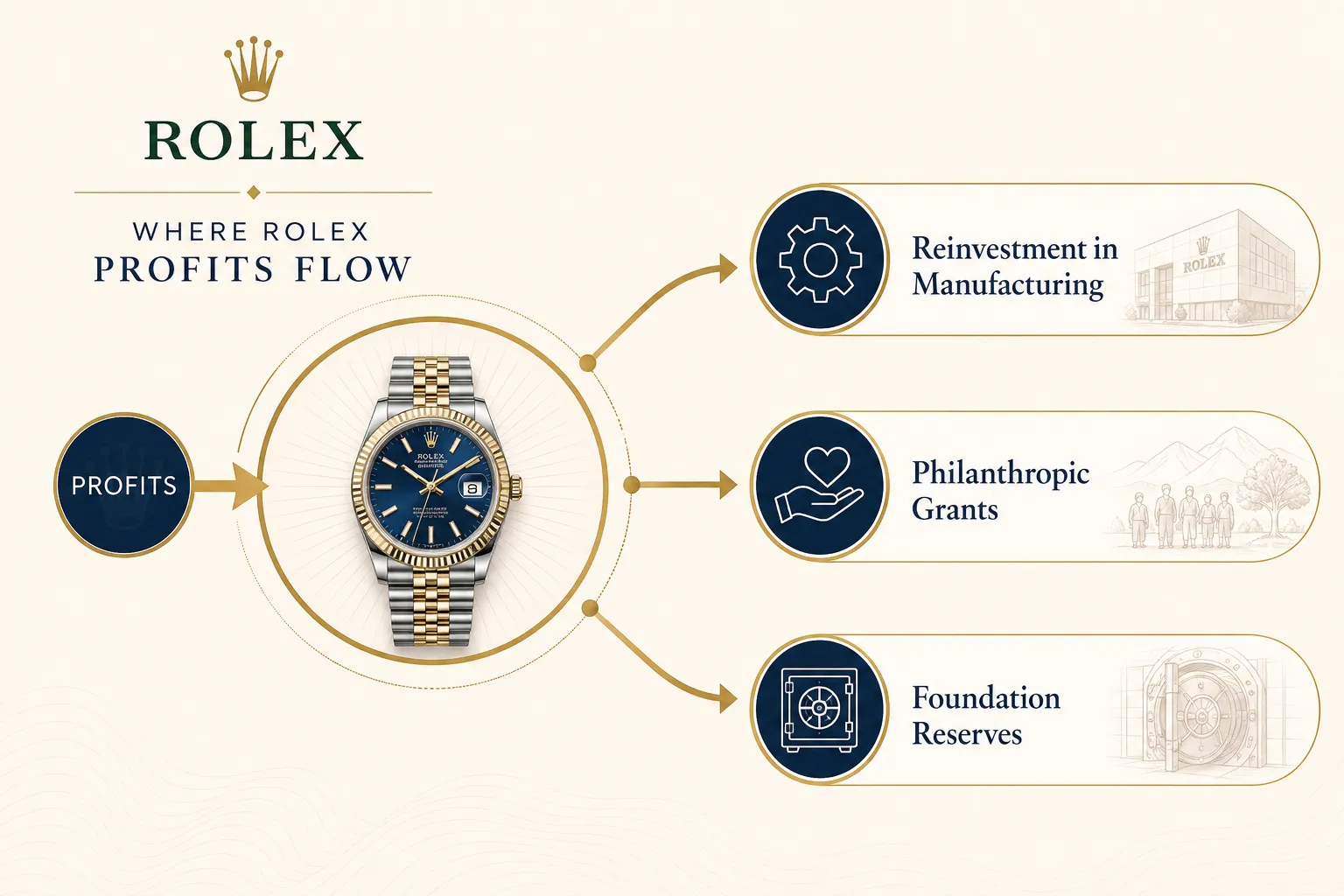
- Profits generated by Rolex flow upward to the foundation, which reinvests them into the company’s growth and charitable programs, rather than into private pockets.
Edge case: because the foundation is not required to disclose detailed financials the way a public company would, outside analysts rely on estimates rather than confirmed figures. This lack of transparency is exactly why the “non-profit” label gets applied loosely, even though Rolex itself is legally a for-profit company.
Does Rolex Still Make Money? How Much Profit the Company Generates
Yes, Rolex generates substantial profit every year, and being owned by a non-profit foundation does not change that. Industry analysts, including estimates cited by Reuters and Morgan Stanley research on the Swiss watch industry, put Rolex’s annual revenue in the range of $10 to $13 billion, with the Deloitte Swiss Watch Industry study consistently ranking Rolex as the single largest Swiss watch brand by sales.
- Rolex produces roughly 1 million watches per year, according to figures widely cited by WatchTime and Hodinkee.
- Rolex holds an estimated 20 to 30 percent share of the entire Swiss luxury watch export market, per SwissInfo coverage of the sector.
- Retail prices on models such as the Submariner, GMT-Master II, and Datejust continue climbing year over year, per reporting from Bloomberg and WWD.
Common mistake: assuming “non-profit owner” means Rolex operates as a charity that breaks even. In practice, Rolex behaves like any other for-profit company chasing margin, market share, and brand value, and its profits fund a genuinely large philanthropic operation on top of normal business reinvestment.
Rolex’s Profits: Understanding the World’s Most Successful Nonprofit Watchmaker
Rolex’s profits are largely reinvested into manufacturing, research, and the brand’s long-term positioning, with a documented portion directed toward philanthropy through the Hans Wilsdorf Foundation. Rolex does not publish exact figures on how much goes where, a level of secrecy typical of privately held Swiss companies.
How Rolex reinvests profits:
- Manufacturing expansion, including new production facilities in Switzerland.
- Vertical integration, buying suppliers such as dial and bracelet makers to control quality.
- Marketing and sponsorships across sailing, golf, tennis, and motorsport.
- Charitable giving through the foundation, including grants tied to the Rolex Awards for Enterprise and the Mentor and Protégé Arts Initiative.
A frequently cited claim online suggests Rolex donates as much as 90 percent of profits to charity. That specific figure has not been confirmed by any audited public filing, and outlets such as Forbes and Vanity Fair treat it as an unverified estimate rather than a fact. What is confirmed: profits do flow to the foundation, and the foundation does fund meaningful philanthropic programs, even without publicly itemized totals.
Rolex vs Other Luxury Watch Brands: Ownership Compared
Rolex’s foundation-owned, for-profit model is rare among Swiss watch brands, most of which are either family-owned, publicly traded, or owned by a larger luxury conglomerate. Comparing ownership structures shows exactly why Rolex draws the “non-profit” question more than any other brand.
| Brand | Ownership Type | Publicly Traded | Owner |
|---|---|---|---|
| Rolex | Foundation-owned, for-profit company | No | Hans Wilsdorf Foundation |
| Patek Philippe | Family-owned | No | Stern family |
| Vacheron Constantin | Conglomerate-owned | Indirectly (parent company) | Richemont |
| Omega | Conglomerate-owned | Indirectly (parent company) | Swatch Group |
| Panerai | Conglomerate-owned | Indirectly (parent company) | Richemont |
The Rolex Omega comparison comes up constantly among collectors, but the two brands could not be more different structurally: Omega answers to Swatch Group shareholders, while Rolex answers to a charitable foundation with no shareholders at all. Which watch company is non-profit in the same way Rolex is? None of the other major Swiss watch brands, according to ownership records compiled by SJX Watches and A Blog to Watch, use a comparable foundation structure.
Is Rolex a Private or Public Company? Tax Status and Legal Structure
Rolex is a private company, not a publicly traded one, and its shares cannot be purchased on any stock exchange. The Hans Wilsdorf Foundation’s non-profit status under Swiss law also carries tax implications, since Swiss charitable foundations typically receive favorable tax treatment compared to a standard for-profit company.
- Rolex SA files as a for-profit company under Swiss corporate law and pays applicable corporate taxes on its own operations.
- The Hans Wilsdorf Foundation, as a registered non-profit organization, benefits from the tax advantages Switzerland extends to genuine charitable trusts.
- Because Switzerland does not require the level of financial disclosure common in the United States or the United Kingdom, exact tax figures for either entity remain private.
This is a reasonable, though partly speculative, explanation among Swiss corporate law commentators for why the structure persists: it protects Rolex from a hostile acquisition, avoids the scrutiny of public shareholders, and still allows the foundation to claim non-profit tax status above the operating company. Whether that amounts to Rolex “avoiding” taxes is a separate question from whether Rolex “is” a non-profit, and the two get conflated often in casual discussion, including on forums asking does Rolex pay taxes.
Rolex’s Charitable and Philanthropic Endeavors
Rolex funds several long-running philanthropic programs through the Hans Wilsdorf Foundation, most notably the Rolex Awards for Enterprise and the Rolex Mentor and Protégé Arts Initiative. These programs support scientific, environmental, and cultural projects around the world, and they are the clearest evidence behind the “non-profit” reputation Rolex has earned.
- The Rolex Awards for Enterprise: launched in 1976, this program has funded individual laureates working on conservation, exploration, and applied science projects worldwide, according to rolex.org.
- The Rolex Mentor and Protégé Arts Initiative: pairs emerging artists with established masters across disciplines including film, music, and literature.
- Perpetual Planet initiative: funds environmental research, including ocean and climate science partnerships publicized through outlets such as National Geographic and GQ.
Every serious wristler eventually runs into this trust-building side of the brand, and it is a meaningful part of why buyers feel confident purchasing from Rolex over lesser-known brands. Trusted worldwide by collectors and investors alike, Rolex pairs prestige and performance with a philanthropic mission that few competitors can match.
Is Rolex a Non-Profit? Final Thoughts
Rolex is not a non-profit company itself; it is a for-profit business owned entirely by a charitable, non-profit foundation. That single distinction resolves nearly every version of the “is Rolex a non-profit” question circulating online in 2026.
For collectors and investors, the practical takeaway matters more than the legal technicality: Rolex behaves like a disciplined, profit-driven Swiss watch brand in every commercial sense, while its ownership above the company happens to be structured as a charitable trust. That combination has helped Rolex avoid the volatility that comes with public shareholders, stay independent from luxury conglomerates, and fund genuine philanthropy at scale.
If you are shopping for a Rolex watch as a serious purchase or an investment-grade piece, focus on what actually protects your money: authenticity, condition, and completeness of the set. MioJewelry offers certified authentic, full set complete timepieces, many still under factory warranty, with fully insured overnight shipping and white-glove service from luxury watch experts. Browse the Datejust collection in stainless steel, the yellow gold Day-Date lineup, or the Yacht-Master in black dial to see rare and highly sought-after references with immediate availability.
Frequently Asked Questions
Is buying a Rolex a tax write-off?
No, buying a Rolex is not a tax write-off for personal use. It could potentially qualify as a business deduction only in narrow, documented circumstances, such as a legitimate business gift under strict limits, and you should consult a licensed tax professional such as those referenced by the IRS before assuming any deduction applies.
Is Rolex a non-profit organization according to Wikipedia?
No. The Wikipedia entry on Rolex confirms Rolex SA is a for-profit company owned by the non-profit Hans Wilsdorf Foundation, not a non-profit itself.
Who owns Rolex?
The Hans Wilsdorf Foundation owns Rolex outright. There are no individual shareholders, family owners, or public investors involved.
Does Rolex pay taxes?
Yes. Rolex SA pays Swiss corporate taxes as a for-profit company, while its non-profit foundation owner receives the tax treatment Switzerland extends to registered charitable trusts.
Why does Rolex donate profits to charity?
Because Hans Wilsdorf structured the company’s ownership around a charitable foundation with no heirs to inherit it, profits that reach the foundation get redirected into philanthropic programs like the Rolex Awards for Enterprise, rather than paid out as shareholder dividends.
Which watch company is non-profit like Rolex?
No other major Swiss watch brand uses an identical foundation-ownership model. Patek Philippe remains family-owned, while Omega and Vacheron Constantin sit under publicly traded conglomerates, according to ownership structures tracked by WatchPro and Professional Jeweller.
Related Insights, Contact Us & Latest Updates
For readers who want to keep exploring, related coverage worth reading includes the Rolex Milgauss anti-magnetic story, the Rolex Wimbledon partnership, a COSC versus METAS chronometer comparison, a modern Explorer I sizing guide, an Omega Seamaster model breakdown, a look at Gerald Genta-designed icons, and entry-level Patek Philippe references under 25,000 euros. From new arrivals to reduced luxury watches ready to sell, Swiss watch brands like Rolex dominate the conversation among vintage and modern collectors alike.
Take the time to know and explore brands like Rolex, especially through initiatives such as the Rolex Awards for Enterprise & the Mentor and Protégé Arts Initiative. On mobile, simply use the menu, back, or close menu options to keep exploring the exclusive collection. For personal guidance on a specific reference, contact us directly, or subscribe for insights on luxury watch trends & releases. Review our privacy policy terms before submitting any inquiry. All Rolex trademarks and Rolex’s brand identity remain the property of Rolex SA; rights reserved.