

Buying Guides
New vs Pre-Owned Luxury Watch: Which Is the Smarter Buy in 2026?

Jun
Last updated: June 9, 2026
Quick Answer
A new luxury watch is the smarter buy when warranty, condition certainty, and ownership history matter most, with full manufacturer coverage usually lasting 5 years. A pre-owned luxury watch is smarter when value, immediate availability, or access to discontinued references is the priority, with savings of roughly 10–40% on common models and waitlist-free delivery on hot ones. The right choice depends on the specific reference, the seller’s credentials, and your goals as a buyer.
Key Takeaways
- New watches offer full manufacturer warranties (typically 2–5 years), pristine condition, and authorized dealer assurance.
- Pre-owned watches can save 10–40% on most references, but hyped models (steel Rolex sport, Patek Nautilus) often sell above retail on the secondary market.
- Depreciation hits hardest in the first 1–3 years; after that, well-chosen pre-owned watches stabilize or appreciate.
- Authentication is the single biggest risk in the pre-owned market. Always demand papers, service history, and use trusted dealers or independent watchmakers.
- Certified pre-owned (CPO) programs from brands like Rolex, Audemars Piguet, and Omega bridge the gap with multi-year warranties.
- Rolex, Patek Philippe, Audemars Piguet, and select Omega and Cartier references hold value best in the used market.
- Buying online is safe with the right vendor; buying online from a stranger on a forum is not.
What’s the Real Price Difference Between New and Used Luxury Watches?
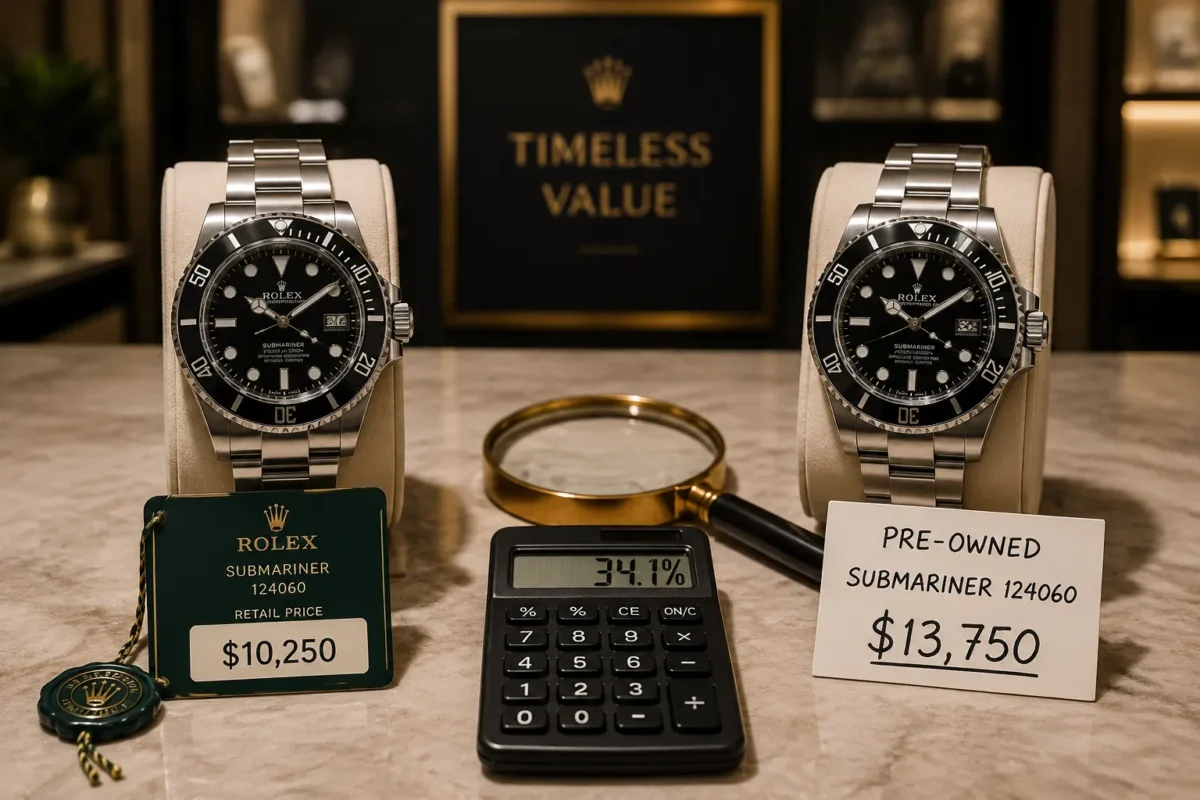
The price gap between a new and pre-owned luxury watch usually ranges from 10% to 40%, but it depends entirely on the model. Entry-level pieces from brands like Omega, Tudor, and Cartier often show the steepest discounts used, while in-demand steel sports watches from Rolex, Patek Philippe, and Audemars Piguet frequently trade above retail even when pre-owned.
Here’s a realistic snapshot of typical price behavior:
| Watch Category | New (Retail) | Pre-Owned (Typical) | Gap |
|---|---|---|---|
| Omega De Ville / Speedmaster | $5,000–$9,000 | $3,500–$7,000 | 20–35% less |
| Cartier Tank (steel) | $3,500–$5,500 | $2,800–$4,500 | 15–25% less |
| Rolex Datejust 41 | $9,500–$14,000 | $9,000–$13,500 | 5–15% less |
| Rolex Submariner (steel) | $10,100 (MSRP) | $13,000–$16,000 | 30–60% more |
| Patek Nautilus 5711 | discontinued | $200,000+ | massive premium |
| Audemars Piguet Royal Oak 15500 | $25,000 MSRP | $35,000–$45,000 | 40–80% more |
The lesson: the assumption that “used is cheaper” only holds for watches that aren’t on a waitlist. If a model is impossible to buy new, the secondary market is the only market — and it sets its own price.
For a deeper look at which references actually appreciate, see this investment guide to high-value luxury watch models.
Do Pre-Owned Watches Lose Value Faster Than New Ones?
No — pre-owned watches typically lose value slower than new ones, because someone else has already absorbed the steepest depreciation. The first owner of a new luxury watch usually takes the biggest hit if they resell within the first 1–3 years.
Depreciation patterns to know:
- Years 0–1: A new watch from a non-waitlisted brand can lose 15–25% the moment it leaves the boutique, similar to a new car.
- Years 1–5: Depreciation slows to a few percent annually on most models.
- Years 5+: Many quality references stabilize. Iconic, well-maintained pieces begin to appreciate.
Decision rule: If you plan to keep a watch under 3 years, pre-owned almost always wins on total cost. If you plan to hold it 10+ years, the new-vs-used math gets closer, especially with warranty value factored in.
The exception is hyped models. A new steel Rolex Daytona doesn’t depreciate — it appreciates the moment it’s worn, because demand outstrips authorized supply.
Can I Trust the Condition of a Second-Hand Rolex?
Yes, if it comes from a reputable dealer with proper inspection, documentation, and a warranty. No, if it’s a private sale with no paperwork, no service history, and prices that seem too good to be true.
What “good condition” actually means for a pre-owned Rolex:
- Movement serviced within the last 5–7 years (Rolex recommends every 10).
- No unauthorized modifications (aftermarket dials, bezels, or diamonds destroy value).
- Original parts (bracelet, clasp, bezel insert) where possible.
- Light polishing only — over-polished cases lose sharp edges and value.
- Box and papers present, ideally with the original purchase receipt.
A pre-owned Rolex Datejust from a trusted dealer is often as reliable as a new one, with the same movement architecture and similar long-term durability. The Rolex caliber 3235 used in modern Datejust 41 references is built for decades of use.
Where Are the Best Places to Buy Certified Pre-Owned Luxury Watches?
The best places to buy certified pre-owned luxury watches are established specialist dealers, brand-run CPO programs, and reputable boutique retailers with in-house watchmakers. Avoid anonymous online marketplaces, social media sellers, and pawn shops unless you can verify authenticity independently.
Top channels ranked by safety:
- Brand-certified pre-owned programs — Rolex CPO, Audemars Piguet, Omega, and others. Highest prices, highest assurance, multi-year warranty.
- Established specialist dealers with physical stores, like Mio Jewelry’s New York and Houston locations. In-house authentication, layaway, returns.
- Major auction houses (Phillips, Christie’s, Sotheby’s) for vintage and rare pieces.
- Vetted online platforms (Chrono24 Trusted Checkout, Bob’s Watches, WatchBox).
- Private sales — only with full provenance, paperwork, and ideally an independent watchmaker’s inspection.
If you’re hunting for something specific or rare, working with a dealer that handles special collectible watch requests is often faster than scanning listings yourself.
What Should I Check Before Buying a Used Luxury Watch?
Before buying any pre-owned luxury watch, verify authenticity, condition, paperwork, and warranty terms. A 15-minute inspection saves years of regret.
The pre-purchase checklist:
- Serial and reference numbers — confirm they match the papers and the brand’s records.
- Movement inspection — request high-resolution photos or video of the caliber.
- Case sharpness — original chamfers and brushed/polished finishes should be crisp.
- Dial and hands — check for re-lume, faded indices, or aftermarket replacements.
- Bracelet stretch — minor on older pieces, but excessive play signals heavy wear.
- Service records — Rolex, Patek, AP all keep service histories; ask for them.
- Box and papers — not mandatory, but they add 10–20% to resale value.
- Return policy — minimum 7–14 days from any reputable seller.
Common mistake: buyers focus on the dial and ignore the caseback, movement, and bracelet end-links. That’s where the most expensive surprises hide.
Are Vintage Watches a Good Investment Compared to Modern Models?
Vintage watches can outperform modern models as investments, but they carry higher risk, require expert authentication, and demand more maintenance. Modern references offer better liquidity and easier servicing.
When vintage wins:
- Rare references in original condition (unpolished, original dial, matching papers).
- Historically significant models (early Submariners, Speedmaster Professionals, Patek perpetual calendars).
- Pieces with documented provenance or celebrity ownership.
When modern wins:
- Buyers who want to wear the watch daily without anxiety.
- Investors who need liquidity (modern pieces sell faster).
- Anyone uncomfortable with movement servicing complexity.
A vintage 1960s Rolex Submariner with original tropical dial can outperform almost any modern investment, but only if it’s authenticated by a specialist. A near-mint modern Patek Philippe like the 5212A Calatrava Weekly Calendar offers more predictable appreciation.
How Do I Authenticate a Pre-Owned Luxury Watch?
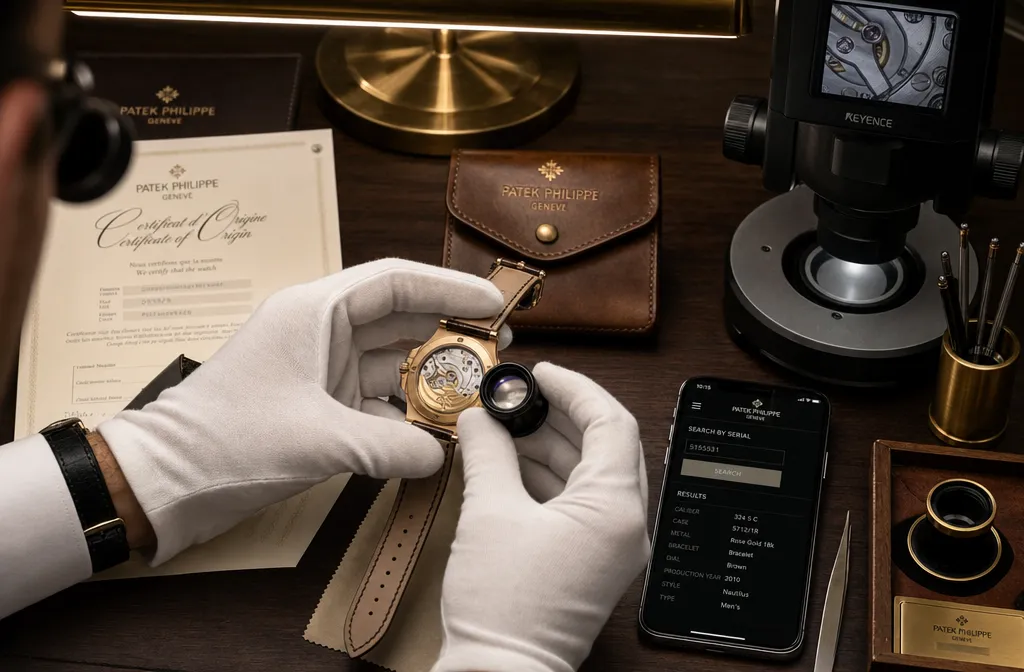
Authenticate a pre-owned luxury watch by combining physical inspection, paperwork verification, and expert review. No single method is sufficient on its own.
The authentication stack:
- Visual inspection — font on the dial, depth of engravings, lume application, crown logo crispness.
- Movement verification — open the caseback (or have a watchmaker do it). Counterfeit movements rarely match factory finishing.
- Serial number check — most brands will confirm authenticity through service records, though they won’t always confirm to private buyers.
- Weight and dimensions — counterfeits often miss precise weight by a few grams.
- Independent watchmaker review — $50–$200 for a formal inspection. Cheap insurance on a $20,000 purchase.
- Papers and provenance — original warranty card, purchase receipt, service stamps.
Red flags: misaligned text, sluggish second hand, rough bracelet finish, “too clean” vintage pieces, and sellers who refuse high-resolution photos.
What Watches Hold Their Value Best When Buying Used?
The watches that hold value best in the pre-owned market are steel sports models from Rolex, Patek Philippe, and Audemars Piguet, followed by select Omega, Cartier, and IWC references with strong heritage.
Value-retention leaders:
- Rolex — Submariner, GMT-Master II, Daytona, Datejust, Day-Date.
- Patek Philippe — Nautilus, Aquanaut, Calatrava, complicated pieces.
- Audemars Piguet — Royal Oak, Royal Oak Offshore.
- Omega — Speedmaster Professional Moonwatch, certain Seamaster references.
- Cartier — Tank (especially vintage), Santos, Pasha.
- IWC — Pilot chronographs, Portugieser.
- Panerai — Luminor Marina, early Submersibles.
Steel and precious metal versions of these references typically outperform two-tone or gem-set variants in resale, though there are exceptions (gold Daytonas have done extremely well).
For broader context on which models to consider, this guide to the best Rolex watches for men is a useful starting point.
Risks of Buying a Pre-Owned Luxury Watch Online
The main risks of buying a pre-owned luxury watch online are counterfeits, undisclosed damage, missing paperwork, shipping loss, and seller fraud. All are manageable with the right vendor and payment method.
Specific risks and how to mitigate them:
“If a deal looks too good to be true on a Rolex sports model, it almost certainly is. Market prices are public — sellers know what their watch is worth.”
- Counterfeits: Buy from sellers who guarantee authenticity in writing.
- Undisclosed condition: Demand multiple high-res photos under different lighting.
- No papers: Acceptable on older watches, suspicious on recent ones.
- Shipping damage: Ensure fully insured shipping with signature required.
- Payment fraud: Use credit card or escrow services, never wire transfer to strangers.
- Stolen watches: Cross-check serials against international watch registries.
A trusted vendor’s shipping and return policy is one of the most underrated buyer protections.
Is It Cheaper to Buy a High-End Watch Used or Wait for Sales?
Luxury watch brands rarely discount at retail, so waiting for sales on new pieces is usually pointless. For most buyers, pre-owned is the actual “sale” on high-end watches.
What to know:
- Rolex, Patek Philippe, Audemars Piguet — never discount. Authorized dealers may offer a complimentary strap or service, but not price cuts.
- Omega, IWC, Cartier, Panerai — occasionally offer modest dealer discounts (5–15%) on non-hyped references.
- Pre-owned market — effectively a permanent discount on most references, often 15–30% below retail for watches without waitlists.
- Grey market — new, unworn watches sold outside authorized channels at varying prices, sometimes below MSRP, sometimes above.
Decision rule: Choose new at retail if you want the warranty, the experience, and the watch is available. Choose pre-owned if the watch is on a waitlist, has been discontinued, or you want maximum value per dollar.
What Warranty Options Exist for Pre-Owned Luxury Watches?
Pre-owned luxury watch warranties come from three sources: remaining manufacturer warranty, brand-certified pre-owned programs, and dealer-backed warranties. Coverage varies widely, so read the terms before purchase.
Warranty landscape:
- Remaining manufacturer warranty — transferable on most brands (Rolex offers 5 years from original purchase, Omega 5 years, Patek 2 years). Verify the start date on the original card.
- Rolex Certified Pre-Owned — 2-year international warranty, brand authentication, available through authorized retailers.
- Audemars Piguet Heritage — multi-year warranty on factory-certified pieces.
- Dealer warranties — typically 1–2 years covering movement defects. Quality varies enormously.
- Extended service plans — some specialist dealers offer paid extensions.
What warranties usually don’t cover: water damage, accidental damage, theft, wear-and-tear parts (crowns, gaskets, crystals from impact).
Common Mistakes People Make When Buying Second-Hand Watches
The most common mistakes when buying a pre-owned luxury watch are skipping authentication, ignoring service history, overpaying for hype, and trusting unverified sellers. Each is preventable with patience and basic research.
The top errors:
- Buying on emotion — falling for a watch in photos without inspecting it in person or via a trusted intermediary.
- Ignoring service history — a watch overdue for service can cost $800–$3,000 to bring current.
- Overpaying for “box and papers” — they add value, but not unlimited value. Don’t pay 30% extra for a recent purchase receipt.
- Skipping the bracelet inspection — stretched bracelets and worn end-links are expensive to fix on Rolex and AP.
- Trusting Instagram dealers blindly — verify physical address, references, and business registration.
- Buying polished vintage — over-polishing destroys 20–50% of value on collector pieces.
- Not negotiating — most pre-owned prices have 5–10% built in for negotiation. Ask.
- Forgetting total cost of ownership — service every 5–10 years, insurance, secure storage.
For first-time buyers, working through a structured guide to choosing the perfect luxury watch helps avoid most of these pitfalls.
Pros and Cons: New vs Pre-Owned Luxury Watch at a Glance
New luxury watch — pros:
- Full manufacturer warranty (2–5 years)
- Pristine, untouched condition
- Boutique purchase experience
- Original box, papers, accessories guaranteed
- Latest movement updates and improvements
New luxury watch — cons:
- Steep first-year depreciation on most models
- Long waitlists on desirable references
- No discounts on top brands
- Limited to current production catalog
Pre-owned luxury watch — pros:
- Better value on most non-hyped models
- Immediate availability, no waitlist
- Access to discontinued or vintage references
- Already-absorbed depreciation
- Wider price range and selection
Pre-owned luxury watch — cons:
- Authentication risk without a trusted source
- Shorter or no warranty (unless CPO)
- Possible hidden service costs
- Variable condition quality
- More research and due diligence required
A Practical Decision Framework
Use this quick framework when weighing a new vs pre-owned luxury watch:
- Is the model available at retail? If no, pre-owned is your only path.
- How long will you keep it? Under 3 years favors pre-owned. Over 10 years narrows the gap.
- How important is warranty? Critical for daily-wear sport pieces, less so for dress watches.
- What’s your authentication confidence? Low confidence means buy new or buy CPO.
- What’s the resale ceiling? Hyped references hold value pre-owned; entry-level often doesn’t.
A buyer eyeing an Omega De Ville Prestige for elegant daily wear has different priorities than one chasing a discontinued Patek Philippe. The smarter buy is the one that matches your priorities, not someone else’s.
FAQ
Q: Does a pre-owned Rolex come with a warranty? A: It depends on the source. Rolex Certified Pre-Owned watches come with a 2-year international warranty. Independent dealers typically offer 1–2 year warranties. Private sales usually offer none.
Q: How much should I expect to pay for servicing a pre-owned luxury watch? A: A full service runs $500–$1,500 for most Rolex and Omega pieces, $1,500–$5,000+ for Patek Philippe, Audemars Piguet, and complicated movements. Budget for service every 5–10 years.
Q: Can I get an authorized dealer to service a pre-owned watch? A: Yes. Most luxury brands service their watches regardless of where you bought them, though they may require their own authentication first.
Q: Are grey-market watches the same as pre-owned? A: No. Grey-market watches are new and unworn but sold outside the brand’s authorized retail network. Pre-owned means previously owned. Grey-market warranties may not be honored by the brand.
Q: What’s the safest way to pay for a pre-owned watch online? A: Credit card with purchase protection, escrow services, or PayPal Goods and Services. Avoid wire transfers, cryptocurrency, and cash app payments to strangers.
Q: Will buying pre-owned hurt my watch’s investment potential? A: Not for value-retention leaders. A well-chosen pre-owned Rolex or Patek often outperforms a new entry-level luxury watch over a 10-year horizon.
Q: Do I need original papers to resell a pre-owned watch? A: They help significantly — typically adding 10–20% to resale value. Lacking papers isn’t a deal-breaker, but it does narrow the buyer pool.
Q: Is it worth paying extra for a brand’s certified pre-owned program? A: Yes, for first-time buyers or anyone who values guaranteed authenticity and warranty. The premium is usually 10–20% over independent dealers.
Conclusion
The smarter buy between a new and pre-owned luxury watch comes down to the specific model, your timeline, and your tolerance for due diligence. For most references that aren’t on a Rolex or Patek waitlist, pre-owned wins on value — but only when bought from a trusted source with proper authentication and warranty. For brand-new collectors, dress watches, or buyers who want the full boutique experience, new at retail still makes sense.
Next steps:
- Define your goal — daily wearer, collector piece, or investment hold.
- Shortlist 3–5 references that fit your budget and style.
- Compare new retail prices to pre-owned market prices on each.
- Identify 2–3 trusted dealers (one new, one CPO, one specialist).
- Inspect, verify, and negotiate before you buy.
Whether you lean toward a brand-new Cartier Tank Française or a meticulously inspected pre-owned IWC Portugieser, the smarter buy is always the one backed by knowledge, paperwork, and a seller you trust.