

Care & Authenticity
How Often Should You Service a Luxury Watch?
Jun
Last updated: June 22, 2026
Quick Answer
Most luxury mechanical watches should be serviced every 5 to 7 years, though some modern Rolex and Omega models can safely go 7 to 10 years between full services. Quartz luxury watches need less frequent attention, typically a battery change every 2 to 3 years and a full service every 8 to 10 years. The right interval depends on the brand, movement type, age of the watch, and how often you wear it.
Key Takeaways
- Standard interval: 5 to 7 years for most Swiss mechanical watches; Rolex officially recommends every 10 years, Omega every 5 to 8 years.
- Full service cost: Usually $400 to $1,500 for mainstream luxury brands; $800 to $2,500+ for Patek Philippe, Audemars Piguet, and complicated pieces.
- Skipping service can cause dried lubricants, metal-on-metal wear, broken parts, and repair bills that far exceed a routine service.
- Vintage watches generally cost more to service because parts are scarce and the work is delicate.
- Quartz luxury watches still need periodic gasket, seal, and movement servicing — not just battery changes.
- Authorized dealers offer factory parts and warranty; independent watchmakers are often cheaper and faster but vary in quality.
- DIY servicing is not recommended for high-end watches; one mistake can cost thousands.
- Warning signs include time drift, moisture under the crystal, a stiff crown, or a rotor that no longer winds.
How Often Should You Service a Luxury Watch?
A luxury mechanical watch should be serviced every 5 to 7 years on average. This is the interval most independent watchmakers and brand service centers recommend to keep lubricants fresh, gaskets sealed, and tolerances within spec.
Brand guidance varies:
| Brand | Recommended Service Interval |
|---|---|
| Rolex | Approximately every 10 years |
| Omega | Every 5 to 8 years |
| Patek Philippe | Every 3 to 5 years |
| Audemars Piguet | Every 4 to 5 years |
| Cartier (mechanical) | Every 5 to 7 years |
| IWC | Every 5 years |
| Tudor | Every 7 to 10 years |
Real-world wear matters more than the calendar. A daily-wear chronograph used in the gym ages faster than a dress watch worn twice a month. If you rotate several pieces, you can stretch intervals; if one watch lives on your wrist, service it sooner.
Decision rule: If the watch is keeping time within the brand’s spec (typically -4/+6 seconds per day for COSC-certified pieces) and shows no warning signs, you can usually wait. If it drifts, fogs, or feels different on the crown, book a service.
How Much Does a Luxury Watch Service Cost?
A full luxury watch service typically costs $400 to $1,500 for mainstream Swiss brands, and $800 to $3,000+ for high complications or prestige brands like Patek Philippe and Audemars Piguet. Pricing depends on movement complexity, parts replaced, brand, and whether you use an authorized service center or an independent watchmaker.
A “complete service” generally includes:
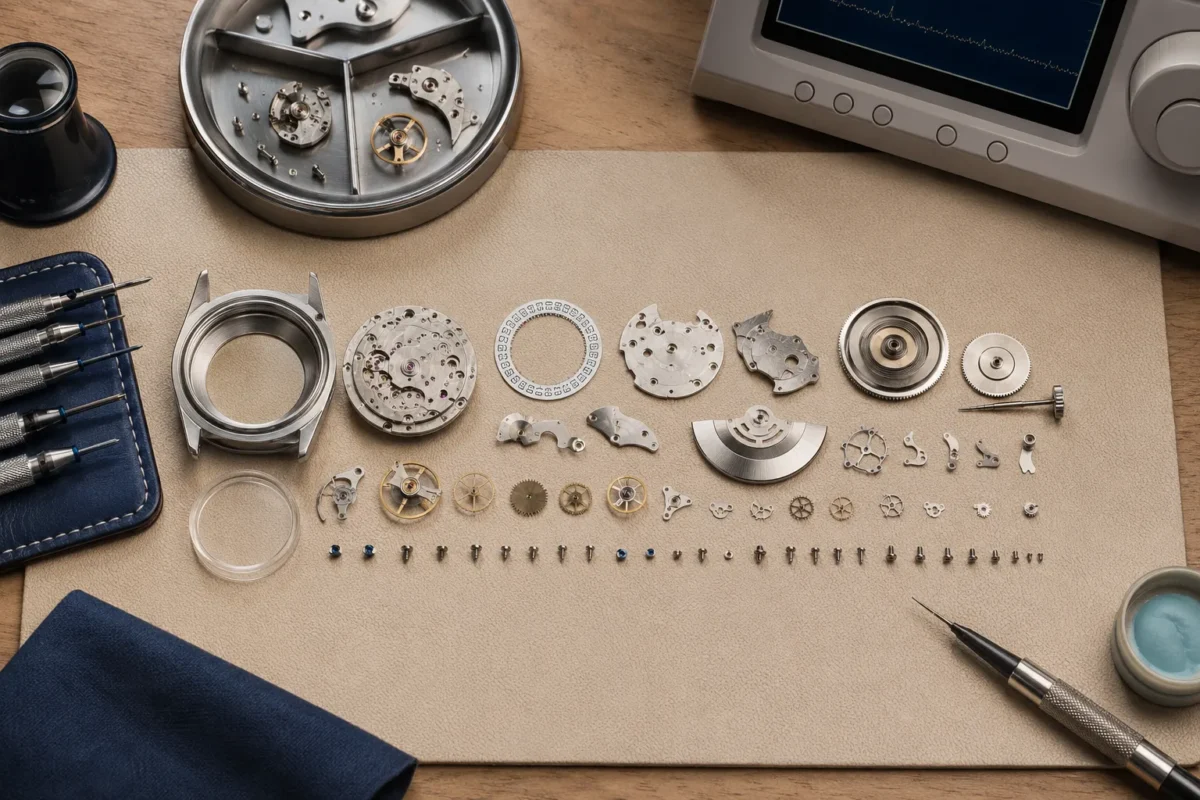
- Full disassembly of the movement
- Ultrasonic cleaning of all parts
- Replacement of worn components (mainspring, gaskets, crown tube if needed)
- Lubrication with brand-spec oils
- Reassembly, regulation, and timing on a machine
- Water-resistance testing
- Case and bracelet polishing (optional)
Average Cost of Watch Servicing by Brand
| Brand | Typical Full Service Cost (USD) |
|---|---|
| Rolex (no complications) | $800 – $1,200 |
| Rolex (Daytona, GMT, Sky-Dweller) | $1,200 – $1,800 |
| Omega | $600 – $1,000 |
| Tudor | $500 – $800 |
| Cartier (mechanical) | $700 – $1,200 |
| IWC | $800 – $1,500 |
| Breitling | $600 – $1,100 |
| Panerai | $800 – $1,400 |
| Audemars Piguet | $1,500 – $3,000 |
| Patek Philippe | $1,200 – $4,000+ |
| Vacheron Constantin | $1,500 – $3,500 |
Expect a quote, not a flat price. Damaged parts, water intrusion repairs, or dial restoration add cost quickly. Always ask for an estimate before authorizing work.
What Happens If I Don’t Service My Rolex (or Any Luxury Watch)?
Skipping service causes the lubricants inside the movement to dry out, which leads to metal-on-metal friction, accelerated wear, and eventually broken components. What started as a $1,000 service can turn into a $3,000+ repair if a pivot snaps or the mainspring fails.
Specific risks of skipping maintenance:
- Dried oils: Synthetic lubricants degrade over time even if the watch sits unused. Dry pivots score the jewel bearings.
- Gasket failure: Rubber seals harden and crack, letting moisture and dust enter the case.
- Magnetization: Without regulation, the hairspring can become magnetized from phones, laptops, and speakers, causing the watch to run fast.
- Crown and stem wear: A stiff or gritty crown signals worn gaskets and a contaminated stem.
- Rotor damage: On automatics, a worn rotor bearing can score the movement plate.
- Catastrophic part failure: Broken balance staffs, mainsprings, or escape wheels often require costly replacement.
For a Rolex specifically, the brand has built tight tolerances and excellent lubricants, which is why they extend their recommendation to 10 years. But “can go 10 years” is not the same as “will run perfectly at 10 years” in every case. If you wear yours daily, a check-up at 7 years is sensible.
Can I Service My Own High-End Watch?
No, you should not service your own luxury watch unless you are a trained watchmaker with proper tools. The risk of damage far outweighs the savings. A single slip with a screwdriver can scratch a bridge, demagnetize a hairspring, or contaminate the movement with dust.
What’s reasonable for owners to do at home:
- Wipe the case and bracelet with a soft cloth
- Rinse a water-resistant bracelet under warm water (sport models only)
- Wind a manual watch gently
- Store the watch properly when not worn
What requires a professional:
- Opening the case back
- Replacing a battery on a quartz model with screw-down crowns
- Changing gaskets
- Any lubrication
- Regulating the movement
If you want to learn more about the inner workings before deciding, see this primer on how automatic watches work. Understanding the mechanism makes it clear why DIY service is risky on a five-figure timepiece.
Differences Between Watch Service at Authorized Dealer vs Independent Watchmaker
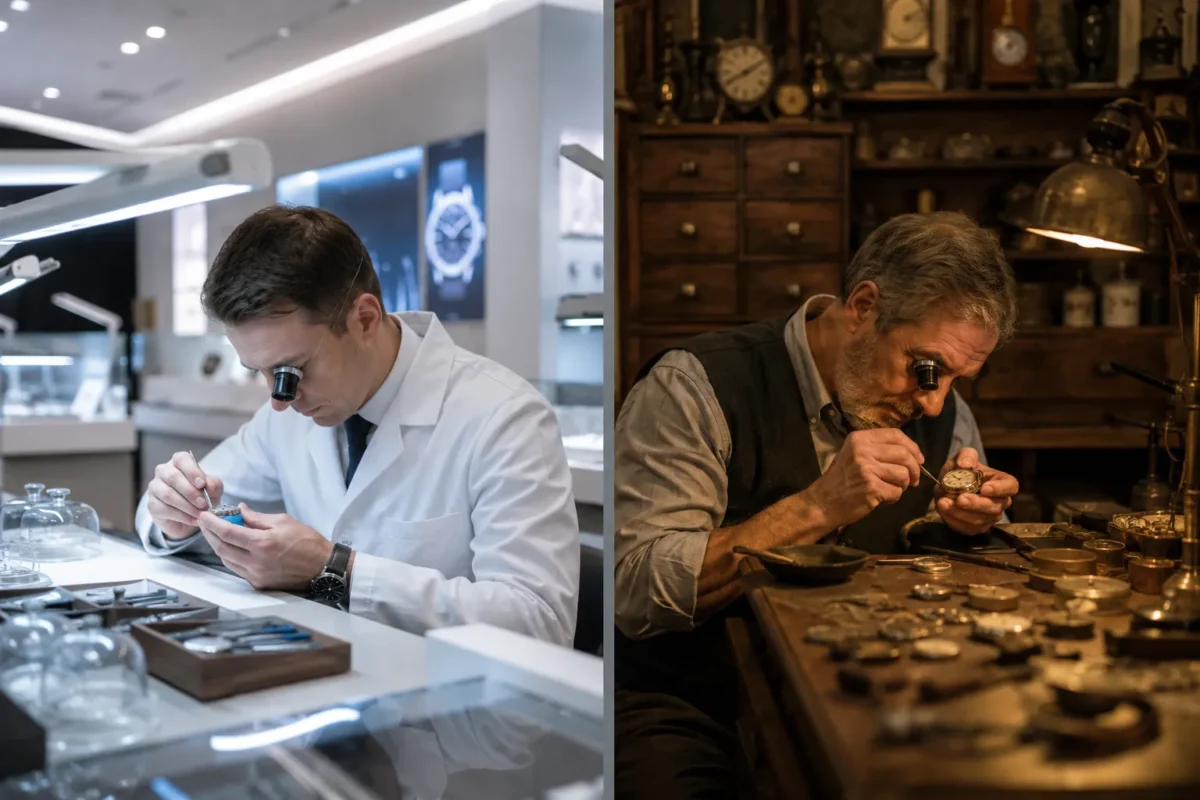
An authorized service center uses factory-original parts, follows brand procedures, and preserves warranty coverage, but costs more and takes longer. An independent watchmaker can be faster and cheaper, and a skilled one delivers excellent results — but quality and parts access vary widely.
Authorized Service Center
Pros
- Genuine OEM parts
- Factory-trained technicians
- Service warranty (typically 2 years)
- Required for warranty-period repairs
- Best for resale documentation
Cons
- Higher cost (often 30–60% more)
- Turnaround of 6 to 16 weeks
- May replace parts you wanted preserved (vintage dials, hands, bezels)
- Polishing is sometimes mandatory
Independent Watchmaker
Pros
- Lower cost
- Faster turnaround (often 2 to 6 weeks)
- More flexible — can preserve patina, refuse polishing
- Direct relationship with the technician
- Often better for vintage work
Cons
- Parts access varies, especially for Rolex, Patek, AP
- Quality depends heavily on the individual
- May void brand warranty
- Less ideal for resale paperwork
Choose authorized if: the watch is under warranty, is a recent prestige piece, or you plan to sell it through a luxury channel.
Choose independent if: the watch is vintage, you want to keep original finishing, or cost is a major concern. Look for a CW21 or WOSTEP-certified watchmaker.
How Long Does a Watch Service Take?
A full luxury watch service typically takes 4 to 12 weeks. Authorized centers usually run longer because watches are often shipped to a regional or factory facility. Independent watchmakers can sometimes complete service in 2 to 4 weeks if they have parts on hand.
Typical timelines:
- Battery change (quartz): same day to 1 week
- Pressure test and gasket replacement: 1 to 2 weeks
- Full service (no parts shortage): 4 to 8 weeks
- Full service with parts order: 8 to 16 weeks
- Vintage restoration: 3 to 12 months
- Patek Philippe or AP complicated piece: 6 to 12 months
If you need the watch for a specific date, book early and ask for a firm completion estimate in writing.
Signs My Luxury Watch Needs Immediate Servicing
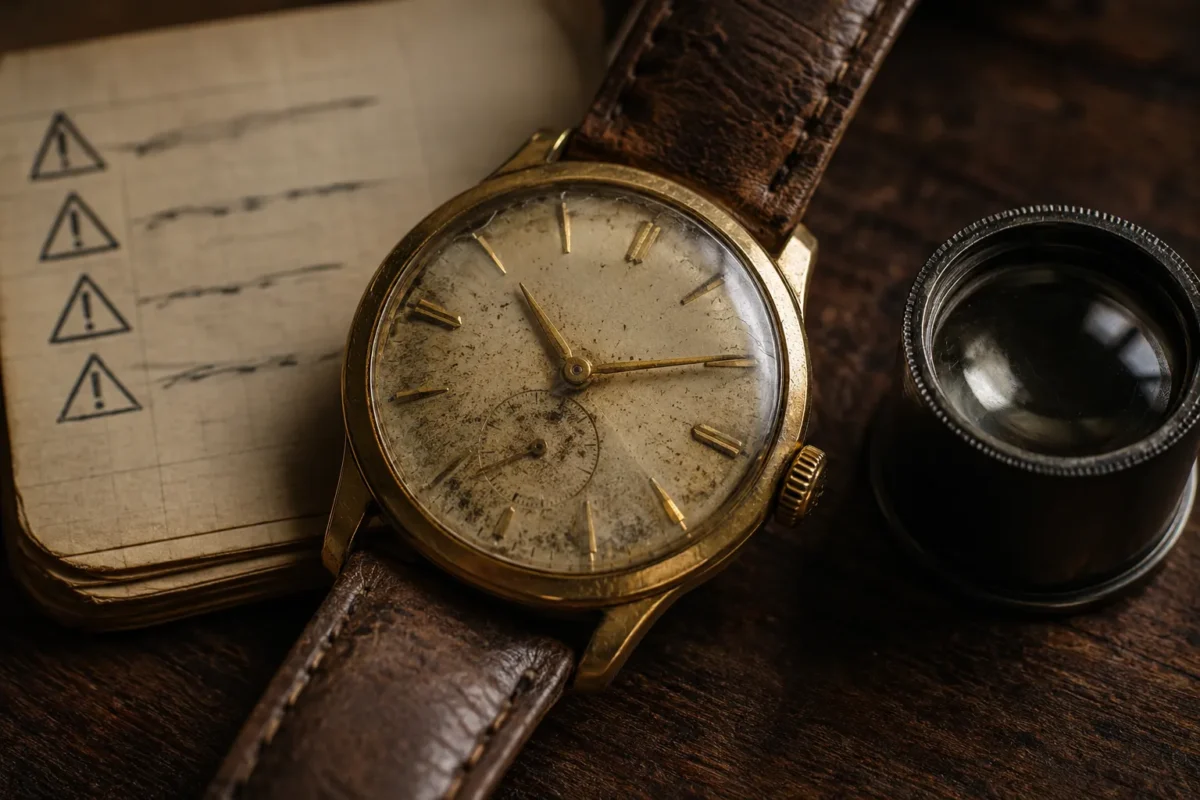
Send your watch in immediately if you notice timekeeping drift, moisture, a stuck crown, unusual sounds, or visible damage. These are not “wait and see” symptoms — they often indicate active wear or contamination inside the movement.
Warning signs that warrant urgent service:
- Time loss or gain beyond brand spec (most modern movements should stay within ±10 seconds/day)
- Condensation or fog under the crystal — even slight moisture can rust steel parts in days
- Crown feels gritty, loose, or hard to wind
- Power reserve drops noticeably (a watch that used to run 48 hours now stops at 20)
- Rotor sounds rough or rattles when you move your wrist
- Date doesn’t change at midnight or jumps at odd times
- Visible rust, debris, or oil spots on the dial
- A drop or hard knock — even if it still runs, the balance can be damaged
For storage habits that help prevent some of these issues, see this guide on how to properly store and protect your luxury watches.
Are Vintage Watches More Expensive to Service?
Yes, vintage watches are typically 30% to 100% more expensive to service than modern equivalents. Parts are scarce, often need to be hand-fabricated, and the work requires a specialist who understands period-correct techniques.
Why vintage service costs more:
- Discontinued parts must be sourced from donor movements or made by hand
- Crystals, crowns, and gaskets in old sizes are rare
- Lume restoration is delicate and time-consuming
- Older movements were assembled with looser tolerances and need careful regulation
- Many independent shops won’t touch certain calibers, narrowing your options
Example: A modern Rolex Submariner service might run $900. A 1960s Submariner with a tritium dial and acrylic crystal could easily reach $1,800 to $2,500, especially if the original parts must be preserved.
If you collect or invest in vintage, factor service costs into your budget. For investment-grade picks, this overview of high-value luxury watch models is useful context.
Is Watch Servicing Worth It for Watches Under $5,000?
Servicing is usually worth it on watches you plan to keep and wear, even under $5,000 — but the math gets tighter. A $700 service on a $3,000 watch is over 20% of its value, so you weigh sentimental and functional value against cost.
A practical framework:
| Scenario | Recommendation |
|---|---|
| Daily-wear watch, $2,000–$5,000, you love it | Service it. Cost is justified. |
| Watch you rarely wear, $1,500–$3,000 | Service only if it stops or fails water test |
| Inherited or sentimental piece | Service regardless of dollar logic |
| Watch you’re planning to sell | Get a quote first; serviced pieces sell faster |
| Quartz watch under $2,000 | Battery + gasket only unless it fails |
If the repair quote approaches 40% of the watch’s current value and the piece isn’t sentimental, consider selling it or trading toward a different model.
What Damages Can Happen If I Skip Watch Maintenance?
Skipping maintenance leads to four main categories of damage: lubricant breakdown, seal failure, mechanical wear, and water intrusion. Each becomes more expensive to fix the longer you wait.
The progression usually looks like this:
- Year 6–8: Oils thin out, amplitude drops, accuracy worsens.
- Year 8–10: Gaskets harden; humidity gets in. Small dust particles enter the movement.
- Year 10–12: Pivots show wear marks. Mainspring loses tension. Power reserve shortens.
- Year 12+: Risk of broken jewels, snapped pivots, or rusted parts. Repair bills can exceed $2,000 even on mid-range pieces.
A routine service every 5 to 7 years prevents most of this. It’s cheaper than a rebuild.
Recommended Service Intervals for Omega and Rolex Watches
Rolex officially recommends servicing approximately every 10 years, citing improvements in lubricants and seal technology. Omega recommends every 5 to 8 years, with some Master Chronometer models tolerating longer intervals thanks to METAS-certified components.
In practice, many independent watchmakers suggest a slightly shorter cycle than the brands:
- Rolex (daily wear): Service at 7 to 8 years
- Rolex (light wear or rotated): 10 years is fine
- Omega Co-Axial: 6 to 8 years
- Omega Master Chronometer: 8 to 10 years
- Older Omega (pre-2000): Every 5 years
If your Rolex has full warranty coverage (newer models carry a 5-year international warranty), staying within the brand network keeps that protection intact. For older Rolex models including discontinued references, an experienced independent often gives excellent results at lower cost.
Do Quartz Luxury Watches Need the Same Servicing as Mechanical Watches?
No, quartz luxury watches need less frequent service than mechanical ones, but they still need periodic maintenance — not just battery changes. The movement has fewer moving parts, but gaskets, lubrication on the stepping motor, and case seals still degrade over time.
Typical quartz luxury service schedule:
- Battery change: Every 2 to 3 years (or when it stops)
- Gasket and pressure test: Every battery change for water-resistant models
- Full movement service: Every 8 to 10 years
- Capacitor replacement (solar quartz like Cartier SolarBeat): Every 15 to 20 years
For a deeper look at how these movements compare, see this breakdown of mechanical vs automatic vs quartz watches.
Common mistake: assuming a quartz Cartier or Rolex Oysterquartz only needs a battery. The case still needs proper resealing, or you’ll get moisture damage that costs far more than a full service.
How to Extend the Time Between Services
A few habits genuinely extend service intervals and reduce wear between visits:
- Keep magnets away. Don’t rest your watch on speakers, tablets, or magnetic clasps on handbags.
- Rinse after saltwater or sweat. Even on sport watches, salt accelerates seal degradation.
- Don’t operate the crown underwater. Always screw the crown down before swimming.
- Use a watch winder sparingly. Constant winding on a piece you rarely wear adds wear without benefit.
- Avoid extreme temperature shifts. Hot showers followed by cold pools stress the seals.
- Clean the bracelet regularly. Trapped grime works into the case at the lug area. The proper cleaning method takes ten minutes.
- Wind manuals at the same time each day and stop at first resistance.
FAQ
How often should you service a luxury watch if you rarely wear it? Even unworn watches need service every 7 to 10 years because lubricants dry out regardless of use. Run the watch occasionally and store it in stable conditions.
Does servicing reduce the value of a vintage watch? It can if the service replaces original parts or polishes the case. For vintage pieces, request “preserve all original components” and ask the watchmaker to avoid polishing.
Is a Rolex really fine for 10 years without service? For most modern Rolex models with light to moderate use, yes. For daily-wear pieces or older calibers, 7 to 8 years is safer.
Can I send my watch to the brand directly? Yes. Rolex, Omega, Patek Philippe, and most major brands accept watches shipped to their service centers, usually through an authorized dealer or directly via their website.
What’s the difference between a “service” and a “repair”? A service is scheduled preventive maintenance. A repair fixes a specific problem like a broken stem or water damage. Repairs often include a partial or full service.
Will polishing during service hurt my watch’s value? Often yes, especially for vintage or collectible models. Sharp case edges and original brushing are part of the watch’s character. Always specify “no polish” if you want to preserve them.
How do I know if a watchmaker is qualified? Look for WOSTEP, SAWTA, AWCI-CW21, or brand-specific certifications. Ask how many of your specific model they service per year.
Are travel and shipping insured during service? Authorized centers usually insure the watch in transit. Independents vary — always confirm in writing and use insured, signature-required shipping.
Does a serviced watch sell for more? Yes. A documented recent service (within 2 years) typically adds 5% to 15% to resale value because the buyer avoids an immediate $1,000+ expense.
What if my watch was serviced and still doesn’t keep time? Reputable shops offer a service warranty (usually 1 to 2 years). Bring it back promptly and document the issue.
Conclusion
Luxury watch servicing is preventive care, not an emergency response. Stick to a 5 to 7 year cycle for most mechanical watches, follow your brand’s specific guidance, and watch for the warning signs that mean “go now, not next year.” Budget $400 to $1,500 for routine service on mainstream Swiss brands and more for prestige or vintage pieces.
Next steps:
- Check when your watch was last serviced. If you don’t know, assume it was longer ago than you think.
- Inspect the watch this week for moisture, drift, crown feel, and power reserve.
- Get two quotes — one from an authorized dealer, one from a certified independent — for any piece nearing its interval.
- Document every service with receipts; it pays back at resale.
- Build a habit of basic care between services: clean storage, magnet awareness, gentle handling.
If you’re evaluating new pieces, considering a sale, or want guidance on which models hold up best long-term, the team at Mio Jewelry can help with appraisals, consignment, and service referrals across major Swiss brands.
Sources
- Rolex Official Service Recommendations, Rolex.com (2024)
- Omega Service Information, Omega Watches Official Site (2024)
- Patek Philippe Service Guidelines, Patek.com (2024)
- WOSTEP (Watchmakers of Switzerland Training and Educational Program), wostep.ch (2024)
- AWCI (American Watchmakers-Clockmakers Institute), awci.com (2024)