

Education & Care, Blog
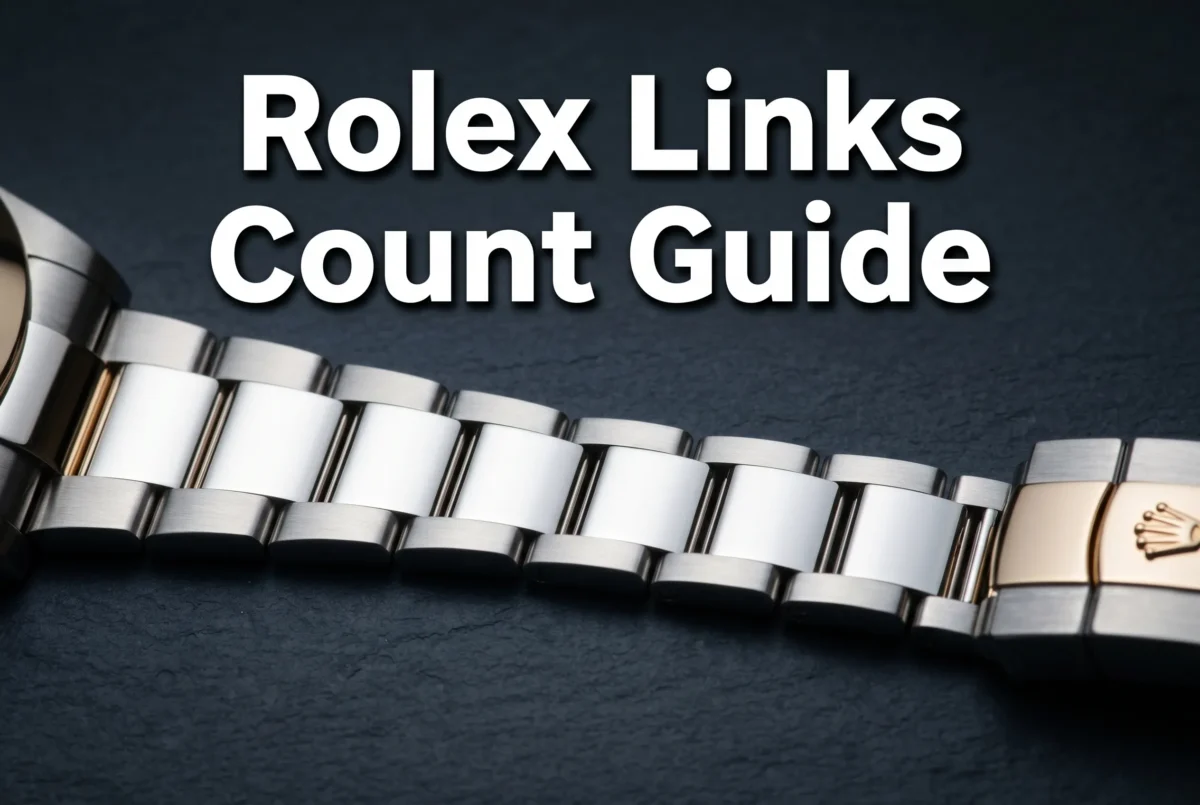
Rolex Links Count Guide
Apr
Last updated: April 23, 2026
Quick Answer: A standard Rolex Oyster bracelet ships from the factory with approximately 13 links on the upper half and 8 links on the lower half, totaling roughly 21 links before the clasp — though the exact count varies by model, case size, and wrist configuration. Understanding your Rolex bracelet link count is essential for achieving a precise fit, verifying authenticity, and making confident purchase decisions.
Key Takeaways
- Rolex produces three primary bracelet types: the Oyster, the Jubilee, and the President — each with a distinct link structure and count range.
- Factory link counts vary by model: most Rolex bracelets ship with 12–15 links on the upper section and 7–9 on the lower, with total counts ranging from 18 to 22+ links depending on case size.
- Wrist size determines how many links you keep: the average wrist (6.5–7.5 inches) typically requires 2–4 link removals from a factory-configured bracelet.
- Link count affects value: a complete bracelet with all original links commands a higher resale price than one with missing or replaced links.
- Authenticity verification relies on link details: genuine Rolex links carry specific hallmarks, tolerances, and finishing patterns that counterfeits consistently fail to replicate.
- Professional adjustment is recommended for high-value pieces to preserve bracelet integrity and avoid scratching.
- Jubilee bracelets have more, smaller links than Oyster bracelets, making fine-tuning easier but adjustment more time-consuming.
- The President bracelet is exclusive to Day-Date models and features a semi-circular three-piece link design with the tightest manufacturing tolerances of any Rolex bracelet.
- Extra links should always be retained in their original box for resale completeness.

What Is a Rolex Links Count Guide and Why Does It Matter?
A Rolex Links Count Guide is a reference framework that details the number of bracelet links found on each Rolex model, how those links are configured, and how link count translates to wrist fit. For watch collectors, luxury investors, and serious buyers, this information is far more than a sizing footnote.
Link count directly influences three critical factors:
- Fit and wearability: Too many links creates a loose, sliding bracelet. Too few causes pinching and discomfort. The correct count produces the “Rolex drape” — a slight, comfortable curve over the wrist.
- Resale and collectibility: A Rolex sold with its full complement of original links, stored in the original box, commands a meaningful premium over an incomplete set. Investment-grade timepieces must be complete.
- Authenticity: Counterfeit bracelets routinely fail on link count, link dimensions, and finishing quality. Knowing the correct specification for your reference number is one of the fastest ways to identify a fake.
This guide covers every major Rolex bracelet type, model-specific link counts, step-by-step sizing guidance, and authentication details — making it the most complete Rolex Links Count Guide available in 2026.
What Are the Three Main Rolex Bracelet Types?
Rolex produces three distinct bracelet families, each designed for specific watch families and wearing occasions. Each has a unique link architecture that determines its total link count and adjustment range.
🔗 Oyster Bracelet
The Oyster bracelet is Rolex’s most iconic and widely used design. Introduced in the 1930s, it features flat, three-piece links with a combination of brushed and polished surfaces. The center link is polished; the outer links are brushed — a signature aesthetic detail.
Key characteristics:
- Wider, more substantial links
- Available in Oystersteel, yellow gold, white gold, Everose gold, and two-tone configurations
- Standard on Submariner, GMT-Master II, Explorer, Sea-Dweller, and Daytona models
- Typical total link count: 18–21 links (excluding clasp)
🔗 Jubilee Bracelet
The Jubilee bracelet debuted in 1945 alongside the Datejust — Rolex’s first self-winding wristwatch with a date display. Its five-piece link construction creates a more flexible, dressy drape on the wrist.
Key characteristics:
- Smaller, more numerous links for a fluid feel
- Traditionally associated with the Datejust and Day-Date
- Also available on the Sky-Dweller and GMT-Master II (Sprite/Batman variants)
- Typical total link count: 22–26 links (excluding clasp)
- Fine-adjustment capability through the Easylink system (5mm extension)
🔗 President Bracelet
The President bracelet is Rolex’s most exclusive design, reserved exclusively for the Day-Date collection. Its semi-circular, three-piece links are machined to the tightest tolerances in the Rolex catalog.
Key characteristics:
- Semi-circular link profile for a smooth, continuous curve
- Available only in 18k gold or platinum
- Hidden crown clasp (Crownclasp) for a seamless appearance
- Typical total link count: 17–20 links (excluding clasp)
How Many Links Does Each Rolex Model Have?
This is the core question this Rolex Links Count Guide addresses. The table below provides factory-standard link counts for the most significant Rolex references.
Mio Jewelry · Owner’s Guide
Rolex Bracelet Reference & Sizing Tool
Look up the exact bracelet specifications for any modern Rolex reference, visualize the link layout, and calculate how many links to remove for a perfect fit.
The reference number is engraved between the lugs at 12 o’clock under the bracelet. Format examples: 126610LN, 126900, 228238.
Estimate how many links to remove based on your wrist measurement. Always confirm with a watchmaker before removing links — this tool is a guide, not a substitute for professional fitting.
Each Rolex bracelet has its own character, link geometry, and clasp system. Knowing the difference helps when buying, sizing, or sourcing replacement parts.
Oyster
Three-link · sporty. Introduced in the 1930s, the Oyster is the most recognizable Rolex bracelet. Broad flat outer links and a polished or brushed center link. Standard on Submariner, GMT-Master II, Daytona, Explorer, and Sea-Dweller.
Jubilee
Five-link · dressy. Created in 1945 for the 40th anniversary of Rolex. Smaller, more intricate links with a softer drape. Often paired with Datejust, GMT-Master II (Pepsi/Batman), and select Sky-Dweller models.
President
Three-link · formal. Designed in 1956 for the Day-Date. Semi-circular links give it a substantial, formal feel. Exclusive to Day-Date and Lady Datejust in precious metals.
Oysterflex
Metal blade · rubber overmolded. Not a true link bracelet — a titanium-nickel blade sheathed in high-performance elastomer. Used on Yacht-Master, Sky-Dweller, and Daytona variants. Sizing is by clasp adjustment, not link removal.
Pearlmaster
Five-link · rounded · gem-set. A more sculpted variant of the Jubilee with rounded, beaded center links. Exclusive to the Lady Datejust Pearlmaster line in 18k gold.
Clasp systems
Glidelock (Submariner/Sea-Dweller): tool-free 2 mm increments up to 20 mm. Easylink (most Oyster bracelets): 5 mm comfort extension. Fliplock (Sea-Dweller/Deepsea): 26 mm wetsuit extension. Crownclasp (Jubilee/President): concealed under the Rolex crown.
Full Rolex Link Reference Table
Total bracelet links, removable-link breakdown, bracelet type, and lug width by model. Filter by collection below.
| Model | Reference Numbers | Bracelet · Lug | Total Links | Breakdown |
|---|
Mio Jewelry · Authorized Luxury Watch Retailer
Need help sizing or sourcing a Rolex?
Our specialists can match you with the right reference, arrange professional sizing, source genuine Rolex links, and verify authenticity of pre-owned pieces. Every watch we sell is fully inspected and serviced.
Specifications compiled from Rolex factory data. Reference numbers and bracelet configurations may vary by production year. Always confirm details with an authorized retailer before purchase or sizing.
For a detailed breakdown of the Sky-Dweller’s bracelet configurations, see our guide to Sky-Dweller 326934 Jubilee and Oyster bracelet link counts.
How Do I Measure My Wrist for a Perfect Rolex Fit?
Achieving the correct Rolex fit begins with an accurate wrist measurement. The target is a bracelet that sits snugly without pinching, allows approximately one finger’s width of movement, and produces a natural drape over the wrist bone.
Step-by-Step Wrist Measurement Guide
- Use a flexible tailor’s tape. Wrap it around your wrist just below the wrist bone, where you would normally wear a watch.
- Note the measurement in millimeters. Most Rolex bracelets are sized in millimeters for precision.
- Add 10–15mm for comfort allowance. This accounts for the natural “drape” that makes a Rolex bracelet feel correct rather than tight.
- Compare to your model’s link measurements. Each Rolex link on an Oyster bracelet measures approximately 8–10mm in length; Jubilee links measure approximately 5–7mm each.
- Calculate the number of links to remove. Divide the excess bracelet length by the individual link length to determine how many links to remove.
Example: If your wrist measures 170mm and the factory bracelet measures 205mm, the excess is 35mm. For an Oyster bracelet with 9mm links, that equals approximately 3–4 links to remove.
Wrist Size Reference Chart
| Wrist Circumference | Typical Links to Remove | Fit Category |
|---|---|---|
| Under 155mm (6.1 in) | 5–6 links | Small wrist |
| 155–170mm (6.1–6.7 in) | 3–4 links | Medium wrist |
| 170–185mm (6.7–7.3 in) | 1–2 links | Standard wrist |
| 185–200mm (7.3–7.9 in) | 0–1 links | Large wrist |
| Over 200mm (7.9+ in) | 0 links / extension needed | Extra-large wrist |
For a complete walkthrough of the adjustment process, the Guide to Adjusting Rolex Watch Band covers every tool and technique in detail.

How Is a Rolex Bracelet Adjusted and What Does It Cost?
Rolex bracelet adjustment involves removing or adding links to achieve the correct fit. The process differs slightly between bracelet types, and the method used can affect the bracelet’s long-term condition.
DIY Adjustment: Tools Required
- Spring bar tool (for Oyster and Jubilee bracelets)
- Link pin punch set (for older-style screw-link bracelets)
- Soft jaw pliers or bracelet holder
- Rubber mallet (for pin-style links)
- Clean microfiber cloth to prevent scratching
⚠️ Important: Rolex uses two types of link systems — pin-and-collar (older references) and screw-link (modern references including most current production). Screw-link bracelets require a small flat-head screwdriver and are generally more forgiving for home adjustment.
Professional Adjustment Costs (2026 Estimates)
| Service | Estimated Cost |
|---|---|
| Basic link removal (2–4 links) | $25–$75 |
| Full bracelet sizing with polishing | $75–$150 |
| Link replacement (single link) | $150–$400+ (depending on metal) |
| Full bracelet restoration | $300–$800+ |
Recommendation: For investment-grade timepieces — particularly gold or two-tone references — always use a certified Rolex watchmaker or an authorized dealer. Improper tools leave micro-scratches on polished surfaces that reduce resale value.
The Easylink comfort extension system, introduced by Rolex on modern Oyster and Jubilee bracelets, allows a 5mm extension without any tools. This is particularly useful for seasonal wrist size changes.
How Does Link Count Affect Rolex Authenticity Verification?
Link count and link quality are among the most reliable indicators of bracelet authenticity. A genuine Rolex bracelet is manufactured to tolerances that counterfeit producers consistently fail to match.
What Authentic Rolex Links Look Like
- Hallmarks and engravings: Genuine Rolex links carry the reference number and metal purity stamp on the inner surface of the clasp. On gold bracelets, each link may carry additional hallmarks.
- Surface finishing: The transition between brushed and polished surfaces on an Oyster bracelet is razor-sharp on a genuine piece. Counterfeits show blurred transitions and inconsistent brushing direction.
- Link tolerances: Genuine Rolex links have zero perceptible play between them when the bracelet is flexed laterally. Counterfeit bracelets show visible gaps or wobble.
- Weight: Genuine Oystersteel (904L stainless steel) bracelets are noticeably heavier than counterfeit versions using inferior alloys.
- Screw heads: On screw-link bracelets, genuine Rolex screws have a perfectly centered, clean slot. Counterfeits often show off-center or damaged-looking screw slots even when new.
For a comprehensive authentication guide, see How to Spot a Fake Rolex — a detailed breakdown of every verification point across the case, dial, and bracelet.
Link Count as an Authentication Tool
If a bracelet has been modified with non-Rolex links to fill gaps, the substituted links will differ in:
- Thickness (typically 0.1–0.3mm thinner)
- Surface texture (less defined brushing pattern)
- Engraving depth (shallower or absent)
- Clasp alignment (the bracelet may not lay flat)
A complete, unmodified bracelet with all original links is a strong positive authenticity signal — and a prerequisite for any watch sold as Certified Authentic.

What Is the Impact of Link Count on Rolex Collectibility and Value?
From a collector’s perspective, bracelet completeness is as important as dial condition or movement service history. This is a point that many general guides overlook — and it represents a meaningful financial consideration.
Why Complete Bracelets Command a Premium
A Rolex sold with its full set of original links — including any removed links stored in the original box — is described in the trade as “full set complete.” This status directly affects secondary market pricing.
Practical examples:
- A Rolex Submariner 126610LN in excellent condition with original box, papers, and full bracelet links may trade at 5–10% above market compared to an identical watch with a shortened bracelet and no extra links.
- For precious metal references — such as a Rolex Datejust in yellow gold — missing gold links represent both a functional gap and a material loss, since replacement links must be sourced from Rolex or the secondary market at significant cost.
- Vintage Rolex bracelets with original riveted links (pre-1980s) are particularly sensitive to completeness, as period-correct replacement links are scarce.
The Collector’s Rule
Keep every link. Even if you remove four links for a perfect fit today, store them in a small zip-lock bag inside the original box. When you sell, those links are part of the watch’s completeness and its story.
For context on current market values and how bracelet condition factors into pricing, see Rolex Prices in 2026.
What Are the Regional and International Sizing Differences for Rolex Bracelets?
Wrist size preferences and sizing conventions vary across global markets. This is a detail that most Rolex Links Count Guides ignore entirely.
Average Wrist Sizes by Region (Estimated)
| Region | Average Male Wrist | Average Female Wrist |
|---|---|---|
| North America | 175–185mm | 155–165mm |
| Europe | 170–180mm | 150–160mm |
| East Asia | 160–170mm | 145–155mm |
| Middle East | 175–190mm | 155–170mm |
These differences have practical implications:
- East Asian markets often require more link removal from factory-standard bracelets, making it more common to find pre-owned Rolex watches in these markets with shorter bracelets and more extra links included.
- Middle Eastern markets occasionally require bracelet extensions, particularly for larger-case models like the Sea-Dweller or Explorer II on larger wrists.
- European boutiques tend to size bracelets with a slightly tighter fit preference compared to North American dealers.
When purchasing a pre-owned Rolex internationally, always verify the current bracelet length and confirm that extra links are included before completing the transaction.
What Are the Most Common Mistakes When Adjusting Rolex Bracelet Links?
Even experienced watch owners make errors during bracelet adjustment. Knowing these pitfalls in advance protects both the watch and its value.
Top 5 Adjustment Mistakes
- Using incorrect tools. Standard household screwdrivers and pliers will scratch polished surfaces and damage screw heads. Always use watch-specific tools.
- Removing links from only one side. For a balanced fit, remove equal numbers of links from both the upper and lower bracelet sections. Removing all links from one side creates uneven tension and an off-center clasp position.
- Losing removed links. This is the most costly mistake. A single replacement gold Oyster link can cost $200–$500 or more from Rolex.
- Over-tightening screw-link screws. Modern Rolex screw-link bracelets require only finger-tight plus a quarter turn. Over-tightening strips the screw head.
- Ignoring the Easylink system. Many owners remove links unnecessarily when a 5mm Easylink extension would provide the correct fit without any disassembly.
Interactive Rolex Bracelet Link Calculator
The HTML tool below allows you to calculate the recommended number of links to remove based on your wrist measurement and Rolex model. Use it before any bracelet adjustment.
How Has Rolex Bracelet Design Evolved Over the Decades?
Understanding the historical evolution of Rolex bracelet engineering adds depth to any Rolex Links Count Guide and helps collectors identify period-correct configurations.
Key Milestones in Rolex Bracelet History
1930s — Oyster Bracelet Origins The first Oyster bracelets were simple three-piece link designs in solid steel. Early versions used riveted links — a construction method that created a softer, more flexible feel but was more susceptible to stretch over time.
1945 — Jubilee Bracelet Introduction Rolex introduced the Jubilee bracelet alongside the Datejust to celebrate the brand's 40th anniversary. The five-piece link design was a significant engineering achievement, requiring more precise manufacturing tolerances than the Oyster.
1956 — President Bracelet Debuting with the Day-Date, the President bracelet represented the pinnacle of Rolex bracelet engineering. Its semi-circular links required entirely new manufacturing processes and were produced exclusively in precious metals.
1980s — Screw-Link Construction Rolex transitioned from pin-and-rivet link construction to screw-link systems on the Oyster bracelet, improving durability and making user adjustment more accessible without specialized tools.
2003 — Glidelock Clasp Introduced on the Submariner, the Glidelock clasp allows 20mm of micro-adjustment in 2mm increments without removing any links — a major comfort innovation for divers wearing the watch over a wetsuit.
2013 — Easylink System The Easylink comfort extension added a 5mm quick-adjust mechanism to the Oyster clasp, allowing wearers to accommodate wrist size changes throughout the day without tools.
2020s — Current Production Modern Rolex bracelets combine screw-link construction, Easylink or Glidelock systems, and Oystersteel (904L) or precious metal construction. The result is a bracelet system that requires fewer link adjustments while offering greater day-to-day flexibility.
Frequently Asked Questions
How many links does a standard Rolex Oyster bracelet have?
A standard factory Rolex Oyster bracelet has approximately 21 links total — roughly 13 on the upper section and 8 on the lower — before any sizing adjustment. The exact count can vary slightly by model and case size.
What is the average link count for Rolex professional models?
Most Rolex professional models (Submariner, GMT-Master II, Explorer, Sea-Dweller) ship on Oyster bracelets with 21 links. The Datejust and Day-Date on Jubilee bracelets typically have 23–26 links.
How do I measure my wrist for a perfect Rolex fit?
Use a flexible tailor's tape to measure your wrist circumference just below the wrist bone in millimeters. Add 10–15mm for comfort allowance. Compare this target length to your bracelet's current length to determine how many links to remove.
What is the difference between Rolex Oyster, Jubilee, and President bracelets?
The Oyster has three-piece flat links and a sportier appearance. The Jubilee has five-piece links for a more flexible, dressy drape. The President has semi-circular three-piece links in precious metal only, exclusive to the Day-Date.
Does removing links affect my Rolex's value?
Removing links does not reduce value, provided the removed links are retained and included with the watch. A complete bracelet with all original links is considered full-set complete and commands a premium on the secondary market.
How much does professional Rolex bracelet adjustment cost?
Basic link removal typically costs $25–$75 at a certified watchmaker. Full bracelet sizing with polishing runs $75–$150. Individual link replacement for gold references can cost $150–$400 or more per link.
What is the Rolex Easylink system?
Easylink is a built-in 5mm comfort extension mechanism in the Oyster clasp, introduced in 2013. It allows wearers to extend the bracelet by 5mm without tools, useful for seasonal wrist size changes.
Can I adjust a Rolex bracelet at home?
Yes, for steel models using the correct tools (spring bar tool, bracelet holder, appropriate screwdriver). For gold or two-tone references, professional adjustment is strongly recommended to avoid scratching polished surfaces.
How do I know if a Rolex bracelet has been modified with non-original links?
Look for inconsistencies in link thickness, brushing pattern, engraving depth, and weight. Non-original links will typically show slightly different surface texture and may cause the bracelet to not lay perfectly flat.
What is the Glidelock clasp?
Glidelock is a micro-adjustment clasp system on the Submariner and Sea-Dweller that provides 20mm of extension in 2mm increments without link removal. It is designed for use over a diving wetsuit.
Are Rolex bracelet links the same across all metal types?
No. While the link design is consistent within each bracelet family, the dimensions and weight differ between Oystersteel, yellow gold, white gold, and Everose gold versions. Gold links are heavier and more expensive to replace
What does "full set complete" mean for a Rolex bracelet?
Full set complete means the watch is sold with all original links (including any removed for sizing), the original box, and all accompanying papers. This status is a key quality indicator for investment-grade timepieces and directly affects resale value.
Conclusion: The Precision Behind Every Link
A Rolex bracelet is not simply a strap — it is a precision-engineered component that contributes directly to the watch's comfort, aesthetics, authenticity, and investment value. This Rolex Links Count Guide has covered every dimension of that engineering: from factory link counts by model, to step-by-step sizing methodology, to the historical evolution of Rolex bracelet design, to the authentication details that separate genuine pieces from imitations.
Actionable next steps for collectors and buyers:
- Measure your wrist before purchasing any Rolex — know your target bracelet length before the watch arrives.
- Verify link count against the reference specifications in this guide when buying pre-owned.
- Retain all removed links in a labeled bag inside the original box to preserve full-set completeness.
- Use the Easylink system before removing links — a 5mm extension often resolves fit issues without disassembly.
- Consult a certified watchmaker for any adjustment on precious metal references.
- Check authenticity markers on link finishing, engraving, and weight before completing any purchase.
For those considering their next investment-grade timepiece, explore the current Rolex collection at MioJewelry — every piece offered is Certified Authentic, complete with original bracelet links, and backed by white-glove service. Whether you are acquiring a Rolex Submariner for its enduring sporting elegance or a Rolex Datejust for its timeless refinement, the bracelet is as important as the movement beneath the dial.
Prestige and performance begin at the wrist.
References
- Rolex SA. Official Rolex Bracelet and Clasp Specifications. rolex.com. (Accessed 2024)
- Rolex SA. Easylink and Glidelock Technical Documentation. rolex.com. (Accessed 2024)
- WatchTime. "The Evolution of the Rolex Oyster Bracelet." watchtime.com. (Published 2021)