

Trends & Culture
Luxury Skeleton Watches: Art or Distraction?

Nov
Last updated: November 27, 2026
Quick Answer
Luxury skeleton watches are legitimate works of mechanical art when engineered by houses like Audemars Piguet and Patek Philippe, but they can become distracting if the layout sacrifices legibility for show. The right skeleton watch balances openworked craftsmanship with a readable dial. The wrong one turns timekeeping into guesswork.
Key Takeaways
- A skeleton watch exposes its movement by removing excess metal from the mainplate and bridges, often finished by hand.
- Houses such as Audemars Piguet and Patek Philippe treat skeletonization as a craft discipline, not a shortcut.
- Rolex does not produce a factory skeleton watch; any “Rolex skeleton” piece is an aftermarket modification.
- Prices for investment-grade skeleton watches typically start near $30,000 and climb past $100,000 for complicated references.
- Skeletonized movements are not inherently less accurate, but they can be more delicate and costlier to service.
- Legibility depends on markers, hand contrast, and layout, not just the presence of exposed gears.
- Skeleton watches with openworked perpetual calendars or tourbillons hold value better than purely decorative skeleton pieces.
- First-time buyers should prioritize certified authenticity, complete documentation, and brand reputation over novelty.
What exactly is a skeleton watch and how does it work
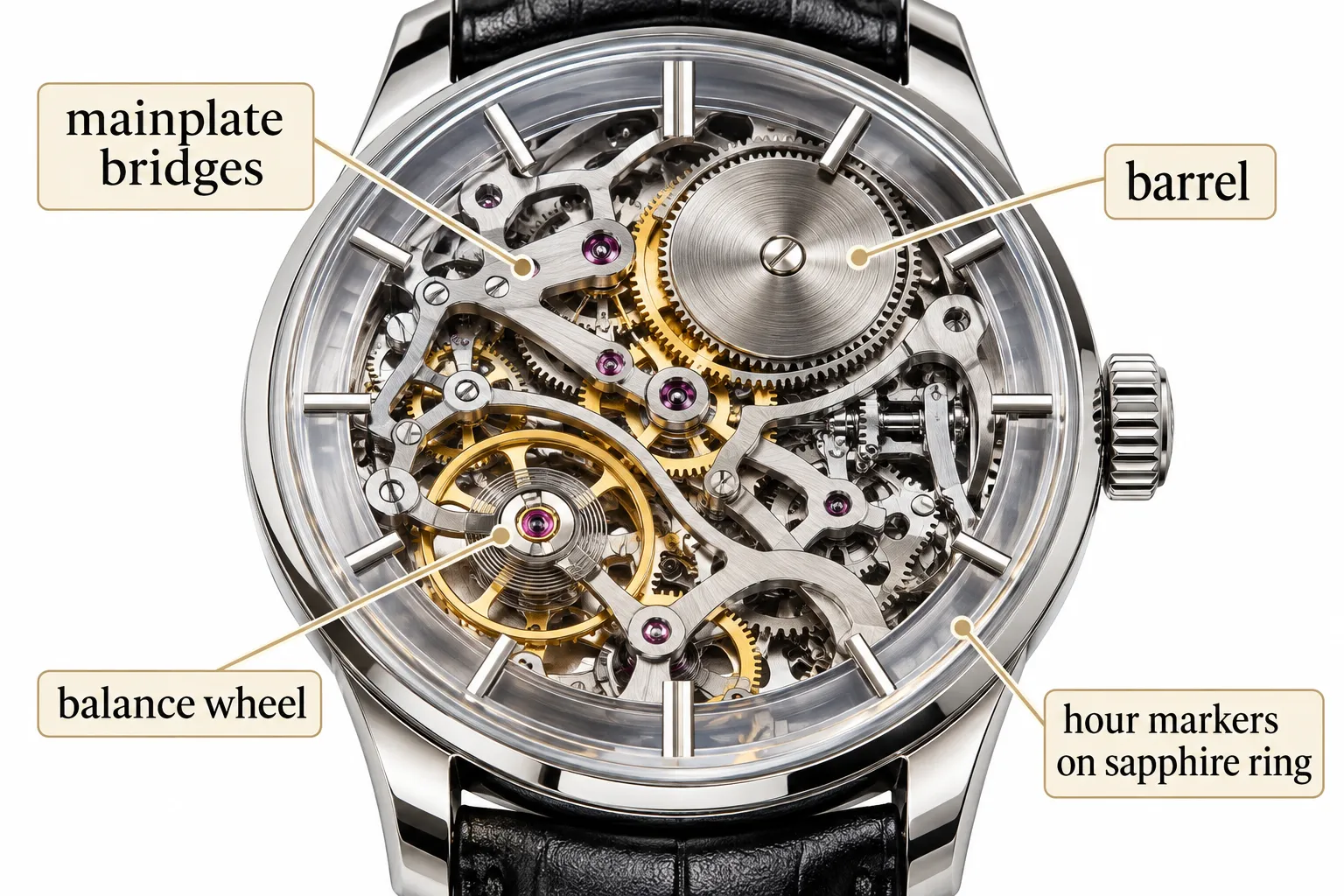
A skeleton watch is a timepiece whose movement has been cut away, or “openworked,” so the gears, bridges, and balance wheel are visible through the dial and often the caseback. The watchmaker removes metal from the mainplate and bridges while keeping enough structure to maintain rigidity and function.
This process dates back centuries in Swiss and French horology. Modern skeletonization goes further than simply drilling holes. Master finishers bevel edges, polish internal angles, and sometimes hand-engrave the remaining metal.
Key components typically exposed include:
- The barrel, which stores mainspring energy
- The gear train, which transmits power
- The balance wheel and escapement, which regulate timekeeping
- Bridges and plates, now shaped into decorative architecture rather than hidden support
Audemars Piguet’s Code 11.59 Perpetual Calendar Openworked, built on Calibre 7139, shows how far this has come. The brand describes the piece as combining openworked artistry with a legible display, which is precisely the tension this article addresses.
Are skeleton watches just a gimmick or actually worth the investment
Skeleton watches are not a gimmick when the skeletonization reflects genuine horological engineering rather than cosmetic drilling. The distinction lies in who made it and how the structure was calculated.
At the high end, skeletonization is a demonstration of mastery. Removing material from a movement without weakening it requires precise stress calculations, often validated through computer modeling before a single bridge is cut by hand. Patek Philippe’s rose-gold Complications ref. 5180/1R-001 calls itself “a tribute to the ancestral art of skeletonizing,” and the hand engraving alone takes roughly 130 hours.
Choose a skeleton watch as an investment if:
- It comes from a manufacture with a documented skeletonization heritage, such as Patek Philippe, Audemars Piguet, or Breguet
- It carries a recognized complication (perpetual calendar, tourbillon, annual calendar)
- It is sold with full set, box, and papers, and remains under factory warranty
Avoid treating a skeleton watch as an investment if it is a third-party modification, an aftermarket “artisan” conversion, or a mass-produced fashion piece with a stamped-out dial. Those pieces may look dramatic but carry little resale authority.
How much do luxury skeleton watches cost and what affects the price
Luxury skeleton watches generally start around $30,000 for steel or gold references from established manufactures and can exceed $100,000 for complicated openworked calendars or tourbillons. Patek Philippe’s skeleton ref. 5180/1R-001 has recently traded in the secondary market at roughly $86,000 to just under $90,000 depending on condition and market.
Price depends on several factors:
A common mistake is comparing a $5,000 openworked fashion-brand watch to a $90,000 Patek Philippe skeleton piece. The materials, finishing hours, and movement architecture are not remotely comparable.
Best luxury skeleton watch brands for collectors
Audemars Piguet and Patek Philippe currently lead the luxury skeleton watch category, with Breguet holding historical authority as the discipline’s originator. Each brand approaches openworking with a different philosophy.
- Audemars Piguet: The Royal Oak Selfwinding Flying Tourbillon Openworked, now offered in an 18-carat sand gold alloy, uses the exposed movement to play with light and texture. The Royal Oak Double Balance Wheel Openworked line spans 37mm to 41mm across steel, yellow, white, and pink gold.
- Patek Philippe: Known for restrained, hand-engraved skeleton work rather than aggressive openworking. The new platinum Cubitus perpetual calendar ref. 5840P pairs a blue openworked dial with a full skeleton movement, reinforcing skeleton references as top-tier catalogue pieces.
- Breguet: The house most associated with the origin of the art form, producing ultra-thin skeletonized movements such as those found in the Breguet Classique Automatic Ultra Slim.
Collectors seeking a broader catalogue of complicated pieces beyond skeleton designs should browse the Patek Philippe Complications collection, which demonstrates the same handcraft standards applied across calendar and moonphase models.
Do skeleton watches require more maintenance than regular watches
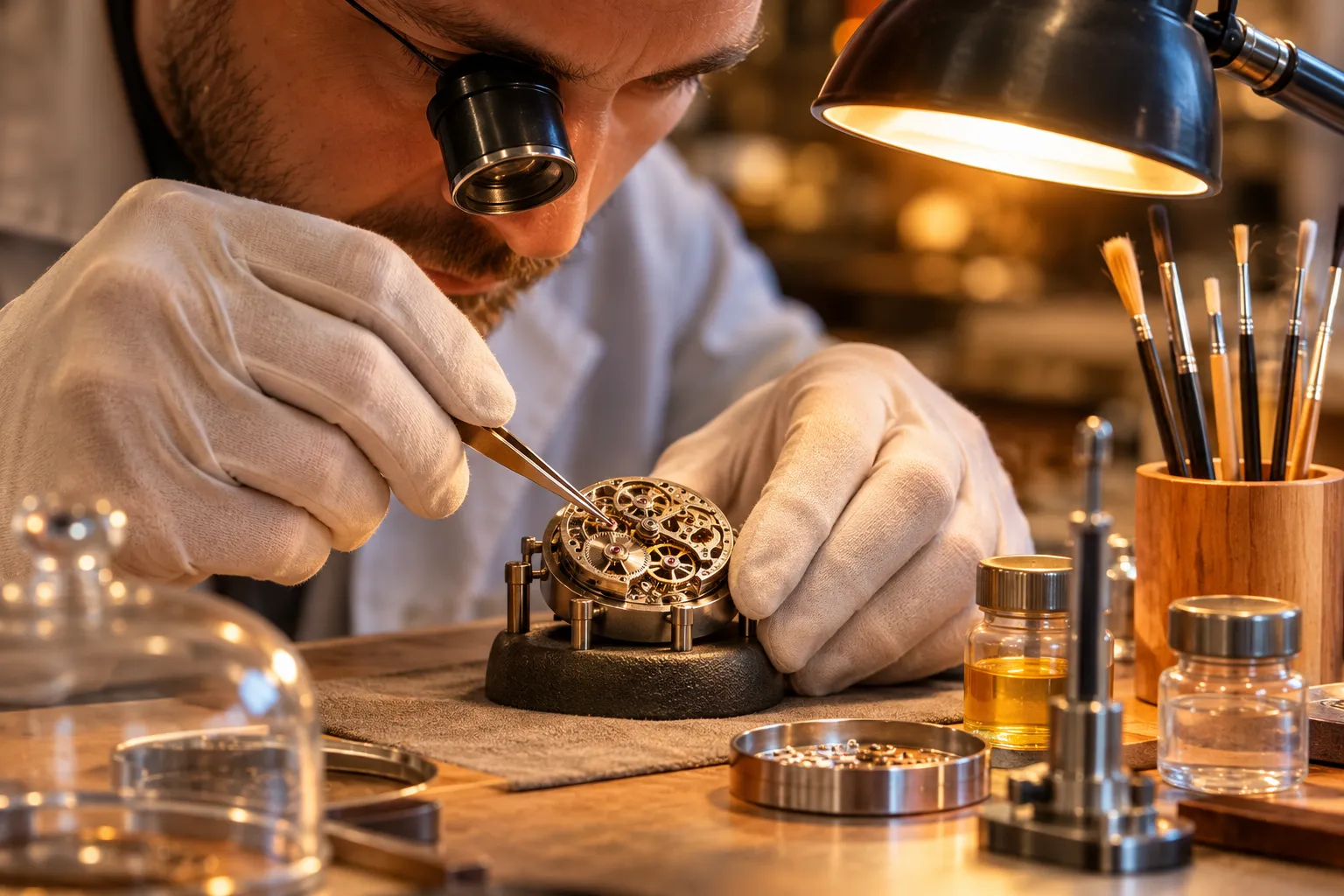
Skeleton watches do not require more frequent servicing than solid-dial watches, but each service tends to take longer and cost more because of the delicate exposed structure. A watchmaker must handle thinner bridges with greater care during cleaning, lubrication, and reassembly.
Service intervals remain similar to standard mechanical watches, typically every three to five years depending on the manufacturer’s guidance. What changes is the labor required:
- Technicians must avoid scratching visible polished surfaces, since every angle is on display
- Dust and debris are more visible on an openworked movement, so cleaning is more exacting
- Replacement parts, if needed, often require specialized finishing to match the original hand-beveled edges
Buyers should confirm the watch remains under factory warranty and purchase only through authorized channels offering authenticity guaranteed service records.
Can you actually read the time easily on a skeleton watch dial
Reading a skeleton watch depends entirely on its layout, not on the fact that it is skeletonized. Well-designed pieces use applied markers, contrasting hands, or a sapphire minute ring to maintain legibility despite the exposed gear train.
AP’s Code 11.59 Perpetual Calendar Openworked was specifically engineered to maintain a harmonious, legible display even with Calibre 7139 fully exposed. That required deliberate placement of calendar indications so they do not compete visually with the moving gear train underneath.
Decision rule: choose a skeleton watch with raised, lumed, or boldly contrasted hands and markers if daily legibility matters to you. Avoid fully transparent dials with thin skeletonized hands if you need to check the time quickly in low light.
A common mistake buyers make is judging legibility from a photograph under studio lighting. Always check the dial in natural daylight and dim indoor light before purchasing.
Are skeleton watches good for everyday wear or just special occasions
Skeleton watches from established manufactures are built for everyday wear, provided the case and crystal meet the same durability standards as the brand’s solid-dial models. Rarity and ornamentation do not automatically mean fragility.
That said, certain skeleton references function better as occasion pieces:
- Limited editions, such as the Royal Oak Perpetual Calendar “150th Anniversary” Openworked, are commemorative objects meant for careful, selective wear
- Highly ornate hand-engraved models benefit from rotation with other watches to limit wear on exposed surfaces
- Robust steel or titanium skeleton sports models, by contrast, are designed for daily use
If daily wear is the priority, choose a skeleton sports watch with a sapphire crystal rated for scratch resistance and a case construction tested for shock, rather than a dress skeleton piece intended for formal settings only.
What’s the difference between a skeleton watch and a caseback window
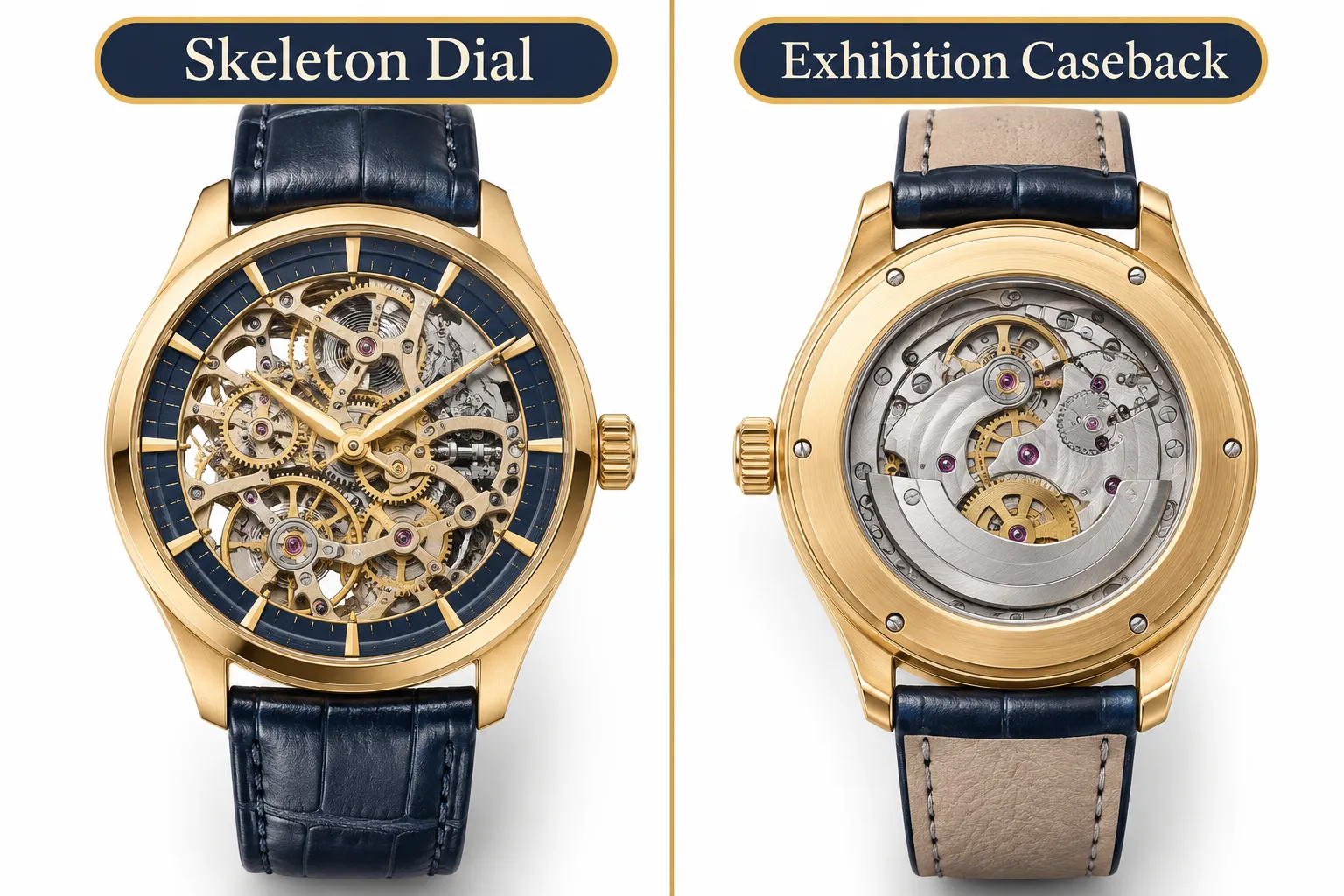
A skeleton watch removes material from the dial side so the movement is visible from the front, while a caseback window only reveals the movement from the back through a sapphire crystal. These are two distinct design choices that can exist separately or together.
- A caseback window is common and relatively inexpensive to add, since it does not affect the dial’s legibility
- A true skeleton watch requires redesigning the movement’s bridges and mainplate for front-facing visibility, which is far more technically demanding
- Many luxury watches, including several Omega De Ville Prestige references, offer exhibition casebacks without any dial-side skeletonization
If your interest is simply seeing the movement without affecting daily legibility, a caseback window delivers that with none of the readability trade-offs of a full skeleton dial.
Do skeleton watches lose accuracy or run slower
Skeletonization itself does not make a movement less accurate, provided the brand has re-engineered the structure to maintain proper rigidity and balance. Accuracy depends on escapement quality, regulation, and movement finishing, not the amount of visible metal.
Audemars Piguet’s R&D team has specifically addressed this balance in developing Calibre 7139, stating the challenge is maintaining performance, ergonomics, and aesthetics simultaneously in an openworked perpetual calendar. That statement reflects the real engineering risk: removing too much material without compensating elsewhere can affect rate stability.
Edge case: aftermarket skeletonization performed outside factory channels carries real risk to accuracy and durability, since independent workshops are cutting into a finished movement never designed to be openworked. This is why Rolex, which does not manufacture a true skeleton watch, warns that any “Rolex skeleton” piece is either an engraved dial, a third-party modification, or counterfeit.
Are skeleton watches more fragile or durable for daily use
Factory-engineered skeleton watches from major manufactures are built to the same durability standards as solid-dial models, since the structural calculations account for the reduced material. Fragility becomes a genuine concern only with aftermarket or poorly engineered skeletonization.
Durability depends on:
- Whether the bridges were computer-modeled for stress distribution before cutting
- The case material and crystal protection surrounding the movement
- Whether the modification was done by the original manufacture or a third-party workshop
Pieces like the “Rolex Daytona Blue Skeleton” from independent ateliers such as Artisans de Genève are marketed as artistic reinterpretations, but they sit outside Rolex’s official ecosystem and typically void the factory warranty. That is a meaningful durability and resale risk, not just a cosmetic footnote.
Skeleton watches for women luxury options
Luxury skeleton watches for women are available from the same manufactures producing men’s skeleton pieces, typically in smaller case diameters with diamond-set bezels or dials. Patek Philippe and Cartier both offer refined openworked designs suited to a woman’s wrist.
Notable options include:
- The Patek Philippe Complications ladies’ hand-wound watch ref. 7121/1J, which pairs fine complications with elegant proportions
- The Panthère de Cartier, favored for its architectural case design that pairs well with openworked movement aesthetics
- The Patek Philippe Twenty~4 Automatic ladies’ watch for buyers seeking Patek craftsmanship in a smaller, more wearable case
Choose a women’s skeleton watch with diamond hour markers if legibility is a concern, since the gemstones add visual contrast against the exposed movement.
How do I clean and maintain a luxury skeleton watch properly
Cleaning a luxury skeleton watch requires more caution than a solid-dial watch because dust and fingerprints are visible on both sides of the exposed movement. Daily care should stay simple and gentle.
Follow these steps:
- Wipe the case and crystal with a soft, lint-free microfiber cloth after each wear
- Avoid pressing on the crystal directly over the dial, since skeletonized dials have less structural backing
- Store the watch in a dry case or watch box away from direct sunlight, which can fade lume and degrade gaskets
- Never attempt to open the caseback yourself; leave all internal cleaning to an authorized service center
- Schedule full servicing every three to five years with a certified watchmaker experienced in skeletonized movements
A common mistake is using a loupe to inspect the movement and accidentally touching the exposed bridges, which can leave oils that attract dust inside the movement over time. Let a professional handle anything beyond the exterior.
Which skeleton watches hold their value best over time
Skeleton watches from Patek Philippe and Audemars Piguet with recognized complications hold value best, particularly limited editions tied to anniversaries or new calibers. Pure decoration without complication or brand pedigree tends to depreciate faster.
Strong value retention candidates share these traits:
- Produced by a manufacture with decades of skeletonization heritage
- Paired with a complication like a perpetual calendar or tourbillon
- Issued as a limited edition or tied to a significant anniversary
- Sold full set, complete, with original box and papers
The Royal Oak Perpetual Calendar “150th Anniversary” Openworked exemplifies this pattern: a commemorative limited edition combining AP’s skeletonization legacy with genuine technical complexity, which collectors treat as both horological art and long-term holding.
Browse the exclusive collection of rare and collectible luxury watches for access to similarly positioned references with strong resale histories.
What should I know before buying my first skeleton watch
First-time buyers should prioritize certified authenticity, full documentation, and brand reputation over visual drama alone. A skeleton watch is still a precision instrument before it is a display piece.
Before buying, confirm:
- The watch is Certified Authentic and sold full set complete with box, papers, and warranty card
- The seller offers white-glove service, including fully insured overnight shipping
- The piece remains under factory warranty or comes with documented service history
- You have tested legibility in person, not just viewed studio photography
- The reference number matches published manufacturer specifications exactly
Working with luxury watch experts who specialize in investment-grade timepieces reduces the risk of buying an aftermarket skeleton conversion mistaken for a factory piece. Explore the full luxury watch collection by brand to compare skeleton and non-skeleton references side by side before committing.
FAQ
Is a skeleton watch harder to read than a normal watch?
It can be, depending on the dial layout. Watches with strong hand and marker contrast against the movement remain easy to read; fully transparent designs without contrast are harder.
Does Rolex make skeleton watches?
No. Rolex does not produce a factory skeleton watch. Any “Rolex skeleton” is an engraved dial, a third-party modification, or counterfeit.
Are skeleton watches a good investment?
Skeleton watches from Patek Philippe, Audemars Piguet, and Breguet with recognized complications can hold value well. Mass-market or aftermarket skeleton pieces generally do not.
How much does a luxury skeleton watch cost?
Prices typically start around $30,000 and can exceed $100,000 depending on complication, material, and brand heritage.
Do skeleton watches need special servicing?
Service intervals match standard mechanical watches, roughly every three to five years, but technicians need extra care and time due to the exposed, delicate structure.
Can women wear skeleton watches?
Yes. Patek Philippe, Cartier, and other manufactures offer skeleton or openworked designs sized and styled for women’s wrists.
Are aftermarket skeleton watches a bad idea?
Generally, yes, for serious buyers. They typically void factory warranty and carry more durability risk than factory-engineered skeleton pieces.
What is the difference between skeletonized and openworked?
The terms are largely interchangeable in modern horology, both describing a movement with material removed to expose its inner workings.
Conclusion
Luxury skeleton watches earn their place as serious horological art when a manufacture like Patek Philippe or Audemars Piguet engineers the structure with the same rigor applied to any other complication. They become a distraction only when legibility is treated as an afterthought or when the skeletonization comes from an unauthorized third party chasing visual drama without engineering discipline.
If you are considering a first skeleton watch, start by confirming authenticity, requesting full documentation, and testing legibility in person under normal lighting. Work only with a trusted worldwide dealer offering white-glove service and fully insured shipping, and favor references with recognized complications over purely decorative pieces if long-term value matters to you. Reach out to a luxury watch specialist to review immediate availability on certified authentic skeleton references before making a decision.