

Trends & Culture
The Most Expensive Watches Ever Sold at Auction

Nov
Last updated: November 24, 2026
Quick Answer
The most expensive watch ever sold at auction is the Patek Philippe Grandmaster Chime Ref. 6300A-010, which brought roughly 31 million Swiss francs at Christie’s Geneva in 2019. It remains the all-time wristwatch record as of November 2026. The most expensive timepiece of any kind is the Patek Philippe Henry Graves Supercomplication pocket watch, and Patek Philippe holds the majority of the top auction results across both categories.
Key Takeaways
- The Patek Philippe Grandmaster Chime Ref. 6300A-010 holds the all-time wristwatch auction record at roughly 31 million Swiss francs, set at Christie’s Geneva in 2019.
- The Henry Graves Supercomplication by Patek Philippe is the most expensive watch of any kind ever sold at auction, a stainless steel pocket watch built in 1932.
- Patek Philippe occupies most of the slots in every published top-ten list of the most expensive watches ever sold at auction.
- The Paul Newman Daytona Ref. 6239, once owned by the actor, is the most expensive Rolex ever sold at auction.
- Provenance, rarity, mechanical complexity, and originality drive auction value far more than brand recognition alone.
- Anyone can register to bid at major auction houses like Christie’s, Sotheby’s, and Phillips; no private membership is required for most watch sales.
- Buyer’s premiums at top auction houses typically range from roughly 20 to 27 percent of the hammer price, on a sliding scale.
- No new all-time wristwatch record has been confirmed as of November 2026, though Phillips’ “Decade One” sale in November 2025 reinforced strong demand at the top of the market.
- Certified authentication, full documentation, and condition reports matter more at auction than at almost any other point in a watch’s ownership history.
What Watch Sold for the Most Money at Auction Ever
The Patek Philippe Grandmaster Chime Ref. 6300A-010 holds the record for the most money ever paid for a wristwatch at auction. Christie’s Geneva sold it in November 2019 for approximately 31 million Swiss francs, including buyer’s premium.
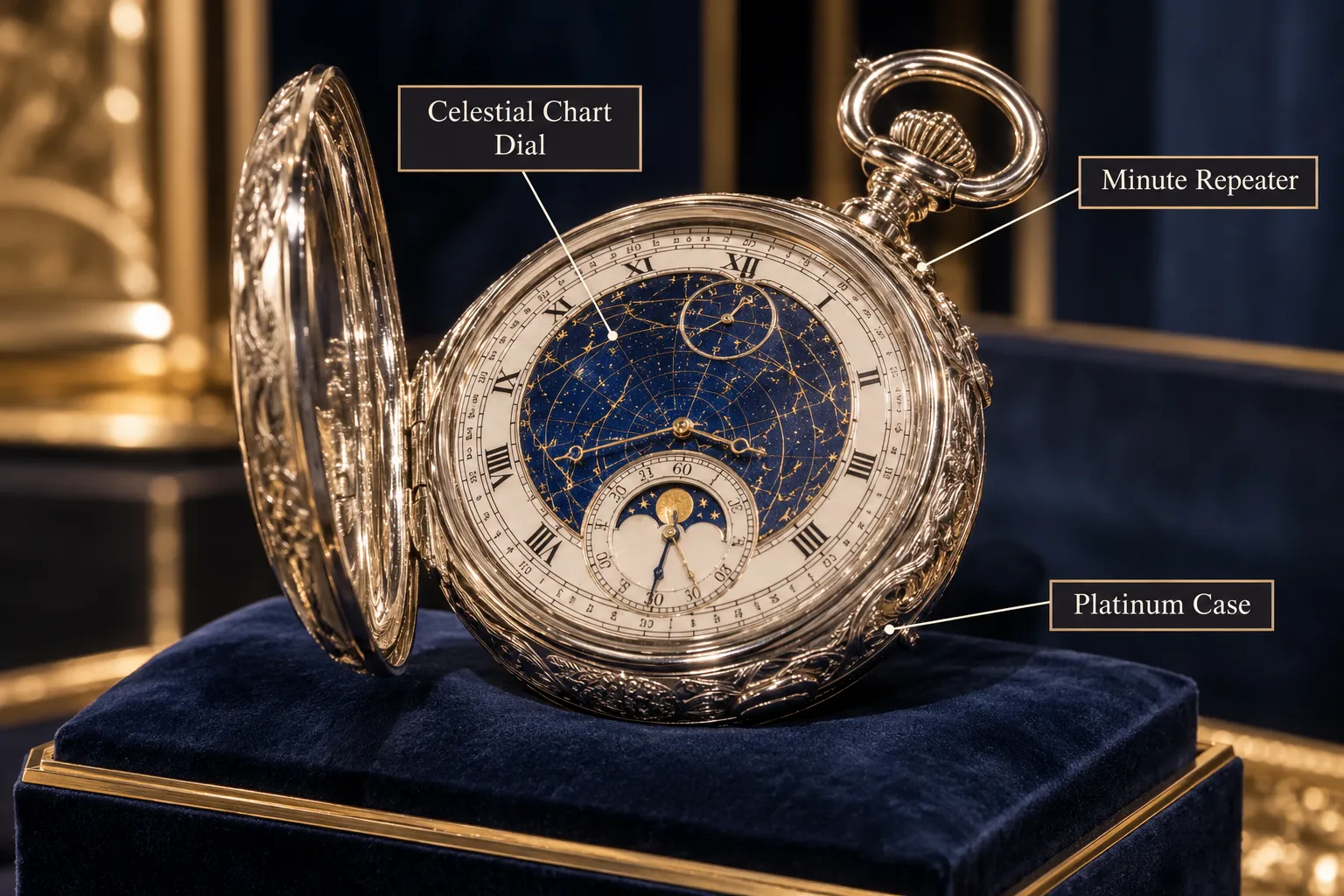
The watch was a unique stainless steel edition, created to mark Patek Philippe’s 175th anniversary, and proceeds benefited a children’s charity. It carries 20 complications across two dials, including a grande and petite sonnerie, a minute repeater, and a instantaneous perpetual calendar. Only one example exists in that steel case, which explains the price far more than the complication count alone.
When buyers ask about the single largest number ever recorded in this market, the Grandmaster Chime is the answer. When the question shifts to “most expensive watch of any kind,” the record moves to a pocket watch instead.
The distinction matters. The Henry Graves Supercomplication, built by Patek Philippe for banker Henry Graves Jr. and delivered in 1932, sold at Sotheby’s Geneva in 2014 for roughly 24 million Swiss francs. It held 24 complications and took nearly three years to construct. For decades it stood as the benchmark against which every other grand complication was measured, and it still ranks as the most expensive timepiece of any category ever sold at auction when adjusted for its standing at time of sale.
Patek Philippe Watches Most Expensive Sold at Auction
Patek Philippe dominates nearly every published ranking of the most expensive watches ever sold at auction, holding the top wristwatch spot and several others in the top ten. This concentration is not accidental; it reflects decades of limited production, in-house movement manufacture, and a collector base willing to pay record prices for rarity.
Beyond the Grandmaster Chime and the Henry Graves Supercomplication, notable Patek Philippe auction results include:
- Patek Philippe Ref. 1518 in steel, one of only four known steel examples of the brand’s first series-produced perpetual calendar chronograph, sold by Phillips for more than 11 million Swiss francs.
- Patek Philippe Ref. 2499 fourth series, among the final examples of this perpetual calendar chronograph, commanding multi-million-dollar results whenever a fresh example appears.
- Patek Philippe Ref. 5016A, a rare steel grand complication that has repeatedly broken estimates at Phillips and Christie’s sales.
Collectors seeking a foothold in this tier without chasing unobtainable auction trophies often start with the brand’s current production icons. MioJewelry’s exclusive collection of Nautilus references and complicated annual calendar models reflects the same manufacturing lineage that drives these record results, offered Certified Authentic and Full Set Complete.
Why Are Vintage Watches Worth So Much at Auction
Vintage watches command high auction prices because original parts, factory finishing, and documented history cannot be replicated. A 1960s chronograph with its original dial, hands, and crystal is fundamentally different from a later service replacement, even if the two look similar at a glance.
Three factors consistently separate a six-figure vintage watch from a five-figure one:
- Originality of parts. Dials that have been refinished or hands that do not match the period lose significant value, often 30 to 50 percent compared to an untouched example.
- Production numbers. A reference made in the low hundreds will always outperform one made in the tens of thousands, assuming comparable condition.
- Documented ownership. Watches tied to a known original owner, a historical event, or a notable public figure routinely sell for multiples of an otherwise identical piece.
Vintage Rolex Daytonas from the 1960s and 1970s illustrate this clearly. Most examples trade in the mid five figures. The rare ones with the right dial configuration and untouched case edges move into seven figures.
How to Bid on Luxury Watches at Auction
Bidding on luxury watches at major auction houses requires registration, a verified payment method, and review of the lot’s condition report before the sale. The process is open to the public, not restricted to industry professionals or existing clients.
Standard steps for a first-time bidder:
- Register with the auction house, providing identification and, for high-value lots, proof of funds or a bank reference.
- Review the condition report and provenance file for the specific lot, including movement photos and service history where available.
- Set a maximum bid in advance and decide whether to bid live, by phone, by absentee bid, or online.
- Account for the buyer’s premium on top of the hammer price before setting a budget ceiling.
- Arrange insured shipping or in-person collection once payment clears, typically within a set number of business days.
A common mistake is bidding without reading the condition report fully. A “service dial” notation, a replaced crown, or a case that has been polished beyond factory tolerances can reduce long-term value even when the hammer price looked like a bargain on sale day.
What Makes a Watch Valuable and Collectible
A watch becomes valuable and collectible when it combines low production numbers, mechanical significance, strong original condition, and demand from an active collector base. No single factor is sufficient on its own.
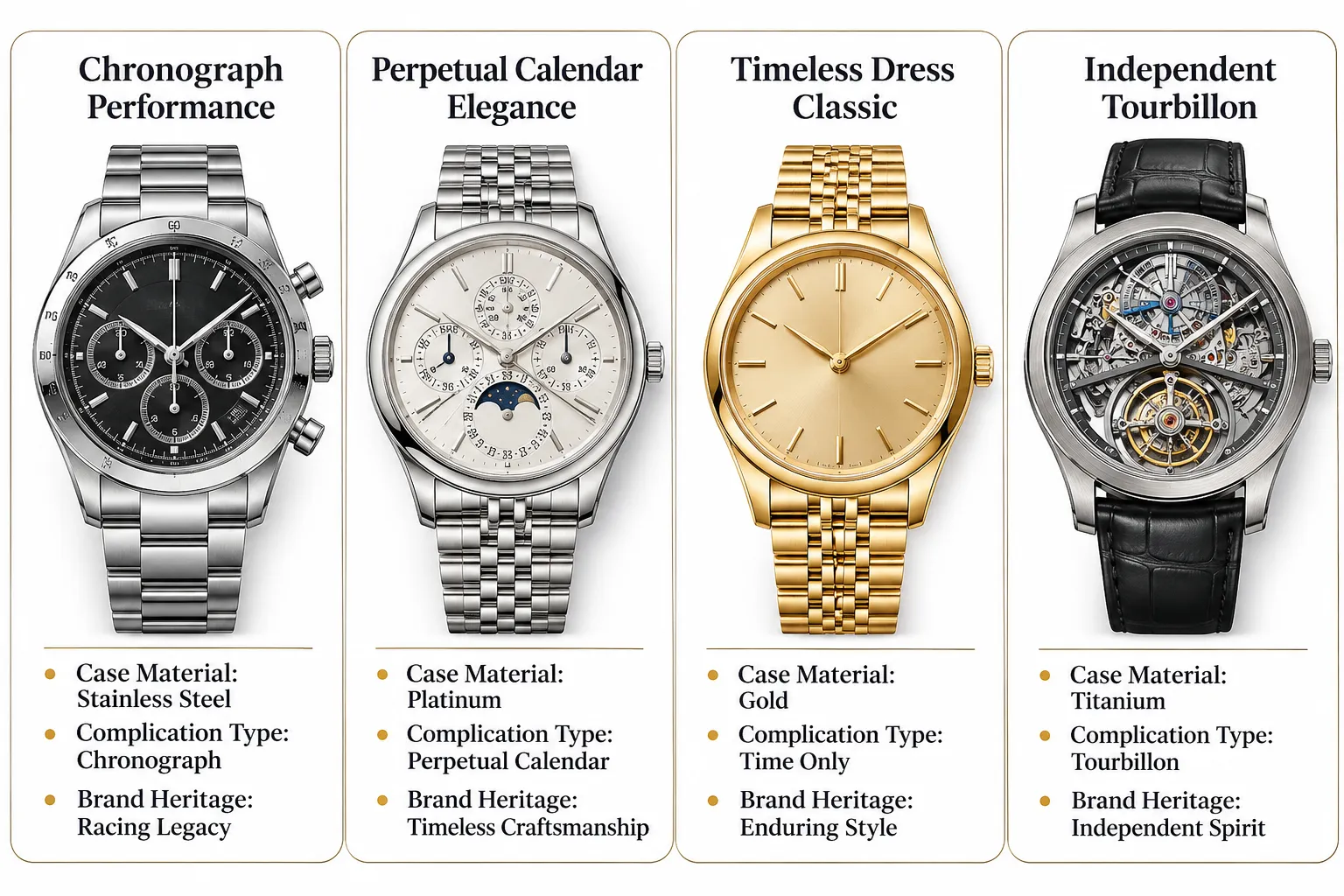
Key value drivers include:
- Rarity of reference or material (steel versions of gold-only models, discontinued dial colors, prototype pieces)
- In-house movement and complexity (perpetual calendars, minute repeaters, tourbillons built by the brand itself)
- Condition and originality (unpolished cases, matching serial numbers, original box and papers)
- Historical or celebrity provenance
- Brand heritage and continuity (decades of consistent manufacturing excellence rather than a single hit model)
A watch missing even one of these can still sell well at retail but will rarely set auction records. This is why MioJewelry emphasizes Full Set Complete documentation and Authenticity Guaranteed status on every investment-grade timepiece in its luxury watch catalog by brand.
Rolex Versus Patek Philippe: Which Is More Expensive at Auction
Patek Philippe is more expensive at auction than Rolex across nearly every comparable category, largely because of lower production volumes and a longer history of in-house grand complications. Rolex sets records within its own category but has never approached Patek Philippe’s ceiling.
| Metric | Rolex | Patek Philippe |
|---|---|---|
| Record wristwatch price | Paul Newman Daytona Ref. 6239, approx. 17.8 million USD (2017) | Grandmaster Chime Ref. 6300A-010, approx. 31 million CHF (2019) |
| Typical driver of top results | Celebrity provenance, rare dial variants | Grand complications, extreme rarity, in-house movements |
| Production philosophy | Larger scale, sports and tool-watch heritage | Smaller scale, haute horlogerie focus |
| Collector base size | Very large, broad entry points | Smaller, deeper pockets at the top end |
Choose a Rolex at auction if the goal is a recognizable sports reference with strong liquidity and resale demand. Choose Patek Philippe if the goal is long-term capital preservation at the highest tier of mechanical watchmaking. Serious buyers often hold both; MioJewelry offers Rolex Day-Date references in Everose gold alongside Patek Philippe complications for exactly this reason.
How Do You Authenticate a Watch Before Buying at Auction
Authenticating a watch before an auction purchase means verifying the movement, case, dial, and documentation against the manufacturer’s known specifications for that exact reference and production period. This should happen before bidding, not after.
Practical authentication steps:
- Match the serial and reference number against the movement, case back, and papers; mismatches are a red flag.
- Inspect the movement under magnification for finishing quality, correct caliber markings, and signs of non-original parts.
- Compare the dial print and hands against verified archive photos of the same reference and era.
- Request an independent service history, including any documented movement overhauls.
- Use the auction house’s in-house specialists, who typically examine lots before cataloging, but do not rely on their review as a substitute for your own research on high-value lots.
A common edge case: a watch can have a correct, original movement but a replaced dial, or vice versa. Both parts need independent verification. MioJewelry’s Luxury Watch Experts apply this same standard to every piece before it enters the Exclusive Collection, which is why every listing carries the Certified Authentic designation.
Where Can I Sell an Expensive Watch at Auction
High-value watches sell best through the major international auction houses, Christie’s, Sotheby’s, and Phillips, which run dedicated watch departments with global collector reach. Phillips in particular has built a reputation for record-setting watch sales since its Geneva Watch Auctions began in 2015.
Sellers should expect:
- A consignment agreement specifying the seller’s commission, typically lower than the buyer’s premium, often in the range of 0 to 10 percent depending on the lot’s value and negotiating leverage.
- A specialist evaluation and estimate before the piece is accepted into a sale.
- A marketing lead time of several months between consignment and the actual sale date, since major watch auctions run on fixed seasonal calendars.
For watches below the auction-house minimum threshold, or for sellers who want a faster, discreet transaction without a public sale, a trusted dealer offering White-Glove Service and Fully Insured Overnight Shipping is often the more practical route. MioJewelry’s rare and collectible watch request service handles exactly this kind of private transaction for sellers and buyers alike.
Which Vintage Watch Brands Hold the Most Value
Patek Philippe, Rolex, Audemars Piguet, and a small group of independent makers hold the most value among vintage watch brands at auction. Independents like Philippe Dufour have also produced individual results that rival far larger manufacturers, despite tiny production runs.

A general hierarchy, based on repeated auction performance:
- Patek Philippe, consistent record-setter across grand complications and vintage chronographs.
- Rolex, strongest in sports references with celebrity or historical provenance, particularly the Daytona and Submariner lines.
- Audemars Piguet, vintage Royal Oak references, especially early “Jumbo” examples, command rising premiums.
- Independent makers (Philippe Dufour, F.P. Journe early production), small runs and hand-finishing produce outsized per-unit results relative to total output.
Omega also appears regularly in top-25 auction lists, usually tied to spaceflight history or early chronograph references, though its ceiling remains well below Patek Philippe and Rolex.
How Much Commission Do Auction Houses Charge for Watches
Auction houses typically charge a buyer’s premium between roughly 20 and 27 percent of the hammer price, applied on a sliding scale that decreases as the price increases. Sellers pay a separate, usually smaller, consignment commission negotiated individually.
A simplified example: on a watch hammering at 500,000 Swiss francs, a buyer might pay an additional 100,000 to 135,000 francs in premium, depending on the house’s current fee structure and whether the total falls into a lower-rate tier. Always confirm the exact published rate card before bidding, since auction houses adjust these tiers periodically.
Can Anyone Bid on Expensive Watches at Auction or Do You Need Membership
Anyone meeting the auction house’s registration and identification requirements can bid on expensive watches, including seven- and eight-figure lots. No private club membership or prior purchase history is required at Christie’s, Sotheby’s, or Phillips.
What is typically required:
- Government-issued identification
- A valid payment method, often with proof of funds for high-value lots
- Agreement to the auction house’s conditions of sale
First-time bidders on very high-value lots may be asked for a bank reference letter before being approved to bid, which is standard practice rather than a sign of exclusivity.
Common Mistakes People Make Buying Watches at Auction
The most common mistake is bidding on condition and estimate alone without independently verifying originality, which can lead to overpaying for a piece with replaced parts. Buyers frequently anchor on the printed low estimate and ignore the premium, service history, and import costs stacking on top.
Other frequent errors:
- Skipping the condition report or reading only the summary instead of the full specialist notes.
- Underestimating total cost, forgetting the buyer’s premium and potential taxes or duties.
- Bidding emotionally on a known name without comparing recent results for the exact same reference and dial variant.
- Assuming auction house authentication is equivalent to a factory service check, when it is a condition assessment, not a warranty.
Buyers who prefer to avoid these risks entirely often choose retail acquisition through a dealer offering Investment-Grade Timepieces Under Factory Warranty instead of competing at auction.
Are There Affordable Watches That Increase in Value
Yes, a small number of watches purchased at retail prices have appreciated meaningfully over time, though most watches depreciate like any other consumer good. Appreciation has historically concentrated in steel sports models from Rolex, Patek Philippe, and Audemars Piguet with limited allocation and strong waiting lists.
Examples collectors point to for sustained demand over the past decade:
- Steel Rolex Daytona references
- Patek Philippe Nautilus steel models
- Audemars Piguet Royal Oak steel references
These models combine low official allocation with consistently high demand, which supports secondary market premiums. MioJewelry carries select Patek Philippe Nautilus references and Rolex Datejust models in steel and gold with Immediate Availability, for buyers who understand that appreciation is never guaranteed and depends on sustained brand demand.
What Year Watches Are Most Valuable and Sought After
Watches from the 1930s through the 1970s generally carry the strongest collector premiums, reflecting an era of hand-finishing, lower production volumes, and the birth of several now-iconic references. The 1932 Henry Graves Supercomplication and the 1960s Paul Newman Daytona both fall within this broader window.
Specific high-demand production windows:
- 1930s, 1940s: Early grand complications and pocket-to-wrist transition pieces from Patek Philippe.
- 1960s, 1970s: Vintage Rolex Daytona and Submariner references, early Royal Oak models from 1972 onward.
- 1980s, 1990s: Early Patek Philippe Nautilus and Audemars Piguet Royal Oak references, now gaining ground as original buyers age out of ownership.
Modern limited editions, including the 2019 Grandmaster Chime, prove that a watch does not need decades of age to set records, provided rarity and complexity are extreme enough.
Conclusion
The record books currently belong to Patek Philippe, and nothing in the 2025-2026 auction calendar, including Phillips’ “Decade One” sale in November 2025, has displaced the Grandmaster Chime Ref. 6300A-010 from the top spot. Rolex remains the strongest competitor in its own category through the Paul Newman Daytona, but the gap to Patek Philippe’s ceiling remains wide.
Buyers entering this market should verify originality before bidding, budget for the full buyer’s premium, and favor pieces with complete documentation. Sellers should consign through a specialist house for maximum-value lots or work with a Trusted Worldwide dealer for faster, private transactions.
For collectors who want investment-grade pieces without the uncertainty of a live auction room, MioJewelry provides Certified Authentic timepieces with Full Set Complete documentation, Authenticity Guaranteed status, and Fully Insured Overnight Shipping. Explore the current online luxury watch store to review available Rolex, Patek Philippe, and independent references backed by White-Glove Service from Luxury Watch Experts.